Why Are Palantir and Deep Intelligence Still Accelerating When the Growth Rates of Large Models Begin to Diverge
In the AI industry of 2026, two completely opposite narratives are unfolding simultaneously.
On one hand, Anthropic, which once expanded at an extremely high growth rate, has begun to see changes in its growth slope.
This large model company that once expanded at an astonishing speed is experiencing a subtle turning point in its growth curve. Against the backdrop of a high base, the market has begun to re-examine: after the continuous leap of model capabilities, can revenue growth maintain the previously steep slope for a long time?
On the other hand, Palantir is still performing exceptionally well.
While Anthropic's growth slope is slowing down, it released its Q2 financial report, with revenue of 1.94 billion US dollars, a year-on-year increase of 93%; net profit of 1.07 billion US dollars, a year-on-year increase of more than twice; GAAP net profit margin as high as 55%. CEO Karp stated that such growth can continue for at least 18 more months.
What is truly worth discussing about this contrast is not which one runs faster, but that two different growth curves are emerging in AI commercialization: one relies on the rapid expansion of model capabilities and user scale, and the other relies on continuously entering the core business of enterprises to transform AI from "capability supply" to "operational results".
In China, these two paths are also taking place. Large model companies are constantly catching up and surpassing others; but at the same time, some companies are delving deeper and cultivating their fields intensively.
The latter goes deeper and is not necessarily slower. For example, Deep Intelligence in the same track saw a 125.2% year-on-year increase in profit for the first half of the year, and its operating profit quadrupled year-on-year.
The growth rate of large models cools down, why has decision-making AI become the new core track of the AI industry
When Palantir went public in 2020, the market was not very optimistic about it.
Five years later, the story has completely reversed.
In 2025 alone, Palantir's market value rose from 170 billion US dollars to 420 billion US dollars. Behind the continuous revaluation of its stock price and market value, the market has given a higher valuation to its business model of "AI entering core business decision-making".
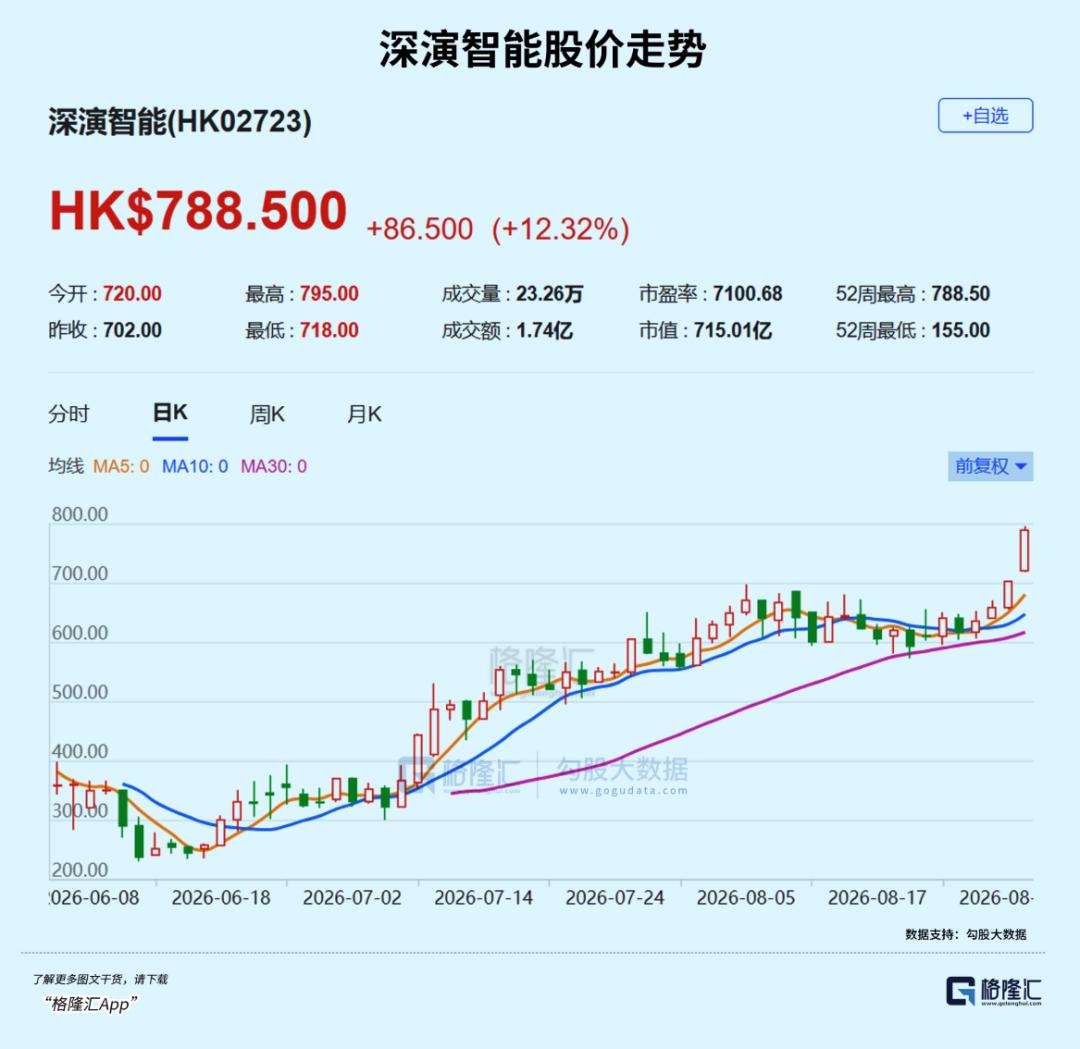
The popularity of the track did not wane in 2026. Deep Intelligence went public in May this year, and its market value has increased more than tenfold in just three months.
Even OpenAI and Anthropic, the two leading players in the large model field, each established independent joint ventures with leading private equity firms in May this year, complementing their delivery capabilities by expanding front-line engineers and consulting teams, trying to follow a path similar to Palantir FDE to delve into the core business of enterprises.
The space for purely selling model capabilities seems to be large enough, why do they still want to get a share of the pie?
This at least indicates a trend: model capabilities themselves are not the end point of commercialization. As AI moves from question-and-answer and generation to the core processes of enterprises, "decision-making" is becoming a layer closer to the realization of business value.
Compared with simply providing model capabilities, decision-making AI presents at least three characteristics that are closer to the realization of enterprise value.
First, decision-making AI is at the "last mile" of the AI value chain.
The entire AI industry chain can be simplified into three layers:
The model layer. For example, OpenAI, Anthropic, Google. The competition is extremely fierce, money is being burned continuously, and product homogenization is accelerating.
The application layer. Tools such as Copilot, AI writing, and AI image generation are built on top of the model, with fast iteration and wide coverage, but most products first solve the efficiency problem, and value measurement often still stays at "how much time is saved".
The decision-making layer. AI directly participates in the core business links of enterprises, such as how to allocate marketing budgets, how to prepare inventory, how to set prices, and how to control risks, mainly making judgments for enterprises.
The decision-making layer is at the end of the value chain. No matter how powerful the model is, if it only stays at question-and-answer and generation, it will always be one step away from the enterprise's purse. And decision-making AI is exactly at this "last mile" position.
The further you go towards the end of the value chain, the closer you get to the actual budget of the customer.
Second, enterprises are more willing to pay for "results" rather than "capabilities".
McKinsey proposed in an article published in August 2026 that the maximum economic benefits of AI rarely come only from labor savings, but more from faster decision-making, better asset allocation, and seizing opportunities that would have been missed.
When an enterprise buys a Copilot account, it is not much different from buying Office software, and pays by headcount. But this budget is repeatedly reviewed within the enterprise: do employees actually use it? How much time is saved? What value does the saved time create? In scenarios other than programming, these questions are very difficult to answer.
The logic of decision-making AI is completely different.
There is an iron law in enterprise internal budget approval: only core businesses that directly affect revenue, profit, risk, and cost can obtain long-term and regular budgets.
Decision-making AI puts more emphasis on mapping technical capabilities to operational results, and its value can be further anchored to revenue, profit, risk or cost, so as to establish a clearer ROI measurement framework.
Deep Intelligence has also directly proposed the development idea of AI for Growth, focusing on the marketing and sales track that drives business growth. Compared with most other scenarios, the business effect of such scenarios can be more clearly quantified. For example, in the scenario of luxury brand repurchase, through the Agentic marketing system, Deep Intelligence analyzes the performance of the brand's past marketing activities, judges the most appropriate contact time, the most appropriate rights and interests for each consumer, and the time window when repurchase is most likely to occur, which can usually bring an actual repurchase rate increase of about 30% to 100%.
This means that decision-making AI is not only striving for the traditional "IT budget", but may also enter the business department and even the company-level operational budget. Financial risk control, manufacturing supply chain, retail marketing and product selection, government-enterprise resource scheduling and risk investigation, are essentially high-frequency and high-value decision-making scenarios. Compared with simple efficiency tools, the accessible budget pool and value space are larger.
Third, the market is at an inflection point, and technical dividends have just been released.
More importantly, such demand is not an occasional phenomenon in a single industry, but a common demand across multiple industries such as finance, manufacturing, retail, and government-enterprise.
In its 2025 Gartner Hype Cycle for AI Technologies report, Gartner listed decision intelligence as a "transformative" technology. In 2010, cloud computing was listed as a "transformative" technology by Gartner; in 2023, generative AI was also included in this category. In the year they were listed, many people had doubts about their commercial value and landing prospects, but in the following years, both proved the forward-looking nature of the judgment with explosive growth.
Palantir has been deeply engaged in the market for 23 years, and Deep Intelligence has been deeply engaged in the market for 17 years, having accumulated early experience. Coupled with the fact that the underlying model capabilities have reached a critical point and the cost curve has dropped significantly, the technical prerequisites for decision-making AI are mature.
The fact that large model manufacturers have begun to complement their enterprise delivery capabilities itself shows that industry competition is extending from "model capabilities" to "business landing capabilities".
However, model capabilities will not automatically transform into enterprise-level decision-making capabilities. For large model manufacturers, from providing standardized models to delving into the core processes of enterprises, there are multiple thresholds such as data governance, business semantics, organizational collaboration, and continuous delivery; this is also the part that is most difficult to scale and replicate in enterprise services.
Therefore, for companies like Palantir and Deep Intelligence that have been rooted in enterprise scenarios for a long time, what is really worth studying is not "what model they use", but how they embed the model into complex business systems.
Why?
Large model manufacturers cannot break in, what exactly is the moat of decision-making AI
The answer is not in the model layer, but in the places that models cannot reach.
There has always been a doubt in the market whether Palantir and its peers are just putting a large model shell on their products. Gil Luria, a Wall Street technology analyst, recently directly refuted this statement: the underlying model can be flexibly replaced, and what is truly difficult to replicate is the business ontology and customer deployment methodology that have been accumulated for many years.
This decision-making AI is not something that can be run by downloading a large model and connecting to enterprise data.
Looking at Palantir and Deep Intelligence together, you will find a set of highly unified business models that are completely different from general AI companies.
The two companies started almost the same, taking on the most complex large organizations first. Palantir devotes a lot of resources to large customers. Among Deep Intelligence's more than 400 customers, nearly 70 are Fortune 500 companies, including Procter & Gamble, Nestle, China Mobile, and China Resources Vanguard. The reason is not only that large customers have strong payment capabilities, but also that the more complex the scenario, the more useful decision-making AI can be trained.
The multi-departmental game and multi-constraint trade-offs within large organizations involve implicit rules and historical conventions that are surprisingly complex. A truly useful decision-making AI must go through the cycles of making judgments, executing, checking results, and revising again in thousands of such real scenarios, so as to distill algorithms and business experience.
These soils only exist in large organizations.
Having complex scenarios only means having training soil. To get a real decision-making AI, the underlying construction of semantic cognition is also required.
BCG Platinion proposed that a large number of enterprise AI Agent projects stop at the pilot stage, and the problem often lies not in insufficient model reasoning capabilities, but in the widespread semantic debt.
Technical debt is the drag on system hardware, code, and architecture, while semantic debt means that all business calibers, implicit rules, department definitions, and historical conventions of enterprises have no unified standards, and only exist in the minds of old employees. General AI can make up for technical debt, but cannot cope with semantic debt.
Both Palantir and Deep Intelligence sort out the data and implicit business rules of customers scattered in various systems through FDE front-line deployment engineers on site. Palantir organizes them into a unified business ontology Ontology, which connects the associations of cross-departmental business objects to support cross-domain resource scheduling. Deep Intelligence builds a business semantic network for marketing operation scenarios, connects multi-source heterogeneous data of placement, users, and transactions, and lays a foundation for global decision-making output.
This is also the permanent shortcoming of general large model manufacturers. Model manufacturers pursue standardized, lightweight, and API-based delivery, and hate customized sorting out.
In terms of delivery form, what the two deliver is a complete set of decision-making systems composed of algorithms, data and scenarios, which can run through the complete business closed loop of "decision-execution-feedback-iteration", rather than simple operation tools.
Taking Deep Intelligence as an example, Agentic Software embeds agent capabilities into the enterprise's own workflow and is continuously run by the customer's internal team; Agentic Marketing Services uses the same set of Agentic Software capabilities to drive outsourcing services, and directly delivers results for marketing goals. The two are not independent of each other, but share the DeepAgent 4.0 Pro technology base, and undertake different needs of customers with different delivery forms.
At present, the company has formed a product matrix of more than 25 vertical AI agents, covering core business links such as product innovation, GTM, social marketing, advertising placement, sales and customer service, user operation, and user insight.
The underlying base model can be replaced at any time, but the trade-off logic and scenario strategy assets accumulated in the business cycle are difficult to migrate. The longer the customer uses it, the higher the replacement cost.
Profit growth rate triples revenue growth rate, what is the growth logic of decision-making AI
If the aforementioned business model is established, it should eventually leave traces in the financial statements: in addition to revenue growth, with the deepening of customer penetration and the reuse of early capabilities, profit growth has the opportunity to be faster than revenue growth.
Deep Intelligence's 2026 semi-annual report is a typical sample. Revenue was 398 million yuan, a year-on-year increase of 43.6%, profit during the period was 8.195 million yuan, a year-on-year increase of 125.2%, and operating profit skyrocketed 402.2% year-on-year. The profit growth rate is nearly three times the revenue growth rate.
Judging from Deep Intelligence's current operating data, this profit elasticity can be broken down into two layers of logic.
The first layer is on the revenue side: continuous penetration of existing customers. The growth of ordinary AI tools is highly dependent on continuously acquiring new customers, and one scenario ends when one order is won. Decision-making AI is different. After it cuts into large enterprises, it first completes underlying data governance, business semantic alignment and business rule adaptation, and then the business will naturally penetrate from one scenario to more links along the enterprise operation chain.
The "Double 100 Strategy" proposed by Huang Xiaonan, founder of Deep Intelligence, refers to exactly this matter. One end is to expand the customer scale by a hundred times, and the other end is to expand the number of products per customer by a hundred times. Segment business data has been verifying this logic.
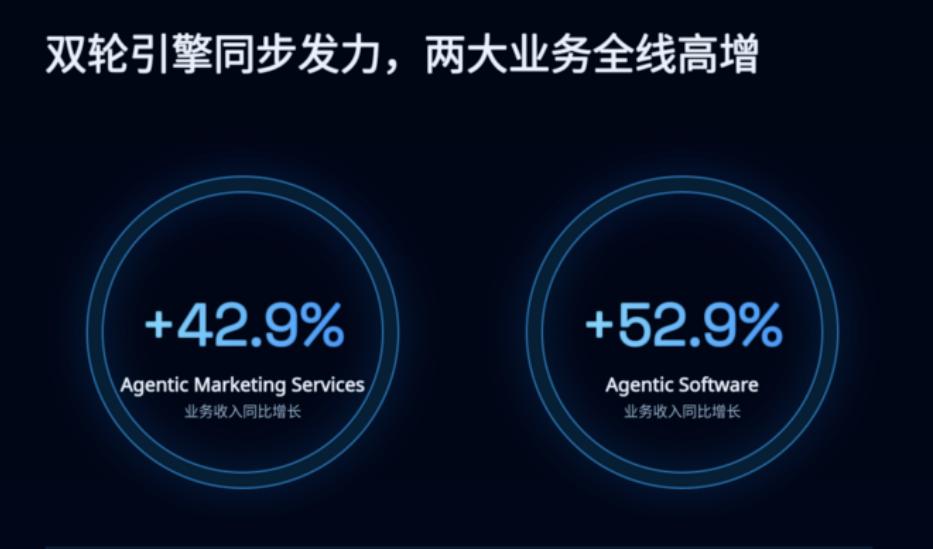
During the reporting period, the agent marketing service realized revenue of 370 million yuan, a year-on-year increase of 42.9%; the agent software revenue was 28.196 million yuan, with a year-on-year growth rate of 52.9%, outperforming the overall revenue scale.
Although there is a clear gap in revenue volume between current agent marketing services and agent software, this to a large extent reflects the differences in the stage of enterprise AI adoption and delivery methods. Gartner predicts that by 2028, 33% of enterprise software applications will integrate Agentic AI, a significant increase from less than 1% in 2024; at the same time, from Palantir to OpenAI and Anthropic, FDE-style front-line deployment is becoming an important delivery method for AI to go deep into the core workflow of enterprises. With the deepening of internal AI capability building in enterprises, more customers are moving from "purchasing results" to "precipitating AI capabilities internally", and Agentic Software is expected to continue to maintain faster growth on a low base.
In the first half of the year, the company's new signed orders for agent products and services increased by more than 300% year-on-year, 30% of new agent customers will purchase multiple agents at one time, and some large enterprises directly deploy more than ten products. From a single agent to multi-agent collaboration, from a single business scenario to the entire operation chain, the revenue ceiling of a single customer is constantly rising.
Source: Deep Intelligence Official WeChat Account
The second layer is on the cost side: the reusability of early accumulation brings operating leverage. Decision-making AI is difficult to be ready-to-use like standard software. In the early stage, it is necessary to invest in R&D, product and business teams to understand complex business processes and complete the adaptation of data, semantics and business rules. The early cost of the project is not low. But once the first scenario is successfully implemented, the already connected customer relationship, the built business semantic network, and the DeepAgent underlying technology base can be directly reused to support new decision-making scenarios. When the same customer deploys the second and third agents from the first one, there is no need to pay the full customer acquisition cost repeatedly, and the semantic layer and agents can be reused repeatedly after fine-tuning. The more you reuse, the greater the growth leverage.
The superposition of these two layers of logic is directly reflected in the expense