Few people have ever imagined that the Cambrian explosion of embodied intelligence started from a duck.
In the Cambrian period 540 million years ago, life completed the leap from a tiny number of species to a massive species explosion in less than 1% of Earth's history. Paleontologists are still debating the cause of this explosion, but one consensus is becoming increasingly clear: it is not that life has become more powerful, but that the threshold for survival has been lowered and the freedom of variation has increased.
On an ordinary morning in US Eastern Time on August 27, 2026, the open-source AI community Hugging Face, together with its acquired French robotics company Pollen Robotics, launched a bipedal robotic duck named Microduck, priced at $399, 25 cm tall and weighing less than 800 grams. Six hours after pre-orders opened, the order value exceeded 1 million US dollars; within 24 hours, the cumulative total exceeded 2.6 million US dollars, equivalent to more than 5,000 units, with an average of one unit sold every 4 seconds during peak hours. The official later released an announcement stating verbatim that "the community has ordered too many ducks", and the delivery schedule for new orders is 4 to 6 months.
The capital market reacted immediately, and the "robotic duck concept" quickly went viral. Beyond the hype, we want to answer three questions: Why a duck, not a humanoid robot? Where will the technical foundation of this duck lead it and its imitators? And what role does China's industrial chain play in this cost reduction revolution?
01 The Rise of a Duck: What Does Selling One Unit Every 4 Seconds Mean
Let's look at the data first. The launch price of Microduck is $399, and Thomas Wolf, co-founder and chief scientist of Hugging Face, set a sales target of 20,000 units in total. This figure needs to be viewed in the coordinate system of the robotics industry: the best-selling robot products in history have sales of around 20,000 units. The KPI set by Microduck is to break this record.
The explosive power on the first day of pre-orders, with 2.6 million US dollars in 24 hours and one unit sold every 4 seconds, means two things.
First, the demand is real, but it has long been buried by high prices. In the past, if people wanted to conduct physical verification of reinforcement learning and world models for bipedal robots, the minimum threshold was a professional humanoid prototype costing tens of thousands of US dollars, which ordinary developers and student teams had no access to. No matter how realistic the simulation environment is, it cannot replace the ground friction, sensor noise, and body jitter in the real world. This $399 duck has for the first time compressed the complete closed loop "from simulation to real machine" to the level of thousands of RMB.
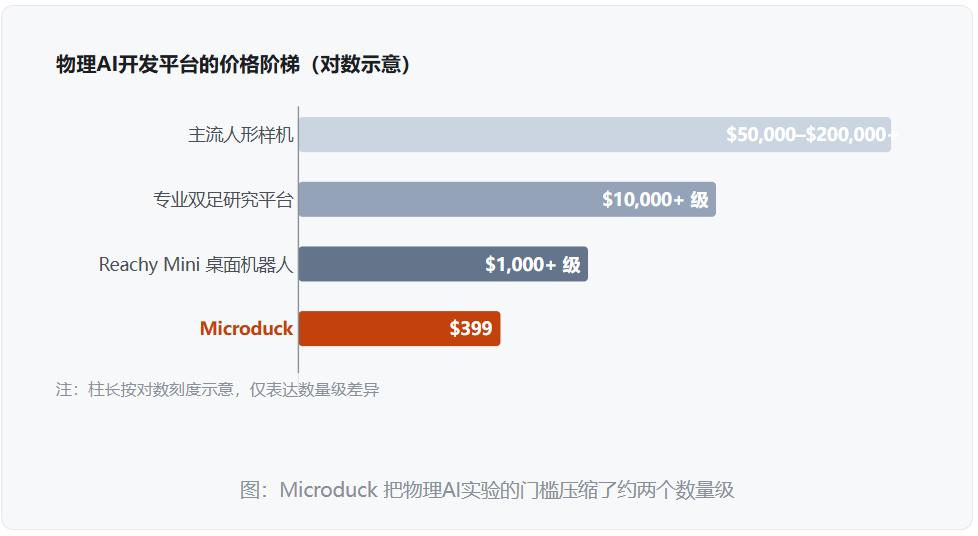
Figure: Schematic diagram of the price ladder for physical AI development platforms
Second, this is a community-driven sales, not a channel-driven sales. Microduck did not launch massive advertising campaigns. What made it a hit was the reposting, disassembly and secondary creation by developers around the world. Hugging Face directly applied the "open source community + developer ecosystem" strategy that has been verified in the AI software field to hardware. The terrifying part of this strategy is that the customer acquisition cost is close to zero, and users are channels, users are content, and users are R&D.
02 Why a Duck, Not a Humanoid Robot
This is the most thought-provoking question.
In the past two years, the mainstream narrative of the robotics industry has been "bigger, faster, stronger": two-meter-level humanoid prototypes compete on the same stage, competing for running speed, load capacity, and degrees of freedom of dexterous hands, and the hardware arms race is intensifying. Why is it not any humanoid robot that first "breaks out of the circle"?
The answer is divided into two parts. The surface-level answers can be summarized in three words: economy, accessibility, and entertainment; the deep-level answers have four points, hidden in physical laws, architecture selection, psychological mechanisms and historical conditions respectively. The surface level explains the mechanism of why this duck "sells well", while the deep level answers why it "is feasible". We will analyze from the shallow to the deep, layer by layer.
Surface level 1 · Economy: Affordable to buy
Behind the $399 price tag, the two traditional pain points of overseas open-source robotics projects -- high mold opening cost for small batch customization, and persistently high procurement cost of servo motors and sensors -- have been systematically flattened by China's hardware supply chain. According to media reports, the entire Microduck unit is manufactured by Shenzhen open-source hardware vendor Seeed Studio.
This is no accident. Hugging Face's previous Reachy Mini desktop robot was also manufactured by Seeed, whose sales exceeded one million US dollars in just five days after release and was displayed on NVIDIA's CES booth. Overseas open-source projects output design and software, while China's supply chain completes structural part processing, component centralized procurement, and complete machine assembly, pressing the BOM cost to a level that overseas local manufacturing cannot achieve. Even for the LeRobot open-source humanoid project under Hugging Face, a large number of core executive motors are also procured from local Chinese manufacturers.
We judge that on the "cost reduction curve" of embodied intelligence, the software end is driven by the open source community, and the hardware end is driven by China's supply chain. The intersection of the two curves is Microduck. This is not a marketing victory, but essentially a realization of structural dividends.
Surface level 2 · Accessibility: Easy to train
Low price is only the admission ticket, and the real moat is the decentralization of training rights. All the software and hardware of Microduck are open source, and developers can modify behaviors with Python and JavaScript; use the PPO algorithm to train new strategies in the MuJoCo simulator, run 4096 parallel environments, and train a new gait in one or two hours, then export ONNX to deploy on the on-board chip. The trained movements can also be sent back to the Hugging Face Hub for ducks all over the world to download and use.
In other words, it is not a finished robot, but a "teachable student". The seven pre-installed skills out of the box, including walking, sitting, squatting, kicking, grasping, roller skating, and self-righting after falling, are just the starting point, and the upper limit of skills is determined by the imagination of global developers. This is a key leap from "device logic" to "ecosystem logic": selling 100,000 ducks is equivalent to deploying 100,000 distributed RL experimental nodes.
Surface level 3 · Entertainment: Lovely to people
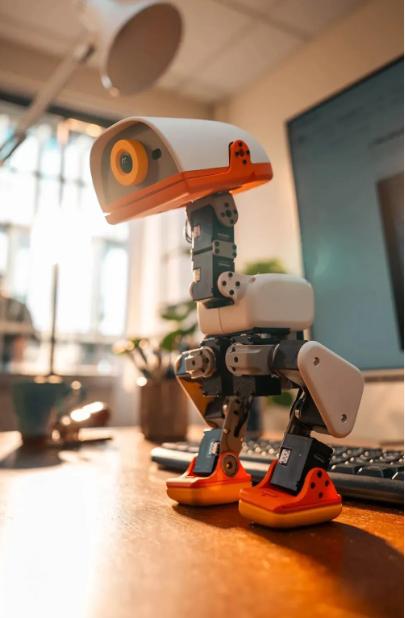
Hugging Face CEO Clem Delangue has publicly expressed his aversion to "humanoid robots" many times, believing that many prototypes evoke dystopian emotions. The design of Microduck deliberately goes the opposite way: single-eye mechanical duck, retro aesthetic of the 90s, and the body language style of Sony Walkman. There is also a nearly paranoid detail: each duck will randomly generate a unique "voice line" when it is turned on for the first time, which remains unchanged for life. There are no two Microducks in the world with the same quack.
In psychology, this is called avoiding the uncanny valley, and in business, it is called creating emotional anchors. For robots to enter thousands of households, they must first enter people's emotional accounts. A duck that will fall, get up by itself, and has a unique quack is much closer to this goal than a two-meter-tall silver humanoid prototype.
Affordable, trainable, and lovely, the three surface factors are closely linked, which together form the "popular formula" of Microduck. But we need to be alert: these three things are more like results rather than causes. The duck does not "become feasible" just because it is cheap, open source and cute. There are deeper reasons that make it possible to be cheap, open source and cute at the same time.
There are four layers of real answers, starting from the laws of physics.
Deep level 1 · Failability: Being able to afford failure is more important than being able to afford purchase
Start from a fact that is often ignored: the mathematical essence of reinforcement learning is learning from failure, and 99% of the training time of an RL agent is spent on falling, hitting walls, and doing useless work. This means that for any robot that takes reinforcement learning as its core paradigm, the first performance indicator of its body is not repeat accuracy, not load capacity, but failability -- the cost of a single failure multiplied by the scale of millions of failures.
From this perspective, miniaturization is not a compromise of product positioning, but an inevitable result of the technical route. The impact energy of an 800-gram body falling is three orders of magnitude different from that of an 80-kilogram humanoid prototype falling: no expensive force control redundancy, no collision safety certification, no manual maintenance after each fall. Falling of a large robot is an accident, while falling of a small duck is a piece of training data. When the marginal cost of failure approaches zero, failure can be repriced as an asset. This is the real physical logic behind the word "economy": $399 buys the right to unlimited free failures.
Deep level 2 · Architecture selection: Humanoid is an electromechanical problem, while duck is a software problem
The core bottlenecks of humanoid robot competition -- dexterous hands, harmonic reducers, torque control, and overall power consumption -- are all electromechanical engineering problems, which follow the R&D cycle law of hardware: calculated in years, in capital, and in trial and error cost, progress can only be gradual.
However, Microduck has made a thorough subtraction: 15 servos, a LiDAR, and an RK3566. The hardware is compressed to the minimum limit that is "just enough to carry the learning loop". The proposition it wants to verify is not "how complex the hardware can be", but "what capabilities the learning algorithm can emerge on a body as simple as possible".
Behind this is a judgment that has long been avoided by ontology manufacturers: the bottleneck of embodied intelligence at the current stage is not the ontology, but the data. The experience of Open Duck Mini has proved that a small body plus RL can emerge natural gaits. This means that the complexity of form is not a prerequisite for intelligence, but the learning loop is. In that case, making the ontology as simple as possible and transferring all the complexity to infinitely replicable software and strategies is a rational architecture choice. In the language of software engineering: the duck is the "minimum viable product" (MVP) of embodied intelligence, while the humanoid robot is a "full-featured flagship" built before the demand is verified.
Deep level 3 · Scorecard effect: Non-human form is a tolerant scorecard
Let's go one step further: Why is it a duck shape, not an abstract "small biped development platform"? This design step is much more critical than it seems. Humanoid robots are naturally compared with humans, and their scorecard is human beings themselves. Walking a little slower is a failure, clumsy hands are a failure, and a fall is a joke spread all over the network: the humanoid form puts every mistake under the trial of human standards, which is a closed scorecard that can never pass.
However, for a duck, there is no human reference system to set a passing line for it. When the duck falls, the audience sees "cuteness"; when the duck learns to roller skate, the audience sees "beyond expectation". The essence of non-human form is to remove the comparison anchor -- replace the closed scorecard of "success only when reaching human level" with an open scorecard of "surprise as long as it exceeds expectations". The so-called "cuteness" is not only emotional design, but also expectation management. Avoiding the uncanny valley is only the appearance, and the replacement of the scorecard is the essence.
Deep level 4 · Historical conditions: Open source is feasible on hardware for the first time
Finally, dig to the bottom: Why there has never been an open source robotics hit before? Because open source can only happen where the marginal replication cost is close to zero. Software open source is feasible because the cost of copying a piece of code is zero; while copying a robot traditionally requires mold opening, supply chain and production lines, with the cost in millions -- hardware open source has never been economically feasible.
Historically, every major explosion of computing paradigm is premised on a "reproducible reference implementation for everyone": the IBM compatible machine in the PC era, Linux and LAMP in the Internet era, the Transformer paper and LLaMA weights in the large model era. What embodied intelligence lacked before is exactly such a reference ontology. China's supply chain has pressed the manufacturing cost of the complete machine to the consumer level, and the simplified ontology has pressed the design complexity to the reproducible level. When these two things are established at the same time, "copying a robot" for the first time approaches the economics of "copying a piece of code". In other words, the popularity of ducks is not a marketing event, but a signal that the historical conditions of open source hardware have just been met.
We judge that the four layers of answers can be summed up in one sentence: the duck can afford failure (failability), so the hardware can be minimized (architecture selection); the hardware is minimized, so the non-human form becomes an advantage rather than a compromise (scorecard effect); the superposition of the three factors makes "copying a robot" close to "copying a piece of code" (historical conditions). Humanoid robots take the body as the end, and "being shaped like a human" is the KPI itself; ducks take the body as an interface, and the body is just an adapter for intelligence to exchange data with the world.
The necessary condition for the Cambrian explosion is to let as many variants survive and try and error at as low a cost as possible. So the ultimate answer to "why the duck" is: the body of the duck (or other non-human embodied intelligence) is the carrier with the lowest "price of intelligence" under the current technical conditions. Being affordable, trainable, and lovely, everything on the surface is derived from this point.
03 Disassemble this duck: Technical mechanism, evolution track and symbolic significance
1. Technical mechanism: A textbook-level "small but complete" engineering design
In terms of hardware, the 25cm body is equipped with 15 servo motors (distributed in the legs, neck and head), a wide-angle camera, a small LiDAR, dual IMUs, microphones, speakers, NFC tag recognition, as well as Wi-Fi and Bluetooth; the main control adopts the domestic Rockchip RK3566 solution -- a duck worth hundreds of yuan is fully equipped with perception, decision-making and execution components.
The software design is more exquisite, and there are at least three decisions worthy of reference for the whole industry:
First, the microservice-based robot operating system. The control board runs about 65,000 lines of Rust code, which is split into 7 independent services, responsible for walking, Bluetooth, camera, network configuration, OTA, etc. They communicate with each other through message mechanisms. The main program responsible for walking is the most prone to crash, while the three services of Bluetooth, network configuration and update are deliberately not dependent on it: even if the duck "brain dies", users can still connect to it with their mobile phones and flash the firmware to revive it. This "recovery path" design is the emergency room in the robot world, which is not usually used but must always be kept on.
Second, the separation of intention and security layer. Any external program, including mobile phones, handles or web pages, can only send "intentions" (move forward, sit down, look over there), and cannot directly send motor commands. The security layer inside the duck decides whether to execute or not: fall detection, joint limit, and temperature protection are all in this layer. Even if the external program goes out of control, the duck will not twist itself to damage.
Third, the complete closed loop of 50Hz. The main motion loop completes a round of "perception -- thinking -- action" every 20 milliseconds: reading the whole body sensors, running a neural network inference, and sending instructions to 15 motors, which is less than one tenth of the duration of a human blink.
2. Evolution track: