The Cross-boundary Drifting of Education Entrepreneurs
"A person must live with drive!"
"Will the next product still focus on education?"
In an era where everyone is a builder, it has become easier for entrepreneurs to pivot. For education entrepreneurs who have never lacked the courage to explore new possibilities, this "pivot freedom" is particularly prominent.
The entrepreneurial landscape is evolving, R&D barriers are being leveled, and investors are adopting a more prudent attitude towards AI applications, all of which make "pivoting/crossing boundaries" increasingly natural.
Duozhi has observed that over the past six months, quite a few AI education startups have broken out of their original frameworks and launched a wide range of innovative products.
01 From TalkMe to information traceability product Stances: "If a ship keeps sailing in one direction, it is because the captain is firm enough in his resolve"
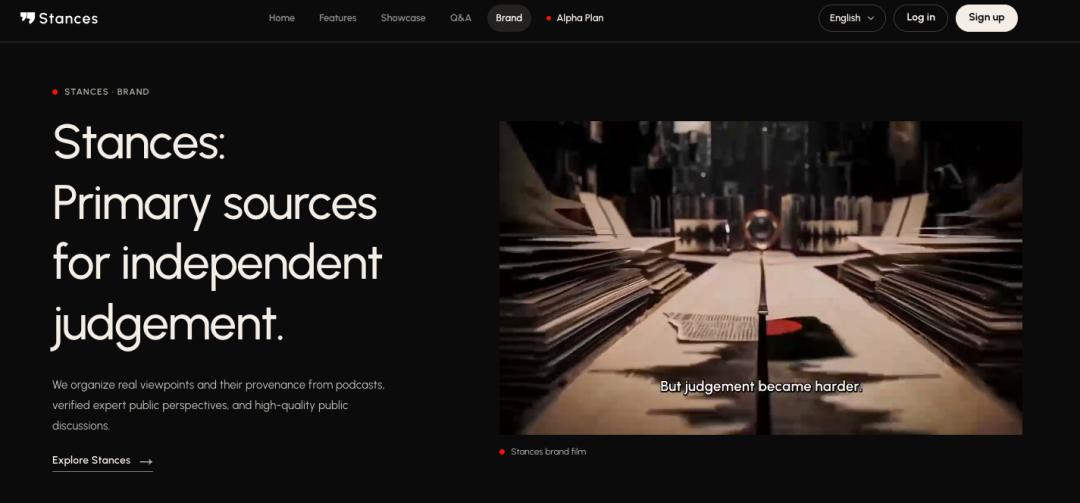
Following TalkMe and ListenLeap, startup Inspired AI recently launched its third product, Stances.
Jia Zijian, founder of Inspired AI, is a serial entrepreneur who has developed dozens of products with over 1 million DAU over the years, including two products with over 100 million daily active users. After graduating in 2011, he joined NetEase and led the development of the online movie seat selection product "NetEase Movie Ticket"; when he was in charge of browser monetization at 360, he generated more than 200 million yuan in revenue within half a year, and the 360 overseas cleaning and acceleration tool he participated in achieved a single-day revenue of 500,000 US dollars. After entering the education industry in 2018, he led the development of the first AI course at Xueersi.
In 2023, he started his business, focusing on the overseas AI language education track, and successively launched TalkMe (for oral practice) and ListenLeap (which aggregates English resources from Podcast and YouTube to help users understand English podcasts). These two products generate a total revenue of hundreds of thousands of US dollars per month and have achieved positive cash flow.
In November 2024, Inspired AI received angel round investment from Jinqiu Fund.
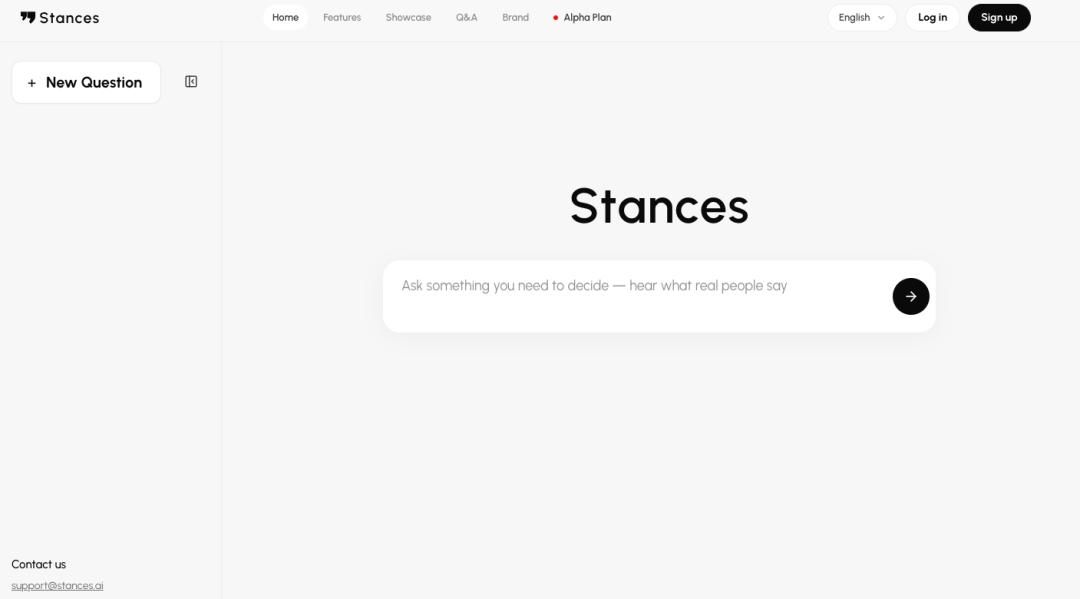
The newly launched Stances is no longer limited to the scope of education products, but an information traceability product. When users input matters that need decisions, Stances will extract insight briefs from the opinions in interviews, podcasts and public conversations. As stated on its official website: "We do not make conclusions for you, but help you make judgments based on first-hand information." It presents consensus, divergences and main views to support users in making independent judgments.
Why develop such a product? According to Jia Zijian's statement quoted by "AI Nao":
"This is my pain point. As a CEO, I have to make a lot of decisions every day, and I want to see first-hand information.
When you ask a question, this product will not give you the answer directly — instead, it will present various opinions, data chains, evidence chains, and papers as a structured brief, including which concepts the opinions are indexed to. All are original words, original opinions, and original contexts... Large models are good at 'generation', but we are doing 'traceability'.
Actually, the threshold for choosing this direction for my first startup is quite high, but on the basis of having successfully developed two language learning products, we have mature experience and accumulation in information traceability, models, data, content and algorithms.
In addition, there is another advantage: the new product forms a product matrix with the previous two products, sharing traffic and users, with similar operation strategies."
"If a ship keeps sailing in one direction, it is because the captain is firm enough in his resolve," Jia Zijian said.
02 From CuFlow to real-time interactive video company SigmaZ AI
This February, AI learning product CuFlow announced the completion of a seed round of financing, with investment from Yunqi Partners.

CuFlow is a generative AI classroom with adaptive full-modality capabilities, which can convert learning materials into summaries, mind maps, flashcards, quizzes and more.
CuFlow founder Yang Bolin (William) is 23 years old this year. He once introduced: "The most easily understood full-modality for everyone is that students can watch, listen, read, write, draw and drag, while AI can also lecture, draw, demonstrate, generate code, charts and videos in a 'classroom'. But we believe that more importantly, full-modality is not just about 'generating different modalities', but having the ability of modal reasoning and modal scheduling — reasoning on graphics, reasoning on spatial relationships, and correcting reasoning in interactive feedback. For example: if you draw a wrong formula or diagram on the real-time whiteboard, the AI will not just say 'you are wrong' in words, it will trace back the structure you drew, align the formula, highlight the part you got wrong, and then show the correct process with animation, so that you clearly know where you made a mistake. At the same time, it will continuously judge your learning state and dynamically decide which method can best promote understanding, whether it is explaining with text, with diagrams, with animations, or running an experiment."
A few months later, Yang Bolin delved deeper into the underlying technology and shifted his entrepreneurial focus to SigmaZ AI Lab, a real-time interactive video generation model company driven by diffusion language models. The company was co-founded by Yang Bolin and Derek Law, head of flagship model visual code training technology at Amazon AGI Lab (London).
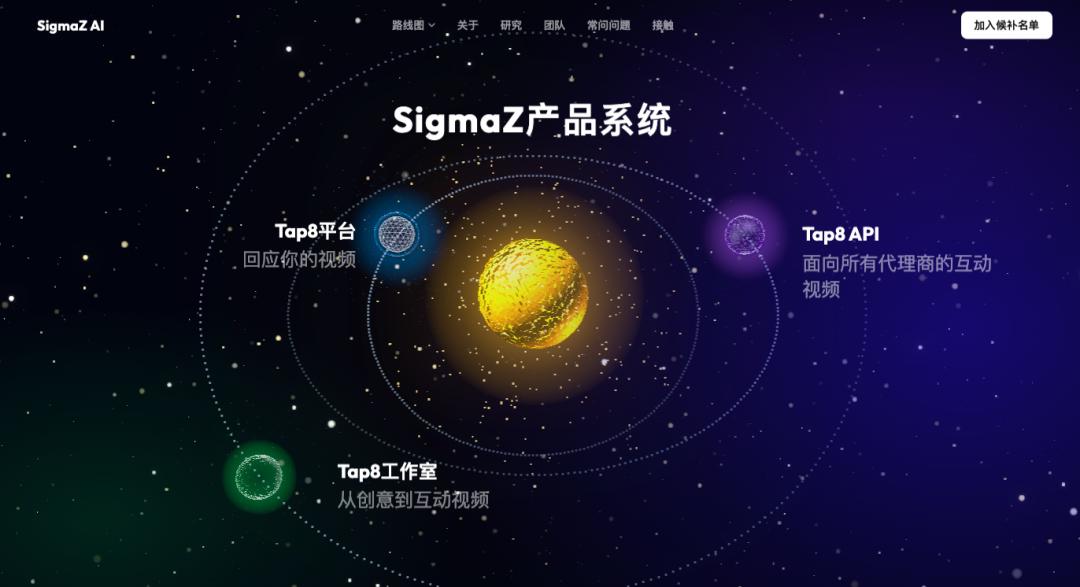
SigmaZ AI focuses on two things: Diffusion-LM model training, and vision-guided RSI, a vision-based model self-evolution framework. It trains models to directly generate visual code, producing "living images" that can be interacted with in real time and modified on the spot, which is essentially different from traditional videos with solidified pixels.
Recently, SigmaZ AI announced the completion of millions of dollars in financing, with investors including BlueRun Ventures, Yunqi Partners, Decent Capital, XIAOXIAO FUND and other institutions.
SigmaZ AI's first product is the real-time interactive content platform Tap8.
Yang Bolin stated on SigmaZ AI's social media account: "Large language models are answering faster and faster, and their outputs are getting longer and longer. But humans have not upgraded accordingly. A model can spit out dozens or even hundreds of tokens per second, while an adult can only read about 5 tokens per second. We often wait for the model to finish writing, then glance at the beginning, jump to the end, and make judgments based on a small part of the content... The direction proposed by Tap8 is to let AI directly generate an interactive video that can be viewed, clicked, asked follow-up questions, and will continue to change as you operate. 'The answer AI gives you can be a chart that you can continue to ask questions about, a machine that can be disassembled, or a lesson that will change its teaching method according to your questions.'"
03 From Talkit to AI management team HiPilot
Following the AI language learning product Talkit, Liu Ye, founder of Xiaohe Technology, launched "HiPilot" this May.
HiPilot "is not an assistant, not a tool, but a 7*24-hour AI management team that monitors the market, makes decisions, and executes for you", it is an AI-native business operating system that can help enterprises redefine their operation methods with the AI-native concept.
Regarding this change in entrepreneurial direction, Liu Ye later shared at the HunChuang Innovation Institute that after founding VisionFlow in 2023, despite his extremely meticulous management and the team using various AI tools, they still created a "fake AI native" product. This is because:
First, the technology is not native. Many technical managers are still used to using the previous generation of development tools, databases, etc., without breaking the old inertia to adopt the latest technical means.
Second, the product is not native. We often spend too much time discussing the buttons, menus and layouts of the GUI (Graphical User Interface), while ignoring intent recognition, intent expression, generation control, etc.
In fact, C-end users all over the world have been educated that no matter how complex the product is, they can just "chat" with it.
Third, the organization is not agile. In the past model, all requirements were submitted layer by layer, waiting for scheduling and development, which often took weeks, and the final product Demo might be rejected in just one minute. In a native AI team, the smallest operational unit may only need one or two people, who can complete product release and iteration within a few days or even hours. "
Therefore, in 2026, he completely restructured the business and organization, founded HiPilot, and achieved the result that 4 people can maintain the output of the original 70-person team, and 16 people can develop new business lines independently.
The technical foundation remains, the drive remains, but the boundary of products has been kicked open by entrepreneurs. As one entrepreneur said: "A person must live with drive!" — this drive, is still there.
This article is from the WeChat Official Account "Duozhiwang" (ID: duozhiwang), author: Xu Jingjing, published with authorization from 36Kr.