Who is footing the bill for AI: The trillion-dollar betting landscape of eight major tech giants
When Anthropic and OpenAI are queuing up at the gate of the capital market, it is the handful of giants already seated at the center of the table that have pre-paid the bills for this AI revolution. Understanding their betting directions, bet sizes and monetization logics means you grasp the power landscape of the AI era.
If we turn the 2026 AI race into a balance sheet, the left side records hundreds of billions of US dollars burned on computing power, salaries and electricity, while the right side shows the revenue that has not been fully realized. And the parties sitting on both sides of the table who keep signing checks are almost the same group of names: the Big Seven Tech Giants — Apple, Microsoft, Amazon, Alphabet (Google's parent company), Meta, Nvidia, Tesla — plus SpaceX, which landed on Nasdaq in June this year with a valuation of 1.77 trillion US dollars.
According to the summary of the latest financial reports and public guidance of each company, the total capital expenditure of Microsoft, Google, Amazon and Meta alone in fiscal year 2026 has exceeded 600 billion US dollars, and the vast majority is directly allocated to AI data centers, chips and power procurement. If all the computing power infrastructure investments of Nvidia, Tesla and SpaceX are included, the total bill is accumulating at the trillion-dollar level. In other words, AI is not a free lunch, but a sky-high bill swiped jointly by eight credit cards.
They bet on AI in different ways: some act as "funders", some make "shovels", and some embed models into billions of devices. How these eight players make their moves determines the direction of AI in 2026.
Microsoft: The Most Aggressive "Funder + Ecosystem" Player
Microsoft is the most special player in this game — it is not only the largest external shareholder of AI, but also the cloud service provider best at monetizing AI. Among all tech giants, no other company sits on the two chairs of "capital" and "distribution" at the same time like it does.
Microsoft's cumulative investment in OpenAI ranges from about 130 billion to 140 billion US dollars. What it gets in return is not equity dividends, but in-depth binding for many years. The revised agreement reached by the two parties in April this year shows that Azure has "first-launch priority", and all new OpenAI models will be launched on Azure first; the Copilot-related authorization is extended to 2032, and the AGI trigger clause is deleted at the same time — even if OpenAI achieves artificial general intelligence in the future, Microsoft's right to use its models will not be cut off. For a company that invests more than 100 billion US dollars a year, this is more practical than equity dividends — it locks in the certainty of returns.
In terms of model strategy, Microsoft also supports the French startup Mistral, acquired the Inflection team, and independently developed the small Phi series models — it deliberately avoids putting all the "cutting-edge model" eggs in the OpenAI basket. This diversified layout ensures that Microsoft can call models for different scenarios and at different costs, further dispersing strategic risks.
In terms of capital expenditure, Microsoft's property and equipment expenditure in fiscal year 2026 has reached about 116 billion US dollars, an increase of nearly 80% over the previous fiscal year, and the vast majority flows to AI data centers and computing power procurement. Correspondingly, this huge investment is being converted into commercial returns: Copilot has evolved from a "trial feature" to a fast-growing line item in Microsoft's enterprise revenue statement: the number of paid seats for Microsoft 365 Copilot exceeded 30 million in fiscal year 2026, with a net increase of more than 10 million in a single quarter; the number of paid subscription users for GitHub Copilot exceeded 4.7 million in the same period, a year-on-year increase of 75%, and enterprise deployment is also expanding at an accelerated pace.
Microsoft's playbook is very clear: use other people's cutting-edge models to nourish its own cloud and enterprise software. It does not bet on the victory or defeat of a certain "super model", but ensures that no matter who wins, the computing power, interfaces and distribution channels are all in its own hands. This "toll collection" business model allows Microsoft to recover part of its costs in the first half of the AI revenue race.
The risk lies exactly here: the revenue quality of Microsoft's AI story is highly dependent on the model competitiveness of the two startups OpenAI and Anthropic. Once one of them falls behind, Microsoft's dual identity as both a funder and a channel will bear the dual pressure of asset impairment and ecosystem stall at the same time.
Google: The Only Full-Stack Self-Developed Giant
If Microsoft is "leveraging external forces", Google is a "full in-house package" — from models (Gemini, developed by DeepMind), chips (self-developed TPU), to applications (Search, Android, Cloud, Waymo), all are self-developed. Among the seven tech giants, only Google has "cutting-edge model capabilities + self-developed computing power + largest-scale distribution" at the same time.
At this year's I/O conference, Google officially released Gemini 3.5 Flash, which focuses on native multi-modality (simultaneous processing of text, image, audio and video), and the self-developed TPU v6 chip brings down the inference cost. Recently, Google launched the Gemini 3.7 Flash model, with a preferential price half of that of the original Gemini 3.6 Flash: 0.75 US dollars per million input tokens, and 3.75 US dollars per million output tokens. This model has been integrated into the Gemini Spark subscription service, open to Google AI Pro and Ultra users, and simultaneously connected to Google AI Studio, Vertex AI and the newly launched agentic development platform Antigravity. Gemini has been deeply embedded in every entry point of Google; Waymo's self-driving taxis have also expanded from Phoenix and San Francisco to more cities in 2026.
In terms of capital expenditure, according to the second-quarter financial report released in late July, Google has raised its 2026 guidance to the range of 195 billion to 205 billion US dollars, further up from the previous maximum guidance of 190 billion US dollars. Google Cloud's second-quarter revenue was 24.77 billion US dollars, a year-on-year increase of 82%, and the cloud backlog orders have increased to 514 billion US dollars.
Sundar Pichai is not facing all good news. The first is the "delay anxiety" of its flagship model — the market has long taken Gemini 3.5 Pro as the ruler to measure DeepMind's capabilities, and in July Pichai publicly admitted that the release schedule was forced to be postponed. The second is organizational turbulence: in early August, DeepMind completed the largest leadership restructuring since its establishment — Demis Hassabis stepped down from his frontline post, and his deputy Koray Kavukcuoglu took over; co-founder Sergey Brin has been deeply involved in the core AI team in recent months. Google has two cash cows, Search and Cloud, to support its business, but the moat in the AI era has changed from "links" to "answers".
Amazon: The "Triangular Formation" of Cloud, Chip and Model
Amazon's AI story is composed of three parts: cloud (AWS), self-developed chips (Trainium / Inferentia), and models (Nova + investment in Anthropic). It does not put all its bets on a single link, but makes the three puzzle pieces interlock with each other.
Amazon's cumulative investment in Anthropic is about 8 billion US dollars. In the first half of this year, it also announced that it will invest more than 20 billion US dollars in Anthropic in the future, making it the second largest "AI funder" after Microsoft. At the same time, Amazon uses self-developed Trainium chips to reduce inference costs, avoiding giving all profits to Nvidia. The Nova series models fill the gap of self-owned models, and form a combination with third-party models on the Bedrock platform. According to the latest information at the end of July, Amazon has raised its estimated AI-related cash capital expenditure for 2026 to about 220 billion US dollars in its second-quarter financial report, an increase of 20 billion US dollars from the 200 billion US dollar forecast in February. AWS's revenue increased by 36.7% year-on-year to 42.2 billion US dollars. The reconstruction of Alexa+ is its flagship attempt to push AI to the consumer end.
Amazon's logic is to use cloud revenue to feed models, and use models to drive cloud business — but the "middle layer" positioning of Nova and Bedrock means that it has to compete with OpenAI/Anthropic for enterprise customers, and compete with Microsoft Azure and Google Cloud for cloud market share. This is a two-front battle of "using other people's models to support its own cloud, and using self-developed models to defend against others".
Meta: Open Source + "Superintelligence Lab"
Meta has taken a path that is hardest to replicate: open source its most powerful models. In the cutting-edge model competition dominated by closed-source products, it chose to bind developers with an open ecosystem.
The Llama series has made it the "de facto standard" for open-source large models. At the same time, Meta invested about 14 billion US dollars in data labeling company Scale AI last year, and recruited its CEO Alexandr Wang to lead the newly established "Superintelligence Lab". According to Meta's latest financial report, the company raised its 2026 capital expenditure guidance to 125 billion to 145 billion US dollars in April, and in July it raised the lower limit from 125 billion to 130 billion US dollars, while keeping the upper limit of 145 billion US dollars unchanged. Meta's actual capital expenditure in 2025 was 72.2 billion US dollars.
Meta's AI investment has two return channels: the first is the AI transformation of the advertising system — recommendation and generative advertising directly boost revenue, and AI-driven advertising creative tools have covered most of its advertisers; the second is AI hardware, and Ray-Ban Meta smart glasses are one of the best-selling AI wearable devices in 2026. Open source is a double-edged sword: the Llama ecosystem has expanded Meta's influence, but it also means that it is difficult to charge directly via APIs like OpenAI does. Meta bets on "exchanging open source for ecosystem, and exchanging ecosystem for advertising and hardware", whose return cycle is longer than selling APIs.
Nvidia: The "Toll" That Everyone Has to Pay
Among the seven tech giants, Nvidia is the only player that does not directly develop applications, but is almost relied on by everyone. What it sells is not models, but the "shovels" for training models.
Blackwell architecture GPUs remain the hard currency for training cutting-edge models in 2026, and the data center business contributes the vast majority of Nvidia's revenue. The company's market cap exceeded 4 trillion US dollars in the summer of 2025, and continued to rank first in the global market cap ranking in 2026 (about 5.3 trillion US dollars as of August). For Microsoft, Amazon, Google, Meta, Tesla and xAI, Nvidia's production capacity schedule is their computing power schedule.
Nvidia bets on "no matter who wins, everyone will use my shovels". But the risks are clear: every one of its big customers is developing self-designed chips — Microsoft (Maia), Google (TPU), Amazon (Trainium), Meta (MTIA), Tesla (Dojo), Apple (self-developed), not to mention China's Ascend. Microsoft's self-developed chips can reduce AI computing costs by up to 40%. Once customers' self-developed chips are scaled up, Nvidia's position as the "water seller" will be eroded little by little. Its moat is the ecosystem (CUDA) rather than a single generation of hardware, but the loosening of the ecosystem often starts with big customers diverting orders quietly.
Apple: The Most Restrained "Terminal Gatekeeper"
Among the seven tech giants, Apple has the slowest and most restrained response to AI. It does not participate in the arms race for the "most powerful model", but guards its own device entry points.
Apple Intelligence focuses on on-device + Private Cloud Compute, emphasizing privacy priority. At this year's WWDC, Apple officially released the new version of Siri AI, which is deeply integrated with Apple Intelligence. Developers can test it starting from now, and ordinary users will experience it in Beta form later this year. This "non-radical" strategy has its logic: Apple's core assets are about 2.5 billion active devices. When everyone is burning money crazily, Apple is the only player at the table that "uses its existing users and gross profit to wait for others to figure out the path".
Its risk lies in: if AI really reconstructs the entry point (for example, conversational assistants replace apps and search), Apple's "conservative" strategy may turn into a "falling behind" strategy. Apple's progress in on-device models in 2026 is the key variable for it to hold its entry points.
Musk's Portfolio: Tesla + SpaceX + xAI, Three Cards Played by One Person
Should Tesla and SpaceX be grouped together? Our judgment is yes — and xAI should also be included.
The three companies are all controlled by Elon Musk, and their AI strategies are highly intertwined: Tesla's FSD and Optimus training data come from real road conditions of millions of cars; SpaceX's Starlink is the world's largest satellite internet, which is the infrastructure for edge AI; xAI's Grok and Colossus cluster are the "model brain" of this system. Talents, computing power and capital flow back and forth between the three companies, which is essentially a one-person AI empire.
The real asset of xAI is not Grok, but Colossus — this supercomputing cluster located in Memphis, Tennessee, has expanded to about 555,000 Nvidia GPUs in early 2026, with capacity crossing the 2GW power boundary; Musk's goal is to exceed 1 million GPUs by the end of the year. In January 2026, xAI completed a 20 billion US dollar Series E financing with a valuation of 230 billion US dollars; then SpaceX completed the largest IPO in global history at 1.77 trillion US dollars in June, xAI merged with SpaceX, and the merged entity's valuation has now risen to 1.9 trillion US dollars.
In terms of models, Grok 4.5 has launched internal private tests within SpaceX and Tesla, and Grok 4.5 (according to public information, the base model has a parameter magnitude of about 1.5 trillion) is under training. SpaceX's listing gives the entire Musk AI map a channel for blood transfusion from the public market. But xAI is also the most questioned player: Grok 4 still has a clear generation gap with Claude and GPT-5.5 in multiple enterprise-level coding rankings; Grok 5 has been "promised to be released soon" for many times but has been delayed repeatedly. Musk's strategy of "buying time with computing power" ultimately depends on whether Grok 5 can take back the title of the most powerful model.
Funder, Water Seller and Gatekeeper
Putting the eight companies together, their roles are immediately clear:
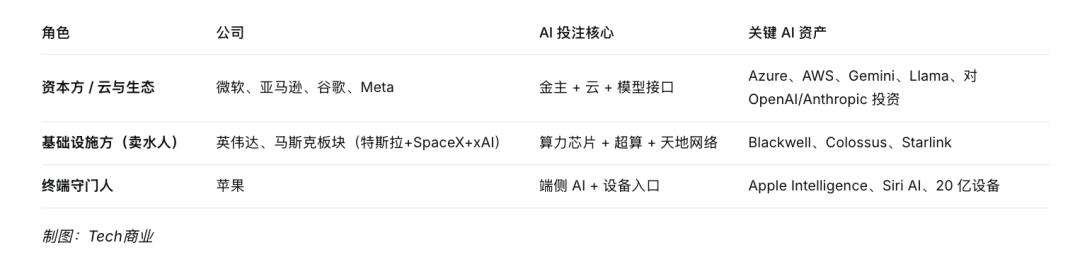
And the vulnerability of this chain is hidden in the August warning from Steve Eisman, the prototype character of *The Big Short*: about 70% of the AI-related revenue of Microsoft, Amazon, Google, Oracle and other companies comes from Anthropic and OpenAI. The AI stories of the giants ultimately depend on the success or failure of these two startups.
In-Depth Risk Depiction: The Bills Are Piling Higher, While Returns Are Still on the Way
The AI bills of the eight giants have three structural features that determine the nature of this gamble:
First, there is a huge time gap between capital expenditure and returns. The total capital expenditure of the four major tech giants alone in fiscal year 2026, which exceeds 600 billion US dollars, will mostly be converted into revenue gradually from 2027 to 2030. Before the returns are realized, every quarterly financial report will be squeezed by depreciation and power costs first.
Second, revenue is highly concentrated in the upstream and a small number of model companies. The AI revenue of cloud vendors mainly comes from training and inference computing power (selling shovels), while the real demand for model APIs is highly dependent on Anthropic and OpenAI — this is exactly the "Achilles' heel" mentioned in Eisman's warning.
Third, the pendulum of bubble controversy is swinging back. From Apple, the "most restrained", to Musk, the "most radical", the attitudes of giant companies towards AI span the entire spectrum. But no matter radical or restrained, they are all betting on the same thing: AI will eventually reconstruct software, advertising, search and hardware.