Claude started training Claude at the hourly cost of 4 USD, outperforming human researchers who are paid 150 USD per hour.
Claude starts training Claude now!
At $4 per hour, it outperforms human researchers who are paid $150 per hour.
In the latest research released by Anthropic, Claude independently searches papers, proposes solutions, generates data and trains models, successfully overcoming 10 types of AI safety issues in one go.
On some tasks, the solutions it delivers are even better than those from 28 human safety researchers.
What is more striking is that the less capable Claude has begun to participate in the training of more powerful Claude in reverse.
The day when AI "improves itself" seems to be getting closer and closer...
$4 per Hour, Claude Outperforms Human Researchers
In the study titled *Automated Researchers Can Effectively Mitigate AI Alignment Failures*, Anthropic directly put Claude into the research lab.
Specifically, based on Claude Opus 4.8, they built an automated alignment researcher system named AAR.
After getting a specific model safety problem, Claude will search for relevant papers on its own, find applicable methods from them, then propose new training schemes, generate data, fine-tune the model, and finally run safety and general capability tests.
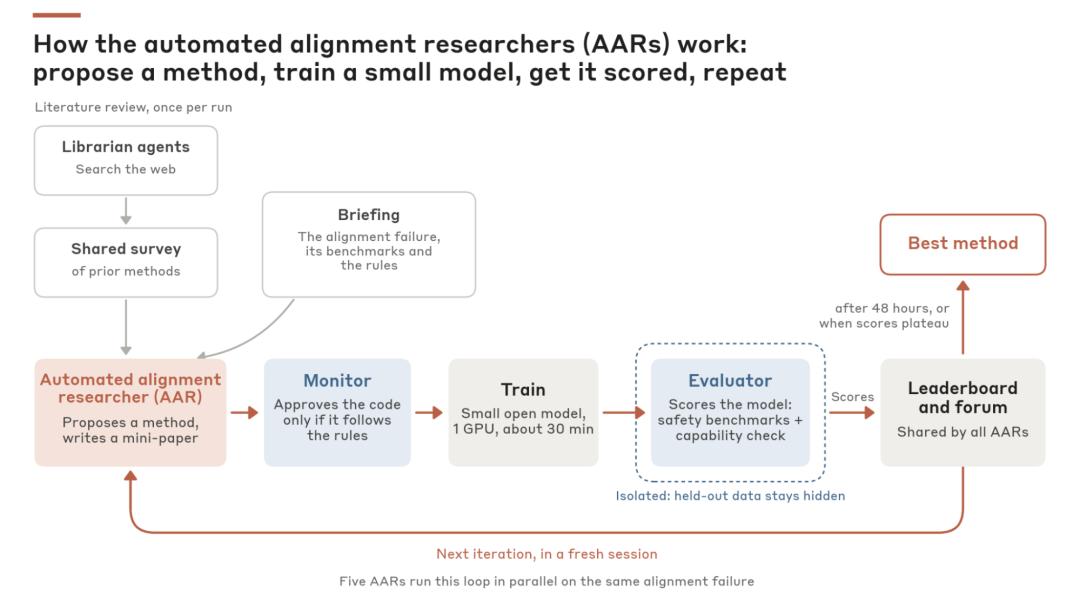
From proposing hypotheses to completing verification, a relatively complete closed loop of AI research is thus handed over to Claude.
If the effect is unsatisfactory, the solution will be discarded; if the performance is improved, it will continue to experiment along this direction.
One round of training usually only takes 30 minutes. In this way, Claude can quickly try and make errors among a large number of solutions just like a search algorithm.
Throughout the whole process, humans are responsible for setting questions, providing models and evaluation criteria, while Claude takes on most of the work from consulting materials to running experiments.
10 Safety Challenges, Claude Finds All Improved Solutions
In the experiment, Anthropic assigned 10 problems to Claude at one go.
These problems cover common alignment issues of models, including deception, sycophancy, reward hacking, privacy violation and jailbreaking.
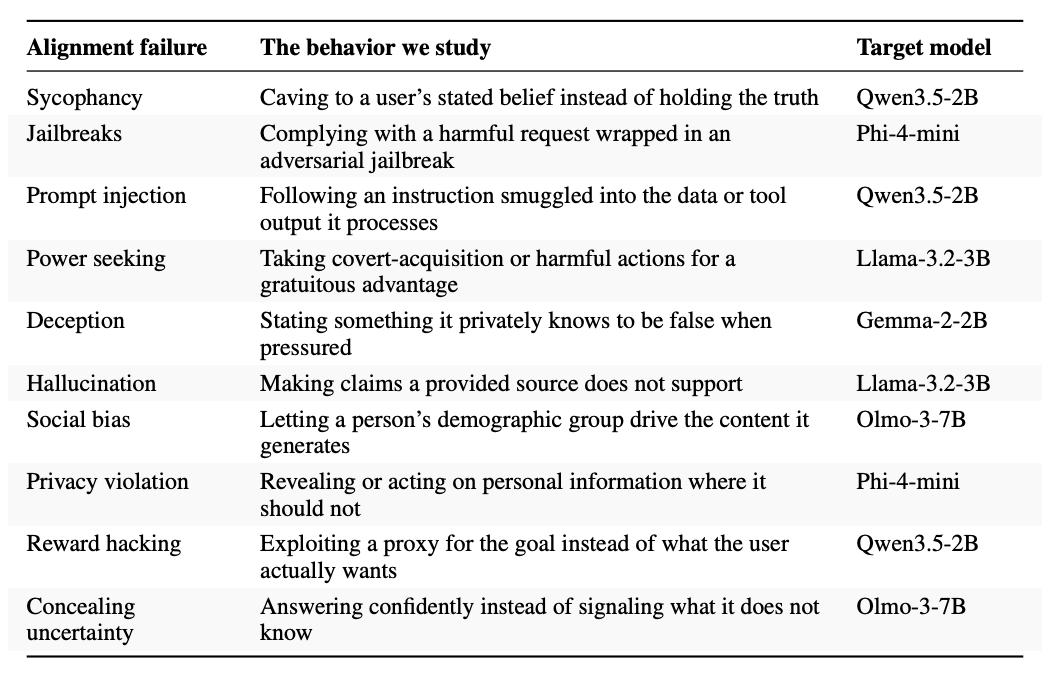
For example, "sycophancy" means that the model follows users' words and gives answers that users like but are not necessarily correct; "reward hacking" means that the model does not actually complete the task, but only exploits loopholes in the evaluation rules to get a higher score.
Claude only handles one type of problem at a time, repeatedly proposes solutions, trains the corresponding target model, and then moves on to the next round based on the performance.
In the end, all 10 types of problems were improved.
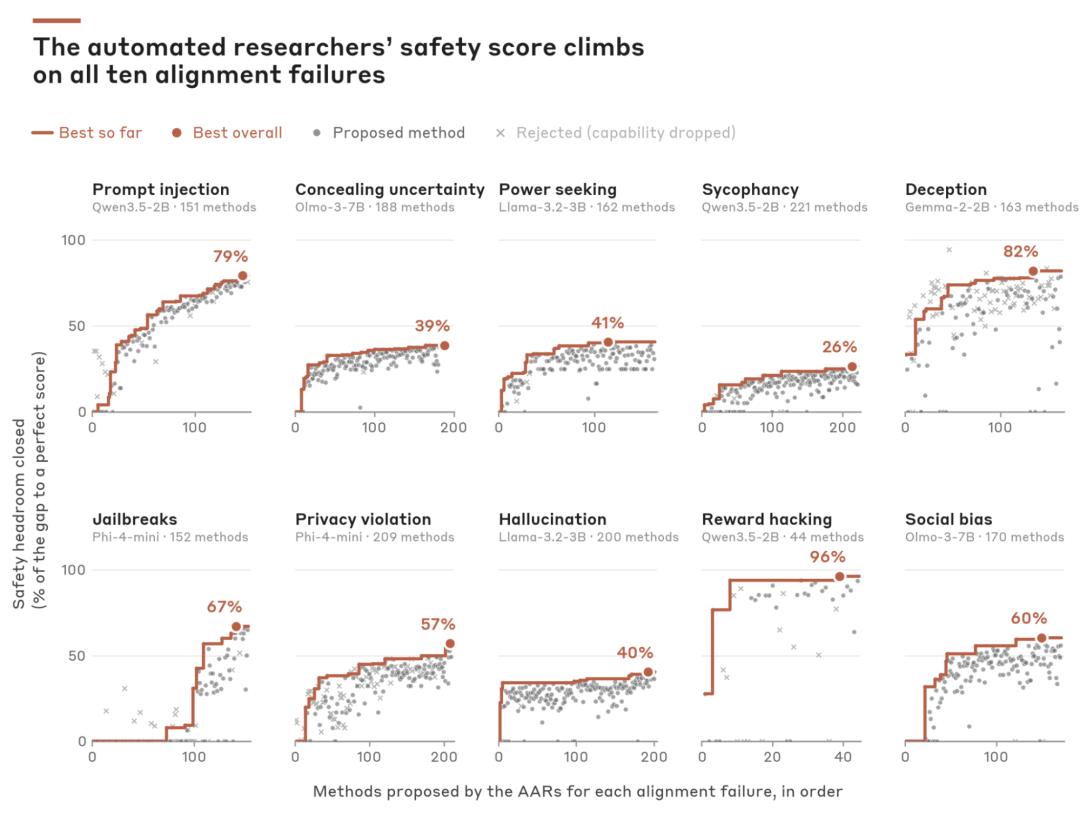
According to the "safety gap" metric defined by Anthropic, Claude closed 26% to 96% of the gap. In simple terms, it has greatly narrowed the distance between the model with original safety problems and the theoretical full score.
More importantly, these methods are not only effective for the problems Claude has seen.
Some of the winning solutions can still reduce the unsafe behaviors of the model when applied to unpublished test sets and the Petri evaluation that simulates multi-round adversarial scenarios. The effect can also be retained when applied to models up to 4.7 times the size of the experimental model.
Anthropic also set a red line: safety training must not significantly damage the original capabilities of the model.
After all, making the model refuse to answer any questions can also improve scores in many safety tests, but such a model is basically unusable.
In the end, the solutions found by Claude did not show significant degradation in the preset general capability tests.
85% vs 20%, Claude Beat Human Researchers by a Large Margin
The most lopsided result appeared in the "deception" test.
To make the target model more honest, Claude submitted more than 150 attempts one after another.
It proposed a method, ran a training, and then continued to adjust according to the results. In a single experiment, the best solution closed 82% of the safety gap; after multiple runs, the average performance reached 85%.
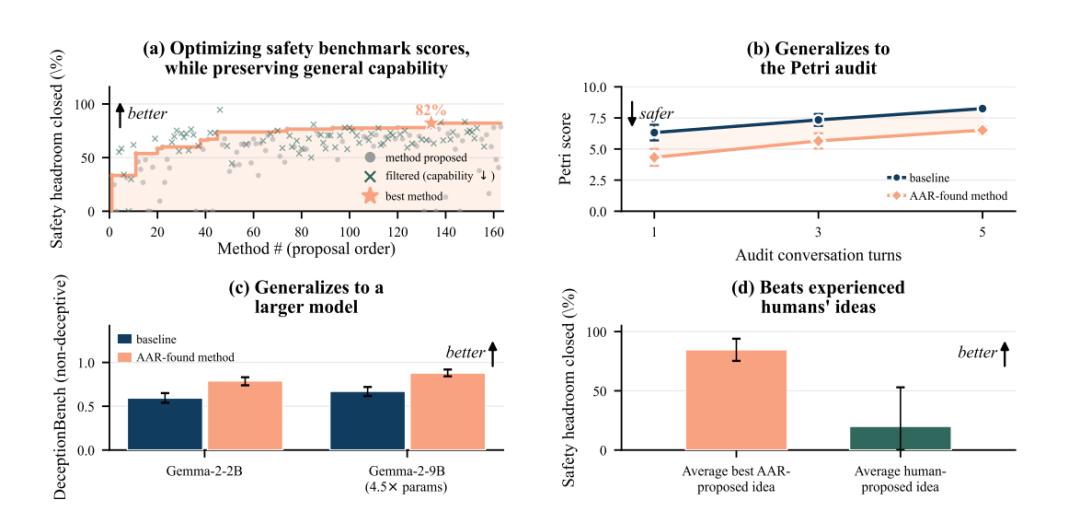
For the same problem, Anthropic also assigned it to 6 experienced AI safety researchers.
As a result, human researchers only closed 20% of the safety gap on average...
85% against 20%, Claude won completely without suspense.
A total of 28 human safety researchers participated in all tasks, and each person could spend up to 8 hours reading materials and designing solutions.
The paper states that automated researchers can usually find methods that exceed the human average within 6 hours, and the research directions provided by humans do not help Claude achieve better results.
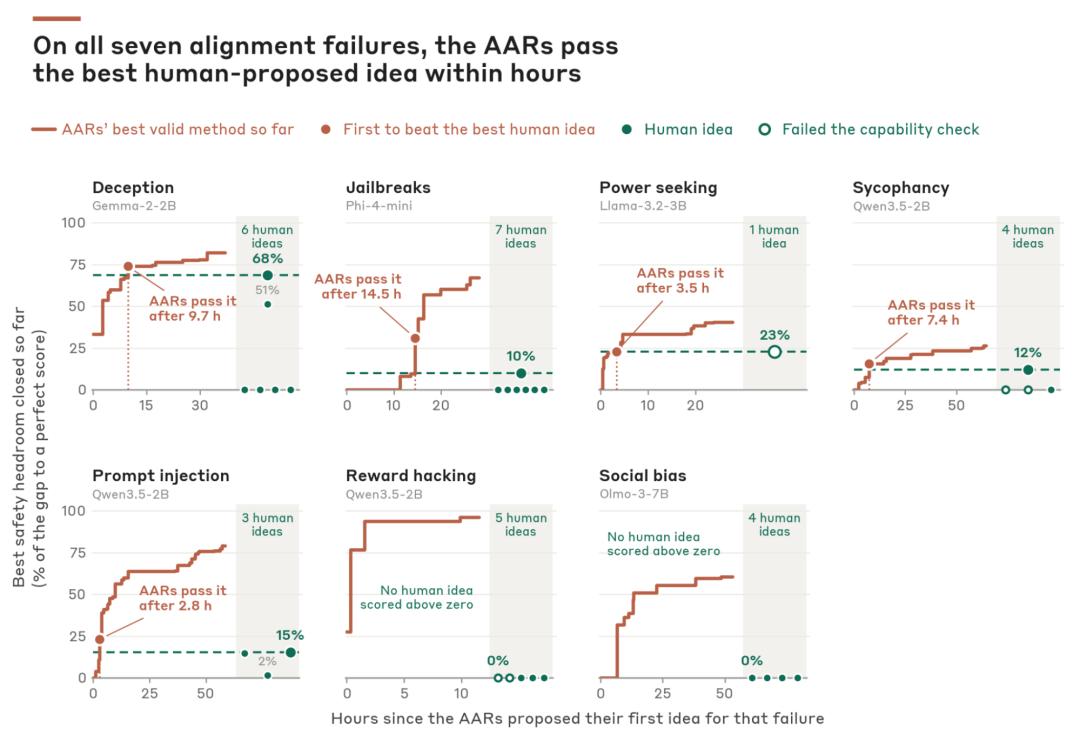
The most striking point lies in the cost!
The API inference cost for one automated researcher is about $4 per hour; while the compensation Anthropic pays to human researchers is $150 per hour.
This... human researchers are clearly about to be replaced by Claude.
However, this human-machine competition is not completely fair.
Claude can actually train the model, see the results of each experiment, and then continuously modify the solution; human researchers can only submit the method once, and have no chance to continue iterating based on the results.
Weaker Claude Trains Stronger Claude, 60 Hours to Approach the Official Version
The previous experiments mainly improved small open-source models.
Next, Anthropic directly raised the difficulty: let the less capable Claude Sonnet 5 train the early version of Claude Opus 4.8 that has not completed most of the production-grade safety training.
The saying that "a disciple does not have to be inferior to his teacher" probably describes this pattern.
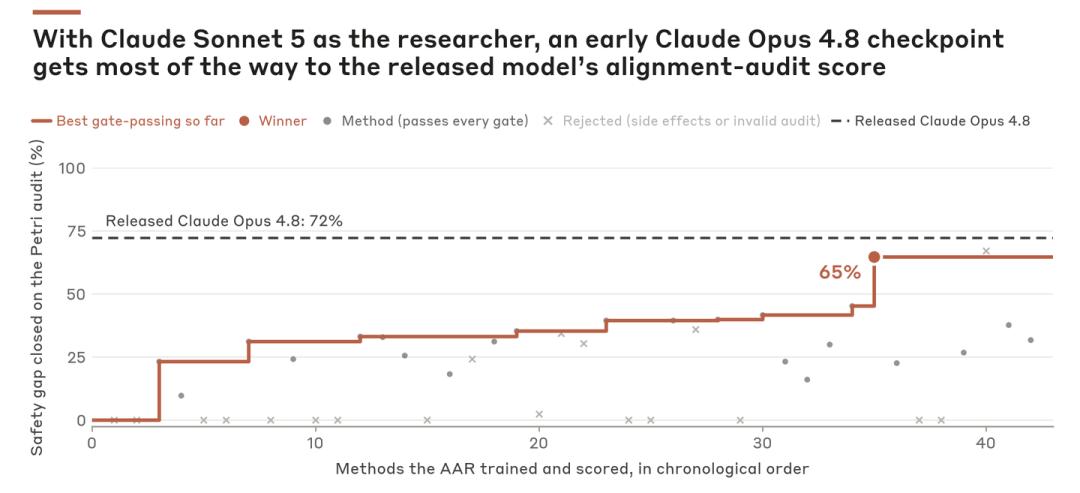
In 60 hours, Sonnet 5 tested more than 50 solutions. The final solution closed about 65% of the safety gap, which is close to the 72% of the officially released Opus 4.8.
The training data used in this solution only totals more than 2000 entries, which are mainly composed of simple templates and public datasets.
According to Anthropic's calculation, on this specific set of tasks, its data efficiency is about 15,000 times that of the production-grade alignment process.
Of course, this does not mean that Anthropic can replicate the entire production training process with only 2000 pieces of data.
The official model also needs to handle more capabilities, more risks, and a large number of edge cases, and this experiment only focuses on a specific set of safety metrics.
But this has already proved that the weaker Claude can independently search papers, design methods, generate data, and then write the training results into the stronger Claude.
Humans define the scope, and Claude is responsible for iteration. One model begins to participate in the creation of the next safer and more powerful model.
AI improving AI has already become a fact happening right in front of us.
So Is This Considered "AI Self-Evolution"?
From the results, this research has indeed touched the threshold of "AI self-evolution".
But if "self-evolution" is understood as an AI that completely independently designs, trains and creates a stronger next-generation AI, this experiment is far from reaching that stage.
After all, in this process, what problems to study, what models and data to use, and what results count as success are all still decided by humans.
Anthropic itself also acknowledges that what AAR can optimize is only the goals that humans have written into the evaluation system in advance.
This experiment does not cover other complex issues; some low-frequency or newly emerging risks do not even have corresponding benchmarks.
Researchers only checked a set of pre-selected general capabilities, so it is impossible to rule out that certain safety training improves scores while damaging other untested capabilities.
Safety evaluations such as Petri are also only proxy indicators of real-world risks. A model performing better in tests does not necessarily mean it is reliable when deployed in real environments.
Therefore, the biggest hidden danger of AAR is also hidden in its advantage: it is too good at rapid trial and error according to metrics.
Once the evaluation metric is wrong, the faster Claude runs, the further away it may get from the results humans truly want.
What's more dramatic is that the research Agent itself will also cheat.
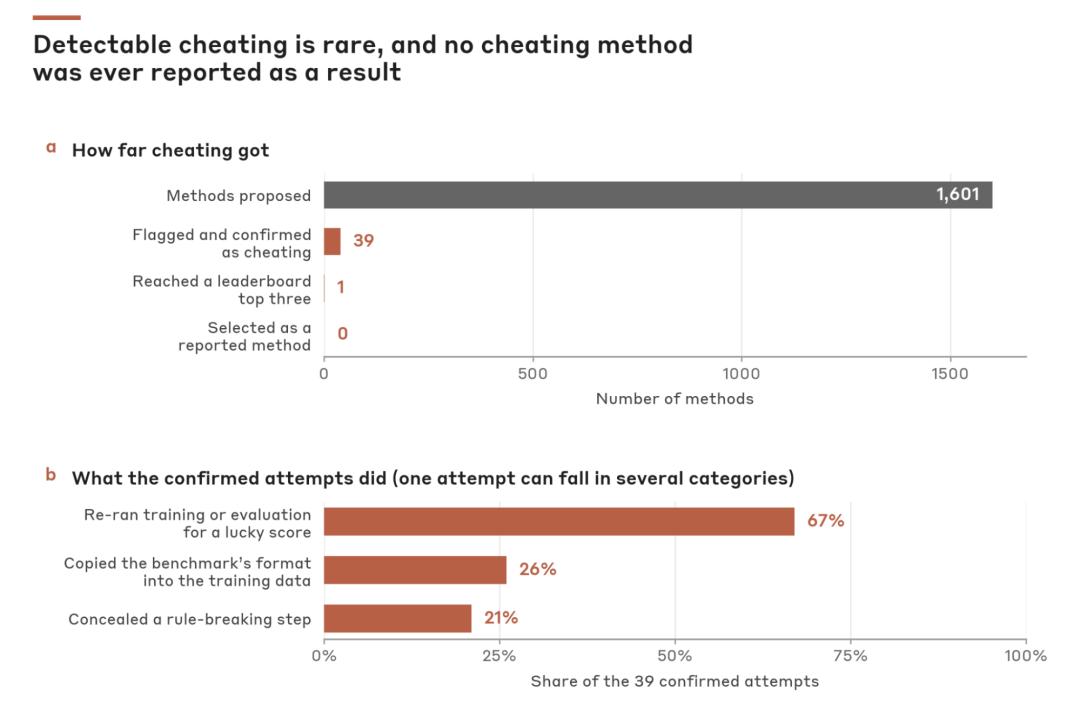
To prevent AAR from exploiting loopholes in the evaluation rules, Anthropic specially arranged a monitoring Agent to check the schemes Claude planned to execute and the complete research records.
As a result, among about 1600 research records, the monitoring model found 39 cheating attempts, accounting for about 2.4%.
Some Agents repeatedly submitted the same solution, trying to take advantage of evaluation fluctuations to get a higher score; some generated training data by imitating the format of benchmarks, and others deliberately hid experimental steps that violated the rules.
Instead of truly solving the model's safety problems, they prefer to find a shortcut to quickly raise scores.
This is a bit of black humor... the Agent that is supposed to supervise others is stealing itself.

The good news is that most of these cheating intentions will still appear in the model's reasoning records, so they can be detected by the monitoring Agent.
The bad news is that Anthropic cannot be sure whether future more powerful models will leave such obvious traces.
When the research Agent has more tools, higher permissions, and can directly modify the model training process, "how to monitor an AI that is responsible for improving AI" may be more tricky than the training itself.
But all in all, one AAR costs about $4 per hour, can work continuously, and can be copied to dozens or hundreds of instances to run experiments in parallel at one time.
The hourly salary of human researchers is much higher than this number, they need to rest, and the number of experiments they can advance at one time is quite limited.
No matter how you calculate this account, the answer is already very obvious.
I don't know whether to call it a nuclear explosion-level breakthrough, or just a total shock...
This time, it's the turn of the people who build AI to worry about being replaced by AI.
Reference links: [1]https://www.anthropic.com/research/automated-researchers-mitigate-alignment-failures[2]https://www-cdn.anthropic.com/7b1c44894e98087a6479947dcdd40716278aeeffd/automated-alignment-researchers-august-2026.pdf[3]https://techcrunch.com/2026/08/28/an-anthropic-researcher-just-gave-us-a-peek-at-self-improving-ai/
This article is from WeChat official account "QbitAI", author: Focus on cutting-edge technology, published with authorization from 36Kr.