Two AI giants devour one-third of the world's newly added computing power, and their share will approach half next year.
This year, roughly one-third of the world's newly added computing power ends up supporting operations for the same two AI companies!
These two companies are Anthropic and OpenAI.
By next year, this proportion is likely to rise to half.
At this momentum, by the end of 2028, these two companies could dominate the majority of the world's effective available computing power.
The person who put forward this view is Dylan Patel, founder of SemiAnalysis.
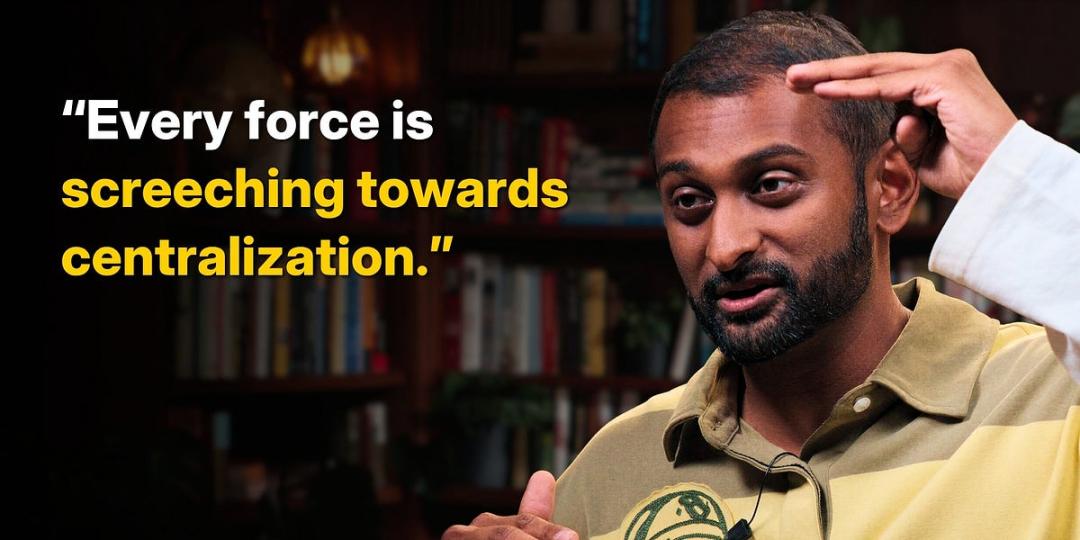
Dylan Patel appeared as a guest on the Dwarkesh Podcast.
On August 25, he joined the Dwarkesh Podcast and calculated the computing power outlook for the next three years.
In the last 10 minutes of the conversation, the topic shifted from computing power to a much bigger issue:
Will the power of AI really fall into the hands of a very small number of companies?
When he saw this content, Thomas Wolf, co-founder and Chief Science Officer of Hugging Face, was completely shocked.
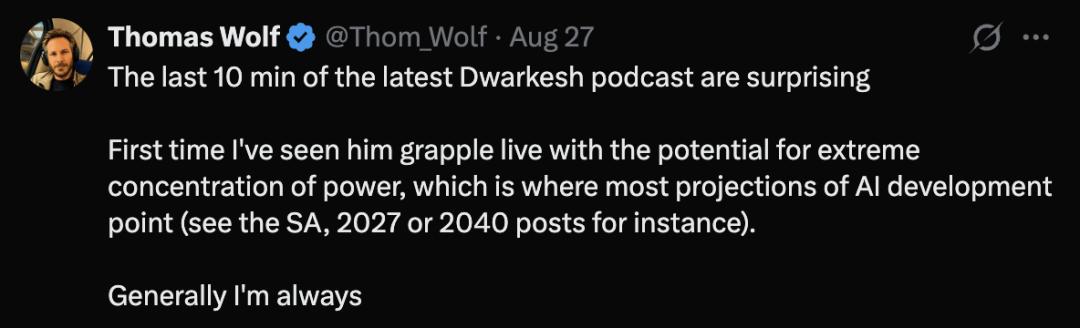
He shared the post and said that this was the first time he had seen Dwarkesh struggle with this question on the spot.
It is not at all unexpected that he is the one saying this.
Wolf has bet most of his career on open source, which he sees as the way to stop the concentration of power among closed-source tech giants.
Consuming the Output of Three Nuclear Power Plants in One Year
First, let's look at how fast these two companies are consuming computing power, and how rapidly the growth rate is rising.
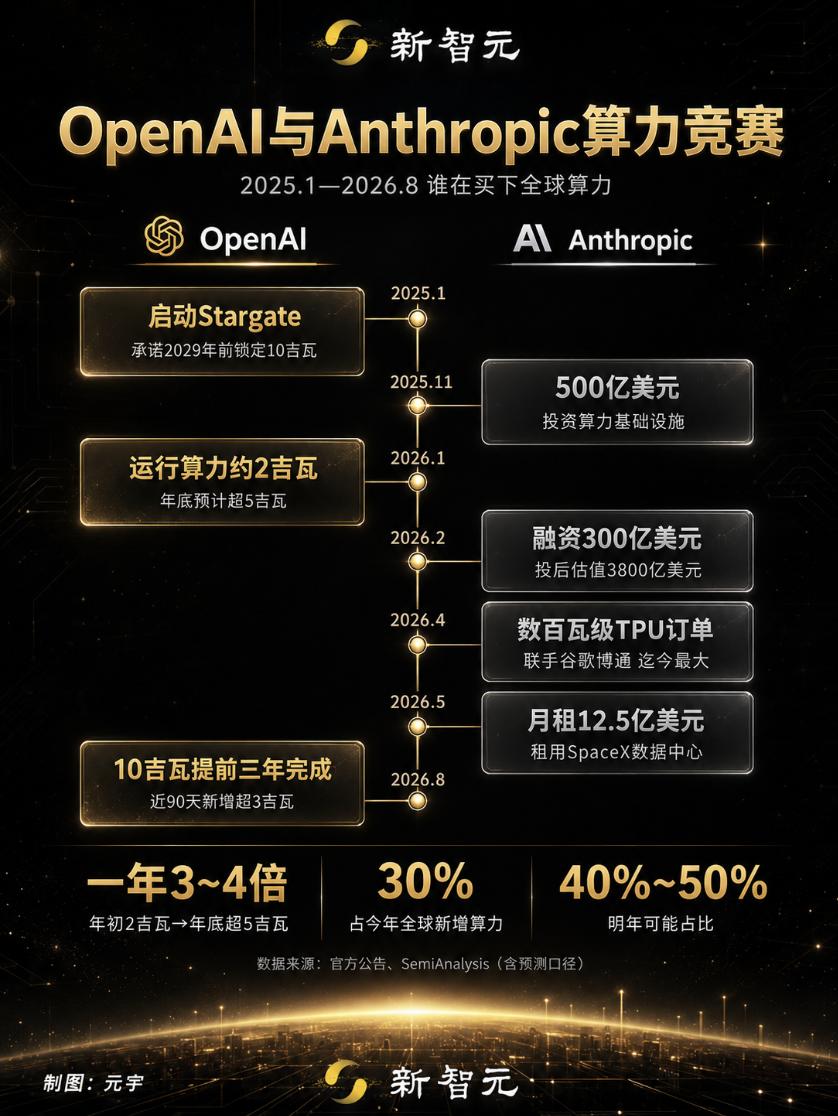
At the start of the year, OpenAI had roughly 2 gigawatts of computing power, while Anthropic had less than 2 gigawatts. By the end of this year, both companies will exceed 5 gigawatts.
The figure has tripled or quadrupled within a year, and the unit here is gigawatt.
One gigawatt is roughly the generating capacity of a large nuclear power plant: which means the two companies are consuming the output of three large nuclear power plants in a single year!
The world's newly built computing power this year is about 30 gigawatts, 50 gigawatts next year, and around 70 gigawatts in 2028. The 30% share taken by the two companies comes exactly from this 30 gigawatts of new computing power.
It is not just the total volume that is growing, there is also an easily overlooked multiplier hidden here: one watt of newly added computing power this year is far more capable than one watt installed two years ago:
Chips of the GB300, TPUv7, and Trainium3 generations deliver 3 to 5 times the performance per watt of the previous generation.
Therefore, when Dylan says the two companies will take up half of the world's new computing power by the end of 2027, that half share represents far higher value than the existing stock of computing power, and this gap will widen further year by year.
The superposition of these two multipliers leads exactly to Dylan's conclusion about "the majority of effective available computing power".
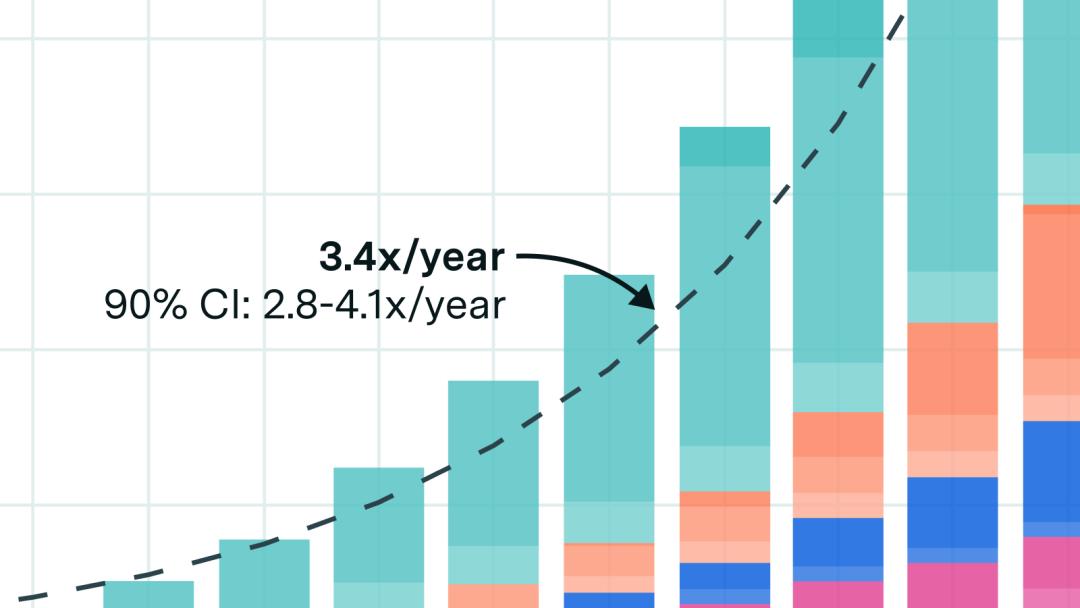
The total computing power of global AI chips doubles every 7 months. The performance of one watt of newly added computing power this year is far higher than that of one watt installed two years ago. (Source: Epoch AI)
However, this statistic counts the end users of computing power, not the ownership of computing power.
When someone calls Claude on Amazon Bedrock, that share of computing power is also counted under Anthropic's total.
Whoever Makes Money Faster Gets More Computing Power
Why are these two companies the ones that dominate this field?
The answer lies in a rarely mentioned indicator: revenue per megawatt.
Going back a year ago, the token business itself was still losing money.
When OpenAI ran GPT-4 on Hopper, every token it sold generated negative gross profit, and Anthropic was also burning through investors' capital.
The situation has now reversed.
Anthropic became profitable in the second quarter of this year, and OpenAI is reportedly set to turn profitable in the third quarter.
After models of the GPT-5.6, Opus 5, and Fable 5 generations were launched, the revenue per megawatt of both companies far exceeded the computing power cost line of 10 million to 15 million US dollars per megawatt.
Anthropic is the leader in this aspect, reaching a maximum of 50 million US dollars in revenue per megawatt.
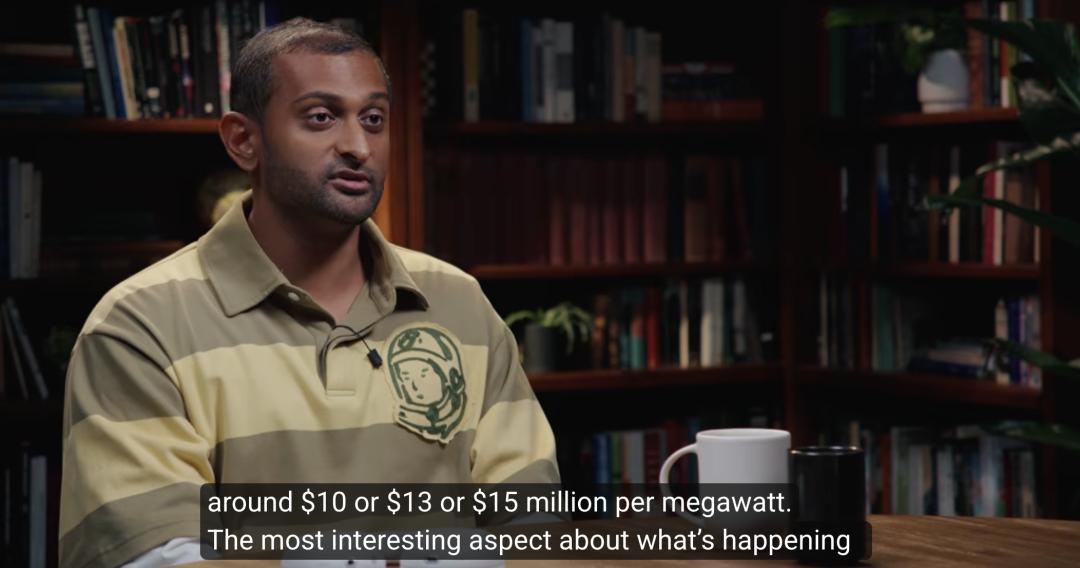
Dylan Patel gives the purchase price of computing power: 10 million to 15 million US dollars per megawatt.
This competition is about how much profit you can make per megawatt, not how many chips you have stockpiled.
Higher profits mean you can afford to pay higher prices; being able to pay higher prices means you can access more computing power, which allows you to train stronger models, and then generate even higher profits.
The 3-4x annual growth rate is formed exactly through this positive feedback loop.
In fact, it is not difficult to cover that cost line.
An ordinary person who buys a GB300 cabinet, downloads a set of open source weights and connects to OpenRouter can earn more than they pay out. As Dylan puts it: this is not difficult, and it is not rocket science.
Precisely because everyone can make a profit from this business, that cost line cannot be held, and the rent for computing power has started to rise to 25 million US dollars per megawatt, then 40 million US dollars per megawatt.
At present, only Anthropic and OpenAI among Silicon Valley tech giants can afford to pay this price.
Dylan predicts that by the end of 2027, their revenue per megawatt will rise to 70 million, even 80 million US dollars.
Cloud Vendors Build the Infrastructure, AI Labs Rent the Space
According to data from Epoch AI, about 71% of the ownership of global AI computing power is still held by the five major cloud vendors.
But the right to use this computing power is increasingly concentrating in the hands of the two AI labs.
Cloud vendors are landlords: they buy the land and build the data centers. OpenAI and Anthropic are like the two major tenants that lease most of these properties.
A third type of player has now also emerged: they build the facilities first, then look for tenants afterwards.
The common practice for most cloud vendors is to sign clients first, then use the contracts to borrow money from banks, and only start construction after the funds are in place.
Meta and SpaceX do not need to follow this process: they have strong capital reserves, so they can skip the steps of finding clients and raising financing and start construction directly, then pick the highest bidders after the facilities are completed.
Elon Musk even sells computing power at a price of 40 billion US dollars per gigawatt.
Dylan did the math for him on the podcast: one gigawatt of computing power is originally worth 15 billion US dollars, but he sold it for 40 billion US dollars, recouping all his capital within a single year.
Anthropic can earn more than 60 billion US dollars from this one gigawatt, so why shouldn't I sell it at a higher price?
SpaceX will also be a major source of new computing power next year, and most of the new facilities it builds will most likely be subleased to OpenAI and Anthropic.
According to WSJ reports, Anthropic is already leasing data center capacity from SpaceX at a price of 1.25 billion US dollars per month.
On the tenant side, their appetite for computing power is even larger than the landlords expected.
OpenAI launched the Stargate project last January, with the goal of locking in 10 gigawatts of computing power in the US by 2029. More than a year later, this target has been completed ahead of schedule, with more than 3 gigawatts of additional computing power added in the last 90 days alone.
Anthropic announced in April this year that it has partnered with Google and Broadcom to secure several gigawatts of next-generation TPUs, which will be launched gradually from 2027. The company states that this is its largest computing power order to date.
Furthermore, the two companies have also started to build their own AI infrastructure: OpenAI is developing self-designed chips, and Anthropic has entrusted Fluidstack to deploy its TPUs.
After being tenants for a long time, they also want to build a few buildings of their own.
What Are All the Purchased Computing Power Used For?
At present, the computing power allocation of these labs is roughly: 50% for research, 10% for development, and 40% for inference.
The largest share goes to research, not model training.
When Anthropic trained Mythos, the pre-training process used less than 200 megawatts of computing power at a single site, ran for about two months, and the subsequent reinforcement learning process used even less computing power.
With several gigawatts of computing power in hand, only 200 megawatts are actually used for "training one single model".
It is not that they are reluctant to use more, but that they simply cannot make use of all of it.
These computing power resources are scattered in data centers all over the world, the speed of data transmission cannot keep up with the speed of calculation, and forcing them to work together will only lead to mutual waiting. The same applies to reinforcement learning: more training volume does not equal better training results.
Therefore, the remaining large share of computing power is all consumed in testing new architectures, adjusting data ratios, and verifying various ideas.
Dylan also put forward a more counterintuitive judgment: the proportion of computing power used for inference will continue to decline.
One megawatt of computing power can currently generate 30 million to 40 million US dollars in revenue by selling tokens for inference, which is a very reasonable arrangement. But what if the value of that megawatt rises to 60 million or 70 million US dollars?
The board of directors will face two choices: continue to sell tokens, distribute the profits as dividends and carry out share repurchases to keep all shareholders happy; or take back all that computing power and invest it in R&D to develop AGI.
Dylan believes there is no suspense about what choice they will make.
From the perspective of these labs, the return on AGI is far greater than the small dividends they can get right now.
Signs of this trend have already appeared: the amount of new computing power added by Anthropic every month is still rising, but the year-on-year growth of its annualized revenue has flattened out. The newly purchased computing power is not converted into revenue, it is all invested in R&D.
But investors will only keep asking: one gigawatt of computing power could have generated hundreds of billions of dollars in revenue, why are you still allocating more resources to model training?
The contradiction arises exactly because both companies are moving towards going public.
The labs are betting on AGI, while investors are waiting for dividends, and the two sides' accounts do not align from the very beginning.
Who Will Pay the 11 Trillion Dollar Bill?
Global AI capital expenditure this year is slightly over 1 trillion US dollars, and will exceed 2 trillion US dollars in 2028.
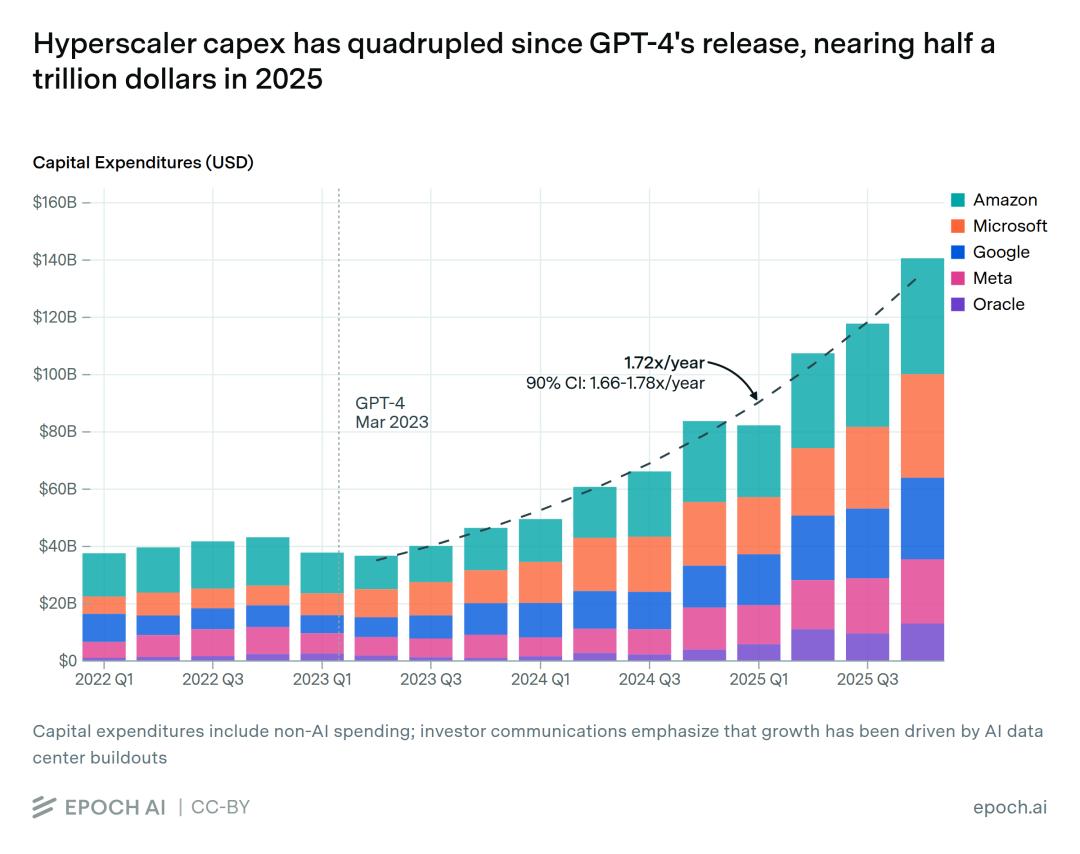
The total capital expenditure of the five major cloud vendors has grown by 72% annually on average, approaching 500 billion US dollars in 2025. If this trend continues, it will reach 770 billion US dollars in 2026. (Source: Epoch AI)
According to estimates from SemiAnalysis, the total cumulative AI capital expenditure from 2024 to 2029 will be about 11 trillion US dollars. Around 6 trillion of this can be paid with self-generated revenue, and the remaining 5 trillion can only be covered by borrowing.
When 5 trillion US dollars of debt is poured into the same credit market, the cost of capital will rise.
The interest rate on Meta's current debt is 5% to 6%. Dylan judges that Meta is willing to pay up to 8%, because the return on the computing power it builds is so high that paying an extra 2 or 3 percentage points of interest will not hurt its profits at all.
The problem is that all capital comes from the same pool.
AI companies are willing to borrow at high interest rates, which pushes up the financing cost for the entire market together.
Apart from the capital side, government regulation is also a factor that cannot be ignored.
New York is imposing restrictions on data centers, Texas has introduced a moratorium, and the governor of Ohio has even announced a suspension of tax exemptions for data centers.
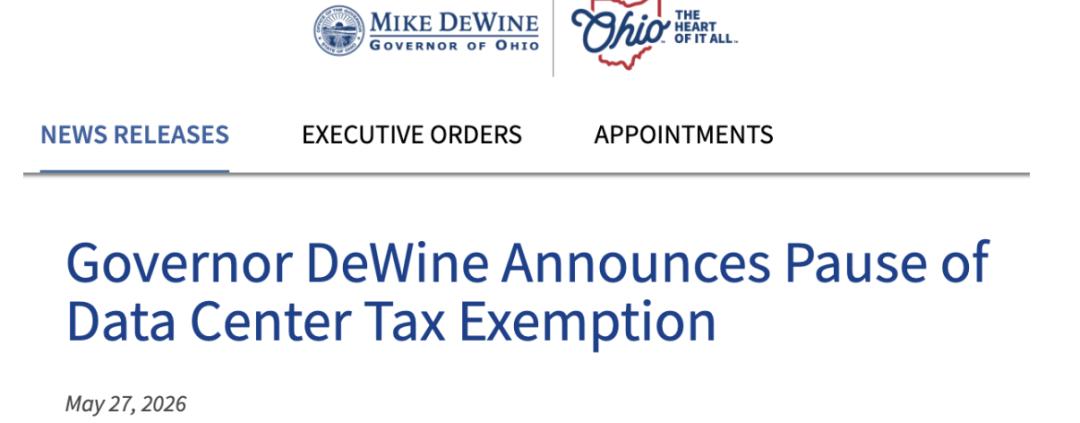
On May 27, 2026, Ohio Governor DeWine announced the suspension of tax exemptions for data centers.
An even stricter measure is to restrict the release