From work order receipt to ROI calculation, Anu Intelligence is betting on the commercialization of embodied intelligence.
On August 26 in Shanghai, at the SAP Robotics Industry Innovation Day event, four types of manufacturers gathered for the same discussion session.
At the benchmark customer roundtable, Xue Jianmin, Vice President of SAP, Lin Lili, Senior Architect of Industry Solutions at Intel China Edge Computing Division, Yang Ke, Vice President of Agibot Robotics China, and Wen Hongjie, Chairman and CEO of Anu Intelligence, discussed one topic — How Embodied Intelligence Can Truly Enter Factories.
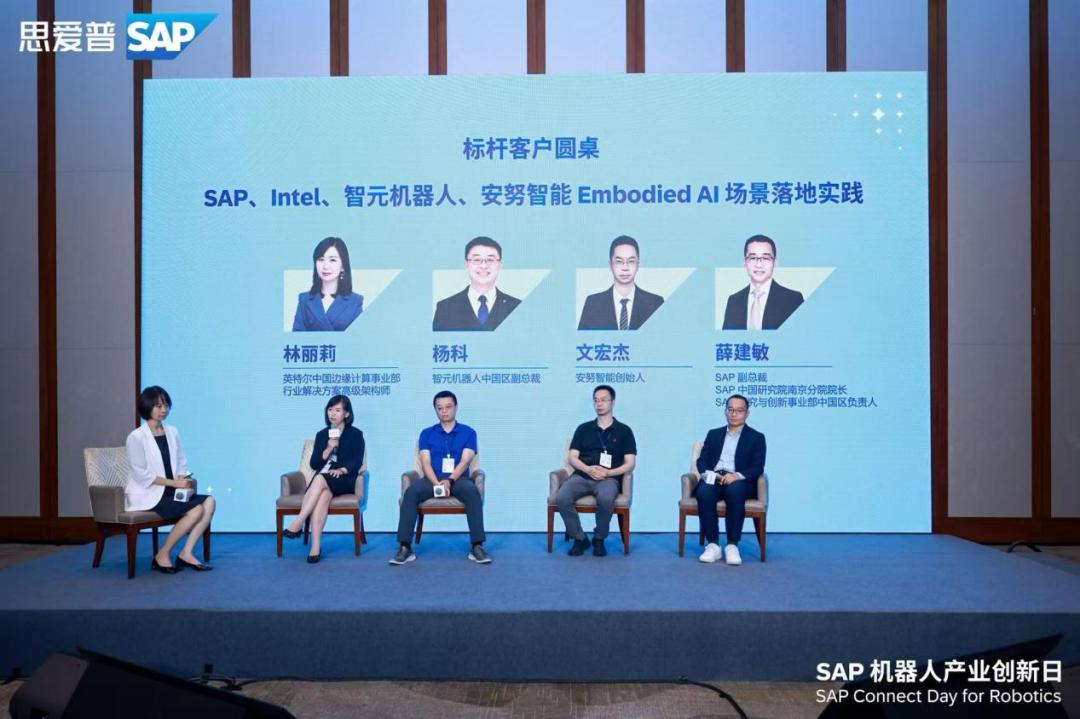
Benchmark Customer Roundtable at SAP Robotics Industry Innovation Day
The conversation soon shifted to the warehouse logistics scenario currently being verified at Intel's Chengdu factory. The SAP system already contains work orders, and knows what materials are needed at what time and where; the robots are capable of handling and executing tasks; Intel provides real industrial scenarios and edge computing infrastructure. However, in the past, tasks in business systems and execution on the robot side were relatively independent, and work orders could not be directly converted into executable actions for robots.
What this project aims to solve is exactly the execution link between the two, so that business tasks can be directly delivered to robots, completed by robots, and then the execution status and results are returned to the system.
This is quite different from the robot demos commonly seen in the industry in the past few years.
After robots are actually deployed to production lines, factories no longer only focus on model parameters and motion performance. More practical issues have come to the forefront, including stable operation capability, recovery ability after anomalies, faster deployment at subsequent workstations, and the ability to calculate clear return on investment in the end.
Robots Start "Taking Orders", Embodied Intelligence Connects to Production Systems
Warehouse logistics is not a new problem in the manufacturing industry. The change lies in the fact that robots have started to access enterprise business systems and are driven by work orders to perform tasks.
In this project, SAP is responsible for the enterprise business system, managing orders, inventory, warehousing and process permissions; Intel provides real industrial scenarios and edge computing infrastructure; Agibot provides the robot bodies; Anu Intelligence is in the middle link, converting business tasks in the enterprise system into processes that robots can execute.
Wen Hongjie refers to the layer where Anu Intelligence is located as "the deployment layer and scenario intelligence layer".
At the roundtable, he gave a more vivid description of Anu Intelligence: connecting various different robot bodies to the same production line, and then linking them to enterprise systems such as SAP.
"We do the dirty, tough and strenuous work, but we actually think this is the most valuable part of embodied intelligence."
△ Intel-SAP-Anu Intelligence Jointly Released the Integrated Solution for Embodied Intelligence Production Lines
Taking the warehouse task issued by SAP EWM as an example, Anu Intelligence is responsible for parsing work orders, understanding tasks, calling corresponding skills and scheduling robots, which then complete material selection, handling and delivery. The status, anomalies and results generated during the execution process are then returned to the SAP system.
As a result, work orders no longer stay only in the software system, but can drive robots to complete on-site tasks and re-enter the original business process.
At present, Anu Intelligence has completed the full connection of the link from SAP business tasks to robot execution and then to result return, and the warehouse scenario at Intel Chengdu is still in the verification stage. Wen Hongjie also emphasized that the successful operation of the technical link does not mean large-scale commercial use, and subsequent procedures including factory compliance, acceptance and multi-site replication are still required.
"Connecting to the system" is only the first step.
Wen Hongjie mentioned at the roundtable that the outside world tends to think that system interconnection is a simple matter, but "stable operation is something that requires a huge amount of engineering effort". For industrial sites, the more difficult part is to make this set of business processes run on the robot body for a long time and stably.
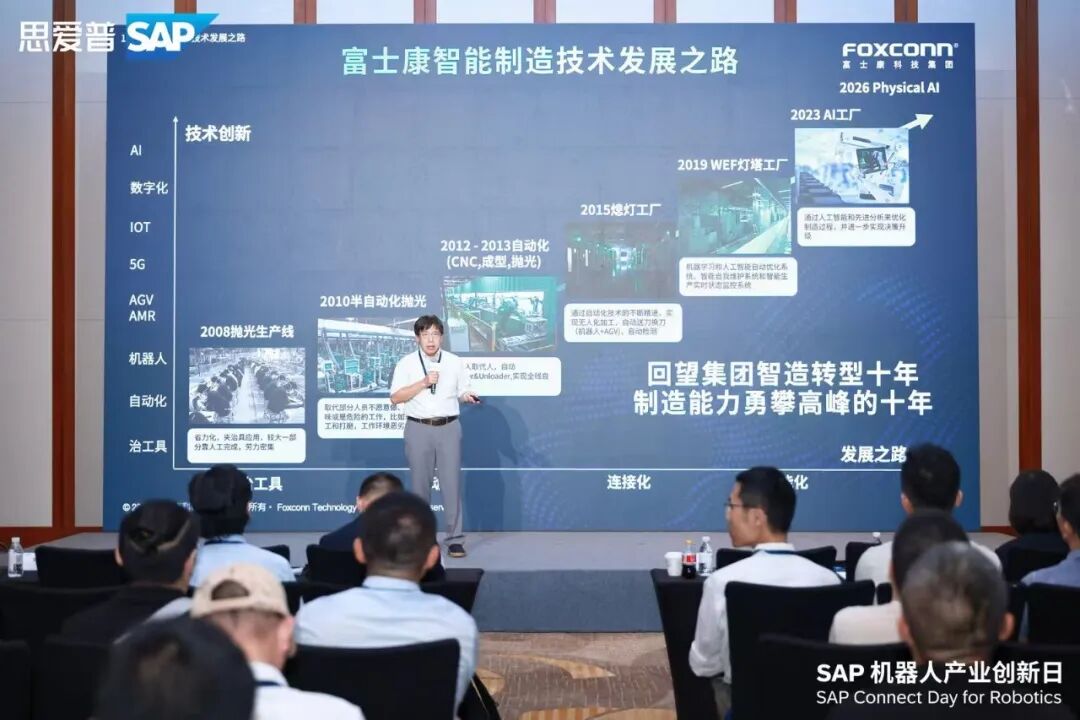
Dr. Wang Shuhua, Head of Robotics and Automation at Foxconn Group, shared Foxconn's thoughts on embodied intelligence in industrial scenarios
After Demos, Factories Begin to Focus on Stability and ROI
After the roundtable, Wen Hongjie put forward a judgment in an exclusive interview with 36Kr: "Demos show the upper limit of capability, while industrial customers care about the lower limit of capability."
That a robot completes a single grasping or handling action only proves that the capability exists. In a factory, whether it can still work normally after switching shifts, changing lighting or replacing materials, and how fast it can recover after an anomaly occurs, are often more important than how fast a single action can be done.
Wen Hongjie gave an example: even if one action is 10% faster, if it requires manual intervention many times a day, its commercial value may be lower than a slightly slower but more stable and easy-to-maintain solution.
A similar problem was encountered on site at Fulin Precision.
After the originally used gray material boxes were replaced with black ones, the reflected light was reduced, which affected vision and radar recognition, and the robot's grasping performance declined as a result. Temporary passing of workers, offset material positions, fixture wear and navigation errors may also affect continuous operation.
Many problems can hardly be fully anticipated in the laboratory, and can only be gradually exposed after long-term operation on real production lines.
Therefore, the Anu Intelligence team has been stationed at Fulin Precision's site for a long time. According to the company's disclosure, the current Mean Time Between Failures (MTBF) of the equipment has exceeded 300 hours.
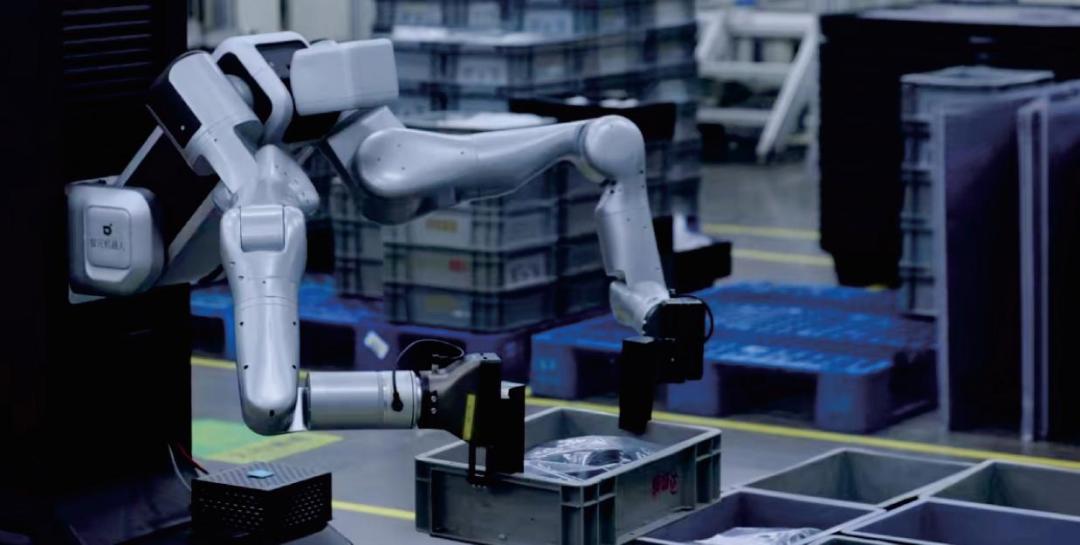
Normalized operation at Fulin Precision's Mianyang Smart Factory
Another change lies in the deployment cycle.
The first workstation of Fulin initially took about 4 months, and later the deployment on the same production line was shortened to about 1 week. According to Anu Intelligence's disclosure, some mature workstations of the same type have achieved 3-day-level deployment. Wen Hongjie also emphasized that currently the verified progress is the reduction from 4 months to 1 week; the 3-day deployment is mainly applicable to mature standard scenarios with clear product boundaries and adapted interfaces and robot bodies, while completely new non-standard tasks still need to be re-evaluated.
This is also the reason why Wen Hongjie repeatedly emphasizes "deployment".
In his definition, deployment is not equivalent to traditional integration. Integration and secondary development are only part of it. More importantly, the highly non-standard solution in one project is gradually turned into a reusable product, so that the same set of processes, models and skills can be migrated to new workstations and new robots.
There is another set of more direct operational data for the Fulin project.
Problems that require manual intervention have dropped from more than 10 times a day to about 2 to 3 times a week; the efficiency of a single robot in one shift is about 70% of that of a single human worker. After realizing two consecutive shifts through battery swapping, one robot is equivalent to about 1.4 industrial workers in total. Calculated based on Anu Intelligence's current cost model, the payback period of investment is about 3 years.
For industrial customers, that a robot completes a task only proves that the technology is usable. Whether it can reduce manual intervention, shorten the deployment cycle, and finally achieve a clear ROI, determines whether it can truly be put into production.
Prioritize Deployment Before Iterating Models, Anu Intelligence Bets on On-site Practice
Wen Hongjie used to be a veteran in the industry and investment fields.
He said in the interview that in the past, when evaluating a company, people usually focused on the technical route, team background, market space and capital efficiency first. After actually entering the factory, his understanding of embodied intelligence has changed.
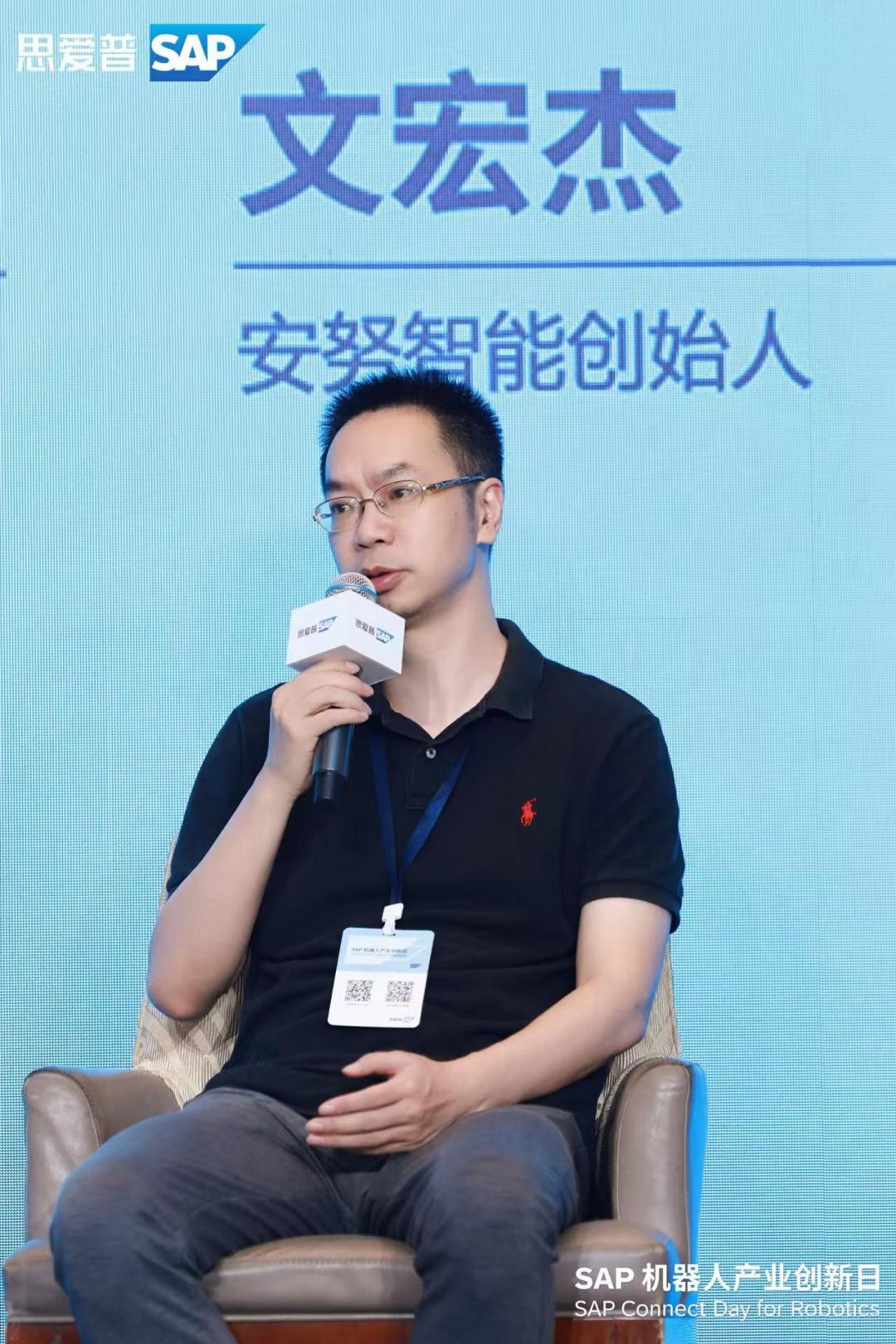
Wen Hongjie, Chairman and CEO of Anu Intelligence
On real production lines, mechanics, algorithms, control, processes and safety are interrelated. Excellent performance of a single technical indicator cannot guarantee the long-term operation of the entire system.
Anu Intelligence's development route has thus gradually become clear.
Over the past year, many embodied intelligence companies developed models first and then looked for landing scenarios. Anu Intelligence chose to enter factories first, solve the problems exposed during the deployment process, and then iterate the models with real data.
There is a saying inside the company: "Models can be open-source, but deployment experience cannot."
Anu Intelligence also regards factory projects as part of product R&D. The team collects real data after entering the scenarios, continuously records working conditions and failure cases after robots are put into use, and then iterates through post-training and reinforcement learning. If the solved problems are universal, they will be further precipitated into skills, models and deployment tools for use by the next workstation and the next type of robot.
Anu Intelligence internally refers to this working method as FDE (Forward Deployed Engineering). Engineers go to customer sites to solve problems, but after the project ends, what really needs to be retained is not on-site personnel, but reusable product capabilities.
Wen Hongjie called this logic the "data flywheel" at the roundtable.
After robots enter production lines, they continuously accumulate data during operation, and continue to upgrade through training. Only when this cycle truly runs, can robot capabilities continue to improve with actual use.
In Wen Hongjie's view, this is also an important difference between embodied intelligence and traditional industrial automation. In the past, collaborative robots and automation equipment relied more on preset rules, while embodied intelligence attempts to endow robots with the ability to continuously learn and adapt to the environment.
He said at the roundtable that he hopes embodied intelligence can eventually "enable every position in the factory to keep learning, upgrade autonomously, and become a master craftsman".
This path also determines Anu Intelligence's current resource investment direction.
Anu Intelligence does not manufacture robot bodies by itself, nor does it invest all its resources in one general foundational model. What the company hopes to precipitate in the long run is industrial data, process know-how, vertical models, skills, scheduling systems, and adaptation capabilities between different robot bodies.
Replicability Determines the Upper Limit of Commercialization
The more projects a company has, the more likely it is to encounter a practical problem: whether the delivery team must also expand synchronously.
If every time you enter a new factory or add a new workstation, you have to send engineers to the site again to collect data, write interfaces and debug the system, then as revenue grows, delivery costs will also increase synchronously.
Wen Hongjie judges whether a project has begun to be productized by checking whether changes have taken place in the second delivery.
Key indicators he pays attention to include whether the core process can be split into standard skills and interfaces, whether failure data can flow back automatically, and whether new customers only need a small amount of data fine-tuning and adaptation instead of redeveloping the entire system.
What Anu Intelligence hopes to finally form is a layer of software capability that can connect different enterprise systems and robot bodies. Just like the "Office system" or core APP in the robot world. According to Wen Hongjie's vision, the upper-layer enterprise business system remains stable, the middle layer is responsible by Anu Intelligence for understanding tasks, selecting models, combining skills and scheduling robots, and the bottom layer connects different robot bodies according to different scenarios. Even if the robot brand is replaced, the existing process knowledge, data and system interfaces do not need to be completely redeveloped.
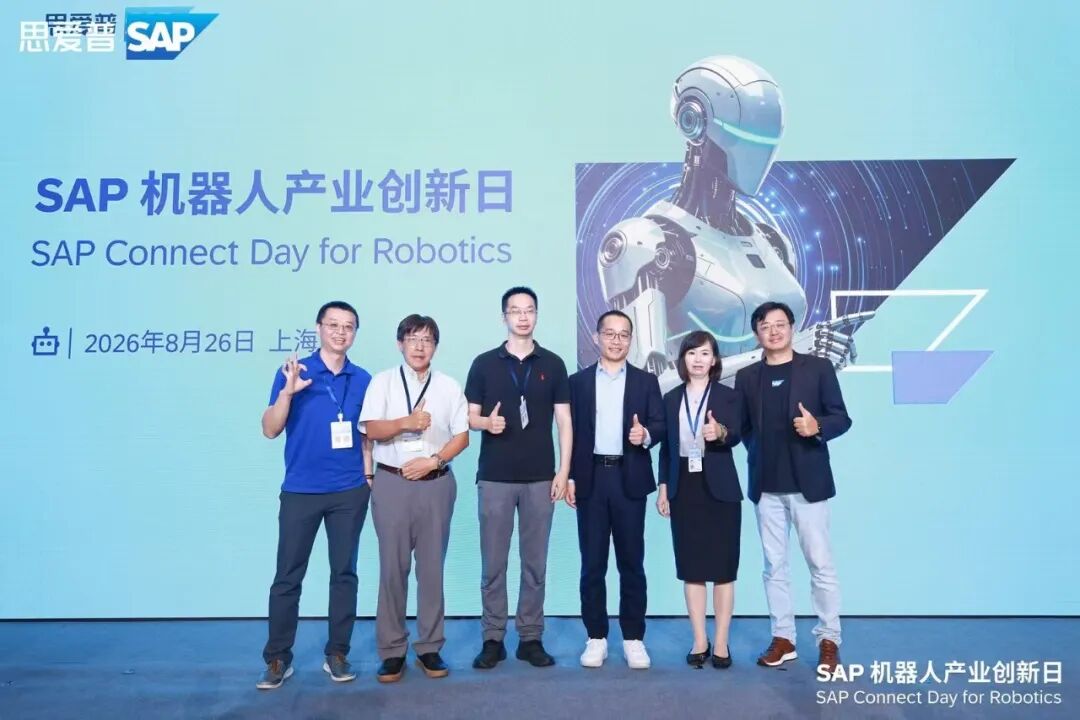
Group photo of guests at SAP Robotics Industry Innovation Day
The Intel Chengdu project is testing this product form. The upper layer connects to the SAP business system, the bottom layer accesses robot bodies, and the middle layer completes task understanding and execution scheduling by Anu Intelligence. At present, the relevant link has been connected, and the warehouse scenario is still in the verification stage.
According to Anu Intelligence, the company has now entered Intel's supplier system, and is the only domestic embodied intelligence enterprise included in this system, and was featured on Intel's global official website in May this year.
At the current stage, robot sales and project delivery are still important ways for Anu Intelligence to enter factories, obtain data and polish its products. But Wen Hongjie hopes that long-term revenue will come more from model licenses, scheduling software, skills and continuous upgrade services.
He set a very specific judgment criterion for large-scale development:
"When the software revenue growth brought by adding one more robot is faster than the growth of delivery manpower, the company has truly achieved large-scale operation."
Next week, Anu Intelligence will also release a batch of models and related product capabilities, covering simulation data, motion prediction, real-machine reinforcement learning, vertical models and end-to-end deployment systems.
All these products ultimately point to the same question: can the data and experience accumulated on site be precipitated into reusable capabilities to make the next deployment faster?
The first workstation proves that the robot is usable.
The second, the 100th workstation, determines whether embodied intelligence can truly achieve large-scale application.