Exclusive Interview with Lin Dahua, Chief Scientist of SenseTime: The emergence moment of multimodality will arrive within one or two years
By | LI Zhaofeng
Edited by | ZHANG Yuxin
"Back in the days when computers did not exist, we still had Einstein and Newton. We would never consider them less intelligent simply because they did not write code."
Recently, Lin Dahua, co-founder and chief scientist of SenseTime, used this line in an exclusive interview with 36Kr to describe the relationship between coding and the upper limit of intelligence, and explained why SenseTime still regards native multimodality as a long-term direction.
At present, Coding Agent has already achieved a closed commercial loop at an early stage. Public information shows that by the end of July, Anthropic's annualized revenue has exceeded 650 billion US dollars, about 7 times that at the end of 2025. When multimodality can deliver equally clear capabilities and commercial results is a question repeatedly raised in this conversation. But in the long run, Lin Dahua believes that "the scope of AI and AGI goes far beyond coding".
When talking about the position of multimodality in the pursuit of AGI, Liang Wenfeng, founder of DeepSeek, once mentioned that multimodality will be developed eventually, but it is not regarded as intelligence itself, but as a "component".
Almost at the same time, Jensen Huang, founder and CEO of NVIDIA, released Cosmos 3, a world foundation model for robotics and autonomous driving. The model integrates visual reasoning, environment simulation and action prediction into a single architecture. Jensen Huang said that Cosmos 3 "can understand and reason, can generate, can enter a simulation closed loop, and can even directly become the policy itself".
In Lin Dahua's view, this is not a matter of right or wrong. Each company faces different tasks, resources and long-term visions, so their choices are naturally different.
SenseTime started with computer vision. After entering the large model stage, it extended this technological accumulation to native multimodality and spatial intelligence, making multimodality a main line running through its model and product layout.
In SenseTime's model matrix, the SenseNova 6.8 series is a multimodal agent model responsible for long-range task planning, execution and multi-agent collaboration; the U series is a unified model for native understanding and generation, focusing on visual understanding, generation and editing, and extending to video and 3D. At the application layer, Seko is an AI short video creation agent that connects story, storyboard and video generation; Raccoon is an AI office agent for tasks such as office work and data analysis.
In April this year, SenseTime released and open-sourced the SenseNova U1 unified native understanding and generation model. Different from common vision-language models, U1 removes the independent visual encoder and VAE (Variational Autoencoder), and jointly processes language, visual semantics and pixel generation in a set of autoregressive architecture.
Nearly four months later, SenseTime released U1.5 Lite, which extends this architecture from understanding and generation to continuous editing, while enhancing high-resolution generation and complex instruction control.
In SenseTime's latest 2026 interim results, the company's revenue in the first half of the year reached 2.91 billion yuan, a year-on-year increase of 23.4%; generative AI revenue was 2.33 billion yuan, accounting for nearly 80% of the total.
Driven by the growth of AI business, SenseTime achieved profitability under the International Financial Reporting Standards for the first time, leaving more room for long-term technical investment in the multimodal field.

The following is the full transcript of the interview:
01
The core is not coding, but long-range thinking
36Kr: Liang Wenfeng regards multimodality as a "component" similar to search, and does not think it is the main line to raise the upper limit of intelligence. However, you judge that after full integration of multimodality, independent language models will no longer be necessary. Where does the difference lie?
Lin Dahua: I actually admire DeepSeek very much. Every company must have its own main direction. DeepSeek hopes to bring its language and coding capabilities to the forefront of the industry, while making the model architecture as efficient as possible. From its position, this choice is very reasonable. When it needs to process images, it can also access multimodal components, so at least the product functions are complete.
The tasks SenseTime faces are different. Office, medical, retail, robotics and world models all cannot lack visual signals. We believed very early that the joint modeling of vision and language is the foundation for artificial intelligence to enter real industries and the physical world.
SenseTime also does coding, and we regard programming capability as an important basic capability of the model; but we will not take complex software engineering as our only main direction.
Looking further down, the key lies in how to understand the upper limit of intelligence. Strong coding capability is the result of improved intelligence level, but the core essence of intelligence is not the work form of coding, but to integrate complex information for long-range thinking, deduction, execution and correction.
36Kr: For long-range intelligence to enter the real world, is native multimodality a necessary condition?
Lin Dahua: If the model only writes code, multimodality may not be a necessary condition. Once the task moves from coding to a wider range of industries and the real world, many scenarios cannot do without it.
Coding is currently the carrier with the most mature data conditions that embodies long-range thinking capabilities. There is a large amount of process data on GitHub, code can run, test cases can provide definite feedback, and there is a mature software engineering market behind it, so it is the first to complete the closed loop of training and commercialization.
But artificial intelligence will not stop at coding. Even for front-end development, after the model finishes writing the code, it has to render the page to see if it looks good and has no obvious errors, which also requires visual capabilities.
36Kr: When we communicated with some researchers working on MLLM (Multimodal Large Language Model) and native multimodality, they mentioned that adding visual data will significantly increase the difficulty of pre-training and post-training, and improper ratio control may even lead to degradation of language, mathematics and reasoning capabilities. What do you think of the training difficulty and cost of native multimodal models?
Lin Dahua: If you just connect a visual encoder to the language model, the extra computation at the inference end is actually negligible compared to the language backbone with hundreds of billions or even 1 trillion parameters. The real difficulty lies in training.
The first is data ratio. When the model adds visual capabilities, corresponding data must be added, while avoiding the degradation of original language, mathematics and reasoning capabilities. This is what I call the Alignment Tax. It is not just adjusting the ratio from 1:9 to 2:8, but also requires a large number of controlled experiments; every time the model is upgraded, the ratio may be readjusted.
The second is reinforcement learning. After introducing new modalities, training objectives and technical solutions will become more complex, and building feedback signals for vision-related tasks itself remains an open problem. The most expensive part is often not the final round of large-scale training, but the time spent exploring methods in the early stage. For model companies, the problem may not be that they cannot afford the cost, but that one extra round of experiment will make the model one month slower than competitors.
This is also why we first iterate with a lightweight model of 8B parameters. The path of unifying understanding and generation has not yet fully converged, so it is more efficient to first stabilize the architecture, data ratio and training scheme before scaling up.
Caption: Image generated by U1 Pro
02
Image generation is the first unlocked capability, not the end point
36Kr: U1 and U1.5 are currently mainly used for image generation. For users, what experiences does this unified architecture that does not rely on traditional visual encoders bring that dedicated models cannot achieve?
Lin Dahua: For users, the most direct change is that the model first understands the content, and then decides how to generate. Faced with several pieces of complex information, it needs to judge which content is important, and then arrange the structure, layout and visual expression. Information graphs exactly require the connection of understanding, reasoning and generation, so we started with this scenario.
The U series has a longer-term goal, which is spatial intelligence and physical intelligence. We also considered developing spatial intelligence and image generation at the same time, but every time the model adds a new capability, the training complexity will increase significantly. So we decided to put aside the more complex spatial intelligence for the time being, let U1 get through the path of unifying understanding and generation, and build technical cognition on how to integrate language and visual elements in a single representation space.
When doing long-term technology research, you cannot work in seclusion for three years without delivering any phased results. SenseTime is a listed company, and it needs to continuously deliver results that are perceptible to users and valuable to the industry. Image generation is the first capability unlocked on this path, but it is not the end point.
36Kr: U1.5 focuses on improving text generation, aesthetics and continuous editing. How does it change the old image generation process of repeatedly "drawing cards"?
Lin Dahua: After U1 was launched, we found in actual use that there is still room for improvement in text generation and local details. From April to June, we iterated the information graph version continuously to gradually correct the text. Later, we found that even if all the text is correct, the image may still look like a PPT made by a student without a sense of design. So we invited real designers to participate to make up for the lesson of aesthetics. Aesthetics and logical ability are two different things, and coding and sense of beauty are also two different things. No matter how powerful the model is, it cannot automatically generate a sense of beauty.
Accurate text and nice-looking images only solve the problem of single generation quality. Real design does not end after one generation, and the complete composition and modification requirements may contain one or two thousand words. The model must not only understand these constraints, but also only modify the specified area and leave other parts as unchanged as possible.
The past one-time generation is more like "drawing cards": if you generate five images continuously, each of them may have an error in a different place, and none of them can be used. Continuous editing allows users to keep the parts that are already correct, and modify only the parts that have problems.
Continuous editing is a basic capability. With this as the hub, we can connect understanding requirements, generated content and repeated modification into a closed loop, which is what we call Agentic Generation. The model iterates continuously around the same work until it can be delivered.
36Kr: Yao Shunyu from Tencent once proposed that users are willing to pay for the most powerful model; when judging cost performance, enterprises also prioritize performance, and sometimes a more expensive model can save money because it gets things right at the first attempt. U1.5 Lite emphasizes cost performance, while U1 Pro pursues the upper limit of capabilities. How does SenseTime understand these two types of demands?
Lin Dahua: The model must first reach a level that users can actually use, then the price is worth discussing. U1.5 Lite is an open-source model with 8B parameters, which focuses more on efficiency and cost performance, and is suitable for a large number of daily tasks. U1 Pro pursues the upper limit of capabilities, and its cost will be much higher, but the goal is to deliver professional-level effects.
This is a bit like a lightweight camera and a professional DSLR. Some people are willing to pay a higher price for top-level effects, while others care more about efficiency. The Lite version may have a higher probability of minor flaws, but it is easy to modify without having to re-draw cards. The two products correspond to different demands.
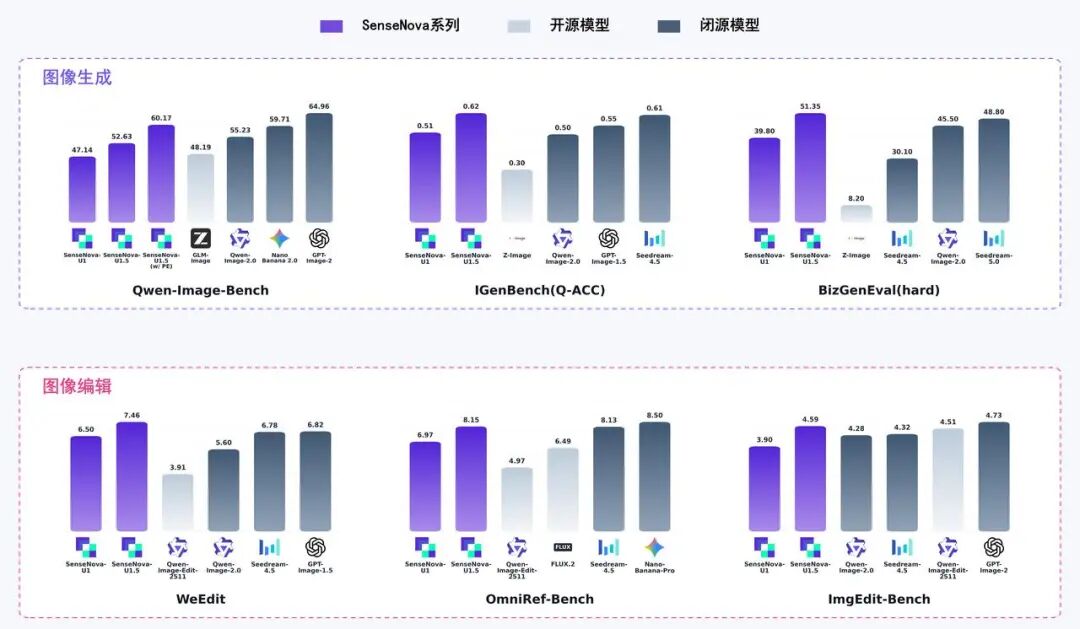
Performance of SenseTime SenseNova U1.5 Lite model in multiple visual tasks
36Kr: Enterprises can either use a general large model to handle all tasks, or let agents schedule multiple professional models. Which way is more economical in the real workflow?
Lin Dahua: The model must first have complete basic capabilities, and then develop expertise in specific fields. There is an impossible triangle here: breadth of capabilities, professional depth and cost. A super model that is both broad and deep can certainly be built, but it will definitely be very large and expensive.
Enterprises will not hire a "superman" for every position either. The realistic approach is to let models of different specialties form a team, and of course each model in this team still has sound basic intelligence.
For SenseTime, SenseNova 6.8 (multimodal agent model) is more like a manager, responsible for long-range tasks and collaboration of multiple professional agents, and this agent also needs to have "eyes" to understand images and decide the next action; the U series is more like a professional in the visual field, making fine visual perception, controllable generation and spatial intelligence reach a very high level. The two have their own divisions of labor and jointly complete tasks.
36Kr: SenseTime's AI content creation platform Seko can complete video creation, and can also access dedicated models such as Seedance. Compared with a single video generation model, what problems does Seko aim to solve?
Lin Dahua: What Seko wants to deliver is a complete video creation process, but not all links need to be completed by SenseTime's own models. The final video rendering can call dedicated models such as Seedance; the creation and iteration closed loop that covers how the story unfolds, how the storyboard is generated, and how to adjust after viewing the effect, this creation process is what truly reflects the creator's intelligence level, and this is what we focus on mastering.
Video quality largely depends on high-quality data and resource input. SenseTime pays more attention to enabling the model to understand the creation intention, judge where adjustments are needed, and then connect understanding, generation and modification. This is also where Seko differs from dedicated video generation models.
03
Spatial intelligence has not yet ushered in its GPT moment
36Kr: Image generation, video generation, 3D and spatial intelligence all require continuous investment. When resources are limited, what criteria does SenseTime use to decide which capability to focus on?
Lin Dahua: What we really focus on are two relationships: whether language intelligence can affect visual imagination and generation; and whether visual generation and imagination can in turn affect reasoning.
Therefore, we focus our investment on things that can improve our cognition of the above two issues.
Image generation, video and 3D seem to be different directions, but at the bottom they are all dealing with these two relationships. So we will not push every indicator to the extreme. For example, for video, we will not take cinematic quality as our main competitive point; portrait generation will continue to be carried out to ensure generation quality, but it will not become the core direction.
When doing generation, we choose information graphs as the key scenario, mainly because it requires real intelligence to judge how to effectively organize and convey information in a limited picture; when doing office work, we also pay special attention to data analysis and prediction, which is a strong test of intelligence level and can drive the improvement of the upper limit of intelligence.
When everyone is competing in coding, we can do things at our own pace. If everyone turns to develop spatial intelligence, our pressure may be a little higher.
36Kr: A year ago, some practitioners compared the world model to the "GPT-