XPENG Robotics' first round of financing exceeds 900 million US dollars: Sexiness and danger coexist
On August 24, 2026, He Xiaopeng posted an update on WeChat Moments, announcing that Xpeng's robotics business has secured financing of over 900 million US dollars. This figure has refreshed the record for the largest single-round private equity financing of embodied intelligence projects in China. Apart from words of gratitude, the post also released a future declaration for Xpeng IRON humanoid robots.
The capital market has delivered a staggering and implicitly unsettling figure: the post-money valuation exceeds 6.3 billion US dollars, which accounts for 57% of Xpeng Group's current market capitalization on the Hong Kong Stock Exchange. A humanoid robot company that recorded nearly zero revenue last year and has not yet launched mass production now holds a valuation close to that of its parent group, which sells nearly 400,000 new energy vehicles per year and posted 19.7 billion yuan in revenue in the second quarter of 2026.
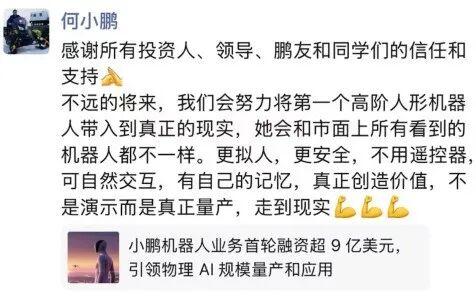
This is far from an ordinary financing news. It is a complex story revolving around "belief" and "cash flow", "shared technological roots" and "commercial gaps", "capital frenzy" and "the critical life-or-death line for mass production". When the robotics business is split off from the parent group and tagged with a standalone valuation of 6.3 billion US dollars, what exactly is Xpeng betting on?
900 Million USD and 6.3 Billion USD: How Is the Valuation Determined?
Let's first unpack the core framework of this financing deal.
According to Xpeng Group's official announcement, this round of financing for Pengxing Intelligence is led by IDG with an investment of roughly 300 million US dollars. Gaorong Ventures, Tencent and Alibaba each invested around 100 million US dollars, Xpeng Group itself participated in the follow-on investment with about 200 million US dollars, and He Xiaopeng and the senior management team subscribed to approximately 100 million US dollars. After the financing is completed, Xpeng Group will still hold about 81.97% of the equity in Pengxing Intelligence, maintaining absolute controlling stake and consolidated accounting status.
From the perspective of capital operation, this is a textbook-level transaction: Xpeng Group only transferred less than 18% of its equity in exchange for about 60 billion yuan in cash reserves, while retaining absolute control over its robotics business. Among external investors, there are top-tier financial capital players such as IDG and Gaorong, as well as strategic shareholders like Tencent and Alibaba — they are not only long-time partners of Xpeng Motors, but also "infrastructure providers" for China's internet industry.
However, the problem is that this 6.3-billion-US-dollar valuation has no anchoring point at all in traditional financial models.
Let's make a stark comparison. UBTECH, the first listed humanoid robot company on the Hong Kong Stock Exchange, recorded 2.001 billion yuan in revenue in 2025, delivered hundreds of robots, and currently has a market capitalization of about 51 billion yuan with a price-to-sales ratio of roughly 25x. In contrast, Pengxing Intelligence, which has almost no revenue and has not yet achieved mass production, is valued at as high as 43 billion yuan, equivalent to 84% of UBTECH's market capitalization. Referring to Figure AI, the American humanoid robot company backed by OpenAI and Microsoft, its valuation surged from 2.6 billion US dollars in February 2024 to 39 billion US dollars in September 2025, marking a 15x increase with revenue also close to zero.
Essentially, this kind of valuation is not pricing the company itself, but pricing the scarcity of "successful mass production of humanoid robots". There are only a handful of companies in the market that can tell this story and have a complete vehicle supply chain to back it up. With abundant capital chasing too few eligible targets, the valuation naturally goes up.
This means that Pengxing's 6.3-billion-US-dollar valuation is neither calculated via the DCF model nor derived from the price-to-sales ratio. It is estimated through "option pricing". The capital market is not buying the present of a company, but a call option for "mass production of humanoid robots". The strike price is the delivery of thousands of units in 2027, the expiration date is the trillion-dollar market of embodied intelligence, and the volatility refers to all technological uncertainties and competitive landscape restructuring in the industry's development process from 0 to 1.
Xpeng chose to complete the financing half a year before the scheduled mass production at the end of 2026, which is the optimal financial window: at this point, the growth story is the most appealing, and the valuation has the greatest elasticity. Once the mass production is delayed or delivery falls short of expectations, the valuation will face a very sharp correction.
Why Xpeng?
To understand why Xpeng can secure this 900-million-US-dollar financing, we cannot only focus on Xpeng itself, but must first clarify the capital landscape of China's embodied intelligence track in 2026.
According to industry statistics, in the first half of 2026, the total financing amount of China's domestic embodied intelligence track exceeded 460 billion yuan (some statistical calibers show the figure as high as 935 billion yuan), with industrial capital and state-owned capital together accounting for more than 40% of the total. For large financing deals of over 1 billion yuan, industrial capital is the absolute main player. More critically, among the 19 newly emerged robotics unicorns, at least 17 have received investment from industrial parties.
This is no coincidence. Industrial capital is undergoing a collective awakening, shifting its focus from "financial investment" to "strategic positioning".
Different from pure financial capital, the investment logic of industrial capital is extremely pragmatic: we invest in you not because of the trillion-dollar market described in your PPT, but because we ourselves are part of that market. What they bring is not just money, but "scenarios, orders and supply chains" — the three elements that are more scarce than cash for the humanoid robot industry, which is still in the "from 0 to 1" development stage.
The most typical example is CATL. After it invested in Qianxun Intelligence, Qianxun's robots were directly deployed in CATL's battery production lines, operating flawlessly for nearly a thousand battery units. This production line itself is a scenario verified by CATL with real money. Even local governments have followed this logic: they provide funding, require enterprises to build local factories, and open up local factories as the first batch of clients.
A common phrase frequently mentioned by industrial capital now is that they will not invest in robotics companies that have no applicable scenarios. Pure financial investors can afford to wait, but industrial capital cannot. Factories are currently facing labor shortages, and orders will be issued immediately once robots can work on production lines. This is not investment, but prepayment for procurement.
This model of "investment equals order" is reshaping the financing rules of the robotics industry. For startups, obtaining capital from industrial players means getting the first real commercial contract; for industrial capital, investing in robotics is not charity, but a way to find "next-generation labor" for their own factories, stores and parks.
However, the choices of industrial capital are not uniform. When it comes to the robotics track, they have formed three clear development paths.
Xpeng's entry into the robotics sector is not an act of bravery, but a more suitable choice.
For car companies, venturing into robotics is essentially a self-assessment test of their "capability boundaries".
The first path is full-stack self-development, represented by Tesla, Xpeng and Xiaomi. Their logic is straightforward: autonomous driving is the "brain" of robots, the automotive supply chain is the "limbs" of robots, and their own factories are the "testing grounds" for robots. Shared technological roots, reusable supply chains, and internally digestible scenarios are the confidence that allows them to get involved in this field in person.
He Xiaopeng put it very directly: "If end-to-end intelligent driving cannot be done well, humanoid robots will definitely not work. A car only has four degrees of freedom. If you can't even handle four degrees of freedom, isn't it ridiculous to claim that you can handle more than 30 degrees of freedom?" Xpeng's Turing AI chip, VLA large model, and end-to-end intelligent driving system can empower both automobiles and robots at the same time. This synergy of "one technology base, two physical carriers" cannot be provided by pure financial investors, and it is also the core reason why Xpeng chose to keep its robotics business within the group system, rather than handing it over entirely to an external entrepreneurial team.
Secondly, the parallel path of self-development and investment represents a balance of exploration and prudence, represented by BYD and GAC. They have extremely strong manufacturing capabilities, but lack advantages in AI algorithms. BYD's self-developed project codenamed "Yao-Shun-Yu" already has 150 prototype robots in training in its own factories, and plans to deploy 20,000 units internally in 2026. At the same time, it has invested in Agibot and Pansini Perception Technology, and cooperated with UBTECH on joint driver development. BYD's logic is: we are good at the "limbs" part, but the "brain" part needs to be supplemented by external resources. Using investment to fill technological gaps and relying on self-development to guarantee core manufacturing capabilities is a more pragmatic balance.
The last path is pure investment and cooperation, represented by SAIC Motor, Geely, NIO and CATL. They clearly recognize that the complete humanoid robot machine track requires long-term high-intensity investment, and the success rate is full of uncertainty. Instead of burning money on independent R&D, it is better to bind the best startups with capital, and empower them with their own scenarios and supply chains. SAIC has invested in 4 unicorns within half a year, covering brain systems, dexterous hands and complete machines, which is the strategy of "exchanging capital for ecological position".
There is no distinction between superior and inferior among the three paths, only differences in capability matching. Xpeng chose full-stack self-development not because it is more "brave" than other industrial capital players, but because it is more "suitable": intelligent driving is the brain of robots, the automotive supply chain is the limbs of robots, and its own factories are the testing grounds for robots. This capability of "homologous reuse" is the most scarce among all industrial capital players.
However, getting involved in this field in person is not without risks.
Midea Group acquired 94.55% of KUKA Robotics for 29.2 billion yuan in 2017, which serves as a cautionary tale. After the acquisition, KUKA's performance growth was sluggish, and Midea lacked technical accumulation and management experience in the industrial robotics sector, leading to "passive operation", extremely difficult integration, and more than 25 billion yuan in goodwill impairment.
That being said, for car companies developing robots, the supply chain and manufacturing capabilities do have reusability, but the core difficulty of humanoid robots does not lie in hardware, but in general operation capabilities. Whether the intelligent driving algorithm of car companies can be migrated to the full-body control of bipedal robots has not been fully verified by any enterprise. Xpeng is one of the closest players to achieving this, but there is still a huge gap between "being close" and "fully realizing" that needs to be bridged by mass production and delivery.
This also reflects the precondition for industrial capital to get involved in the robotics sector: there must be "homology" between its own capabilities and the robotics business. Home appliance companies developing industrial robots is a cross-border attempt, while car companies developing robots have natural advantages.
Financial Breakdown: The "Group Ledger" Behind the 6.3-Billion-US-Dollar Valuation
Shift the perspective from the industrial narrative to financial statements, and see what this financing means for Xpeng Group.
First of all, the "inversion" phenomenon between valuation and market capitalization is worth vigilance. The valuation of Xpeng's robotics subsidiary exceeds 6.3 billion US dollars, accounting for about 57% of the group's current Hong Kong market capitalization. The mathematical comparison is straightforward: this means that the capital market believes the option value of Xpeng's robotics story has surpassed the present value of its core automotive business.
This inversion, on the one hand, reflects the capital market's enthusiasm for embodied intelligence, and on the other hand means that Xpeng Group's stock price is deeply tied to the expectations of its robotics business. If the mass production of robots falls short of expectations, the parent company's stock price will face a "double kill": the weak performance of the automotive business will not be improved, and the new robotics growth story will also collapse.
Secondly, the consolidated accounting structure determines the reality of "shared losses". Xpeng's management has clearly stated that the robotics business is expected to be fully incorporated into Xpeng's financial statements. This means that all revenues, costs, expenses and losses of the robotics business will be merged into the group's statements, and the 18.03% equity held by external investors will be recorded as "minority shareholders' equity".
Let's make a hypothetical calculation: if the robotics business loses 1 billion yuan in 2026 (referring to the 369 million yuan loss in 2025, the loss will most likely expand as mass production investment increases), the group will need to bear 820 million yuan of that loss. Raising 900 million US dollars does not allow the robotics business to "bear losses independently", and Xpeng Group still has to take more than 80% of the losses. However, the cash from external investors has greatly supplemented the operating funds of the robotics business, reducing the pressure of direct capital injection from the group.
From a cash flow perspective, the "stress reduction effect" of this financing is very obvious. Xpeng Group's cash reserves decreased from 42.09 billion yuan to 40.48 billion yuan in Q2, with a net decrease of 1.61 billion yuan in a single quarter. If the robotics business continues to be fully funded by the group, the cash flow pressure will increase significantly at the current cash burn rate. This financing effectively externalizes part of the "cash consumption" of the robotics business, allowing the group to concentrate more resources on its core automotive business.
Thirdly, the choice of financing timing exposes the group's financial anxiety.
Several dangerous signals in Xpeng's Q2 financial report cannot be ignored: automobile delivery volume only increased by 0.1% year on year, automotive gross margin decreased by 2.2 percentage points year on year to 12.1%, and net loss expanded by 179.9% year on year to 1.34 billion yuan. More subtly, the group's total gross margin of 20.7% is almost entirely supported by "service revenue" — service and other revenue reached 2.7 billion yuan, with a gross margin as high as 75.1%, contributing 49.6% of the total gross profit.
The core automotive business is trapped in the dilemma of "flat sales volume, falling prices and shrinking gross profit". Launching the robotics financing at this time is essentially telling a new growth story to the capital market to hedge against the weakness of the automotive business. The market sees clearly: what Xpeng lacks most now is not a technological story, but the profit inflection point of its automotive business. Robotics financing can boost the stock price in the short term, but if the automotive gross margin continues to decline in Q3 and Q4, relying solely on the robotics option will not be enough to support the group's valuation.
Xpeng chose to complete the financing half a year before mass production because at the "pre-mass production" window, the valuation can still be supported by "imagination space"; once entering the "post-mass production" stage, it has to be validated by actual delivery data, and there will be far more hard constraints on valuation.
Finally, from the perspective of investment return, this transaction is "low risk and high leverage" for Xpeng Group.
Xpeng Group invested 200 million US dollars in the follow-on financing, in exchange for 81.97% control over assets valued at 6.3 billion US dollars. If the robotics business is independently listed in the future, the value of the equity held by the group will far exceed the current investment. Even if the robotics business fails, the group will only lose the 200 million US dollars in follow-on investment, while the 700 million US dollars from external investors has already sustained the operation of the robotics business. This is a typical financial operation of "using external capital to leverage high-value assets".
The Life-or-Death Line for Mass Production: The Stress Test for the 6.3-Billion-US-Dollar Valuation
All financial analyses, industrial logics and capital stories will eventually return to the most down-to-earth business question: can Xpeng's robots achieve mass production by the end of 2026 and start delivery in 2027?
This is the absolute life-or-death line for the 6