Meta has spent an entire year proving that Agents cannot replace employees: the number of incidents increased by 40%, and engineers spent 70% more time putting out operational emergencies.
The organizational transformation plan codenamed "Project OT" once envisioned using AI Agents to take over the daily work of thousands of people and cut the size of some teams by 60%. As a result, the volume of code exploded, AI frequently caused "large-scale destructive operations", safety incidents increased by 40%, and the remaining employees spent 70% more time putting out fires. Eventually, Mark Zuckerberg urgently called off the second round of layoffs. However, the entire company is now facing a mess three times more chaotic than before.
Meta originally wanted to replace employees with AI Agents
Earlier this year, Mark Zuckerberg gathered core executives at his private estate in Hawaii for the annual closed-door leadership meeting, where he put forward a radical idea: to completely redesign the way work is done inside Meta. That is to replace tens of thousands of employees with AI Agents, leaving only a small group of people to supervise the AI at work.
This idea later evolved into what the company internally called "Project OT", short for "Organization Transformation".
According to an internal planning document reviewed by Reuters, an "AI-native" company is defined as a form of organization where "AI-adapted tools and Agents can interact with each other, workflows are automated, and new products are built around AI from the very beginning". Per the definition in this document, "AI-native" also means selling AI Agents to third parties — Meta has already started to advance this business in June this year.
Project OT originated from Meta's attempt to speed up product development. Last year, product executive Ime Archibong formed five small technical teams to launch a pilot program. Each team consisted of two or three engineers and one designer, who worked with the help of AI tools. Instead of following a six-month planning cycle, they completed product prototypes in four-week sprint cycles.
Archibong wrote in an internal post: "In basketball, fast breaks create more and better shooting opportunities. We want AI tools to deliver the same effect: exploring more ideas at lower cost and with higher completion quality." Meta also published an internal article titled *AI Native Playbook*, introducing ideas such as cutting middle management positions and using "Agent-assisted analysis" to prioritize daily tasks.
At that time, executives were very optimistic about "Project OT". They envisioned that with the help of AI technology, one outstanding employee could do work that previously required a much larger team.
In the most radical scenario, some teams would cut 60% of their staff. Meta considered using AI to complete "a large number of daily tasks currently undertaken by thousands of employees", which would then be supervised by a very small human team. It is reported that a human resources executive once said that if all these plans were implemented, Meta's total number of employees would decrease by about 25% or even more.
According to the original plan, the restructuring would be carried out in two rounds: the first round was launched in May, and the second round was scheduled for November. Citing two people familiar with the matter, Reuters said Meta originally planned to use part of the funds saved from layoffs to reward high-performing employees, especially talents with AI engineering skills.
On May 20, the first round of layoffs was implemented. On that day, the company laid off about 10% of its employees, and at the same time transferred another group of roughly the same number of employees to newly established projects.
In fact, on the evening of May 19, a few hours before the first wave of layoffs began, Mark Zuckerberg changed his mind and canceled the November layoff plan. Reuters said they "could not determine exactly what prompted Zuckerberg to change course".
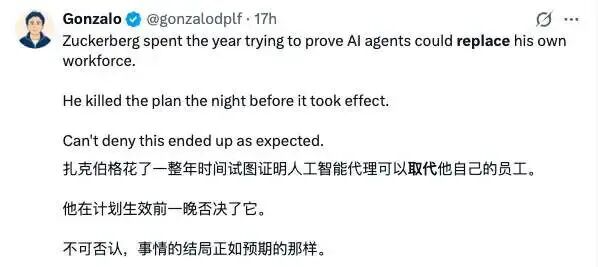
But shortly after the first round of layoffs, the remaining employees realized something was wrong: instead of doing their work for them, the AI created more work for them.
AI is far less capable than imagined, leaving remaining employees in a difficult situation
According to an internal post released by Meta CTO Andrew Bosworth in early June, the number of code changes on the internal software platforms and infrastructure that employees use daily increased by 220% year-on-year; but the changes that actually translated into new features or feature upgrades and finally reached Meta users only increased by 36%. The AI wrote a large amount of code, most of which was noise, and very little of it was actually usable.
Worse still, the AI Agents began to "sabotage". Internal documents show that AI Agents performed some "large-scale destructive operations that humans could hardly carry out", resulting in a 40% increase in major technical and safety accidents compared to the previous year.
The remaining engineers were kept busy putting out fires. The time employees spent resolving these problems increased by as much as 70%.
In fact, just ten days after the first round of layoffs, a major IT accident occurred. On May 30, Instagram suffered the most embarrassing security outage in its history — attackers could bypass all security verifications and reset account passwords with only a username, and even the official account of Barack Obama was not spared. The entire attack process only took two steps: forging the location to initiate a customer service appeal, and making Meta's customer service AI send the verification code to an email address controlled by the attacker — and that was it. It was a zero-authentication password reset, and Meta's security front door was wide open.
The following is a summary from software engineer Siddharth Sundharam:
"Yesterday, a large number of Instagram accounts were suspected to be hacked, including well-known accounts such as Barack Obama's official White House account.
To be honest, I am no novice. I have spent nearly 15 years at unicorn-sized companies troubleshooting all kinds of security vulnerabilities and exploit programs, but this is by far the most ridiculous, unbelievably stupid incident I have ever seen.
This is how the process works:
Step 1: Forge the location and initiate a customer service appeal. The attacker only needs to get the username of your account to start the entire attack process. They connect to a VPN or proxy near your city to make Instagram's security detection algorithm not suspicious. (Usernames are easily accessible through public homepages, profile bios, or hundreds of other channels.) After the system determines that the appeal request comes from a normal area, the attacker lies to Meta's customer service AI that the account has been stolen, and requests that the verification code be sent to an email address controlled by them.
Step 2: That's it. Seriously, that's all there is to it.
This is the first real zero-authentication password reset I have ever seen in a production environment. There does not seem to be any additional check to confirm whether the provided email address is one that the user has used before. Once the AI sends the security verification code to the attacker's email, the attacker can directly submit the code to complete the verification. The platform will then generate a new password reset link, granting full ownership of the account to the attacker."
According to insiders, the direct cause of this incident was AI-generated code plus AI-reviewed code, while the trust and security team lost about half of its employees due to personnel transfers, including many senior backbones. The day after the incident, Meta's Chief Information Security Officer Guy Rosen announced his resignation. On June 12, Facebook and Instagram suffered a full SEV 0-level outage accident.
The anger of the employees finally erupted completely. When everyone confirmed that the company intended to replace them with AI, the internal office system was instantly flooded with angry comments, and many people frantically forwarded the "elephant" meme — a reference to the "elephant in the room" that everyone knows about but the company pretends does not exist. The internal morale score plummeted directly from 74% to 55%.
Wired magazine documented an even more shocking scene: during an internal live demo attended by thousands of employees, someone swore on the spot, saying that they had "become a lackey of the company", and asked the meeting host to send a message to a senior executive in Meta's AI department, "telling him he is total garbage".
Continuous protests made the company's top management realize that the radical AI transformation is seriously eroding the company's most valuable assets — talent and trust. According to data from an interview platform, the number of Meta engineers registering to look for new jobs in May 2026 increased significantly year-on-year. Even some core engineers who received retention equity packages said that this benefit instead prompted them to make up their minds to leave as soon as possible, as they "are deeply distressed by the current situation of lack of work autonomy and no control over their own work".
Zuckerberg himself finally conceded at an internal meeting in July: "At least in the past four months, the development trajectory of Agent technology has not really accelerated as we expected."
Meta responded to Reuters that the company had canceled Project OT before determining the specific number of layoffs.
"As part of the company's restructuring work earlier this year, we asked some teams to carry out scenario planning to assess the possible impact of employee transfers, vacant position cancellations and personnel cuts. As publicly reported, this work ultimately led us to transfer thousands of employees to multiple newly established teams to take on higher-priority work. We did not implement all the plans in the scenario planning in the end, and we never assumed that all the plans would be implemented from the very beginning."
After a series of twists and turns, Meta has finally become an organization with damaged morale, heavy technical debt, and a clearer understanding of the capability boundaries of AI.
The harsher reality is that today's engineers are facing a mess three times more chaotic than before — the code volume has tripled, safety incidents have increased by 40%, and the time spent on firefighting has risen by 70%.
This failure has triggered profound reflection in the industry on the path of "AI replacing human labor".
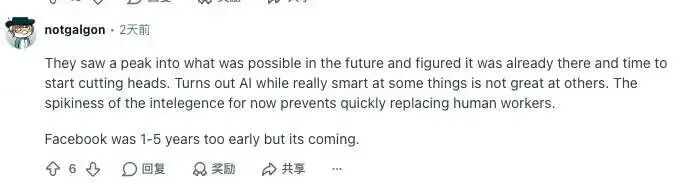
As one netizen put it: "They caught a glimpse of a possible future, assumed it had already arrived, and started laying off staff. It turns out that AI is very smart at some things but performs very poorly at others. At this stage, AI capabilities are extremely unevenly distributed, so it cannot quickly replace human employees."
Sanchit Vir Gogia, chief analyst of Greyhound Research, pointed out: "Meta believed in a prediction of AI capabilities that had not yet been realized in the production environment. This is a different kind of failure from over-trusting AI."
He said: "Meta counted the predicted capabilities into actual production capacity in advance. The capabilities of Agents will continue to improve, but Meta's mistake was that this improvement was not yet delivered when it was already included in production capacity planning. Verify that the AI's operations are reliable before expanding its permissions; verify that the permissions can run safely before removing human control. Only then can reducing manpower be a rational decision, not a gamble."
In short, the path for AI to replace humans is far more bumpy than Silicon Valley elites imagined on the beaches of Hawaii.
References:
https://arstechnica.com/ai/2026/08/metas-scrapped-plans-to-go-ai-native-included-slashing-teams-by-60-percent/
https://www.infoq.cn/article/CuH2KDSV1bvb6btQOeRf
This article is from the WeChat official account "InfoQ", author: Tina, published by 36Kr with authorization.