Your podcast has been listened to on your behalf by AI.
In 2026, podcasts are gaining unprecedented popularity, with various dialogue and interview programs going viral almost every day. Although in terms of audience size, podcasts still lag far behind short videos and short dramas, their number of listeners has been growing steadily.
According to the *CPA Chinese Podcast White Paper 2026*, the number of Chinese podcast listeners will exceed 150 million in 2025. In addition to audio platforms such as Xiaoyuzhou, Ximalaya and NetEase Cloud Music, the entry of social and content platforms including Bilibili, Xiaohongshu, Weibo and Tencent Video has also helped podcasts further expand their reach and break through circles through hosts' social media accounts, videoized programs and video podcasts.
For all the hype, several inherent problems of podcasts remain unsolved:
The first is length. A single episode that runs two to three hours places a considerable burden on most people.
The second is quantity. A massive flood of programs, many of which are padded with redundant content, are not necessarily worth users' time.
Therefore, as AI grows increasingly advanced, a new trend has emerged in the past two years — feeding long podcasts to AI to generate a "condensed version" in just over ten minutes, with the tone and timbre perfectly replicating the original host's voice. Some people have even created new podcast accounts based on this technology, becoming "AI extraction specialists".
From "watching dramas at double speed" a few years ago, to "scrolling through short videos at accelerated pace", and now to "AI listening on our behalf", human beings' obsession with speed seems to have no end.
However, is there really no problem with such speed-up? TopKlout believes this topic is worth discussing.
01
The Business Logic of AI-Condensed Podcasts
First of all, it must be acknowledged that condensed podcasts do address many real pain points.
Take my personal experience as an example: even as a loyal podcast listener with many favorite programs, I cannot focus on listening to every episode for several hours straight.
Long dialogues naturally have uneven information density — greetings at the beginning, digressions in the middle, and the truly interesting parts scattered across different sections, which are easy to miss due to limited energy. In scenarios where people listen to podcasts while driving or running, changing road conditions often turn the podcast into mere background sound.
Therefore, as AI costs drop significantly and processing capabilities continue to improve, the emergence of AI tools such as BibiGPT and Snipd on the market is understandable. BibiGPT focuses on cutting audio and video podcasts into 5 to 20 minute "digestible versions", and generating mind maps with one click, claiming that "a 1-hour video can have its key points summarized in 3 minutes".

Function-wise, these tools work really well as "filters". They not only allow users to acquire knowledge quickly, but also enable more people to listen to the summary first before deciding whether to listen to the full episode, thus saving time.
However, improved efficiency does not mean there are no other problems. For example, many people use the "filter" as a "substitute": after listening to the 15-minute summary, they think they have mastered all the value of the podcast episode, which is going too far.
This is similar to reading book reviews, book summaries or using AI to extract the essence of books: you can indeed quickly grasp the core viewpoints of a book, but a lot of content details and demonstration processes will be ignored. This kind of extraction may work for reference books, but if you apply it to novels, all the pleasure of reading will be completely lost.
The same logic applies to the podcast field.
Listening to podcasts, more often than not, is all about those "non-essential" parts — the sentence that the guest utters after three seconds of hesitation, the sharp debates between two conversing guests, or an off-topic joke that suddenly sheds light on a certain point... These marginal details and blank spaces are also integral parts of the soul of conversational content, which AI can hardly fully extract.
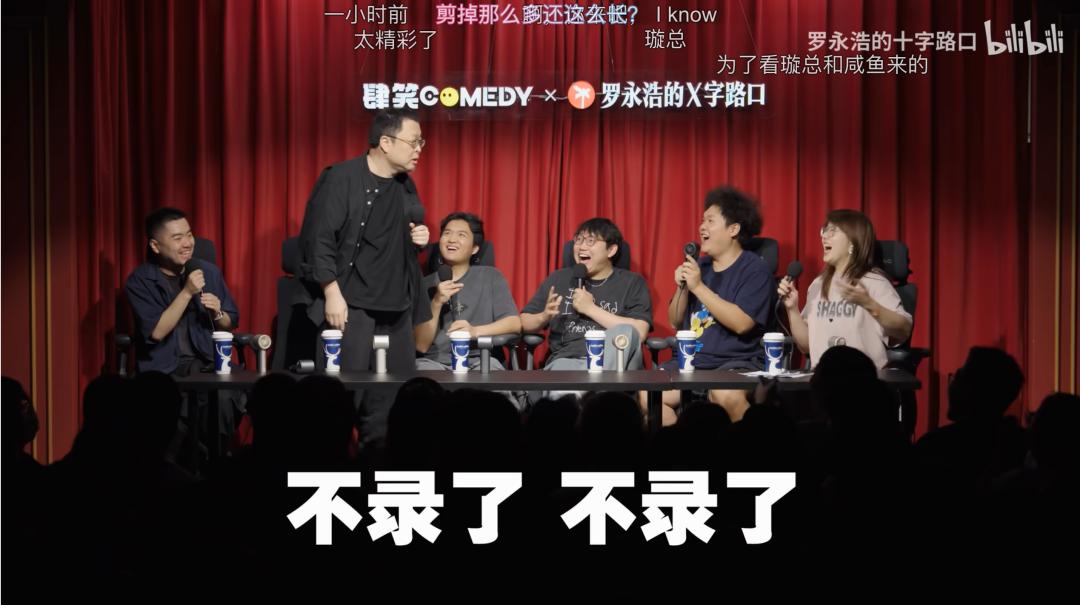
A very obvious example is Luo Yonghao's latest "Crossroads" series. The banter among a group of stand-up comedians leaves AI completely powerless. AI can perfectly summarize their views on each topic, but can it capture the humor from their mutual teasing and banter? Obviously not.
02
When "Listening" is Outsourced
To put it another way, is there anything wrong with wanting to be efficient? No, the pursuit of efficiency is human instinct. But there is a critical point for efficiency: when you even skip the process of exposure itself, what you get is no longer knowledge.
At this point, some people will definitely say: "Listening to AI summaries is better than not listening at all, right?"
On the surface that seems true, but the risk is that when we get used to the "pre-chewed version", we will gradually lose the ability to judge the quality of the original audio, because without hearing the full high-quality content, we will not know what good content really is.
This kind of "substitution" will also quietly change users' expectations for content. People will start to only accept clean, coherent, high-density information, and cannot tolerate any digressions, silences or repetitions.
Yet real in-depth dialogues precisely require those seemingly "useless" breathing spaces to carry emotions and a sense of trust. Once you completely outsource the act of "listening", you do not gain more time, but lose part of your perception.
In addition, current AI summaries will actively "add extra content".
For example, when large language models compress information, they will unconsciously "fill in" logical gaps, using self-generated content to fill the jumps and blanks in the original dialogue. If a guest mentions point A and then point C without explicitly stating point B in between, some AI will automatically "add" the transition of point B to make the summary read more smoothly.
You think you are listening to what the guest said, but in fact you are listening to what the AI thinks the guest "should have said". You think you are learning efficiently, but in reality you are consuming AI's secondary creation, with the original content only serving as its raw material. When everything is wrapped in a shell of indistinguishable authenticity — the voice sounds like a real person, and the logic is coherent — you cannot tell which line was said by the guest and which was added by AI.
Future podcasts will most likely feature two AI hosts talking back and forth, with pauses, interruptions and filler words all mimicking real human conversations, and all knowledge derived from AI summaries of other podcasts or online content. If podcast creators do not disclose that the content is AI-generated, many people may never realize it, and a large number of such podcasts are already in existence today.
There is nothing wrong with the mentality of pursuing speed. Watching short videos at double speed and wanting to condense long podcasts are both very human. But if you even outsource the act of "listening", what you get is not an efficient version of knowledge, but an illusion of knowledge, which is something many efficiency-seeking listeners need to be alert to.
03
The Gray Area of Copyright
After talking about knowledge, let's move on to copyright.
A single podcast episode is an audio work that enjoys full copyright protection. But when AI comes along, compresses a two-hour episode into 15 minutes, reads it out with an AI-generated voice, and uploads it to another platform as content for a different account — what is this? To put it nicely, it is "essence extraction"; to put it bluntly, it is "parasitic content scraping".
Many current podcast creators grow their accounts by repeatedly processing other people's content with AI, and using the condensed AI-generated content as their own podcast programs. One original podcast is summarized by A, then B summarizes A's summary, and C further creates based on B's version. By the third round, the original content may have been completely unrecognizable.
In this cycle, the original creator's labor is siphoned off layer by layer, with almost no returns going to them. Listeners are also trapped in second-hand or even third-hand content channels, and the play counts, subscription numbers and interaction heat of original podcasts are all undermined, with the commercial value that should belong to the creators being transferred away in this way.
In addition to this kind of content scraping, there is also the practice of replicating people's voices.
In February 2026, former NPR host David Greene sued Google at the Santa Clara County Court in California. He accused that the male AI voice generated by the Audio Overviews feature of NotebookLM highly replicates his own voice in terms of intonation, pauses and even filler words such as "uh". Many of his colleagues and friends mistook the AI voice for his own recording, and Greene said he was greatly shocked when he first heard it.
However, Google denied all the allegations, claiming that the AI voice came from a paid actor. The case is still in the judicial process and no verdict has been reached yet.
Under the current legal framework, these scenarios are almost all gray areas. Copyright law protects the "work" itself, but there is no clear legal definition on whether AI-generated summaries constitute "adaptation" or "new creation"; the rights to one's voice and performer's rights are even more ambiguous in the face of digital replication.
Especially as Chinese podcasts are booming and AI technology is advancing by leaps and bounds, there will definitely be more and more such copyright disputes in the future.
04
Conclusion
The development of AI is undoubtedly the direction of technological progress, and not using it seems to go against the law of technological advancement. Even so, many people feel a little awkward when listening to such AI-summarized or AI-created podcasts.
Feeling awkward is a good thing. What we fear is that one day we will no longer have this sense of awkwardness, and willingly hand over our right to "listen" and the last line of defense in our minds to AI.
This article is from WeChat official account "TopKlout" (ID: TopKlout), written by Su Men, and republished with authorization from 36Kr.