AI chip entrepreneurship has gone wild again.
Beyond GPUs, a new entrepreneurial war centered on inference, storage, interconnection and CPUs is breaking out across the globe. Why do we say so? Recent financing figures in the AI chip sector show that AI chip startups are entering an almost frenzied stage.
On August 18, US AI chip startup Etched announced the completion of a new $700 million financing round, with a valuation reaching $21 billion. Less than a month earlier, on July 23, Etched had just closed a $300 million Series C financing at a valuation of $10.3 billion. In less than a month, the company's valuation directly doubled.
Almost on the same day, another far less well-known AI chip firm Velaura AI also announced the completion of $110 million Series A financing, with its valuation breaking through $1 billion in one go, directly joining the ranks of unicorns.
Looking further back, stories like this have happened over and over again this year.
In February, Cerebras raised another $1 billion, with its valuation reaching about $23 billion, nearly quadrupling from $8.1 billion four months prior; in March, South Korean AI chip company Rebellions completed $400 million financing at a valuation of around $2.34 billion; in May, UK-based Fractile closed $220 million Series B financing; Canada's Taalas raised $169 million in February this year, with total accumulated financing of about $219 million, and less than half a year later, it was acquired by AMD in August; Tensordyne is preparing to launch its Series D financing later this year, and its new inference system has already received projected demand of over $200 million.
These are not scattered financing events. Statistics from Semiconductor Engineering show that in the first quarter of 2026 alone, 80 semiconductor startups raised a total of $8.4 billion, 18 of which secured more than $100 million in a single round. What is more notable is the destination of the capital: a large number of companies have not chosen to build another traditional GPU, but are betting on AI inference, or trying to solve bandwidth and data movement problems at the chip, memory, interconnection and even the entire data center level. Photonic technology has therefore continued to be a hot investment track.
After more than a decade of industry reshuffling, AI chip entrepreneurship seems to have suddenly made a comeback. But this time, the game is completely different.
Why is the AI chip startup boom resurging?
Looking back at the last wave of AI chip entrepreneurship, the story was not as complicated as it is today.
Around 2016, deep learning exploded, and a large number of startups worldwide saw the same opportunity: neural networks require increasingly massive matrix calculations, while GPUs were not originally designed specifically for AI, so there is theoretically huge room for architectural optimization.
As a result, companies began to develop all kinds of AI Accelerators, NPUs, and ASICs. A host of startups including Groq, Cerebras, Graphcore, SambaNova, Habana, and Tenstorrent emerged like mushrooms after rain.
But what happened next is well known to all — NVIDIA not only continuously improved GPU performance, more importantly, it built a complete ecosystem around CUDA, communication, servers, networks and software. To beat a single GPU, people eventually find that what they really need to defeat is the entire NVIDIA computing platform.
The peak computing power of a chip being 20% higher or even double that of NVIDIA's is not as important as imagined. What customers really care about is whether the model can run, whether the software can be migrated, whether the cluster can be scaled, whether the system is stable, and whether the chip can still be used after the next-generation model is released.
The first batch of AI chip startups have seen obvious differentiation. Cerebras eventually went public and increasingly sold its chips in the form of Cloud Service; Groq's core technology was fully licensed by NVIDIA at a large price at the end of 2025, and part of its core management team was absorbed by NVIDIA; Tenstorrent was reported this year to be in discussions with Qualcomm for an acquisition valued at $8 billion to $10 billion; many early startups exited, transformed their business, or were acquired.
Therefore, if you just want to redevelop another general-purpose AI training chip, there is actually very little room for entrepreneurship today. But now, a new window has reopened.
The reason is not that GPUs suddenly failed, but that the main contradiction of AI is changing.
In the past few years, the scarcest resource was training computing power. A large model needs to be trained for several months first, so what people cared most about was how to organize thousands of GPUs to complete the model training process.
But as ChatGPT, Reasoning Model and AI Agent are truly moving into large-scale application, the center of gravity of the AI industry is increasingly shifting to another direction — Inference.
Training a model may only happen once, but once the model is called repeatedly by billions of users and millions of Agents, inference needs to happen billions, tens of billions or even more times. And Reasoning Model further changes this problem. After receiving a question, a traditional model may generate hundreds of Tokens; in the future, complex Coding Agents, scientific research Agents, autonomous driving or robotic systems may need to continuously plan, call tools, reflect, and retry, generating tens of thousands, millions or even more Tokens internally before finally outputting the result.
Fractile even directly defines this problem as the biggest bottleneck in the next stage of the AI industry: as models increasingly rely on long-duration, continuous inference, what restricts AI capabilities is no longer just how smart the model is, but how long it takes to generate enough Tokens, and how much it costs to generate these Tokens. Its judgment is that current architectures are increasingly constrained by memory bandwidth, so the company has chosen to redesign the relationship between computing and storage.
Mamoon Hamid, Managing Partner of Etched's investor Kleiner Perkins, summed up this new rule of game more concisely: the winner of future inference chips will increasingly be measured by how many Tokens can be generated per dollar, and how many Tokens can be generated per watt.
This sentence actually explains this round of AI chip startup boom in 2026. FLOPS have not lost their significance, but FLOPS are changing from an end goal back to an intermediate indicator. The real focus has begun to shift to Tokens.
Reuters reported in March this year that NVIDIA itself expects its AI chip revenue opportunity to reach at least $1 trillion by 2027, while it is making more aggressive layouts for real-time inference.
Overseas AI chip startups are frantically "bypassing GPUs"
Why could Etched's valuation jump from $10.3 billion to $21 billion in less than a month? A closer look shows that what they are doing is critical: it does not intend to simply copy NVIDIA's path.
Etched defines its product as a new type of "Frontier Inference Cluster". The company covers everything from chips, packaging, PCBs, liquid cooling, interconnection, memory to cabinets and software, aiming to carry out overall optimization for Prefill and Decode of large models.
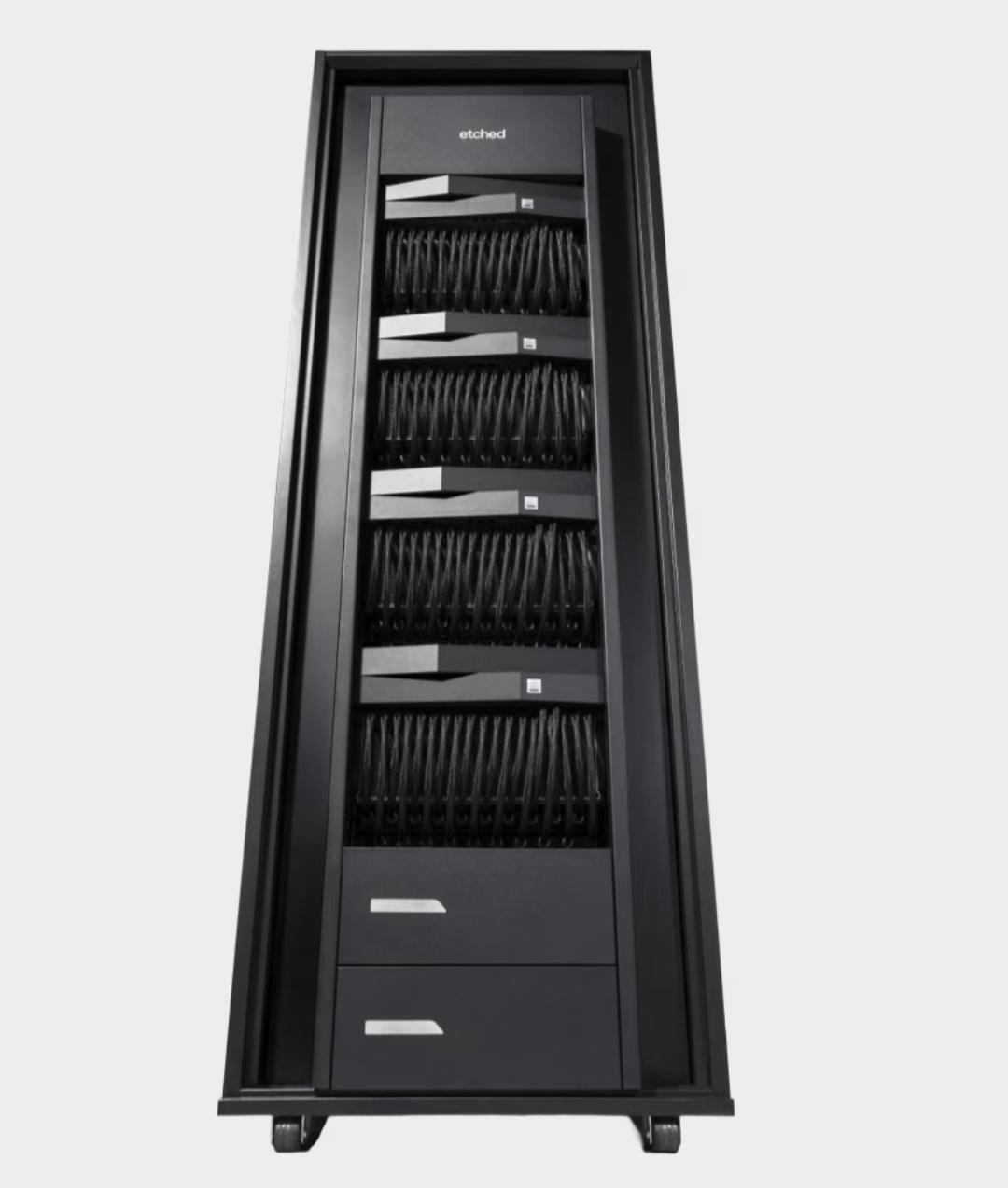
(Source: Etched)
Etched's latest publicly released architecture is no longer just a "Transformer ASIC". It proposes Low Voltage Inference, which increases continuous computing density by reducing the working voltage of computing units; on the other hand, it designs Cluster Scale Memory, which uses a hybrid architecture of HBM and SRAM paired with self-developed low-latency interconnection to form a larger shared memory pool across the entire Scale-up domain. Its first A0 chip is manufactured using TSMC's N4P process, and has now entered the stage of verification by end customers.
Note the change taking place here: a chip startup has begun to design chips, memory, interconnection, heat dissipation and cabinets as a whole.
Fractile takes another path. It believes that the real problem of AI inference is storage bandwidth, so it directly tries to intertwine computing and storage more closely. The company hopes to simultaneously achieve two indicators that traditional AI hardware can hardly balance: ultra-low latency on one hand, and high throughput under large-scale concurrency on the other. The $220 million financing completed in May is to promote the first batch of chips and systems to be delivered to customers.
Cerebras is even more extreme. Since its inception, the company has never accepted the traditional idea that "chips must be cut into individual Dies", but directly built the Wafer Scale Engine, turning an entire wafer into a giant processor. In February this year, Cerebras secured another $1 billion financing, with its valuation reaching $23 billion; more importantly, large model companies including OpenAI are actively looking for inference computing power sources other than NVIDIA, which is also the important background why capital is willing to continue betting on these non-traditional architectures.
Taalas went even further. Its proposed concept is called "The Model is The Computer": instead of building a chip and then running different models on it, it directly turns a specific AI model into customized silicon. Its demonstrated HC1 maps the Llama 3.1 8B model directly into hardware, with the goal of eliminating the overhead brought by general-purpose computing to the greatest extent. Such an architecture is obviously far less flexible than GPUs, but if certain models need to run trillions or tens of trillions of times a day in the future, and the same model remains unchanged for a long time, the cost advantage brought by extreme specialization can be extremely huge.
The outcome of Taalas is also thought-provoking. It just raised $169 million in February this year, and on August 6, AMD announced the acquisition of Taalas, planning to integrate its technology into AMD's AI Accelerator roadmap. In other words, the value of AI chip startups no longer necessarily lies in eventually growing into a new NVIDIA. They can also become part of the next-generation architectural innovation of AMD, NVIDIA or cloud computing giants.

(Source: Taalas)
South Korea's Rebellions represents another model. In March this year, the company obtained $400 million financing, with the South Korean National Growth Fund directly investing about $165 million, and including it in the "K-Nvidia" strategy to build its own AI inference chip system. The core competitive point chosen by Rebellions is also not the maximum peak computing power, but to obtain the highest possible inference performance with the least possible energy.
From the US to the UK, and then to South Korea, capital is doing one thing at the same time: seeking the computing dividend beyond the general-purpose nature of GPUs.
A number of new AI chip startups have also emerged in China
Interestingly, if you shift your sight back to China, you will find that almost the same scenario is taking place.
However, compared with overseas startups that focus more on dedicated inference ASICs, Dataflow architecture and extreme energy efficiency, the routes chosen by China's new round of AI chip entrepreneurship are more diversified. 3D DRAM, compute-in-memory, optical interconnection, optical computing, RISC-V, agent CPU... Technical directions that were once overshadowed by the light of GPUs are now becoming the key targets of capital bets again.
In 2026, the capital in China's primary market for AI chips is clearly no longer only flowing to GPUs. Based on the publicly disclosed financing amounts, the 3D compute-in-memory track has seen financing rounds of 2 billion yuan and 1 billion yuan, the CPU track has also consecutively seen projects with financing close to 1 billion yuan and exceeding 1 billion yuan, while the optical interconnection and optical computing sectors have entered the stage of hundreds of millions of yuan in financing.
This change is significantly different from the last wave of AI chip startup boom. In the past few years, when talking about domestic AI chip startups, the market's first reaction was often still GPUs. Companies such as Cambricon, Biren, Moore Threads, Iluvatar, and Moffett have largely represented the main line of the last round of domestic AI computing power entrepreneurship — after NVIDIA GPUs became the de facto standard for AI computing, China first needed to solve the problem of "whether there are domestic high-end AI computing chips".
And the startups that capital is betting on now are more pragmatic.
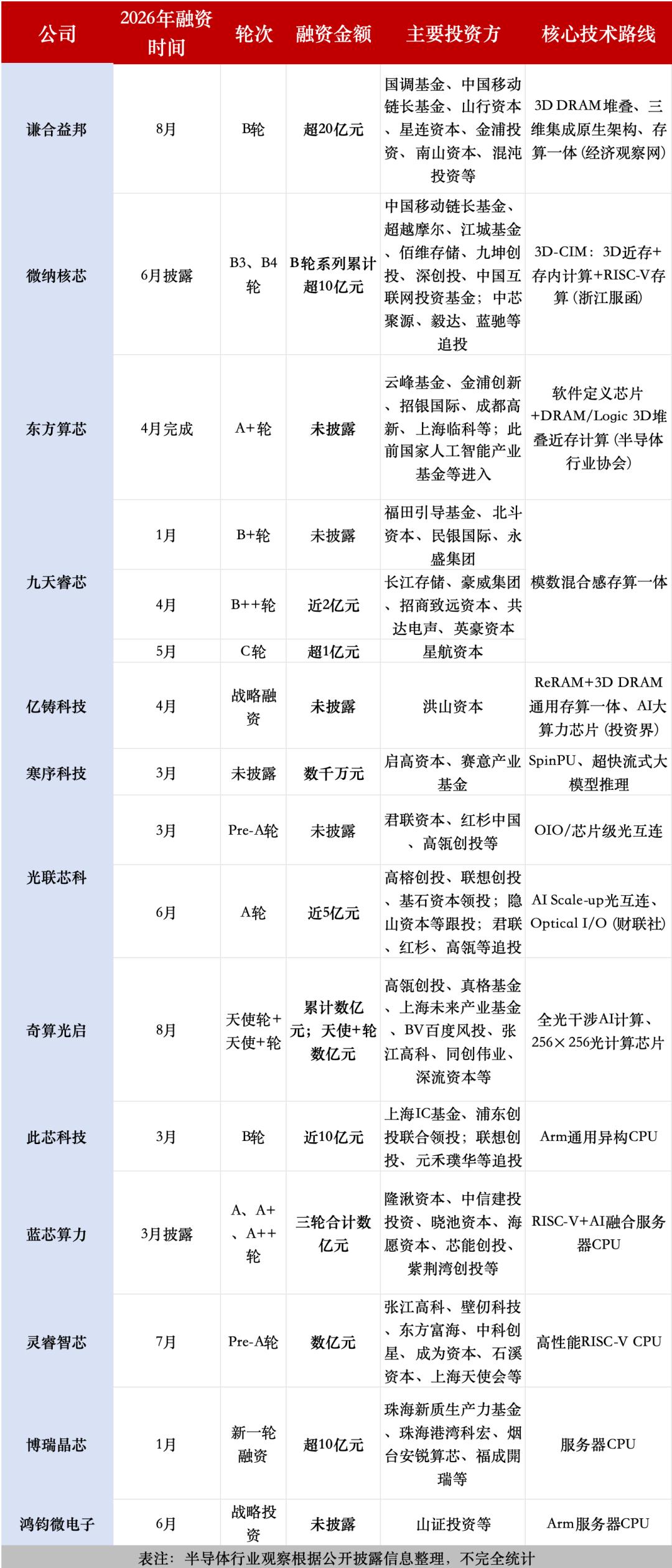
The most obvious track is 3D DRAM and compute-in-memory. In August, Qianhe Yibang completed a Series B financing of over 2 billion yuan, focusing on 3D DRAM computing-storage integration; in June, Micro-Nano Core consecutively completed Series B3 and B4 financing totaling over 1 billion yuan, betting on 3D-CIM, near-memory computing and in-memory computing; Oriental Computing Core explores high-bandwidth near-memory computing under mature process through 3D vertical integration of DRAM and Logic. Jiutian Ruixin and Yizhu Technology have also continued to receive capital increases this year.
The routes of these companies are not exactly the same, but their goals are highly consistent: to minimize the movement of data between computing units and memory.
Another hot track is photonics.
In June, OIO optical interconnection company Guanglian Xinke completed a Series A financing of nearly 500 million yuan, trying to solve the increasingly severe bandwidth and power consumption problems between AI chips; on the other hand, Xizhi Technology, Qisuan Guangqi and other companies continue to explore optical computing, hoping to directly use light to complete matrix operations. The two types of companies solve different problems in essence: optical interconnection solves "how data is transmitted", and optical computing solves "how data is computed".
What is more counterintuitive is that CPU has also re-emerged as a direction of capital attention.
In March, Xinchi Technology completed a Series B financing of nearly 1 billion yuan for the R&D of next-generation agent CPUs; Lanxin Computing Power consecutively completed multiple rounds of financing to promote RISC-V+AI integrated server CPUs; in July, Lingrui Zhixin completed hundreds of millions of yuan in financing, also targeting high-performance RISC-V and agent CPUs. At the same time, server CPU startups including Borui Jingxin and Hongjun Microelectronics have also received new rounds of capital support.
The logic behind this is not complicated. As AI evolves from training to inference, and then to Agents, the computing load is no longer just matrix multiplication. The importance of task scheduling, tool calling, data processing, system control and heterogeneous collaboration is constantly rising, and the value of CPUs has therefore been rediscovered.
Overall, China's capital market is simultaneously betting on three things: bringing computing and storage closer, replacing electrical interconnection with optical interconnection, and re-elevating the status of CPUs in the Agent era.
The track for this round of AI startups has changed
NVIDIA is already so strong, why are there more and more AI chip startups?
Putting all these AI chip startups together, you will find a very interesting phenomenon: Etched is working on low-voltage computing and cluster-level memory, Fractile is redesigning the relationship between computing and memory, Taalas turns models directly into chips, Cerebras turns the entire wafer into a processor, Velaura pursues extreme low power consumption, and Tensordyne bets on high energy efficiency inference systems.
While in China, Qianhe Yibang works on 3D DRAM compute-in-memory, Oriental Computing Core works on 3D near-memory computing, Guanglian Xinke works on OIO, Xizhi and Qisuan Guangqi explore optical computing, and Lanxin Computing Power, Lingrui Zhixin and Xinchi Technology are redefining CPUs.
These seem completely unrelated, but in fact, they are all solving the same problem: data movement.
What is really expensive in modern AI chips is not just completing a single multiplication operation. Model parameters need to be fetched from memory, KV Cache needs to be read continuously, data needs to be moved from one chip to