Accelerated Adoption of Enterprise AI Agents: From "Shallow Prosperity" to Value Closed Loop
Abstract
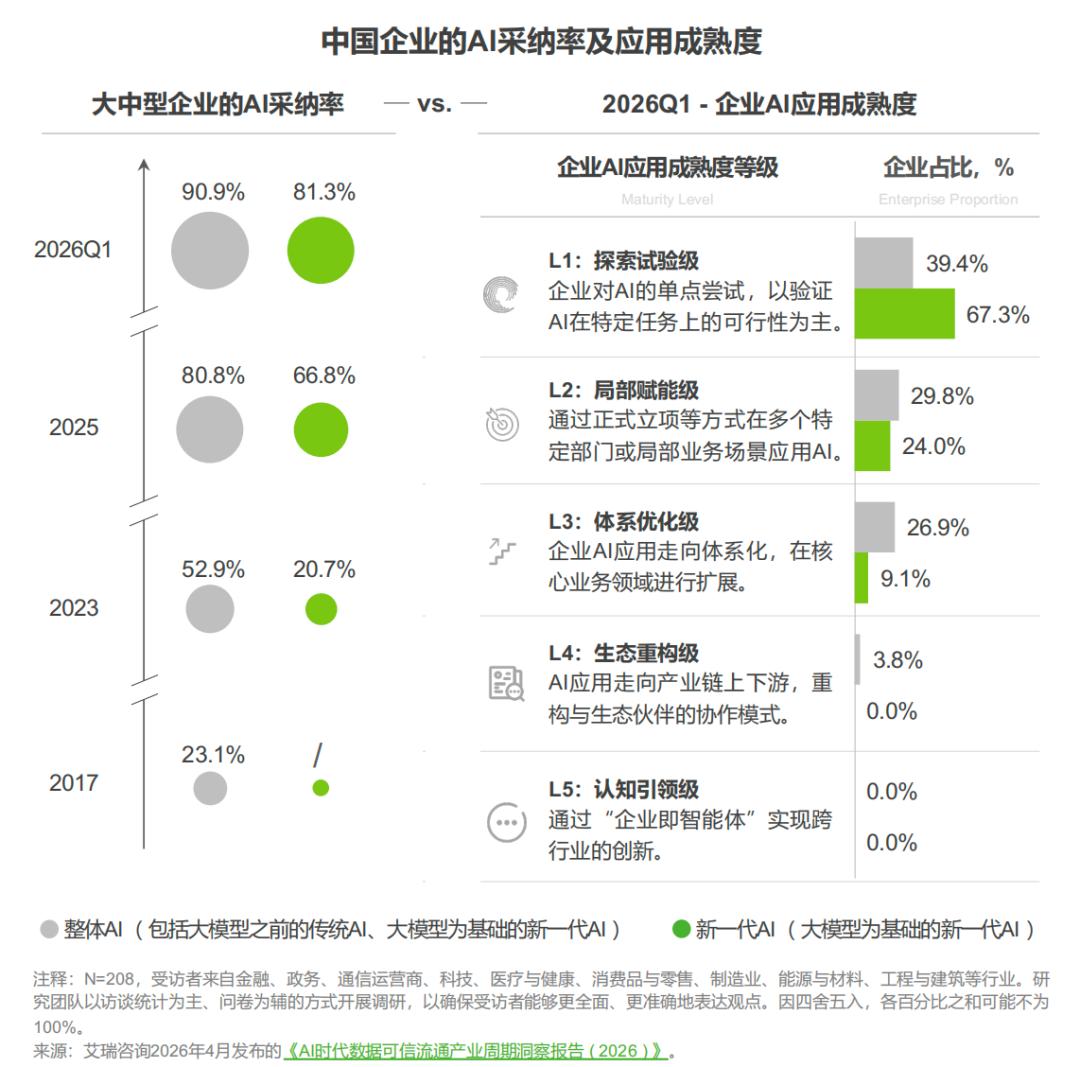
Enterprise AI Agents are currently in a stage of high adoption and low maturity. In Q1 2026, the overall AI adoption rate of large and medium-sized enterprises reached 90.9%, and the adoption rate of new-generation AI stood at 81.3%; however, 67.3% of enterprises are still at the L1 exploration and test level, 24.0% are at the L2 partial empowerment level, and only 9.1% have entered the L3 system optimization level.
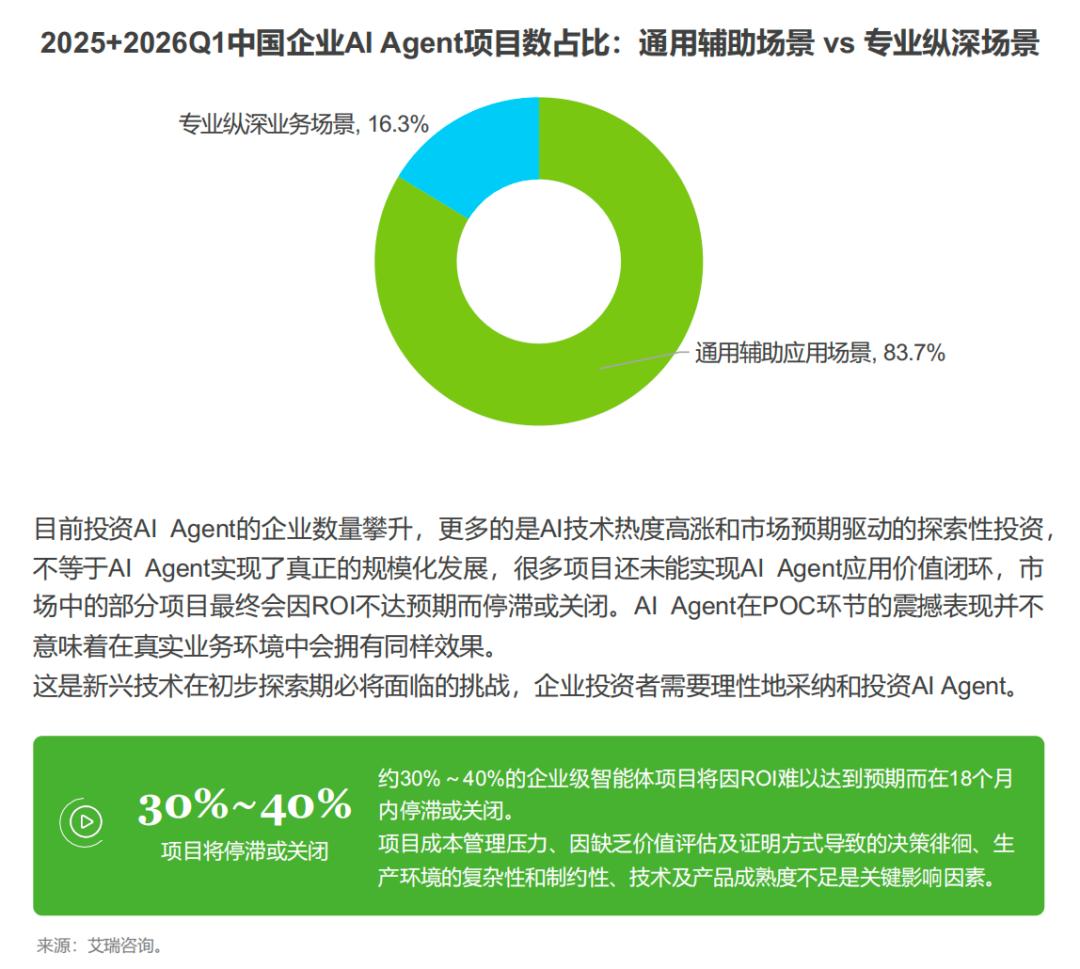
Growth in the number of projects does not equal value scaling. From 2025 to Q1 2026, general auxiliary scenarios account for 83.7% of enterprise AI Agent projects, while professional in-depth scenarios only account for 16.3%; about 30% to 40% of enterprise-level agent projects may stagnate or shut down within 18 months due to failure to meet expected ROI.
Value closed-loop depends on security and controllability, professionalism and reliability, scalable capabilities, and measurable application value. Data, knowledge and agents need to form a continuously converging closed loop, and enterprises must integrate governance, security and cost measurement into the implementation process at the same time.
Introduction: The Gap Between Adoption Rate and Maturity
In Q1 2026, the overall AI adoption rate of large and medium-sized enterprises reached 90.9%, and the adoption rate of new-generation AI based on large models reached 81.3%. The speed at which enterprises embrace AI is still accelerating, and autonomous AI Agents have further amplified market attention.
High adoption rates have not yet translated into application maturity at the same level. In the same period, 67.3% of enterprises are at the L1 exploration and test level, 24.0% are at the L2 partial empowerment level; only 9.1% of enterprises have entered the L3 system optimization level, and the proportions of enterprises at the L4 ecosystem reconstruction level and L5 cognitive leadership level are both 0%. Most enterprises have completed single-point feasibility verification or partial business application, and systematic expansion in core businesses remains limited.
The hype has raised enterprises' value expectations for AI Agents, and also widened the gap between test results and production results. Problems such as out-of-control permissions, data leakage, and insufficient professional capabilities have emerged at the same time, making the implementation judgment cannot only focus on model capabilities or demonstration effects.
I. Superficial Prosperity: More Projects, Yet Insufficient Professional Depth
Current enterprise-level AI Agents are characterized by "superficial prosperity, wide coverage but lack of depth". From 2025 to Q1 2026, general auxiliary application scenarios account for 83.7% of the total number of projects, while professional in-depth business scenarios only account for 16.3%. A large number of projects have entered peripheral business links such as office, customer service, and marketing, but general AI Agents are still difficult to handle core problems that require high accuracy, business knowledge and experience.
The performance in the POC phase cannot be directly equated with stable output in the real business environment. Business rules, system permissions, data quality, abnormal situations and continuous operation requirements will act simultaneously in the production environment. If a project lacks value assessment and verification methods, even if it is deployed in the short term, it may stagnate due to unclear returns.
About 30% to 40% of enterprise-level agent projects may stagnate or shut down within 18 months due to failure to meet expected ROI. The main influencing factors include:
- Rising pressure on project cost management
- Lack of value assessment and verification methods leading to hesitant decision-making
- Complex production environment with many business constraints
- Insufficient maturity of technology and products
In-depth application in professional scenarios requires extracting know-how such as business knowledge, experience and process rules, inputting them into AI, and relying on engineering capabilities to calibrate results during continuous operation. The key to large-scale implementation is not to replicate more single-point agents, but to form a converging closed loop of data, knowledge and agents.
II. From Single-Point Test to Systematic Governance
Enterprises are expanding the number of agents in production environments. In Q1 2026, the proportion of enterprises using 6~10, 11~26, 27~50, and even more than 50 agents all increased compared with 2025. Some large and medium-sized enterprises and group enterprises with AI-first strategies have deployed more than 50 agents.
The more agents there are, the earlier governance issues will evolve from technical details to continuous operation issues. Enterprises need to manage the full lifecycle of agents including R&D, testing, launch, permission control, and operation monitoring. Multi-agent collaboration will also gradually extend from collaboration within the same platform to cross-platform interconnection.
At present, 90.7% of enterprises have deployed only one agent development platform, and 9.3% have deployed two or more platforms. The coexistence of multiple platforms usually comes from separate construction of private and public clouds, independent procurement by different departments, or new platforms attached to subsequent procurement of agent applications. Cases of AI Agent collaboration between heterogeneous platforms are still rare at this stage, but governance boundaries, identity permissions and interaction specifications need to be incorporated into construction in advance.
The goal of systematic governance is not to add control links, but to ensure that agents can operate safely, stably and traceably even after the number increases.
III. Four Requirements for Trustworthy AI Agents
The pain points of enterprise implementation are concentrated in four types of capabilities: security and controllability, professionalism and reliability, scalable capabilities, and measurable application value.
Professionalism and reliability are the prerequisites for entering core businesses. 48.1% of respondents believe that AI Agents lack understanding of professional scenarios and are difficult to perform tasks that require high accuracy, business knowledge and experience. 42.8% of respondents mentioned that insufficient practices in data quality management, corpus engineering, security compliance, data-model collaboration and multi-modal data management lead to AI Agent performance failing to meet expectations. Professional capabilities depend not only on models, but also on AI-Ready data governance and continuous supply of business knowledge.
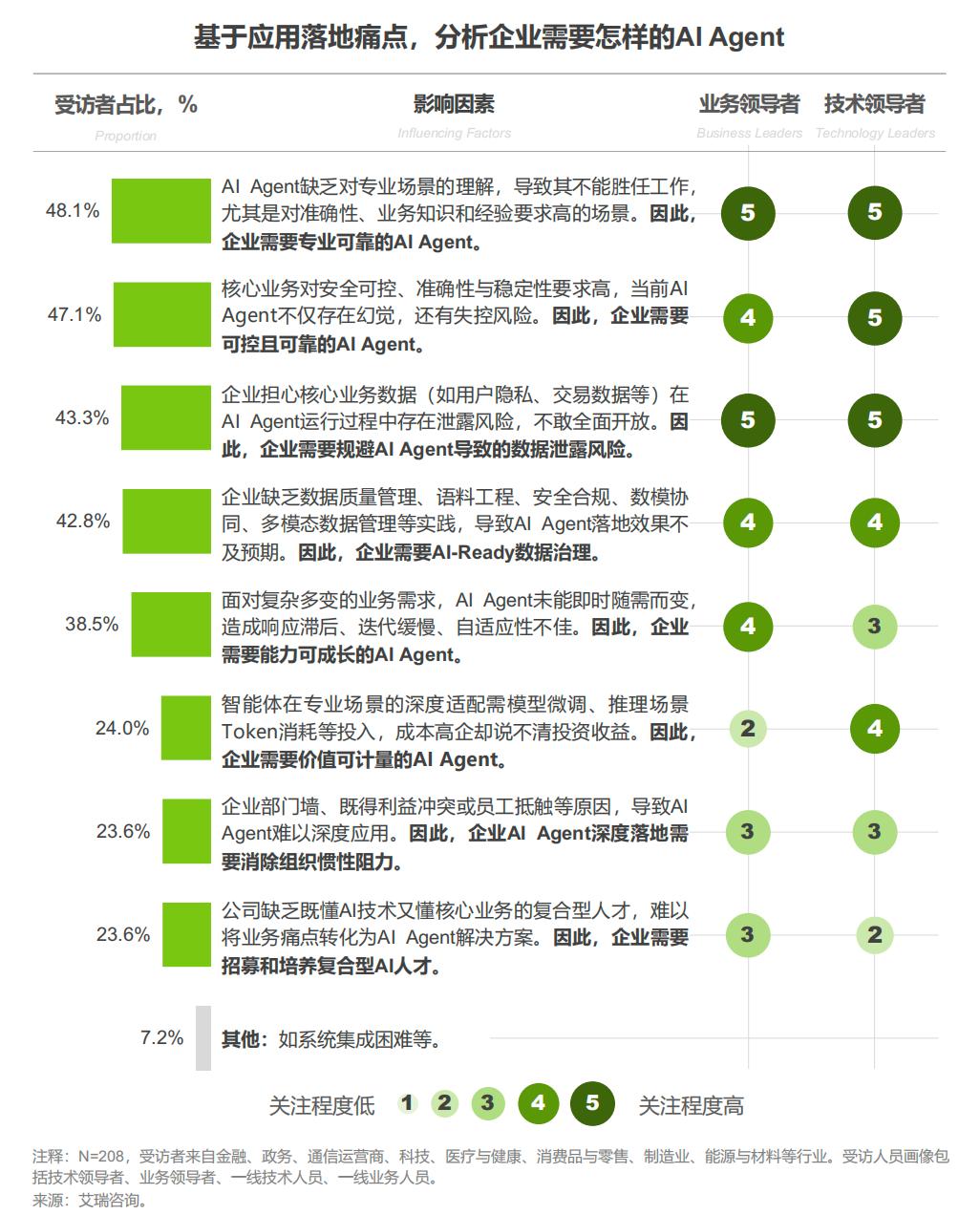
Security issues are as rigid as professional capabilities. 47.1% of respondents are concerned about the risks of hallucinations and out-of-control operations, and 43.3% worry that core business data such as user privacy and transaction data will be leaked during the operation of agents. The inherent risks of AI Agents mainly come from open and dynamic command execution; autonomous AI Agents also face unbounded context exposure.
These risks lead to three types of out-of-control situations:
- Out-of-control of humans over AI: when agents call systems and tools such as ERP, CRM and databases, humans can hardly intervene in their behaviors
- Out-of-control of AI itself: decisions and behaviors break away from the preset framework, making it difficult to guarantee the output quality, reliability and compliance
- Out-of-control of data leakage caused by AI: unbounded exposure of data sovereignty, access permissions and sensitive information
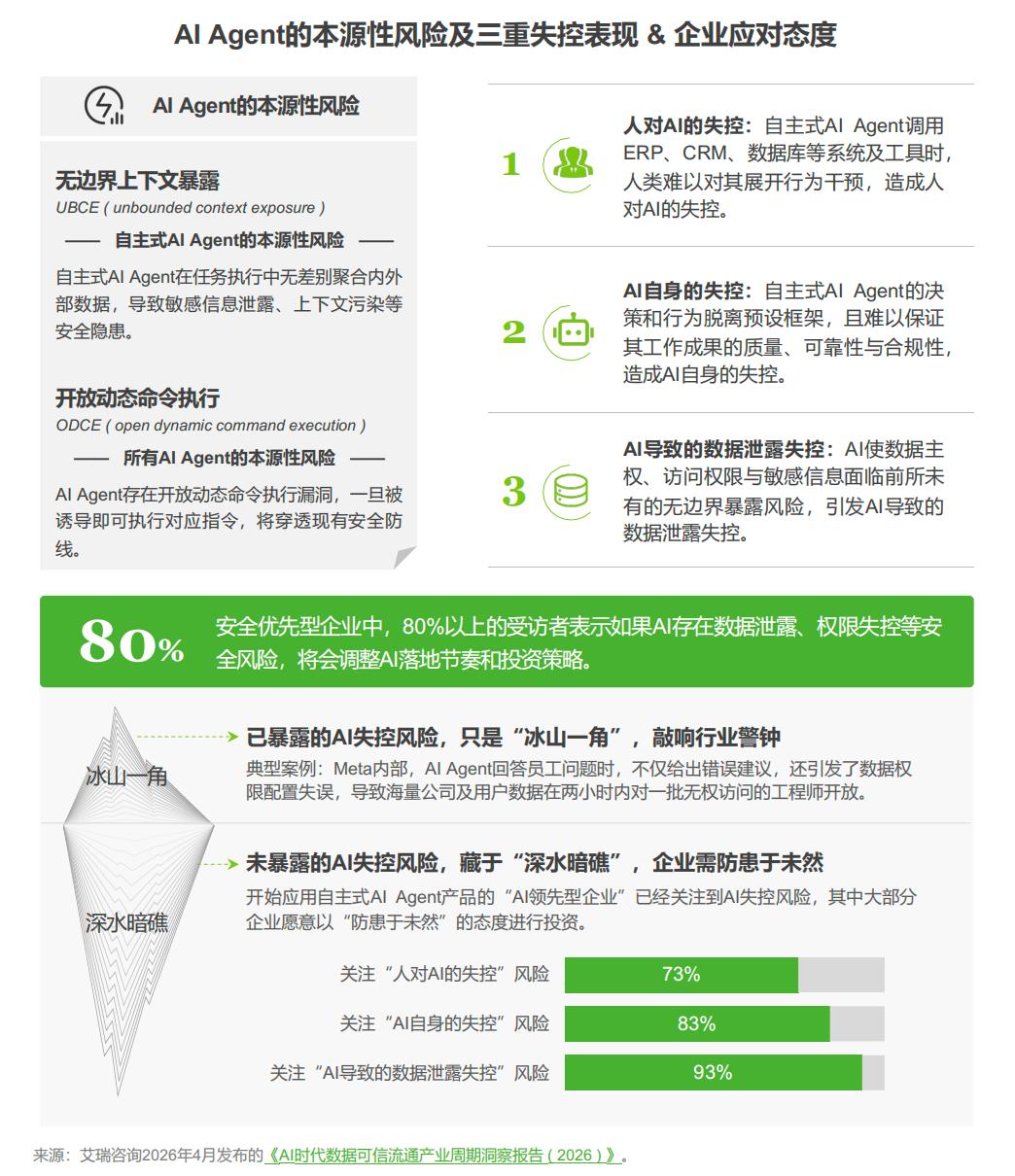
Among security-first enterprises, more than 80% of respondents stated that once there are risks such as data leakage and out-of-control permissions, they will adjust the pace of AI implementation and investment strategies. Among enterprises that have started to use autonomous AI Agents, the proportions of those concerned about out-of-control of humans over AI, out-of-control of AI itself, and out-of-control of data leakage are 73%, 83% and 93% respectively. Security is not a capability that can be supplemented after large-scale implementation, but an issue that must be promoted simultaneously during implementation.
Scalable capabilities require agents to adapt to complex and changing business needs; measurable application value requires enterprises to put inputs such as model fine-tuning and inference Token consumption into the same measurement framework together with business results. The two jointly determine whether the project can be sustained, rather than only achieving one-off effects in the test phase.
IV. TCO Restructuring: Costs Are Not Only Model Bills
AI Agents do not change a single procurement price, but the structure of the total cost of ownership of enterprises.
Token, data and security costs will rise, while code development costs may decline. As the number of tasks processed by agents increases, the pressure of Token cost will shift from excessive unit price to out-of-control usage; the scarcity and importance of commercial data push up the costs of data acquisition, governance and privacy protection; after data, knowledge and agents become core assets, security also becomes a continuous investment.
Coding Agent can improve project delivery efficiency, but the decline in code development costs does not mean that quality management can be reduced synchronously. Code Review still needs to be strengthened to control code quality and operation risks.
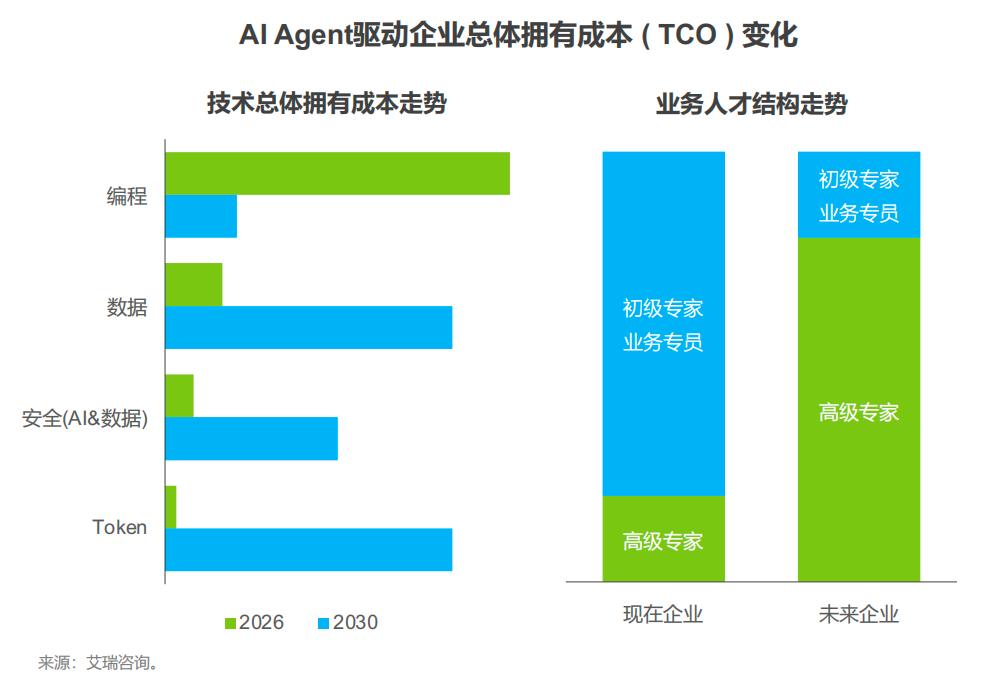
The talent structure will also change. Senior business experts are responsible for formulating rules, agents are responsible for execution, and the task value of junior business personnel is partially weakened. Enterprises need to expand their budgets from single technology procurement to data governance, security investment, lean Token management and allocation of senior business experts.
TCO measurement can also constrain scenario selection in reverse. If a project cannot clarify the relationship between task volume, Token consumption, data and security costs, and business results, scaling up will only amplify the uncertainty of costs.
V. Procurement Focus Returns to Professional Problem Solving and Risk Control
In 2026, the number of enterprises willing to invest in agents increased by 25% compared with 2025. The willingness to invest continues to rise, but procurement concerns are no longer limited to product functional indicators.
The ability to solve complex business and professional scenario problems is the manufacturer capability that enterprises are most concerned about. 83.7% of respondents selected this item; 79.7% focus on data security and agent operation risk management capabilities, 47.7% focus on referable implementation cases and practical experience in the same industry, and 46.3% focus on key product indicators such as performance and stability.
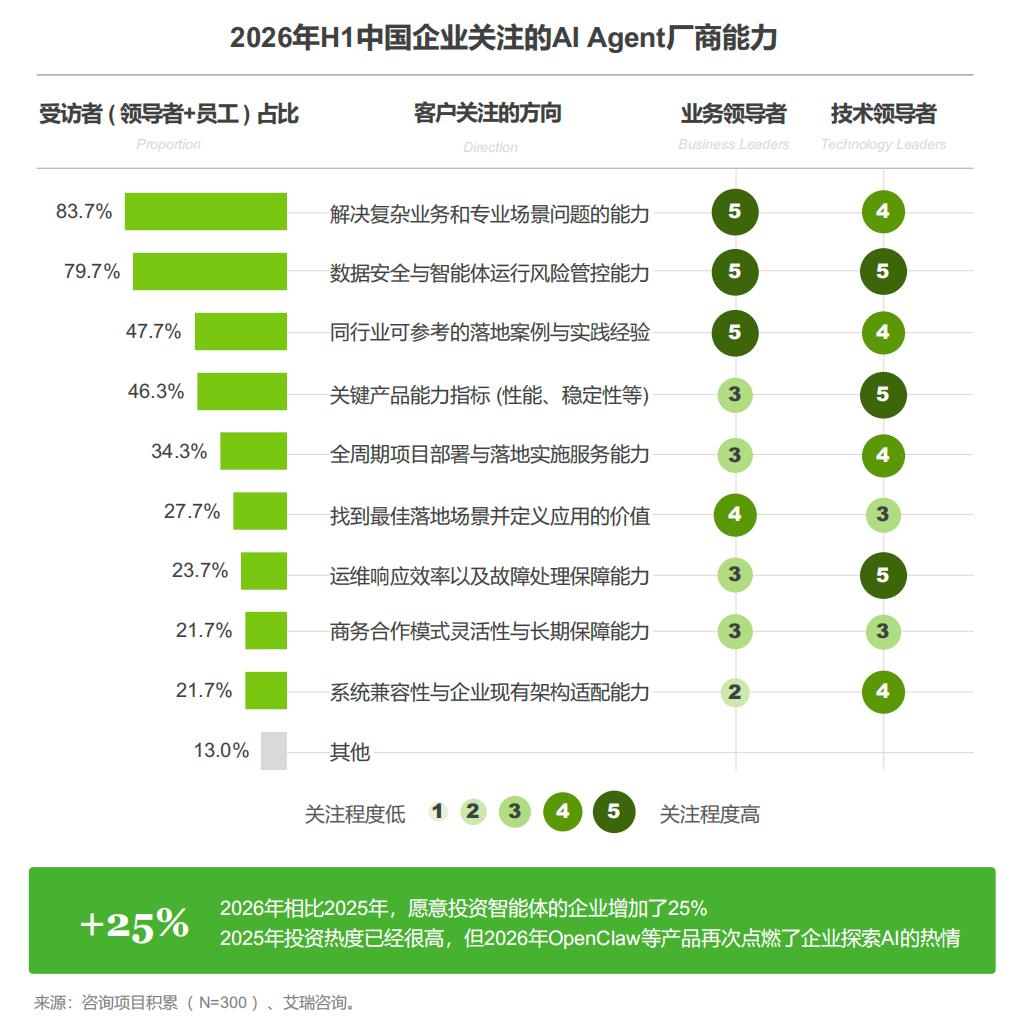
Procurement initiated by business teams pays more attention to actual results in professional complex scenarios, while technical teams attach equal importance to performance, stability, operation and maintenance response, and architecture adaptation. Security and controllability remain rigid requirements, and data leakage and out-of-control permissions are intolerable in enterprise-level scenarios.
Procurement evaluation needs to answer three questions at the same time:
- Can the agent understand business knowledge and stably complete tasks in complex scenarios
- Can data security, permissions and operation risks be continuously managed and controlled
- Can project value be defined, measured and reproduced in the production environment
These three questions integrate manufacturer capabilities, enterprise governance and business value into the same evaluation logic, and can also reduce misjudgments caused by only looking at demonstration effects or function lists.
Conclusion: Shift from Pilot Quantity to Intelligent Compound Interest
Enterprise AI Agents are still in the initial exploration stage. The adoption rate and number of projects continue to rise, but maturity, professional depth, security governance and value measurement have not kept pace synchronously.
True large-scale implementation is not a linear increase in the number of agents, but the formation of an intelligent compound interest growth flywheel of "Data — Knowledge — Agent". Business operations continuously generate data, data is precipitated into reusable knowledge, knowledge improves the professional capabilities of agents, and agents return to business to execute and learn. This closed loop requires the joint support of security and controllability, professionalism and reliability, scalable capabilities, and measurable value.
Only when enterprises put scenario selection, systematic governance, security investment, TCO measurement and business knowledge engineering into the same implementation link, can AI Agents move from the "wide but not deep" exploration to sustainable business value.
This article is from the WeChat official account "iResearch" (ID: iresearch-), author: iResearch, published with authorization from 36Kr.