32-bit MCUs are all competing to be the smallest.
Your next 8-bit MCU is 32-bit. That's a statement ST made before.
In the MCU sector, some players compete to boost performance, while others focus on downsizing packages and cutting prices. After all, MCU selection is a discipline of "just the right fit": if you can solve the problem at a lower cost, there is no need to use a more expensive and larger solution.
The MCU field is different from the CPU field. The product with the strongest performance is not necessarily the best choice, and excessive performance is also an unnecessary waste. Every embedded engineer should pursue perfection and bring the performance of the MCU to full play. That's why many senior engineers still stick to the 8-bit and 16-bit MCUs they are familiar with.
However, as MCU manufacturers, they need to continuously improve their product lines, so they have been fiercely iterating and competing on this track.
32-bit MCUs are getting smaller and more affordable
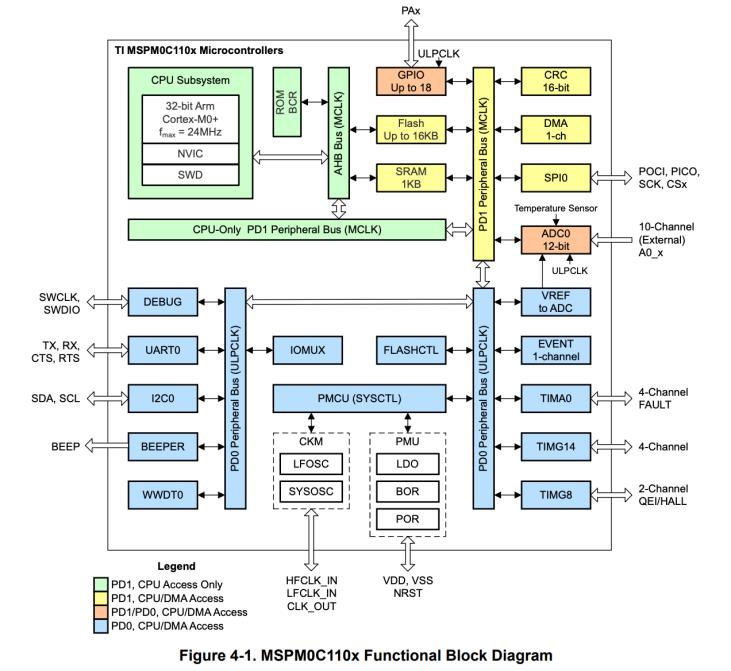
TI is not only pursuing the smallest package size, but also higher cost-effectiveness. It laid out the Cortex-M0/M0+ core at a very early stage and launched the MSPM0 series of products. The MSPM0C1104 launched last March was recognized as the smallest MCU at that time. It adopts Wafer-Level Chip Scale Package (WCSP) with an area of only 1.38mm², which is roughly the size of a grain of black pepper.
In terms of configuration, the MSPM0C1104 is equipped with a 24MHz Arm Cortex-M0+ core, 1KB SRAM, 16 KB memory, a power supply voltage range of 1.62 V ~3.6 V, a 3-channel 12-bit ADC, and 6 general-purpose input/output pins. It integrates a high-speed on-chip oscillator with an accuracy range of -2%~+1.2%, no external crystal oscillator is required. It is compatible with standard communication interfaces such as UART, SPI and I2C, with an operating temperature range of –40°C to 125°C.
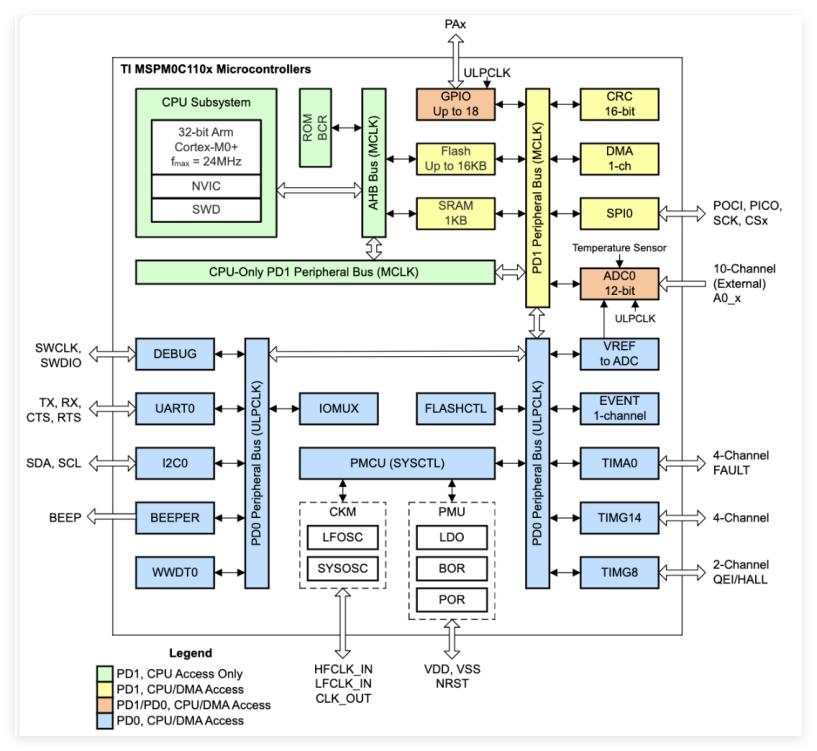
TI's MSPM0C1103 is also a product with extremely high cost-effectiveness, priced at around 0.25 US dollars, with a minimum package size of 1.6 x 0.86mm, 24 MHz M0+ core, 8 KB Flash, 1 KB RAM. It delivers excellent analog performance, and is suitable for scenarios such as sensors and power supply monitoring where accuracy requirements are higher than speed requirements.
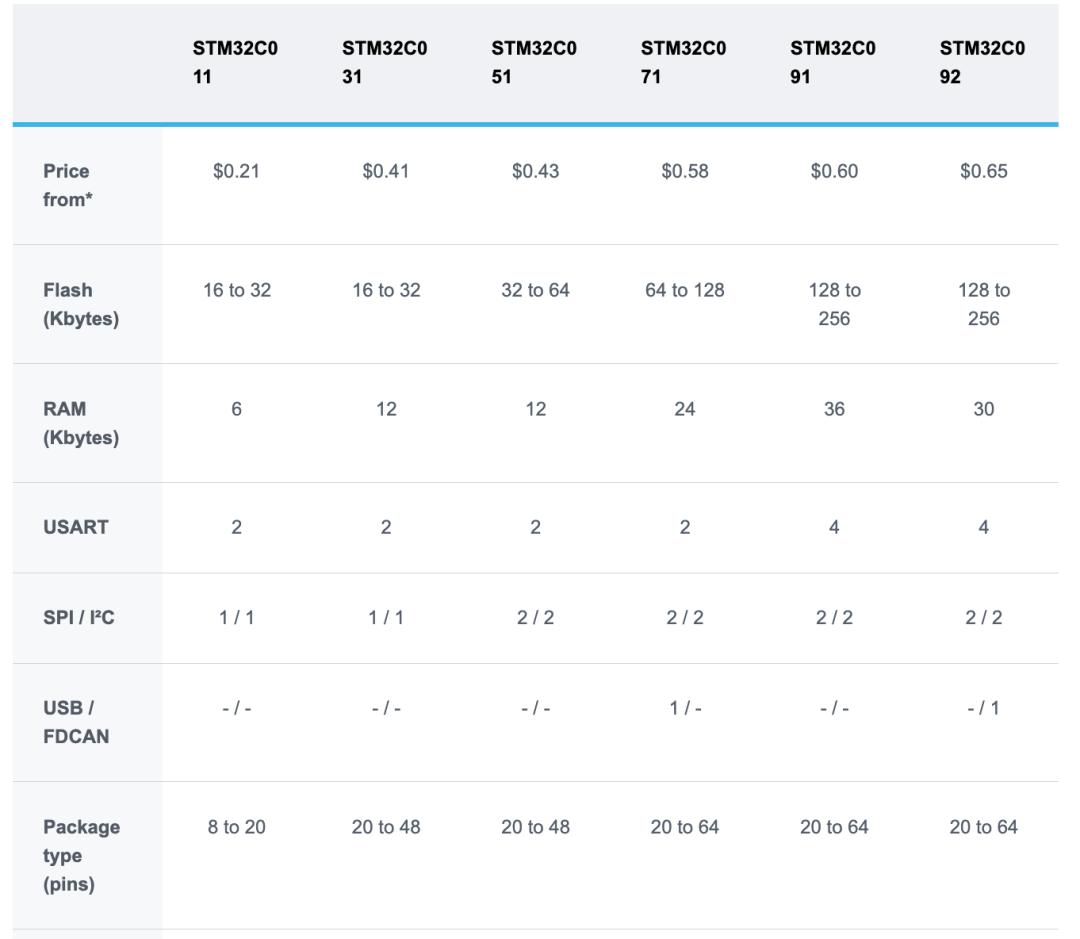
ST has long been committed to replacing 8-bit MCUs. Its Cortex-M0+ based STM32C0 series starts at 0.21 US dollars, and the minimum package size of some products can reach 1.70×1.42mm. It also provides as many I/O resources as possible within the limited size, and only requires a pair of power pins for power supply. The STM32C0 is also included in ST's 10-year long-term supply plan, and supports IEC 61508 functional safety, providing more guarantees for products that require long-term stable supply.
With the continuous expansion of product models, the STM32C0 also offers different function options. For example, the STM32C051 increases the maximum Flash capacity to 64KB; the STM32C071 adds USB connection; the STM32C091 further expands to maximum 256KB Flash and 36KB SRAM; the STM32C092 supports FDCAN communication.
In terms of hardware design, the STM32C0 is partially pin-compatible with the STM32G0, and integrates an internal clock with an accuracy of 1%, which helps simplify peripheral circuits and PCB design.
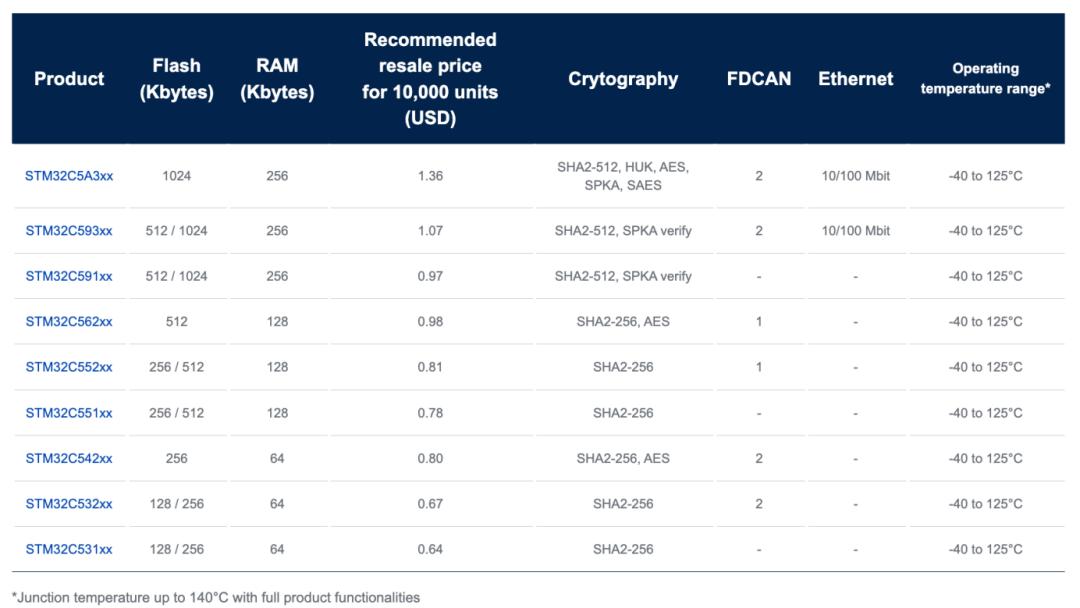
Later, ST launched the Cortex-M33 based STM32C5 this March, which is built on ST's 40nm process platform, with a maximum main frequency of 144MHz and a CoreMark performance of 593 points. It integrates up to 1024KB Flash and 256KB SRAM, and is also equipped with key peripherals such as Ethernet, OctoSPI and FDCAN. It provides options from 20 pins to 144 pins, supports a maximum operating temperature of 125°C, and can cover a wide range of mainstream application scenarios.
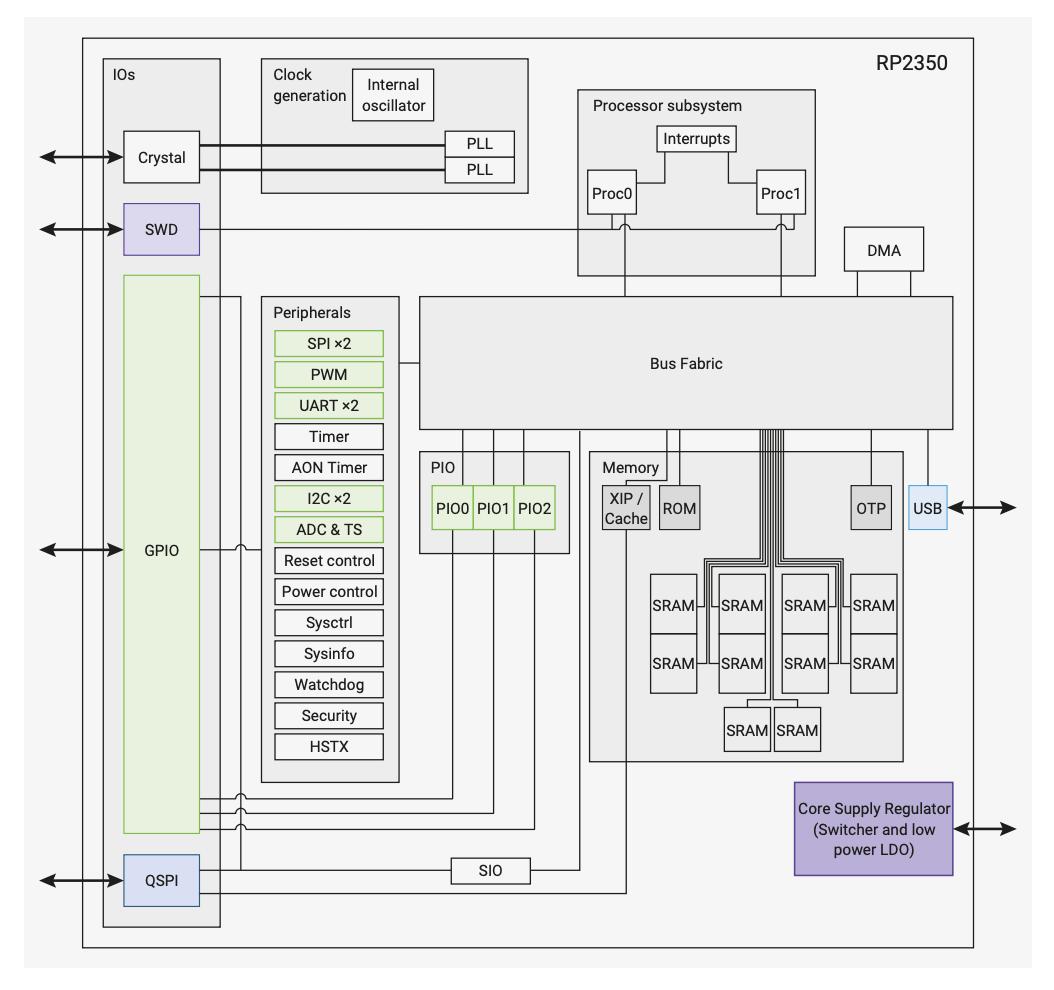
Of course, when it comes to low-cost and small-sized MCUs, RP2040/RP2350 cannot be ignored. The RP2040 has dual Cortex-M0+ cores, 133 MHz main frequency, 264 KB SRAM, and requires external Flash. The RP2350 has stronger performance, and its mass production price is still less than 1 US dollar. Its development boards Pico/Pico 2 have perfect support and a huge community, which is suitable for low-cost products requiring high computing power.
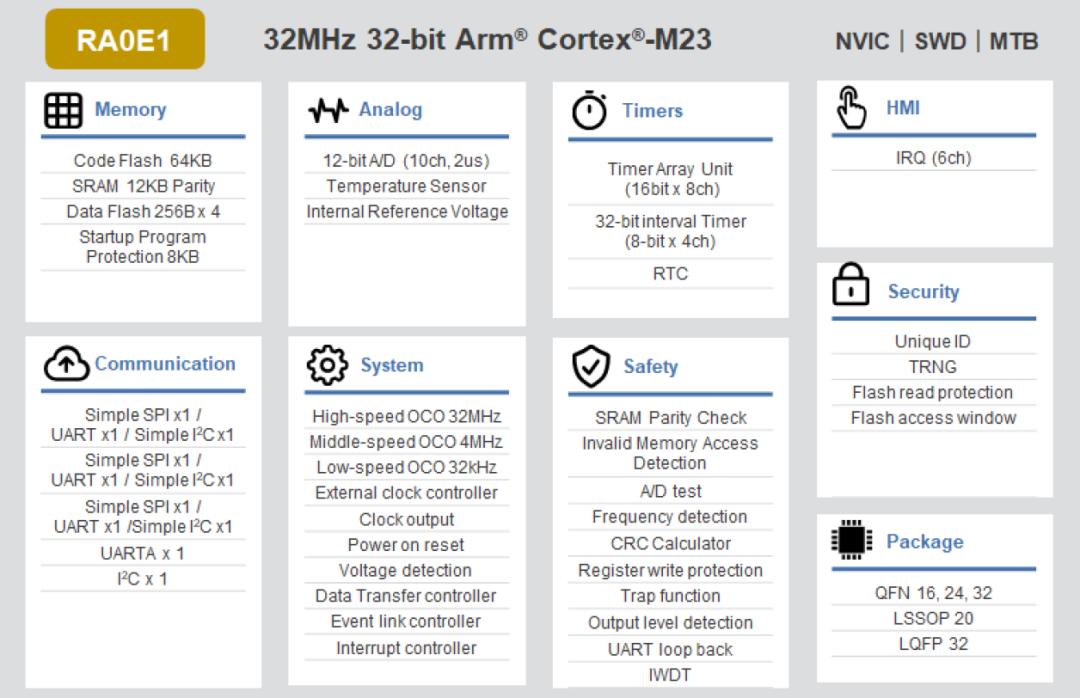
Renesas' RA0E1 is a 32-bit solution suitable for users pursuing cost-effectiveness and long-term stability, with a price of about 0.6~0.7 US dollars per thousand units, Cortex-M23 core, 32 MHz main frequency, 64 KB Flash, 12 KB RAM. It supports TrustZone security and has industrial-grade reliability.
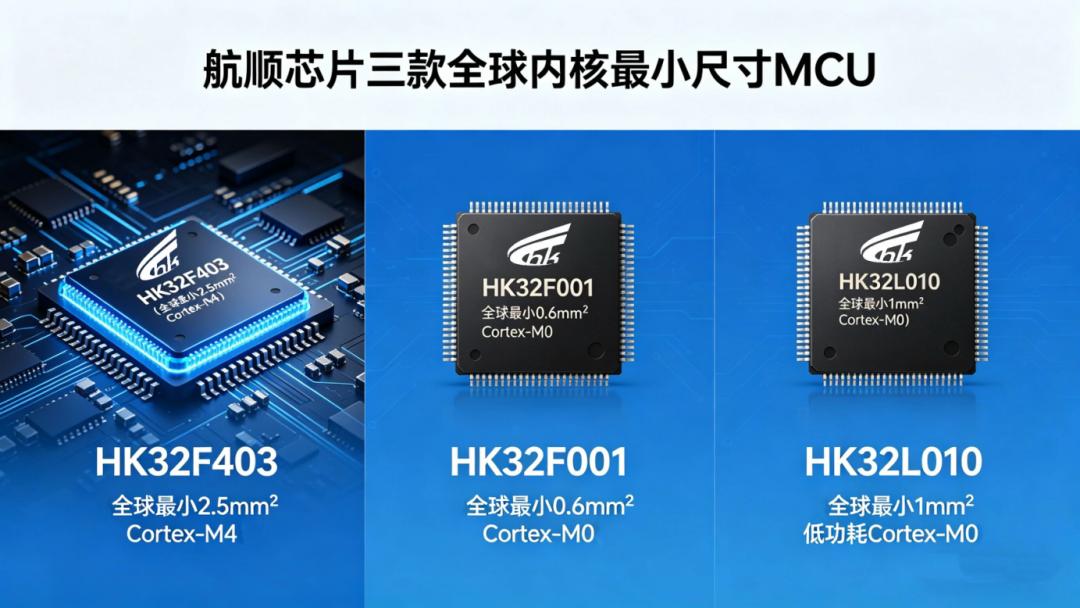
Domestic manufacturers are also working on miniaturization. Hangshun announced last year that its 32-bit MCU HK32F005 has a package area of 1mm². This June, Hangshun continued to launch the HK32F001, which adopts WLCSP (Wafer-Level Chip Scale Package) process to further reduce the package area to 0.6mm², setting a new record. In addition, Hangshun also released the small-sized M4 MCU HK23F403.
WLCSP can be simply understood as a technology that "makes the package the same size as the chip". It does not perform subsequent packaging after the chip is cut, but completes the relevant processes directly on the entire wafer, and then cuts it into individual chips. This approach reduces multiple processes and chip handling in traditional packaging, and also helps improve production efficiency. There is basically no obvious extra packaging space around the chip, so the length and width of the final device are very close to the bare die. Compared with common packages such as SOP and QFP, it has very obvious advantages in volume and weight, and is especially suitable for products that are sensitive to PCB space.
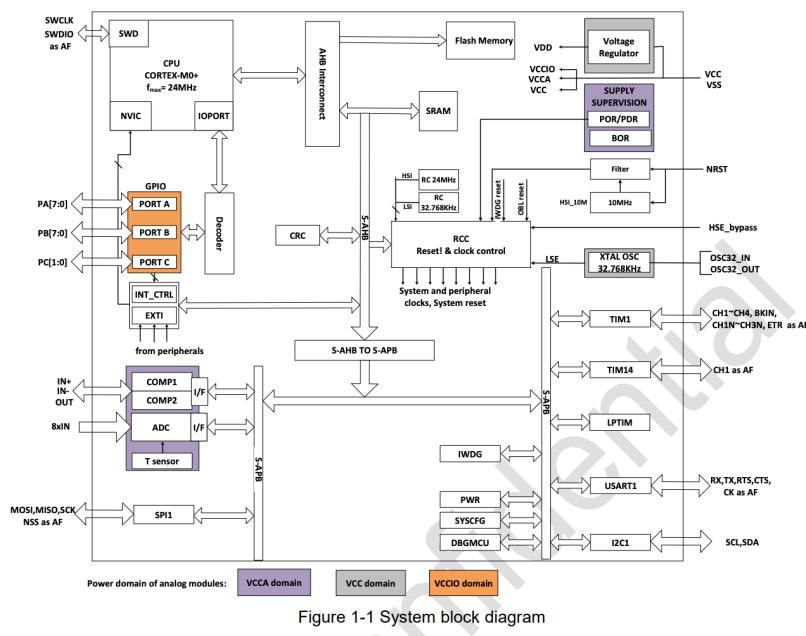
Puyuan has always been an unbeatable leader in the low-cost small-size MCU track. The PY32F002B is the most typical product, priced at around 8 cents, with 24Mhz M0+ core, 24 Kbytes Flash and 3 Kbytes SRAM.
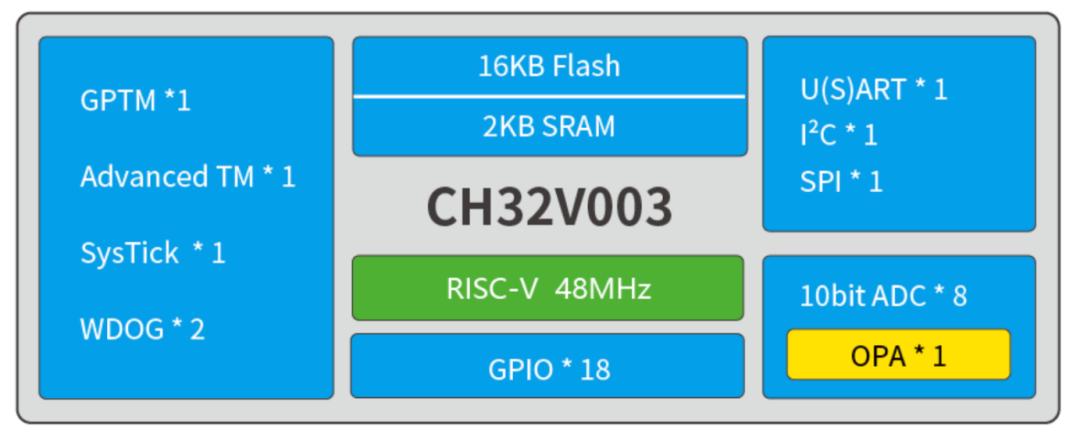
Qinheng's CH32V003 is a very cost-effective MCU on the RISC-V track, with a price of about 0.1 US dollars per thousand units, extremely low price, 32-bit RISC-V architecture, 48 MHz main frequency, 16 KB Flash, 2 KB RAM.
The long-running debate between 8-bit and 32-bit MCUs
Compared with 8-bit MCUs, 32-bit MCUs have many advantages. For example, they have stronger processing capability, wider memory bus, provide more advanced communication interfaces such as UART, USB, Ethernet, CAN, SDMMC and integrated LCD controller, pack more instructions per cycle to achieve faster execution speed and lower power consumption, and allow easy access to various libraries and well-maintained drivers.
However, 32-bit MCUs are not a universal solution. Achieving the best low-power operation is much more complex than simple 8-bit MCUs, they are more difficult to program and debug than 8-bit MCUs, and the code size may be larger than that of 8-bit MCUs for applications with limited memory. Of course, these are not the key points, the most important factor is still the price.
Some engineers said that the 32-bit M0/RISC-V MCUs from Qinheng and Puyuan priced at less than 0.5 US dollars support Arduino, which makes 8-bit MCUs almost meaningless. The power consumption performance of 32-bit MCUs is now very good, and the advantages of 8-bit MCUs hardly exist. Domestic M0 MCUs can be priced under 1 US dollar for consumer products, and less than 2 US dollars for industrial products. In addition, more and more devices need to access the network, and 8-bit MCUs are no longer sufficient for these scenarios.
Some others say that there are a huge number of 8-bit MCUs on the market, but few of them can still be called "MCUs" with full features. More extreme views hold that 32-bit MCUs are already extremely cheap, so there is no reason to use 8-bit MCUs at all.
Opponents argue that no matter how cheap 32-bit MCUs are, you can't find a 32-bit MCU at 0.5 US dollars. For simple light control MCUs priced at 0.5 US dollars, using M0 core is not cost-effective. Of course, some people say that CM0 can be obtained at that price in large volumes, but the OTP of 8-bit PIC MCUs with very few pins can still beat them, similar to the 4-bit cow-chip for calculators. We will not discuss these extreme cases, and ordinary 8-bit MCUs do not need to compete with CM0.
This article is from the WeChat Official Account , written by Fu Bin, and authorized for release by 36Kr.