Five years after being shut down, Xiami has been "resurrected" by Alibaba with AI.
After years of absence, has Xiami Music made a "resurrection from the dead" comeback?
Recently, Alibaba officially released its AI music model HappyShrimp 1.0, and simultaneously launched its PC web version for domestic and overseas users. On the first day of its launch, HappyShrimp announced a strategic cooperation with Taihe Music Group, covering the music industry ecosystem, AI music platforms, and co-creation with musicians.
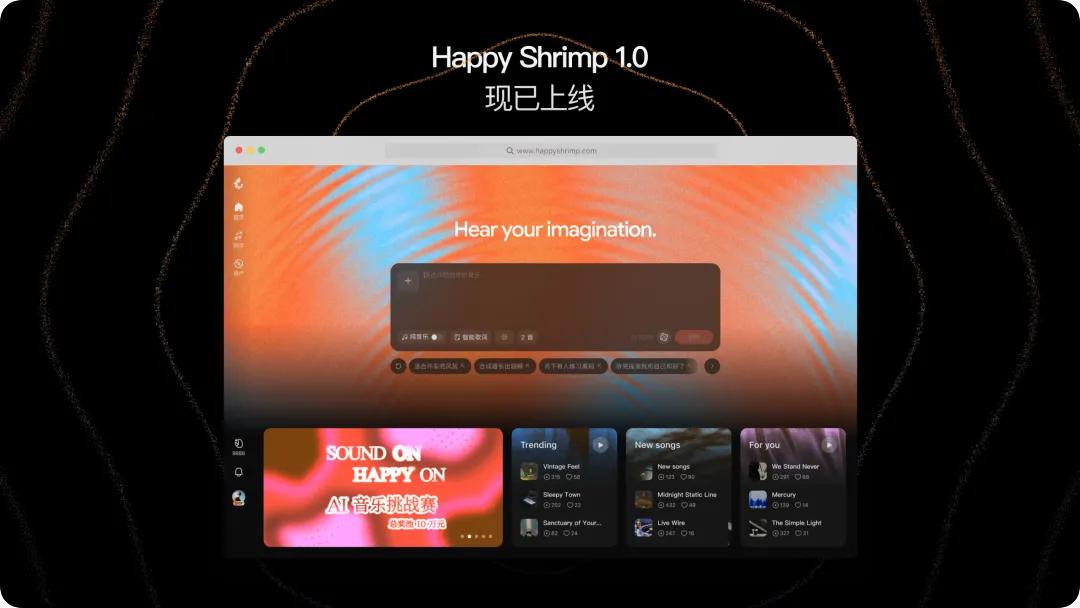
In February 2021, Xiami Music officially ceased operations. More than five years later, when the name "Xiami" reappears in Alibaba's music business layout, it brings a sense of emotional return for many long-time users. However, the Xiami that has returned is a brand-new one redefined by AI.
In 2026, when the AI music platform track is getting increasingly crowded, how much innovation can the belated HappyShrimp still offer? And why did Alibaba, which left the online music market many years ago, decide to bring Xiami back at this very moment?
Xiami is "resurrected" with the help of AI
Judging only from its product form, HappyShrimp does not go beyond the existing imagination of AI music tools.
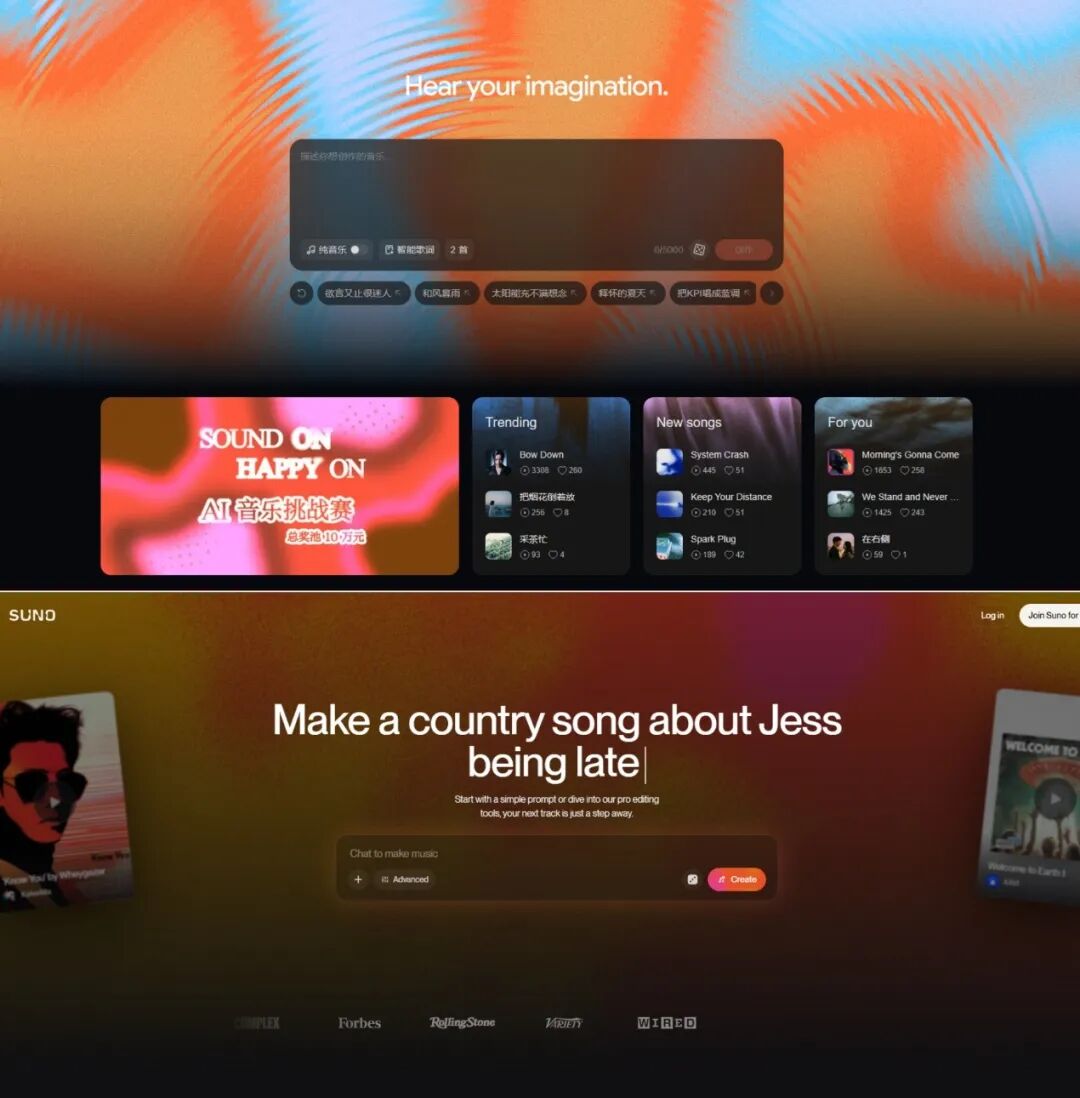
Its homepage is similar to the verified product paradigm of Suno: a large-sized prompt input box occupies the visual center, and outside the input box, the platform meets user consumption demands through popular songs, new tracks and personalized recommendations.
However, compared with domestic AI music platforms that have been iterated for many rounds, its interaction mode and subsequent creation tools are still relatively simple.
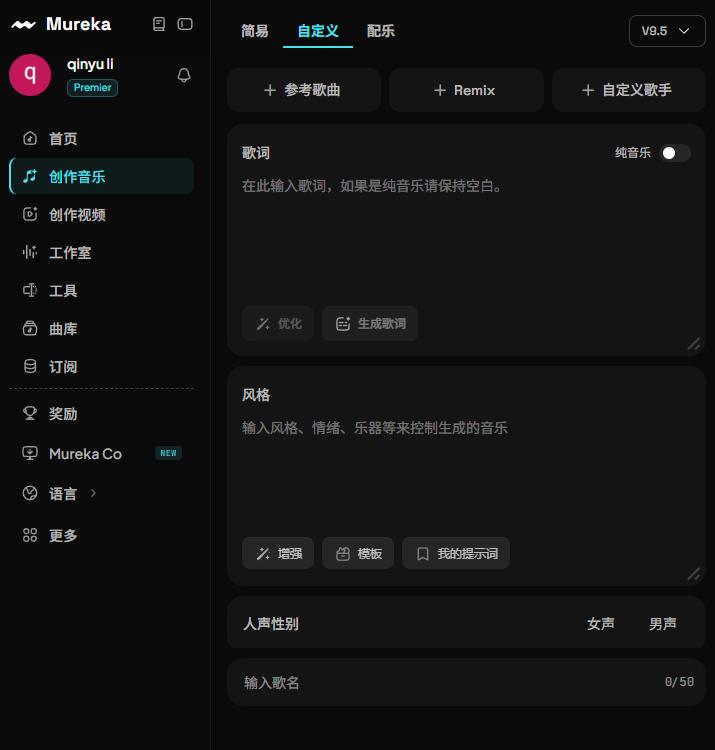
At present, most mainstream domestic AI music products have adopted a two-layer design of "low-threshold generation + professional control". Take Mureka as an example: on the one hand, it provides a "simple" mode that allows ordinary users to generate songs just by describing their inspirations; on the other hand, it offers a "custom" mode, and further extends tools including song editing, score conversion, track separation, continuation and Remix, embedding AI into a more complete music production workflow.
A similar layered design idea has also been applied to Sponge Music, NetEase Tianyin and Tencent VEMUS, all of which provide creation entrances of different depth.
Compared with AI music platforms that have gone through multiple iterations, HappyShrimp has not built a complex creation workstation for now, but tries its best to reduce the choices users need to make before generation.
From the perspective of actual generation results, a more obvious change is that the gap between different AI music models in generating a complete song is narrowing rapidly.
In order to eliminate the influence caused by the prompt itself as much as possible, we tested HappyShrimp, Mureka, Suno, Minimax, Sponge Music, VEMUS and NetEase Tianyin respectively with similar Chinese pop music requirements. We uniformly specified the theme of the song, gender of the vocalist, overall emotion, and tried to compare the results generated in one attempt.
Unified prompt (including lyrics): Create a Chinese pop music, set on the rooftop of a city, telling the story of relaxing and letting nature take its course. The vocal is a deep narrative male voice, the verse unfolds slowly with a simple texture, the chorus is full of harmony and releases energy, and the melody of the chorus should be catchy and memorable. The overall style is inspiring and relieving, so that listeners can picture the scene as soon as they hear it.
After several rounds of experience, Mureka and Suno still have relatively stable overall performance. Under the unified prompt, they rarely have obvious shortcomings in melody coherence, song structure and overall arrangement. Even if the first generation does not meet expectations, the functions of continuation, editing, Remix and track separation provided by the platform leave room for subsequent adjustment.
Sponge Music and Minimax also have good completion, which can basically accurately build the structure that an ordinary pop song should have, and there is no obvious sense of fragmentation between vocal, lyrics and accompaniment. Only in the test, the melody tension and memory points of some songs, as well as the tension of lyrics, are slightly weaker.
In contrast, the results of HappyShrimp, VEMUS and NetEase Tianyin fluctuate more obviously. There are occasional subtle flaws in prompt understanding, melody progression or vocal performance, and the overall listening experience has no obvious advantage for now.
However, HappyShrimp also shows its own strengths: in the case of one-time generation, the completion of its song text is relatively outstanding, and the efficiency from creative input to full song delivery is higher.
For example, under the guidance of the same prompt, the two songs generated by HappyShrimp are named "Through the Wind" and "Go with the Wind" respectively. Compared with titles such as "Night Breeze on the Rooftop" and "Let Nature Take Its Course on the Rooftop" given by other platforms, the former two do not mechanically repeat the scenes and keywords in the prompt, but further refine the images and emotions in it.
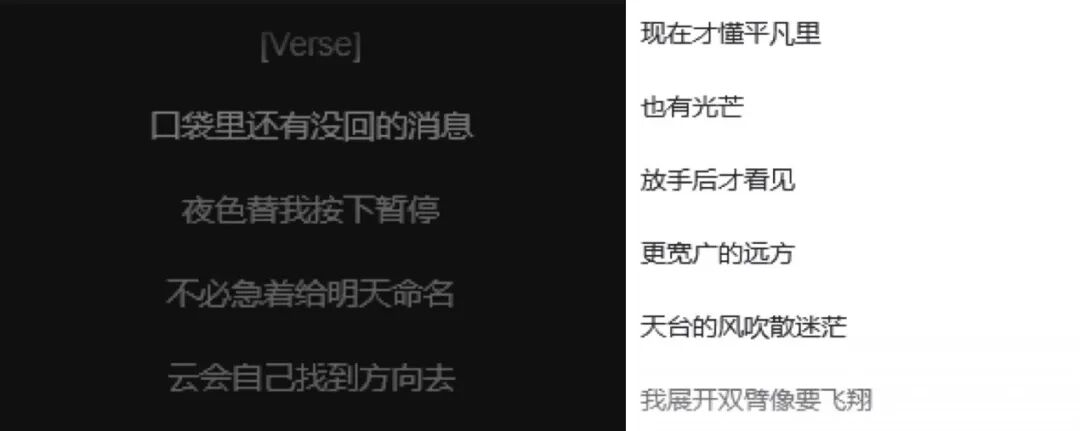
Similar features also appear in the lyrics. Taking a verse as an example, facing the prompt of "rooftop, relaxation, let nature take its course", some platforms tend to directly use common pop music lyric images such as "light", "distance", "confusion" and "flying". Although the expression is complete, it more or less feels like a standard answer.
In comparison, the lyrics generated by HappyShrimp such as "No need to rush to name tomorrow" and "Clouds will find their own way" do not directly repeat the phrase "let nature take its course", but break down this emotion into more specific life details and images. In other public actual tests, the quality of lyrics is also considered to be a relatively prominent advantage of HappyShrimp.
Of course, a single comparative test is not enough to prove that the model has an absolute leading advantage in text capability. But combined with several rounds of generation results, it at least presents a distinct feature of HappyShrimp at present: instead of asking users to describe their music needs professionally enough, it prefers to translate vague human expressions into music on its own.
In other words, the feature of HappyShrimp is that it builds its product more thoroughly on natural language interaction.
But it needs to be clarified that this is only a product orientation, not a unique technical barrier owned by HappyShrimp. More importantly, it catches the node where AI music further develops from lowering the production threshold to lowering the expression threshold.
At present, natural language generation has become the common evolution direction of this generation of AI music products. Even a few months ago, we tried to use similar daily language descriptions to let AI models generate songs, but when the prompt lacks clear labels of music style, BPM, instrument and emotion, the controllability of the generated results is often not as good as it is now.
Therefore, for HappyShrimp, its most distinctive product orientation at this stage is also its pressure. After all, when "one-sentence generation" itself changes from a differentiated selling point to the standard configuration of the industry, entering a more professional production process is an inevitable evolution direction, while the control space it can provide at present is still limited.
Overall, the "returning Xiami" has got the ticket to enter the AI music market, but this ticket does not equal to leading advantage. After the model capabilities gradually converge, whether Alibaba can truly connect natural language interaction, Xiami's brand assets, content distribution capabilities and music industry resources remains to be seen.
Why did Alibaba think of Xiami again?
Alibaba is actually no stranger to the idea of letting ordinary people create music.
As early as 2019, the Alibaba Innovation Business Group internally incubated the strum and sing app Changya. At that time, Changya tried to reduce the threshold of playing and singing through color keys and chord accompaniment, so that ordinary users who can't play musical instruments and lack music theory knowledge can also participate in music creation. Alibaba even defined this demand as the "pan-creation" of young people.

Interestingly, although Changya later left the Alibaba system, the group of people who did music "pan-creation" in those years did not leave the music industry. With the contraction of Alibaba's innovative business, the Changya business and part of its team later joined Tencent Technology, and continued to incubate the AI music large model Tianpule; Li Yang, the former project leader, left Alibaba and joined Kunlun Wanwei, and later developed the AI music model Mureka.
The emergence of HappyShrimp now more or less means a cycle of history. Of course, HappyShrimp is first an AI product, and then a music product, which is more suitable to be understood in Alibaba's current AI strategy.
Since the beginning of this year, Alibaba ATH Business Group (Alibaba Token Hub) has successively launched products such as HappyHorse and HappyOyster, extending from video generation to world models, and now to HappyShrimp for music generation. The "Happy series" has begun to cover different generation media.
Behind this is a question that all large AI manufacturers need to answer: when the model capability becomes stronger and stronger, besides selling models, Tokens and other products, how to deliver these capabilities to ordinary users?

Data shows that in the first quarter of this year, Alibaba Cloud's external revenue increased by 40% year on year. AI-related products have achieved three-digit growth for 11 consecutive quarters, accounting for 30% of the cloud's external revenue; the customer scale of Model Studio increased by 8 times year on year. Alibaba predicts that by the end of this year, the annualized recurring revenue of AI model and application services will exceed 30 billion yuan.
At the earnings call for the third quarter of Alibaba Group's 2026 fiscal year, group CEO Wu Yongming has set a very clear commercialization goal for Alibaba Cloud and AI business: in the next five years, the total revenue of cloud computing and AI external business will exceed 100 billion US dollars.
At the same time, Alibaba's AI layout is moving from capacity building to large-scale commercialization. From Pingtouge chips and cloud infrastructure to Tongyi model, MaaS, and then to Qwen and various consumer-level applications, Alibaba has built an increasingly complete full-stack AI chain. Wu Yongming also made it clear that the full-stack AI investment has crossed the early cultivation stage and entered the large-scale commercial return cycle.

In this context, Qwen covers text, HappyHorse and HappyOyster cover video and world models. Music, as a content media with natural high emotional value, strong consumption attributes, and suitable for creation and sharing, has almost no reason to be absent for a long time.
What's more, some people have completed the first round of market education for Alibaba. Overseas, Suno and Udio have proved that ordinary users are willing to use AI to generate music, and they have also stepped on the first round of copyright minefields for the whole industry.
Therefore, the significance of HappyShrimp announcing a strategic cooperation with Taihe Music Group on the first day of its launch is not just a conventional copyright cooperation. The two sides plan to explore around the music industry ecosystem, AI music platforms and co-creation with musicians, and HappyShrimp will also be applied to the actual scene of Aranya Xiami Music Festival.
For latecomers, entering the market a few years later means missing the first-mover advantage, but they can also see the problems left by the first round of competition clearly.
But the real reality in front of HappyShrimp is that today's domestic AI music market is no longer a no-man's land.
Alibaba (HappyShrimp), Tencent Music (Tencent Music · Qimeng / VEMUS), ByteDance (Sponge Music), NetEase (NetEase Tianyin) and other large manufacturers have entered the market one after another, but they have different resources. Tencent, ByteDance and NetEase are better at embedding AI music into their existing content ecosystems, connecting creation with playback, short video and musician services; Alibaba's advantages come more from models, cloud computing and its expanding AI application matrix.
Model manufacturers such as Kunlun Wanwei (Mureka) and MiniMax are closer to Suno's path, directly verifying the commercial value of AI music through subscriptions, APIs and professional tools; vertical players such as Tencent Technology (Tianpule) and Xianchord (DeepMusic) continue to dig into segmented creation demands and professional workflows.
