Professors from 985 universities have collectively started their businesses in the embodied intelligence sector, and have raised more than 10 billion yuan in financing this year.
How crazy the embodied intelligence track was in 2026: some companies secured a single round of financing of 2 billion yuan or 3 billion yuan, with the financing figures getting increasingly staggering. A few days ago, IT Orange released its latest *Report on the Ecological Portrait of Chinese Embodied Intelligence Entrepreneurs*, which has drawn wide attention from numerous readers.
In this boom, we found another conspicuous force is the academic faction. How to define "academic faction"?
It does not refer to the situation where "colleges and universities supply graduate talents", but refers to the embodied intelligence companies founded or incubated directly by higher education institutions.
Can you imagine that? Professors no longer only bury themselves in research in laboratories and publish papers in top journals. They directly register companies, serve as founders or co-founders, and even raise financing and operate production lines. And this is no longer an isolated phenomenon.
According to statistics from IT Orange, in the embodied intelligence circle, there are more than 70 companies whose founding team members are currently serving or have served as professors in universities. However, the screening criteria for the "academic faction" mentioned here are more stringent:
The first category is: Professors who serve as founders still hold positions in universities while starting their businesses, can mobilize resources and support from their alma maters, and cases with direct shareholding by universities are even more typical. Those that only invite university professors to serve as consultants or chief scientists are not included.
The second category refers to embodied intelligence companies that are the platformized products of universities, research institutes or laboratories, which is another representative of the academic faction.
Therefore, based on this standard, I have compiled a list, and the table counts a total of 18 "academic faction" embodied intelligence companies.
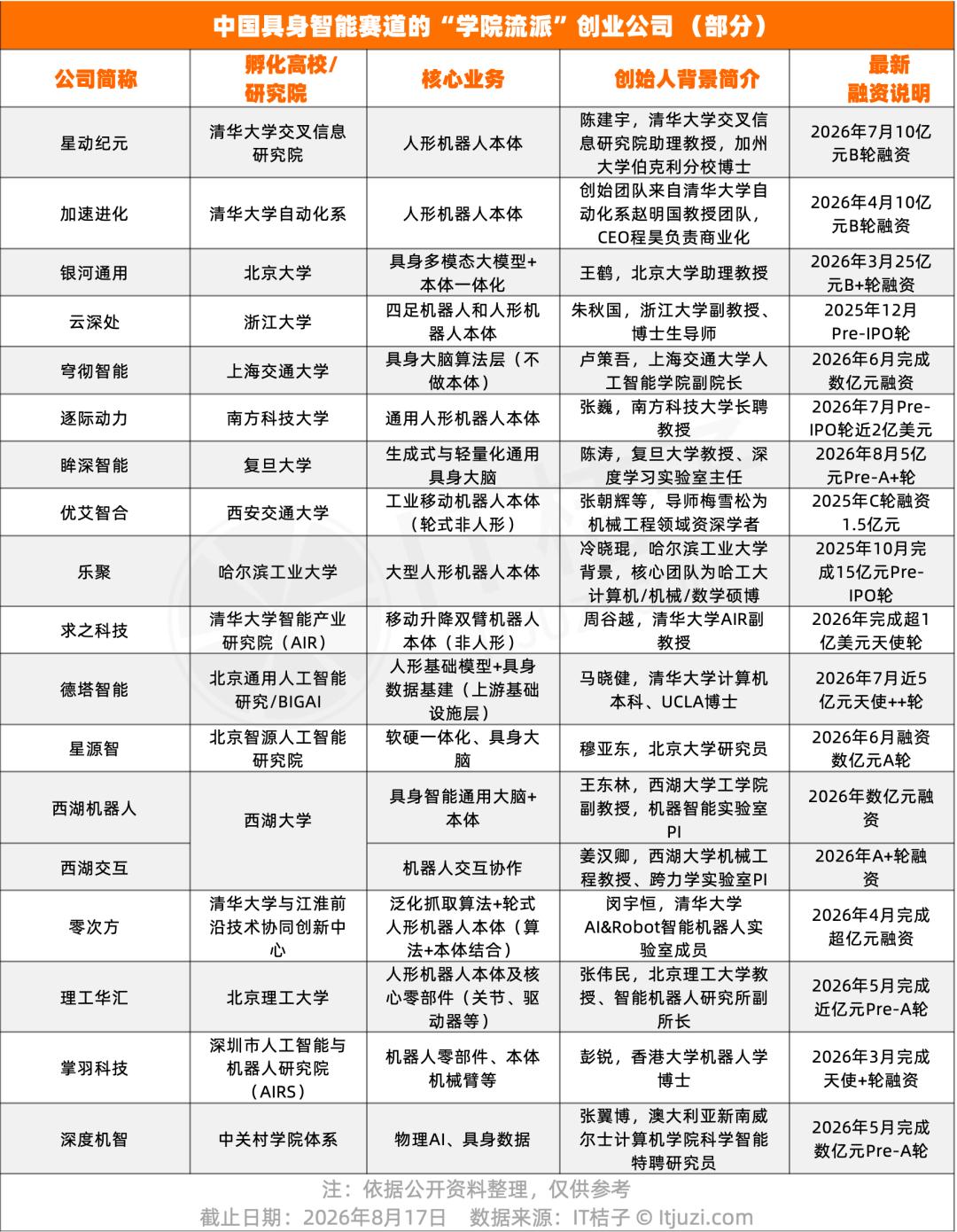
How capable are this batch of companies founded under the leadership of university professors and incubated by research institutes?
The financing data we counted shows that in the first 8 months of 2026, the total disclosed financing amount of these 18 "academic faction" embodied startups is about 150 billion yuan (estimated value), of which the clearly disclosed amount exceeds 130 billion yuan.
It can be said that they have held high the banner of the "academic faction" in embodied intelligence and become a core force in this track.
Now we simply divide these companies into two major categories. The first category is that the core founders or co-founders are backed by well-known universities, covering comprehensive and high-ranking 985/211 universities such as Tsinghua University, Peking University, Zhejiang University, Shanghai Jiao Tong University and Fudan University.
The second category is directly incubated by universities or research institutes, such as Westlake University, Tsinghua AIR, Beijing Academy of Artificial Intelligence, Chinese Academy of Sciences, etc. It will be clearer to look at them separately.
When 985 University Professors Take the Lead and Dive into the Business
The number of companies in the embodied intelligence sector founded by 985 university professors in person is not very large, but they naturally attract the most attention. Founders usually have the title of professor, and devote themselves to entrepreneurship with the motivation to transform academic research results into commercial applications.
Star Era, in which Tsinghua University holds shares, is a typical case that focuses on humanoid robot ontology. Its founder Chen Jianyu is an assistant professor at the Institute for Interdisciplinary Information Sciences of Tsinghua University and a PhD graduate of the University of California, Berkeley. The company was established in August 2023, starting as an incubation project of the Institute for Interdisciplinary Information Sciences. It completed a 10 billion yuan Series B financing in July 2026 and grew into a unicorn in more than two years.
There is also Accelerated Evolution in the Tsinghua University camp, which also focuses on humanoid robot ontology.
The company was established in June 2023. Its founding team comes from the humanoid robot team of Professor Zhao Mingguo from the Department of Automation of Tsinghua University, and CEO Cheng Hao is in charge of commercialization. In April 2026, Accelerated Evolution completed a 10 billion yuan Series B financing and also became a unicorn.
The representative embodied intelligence company of Peking University is Galaxy Universal, which takes the integrated route of "embodied multimodal large model + general humanoid robot ontology". Its founder Wang He is currently an assistant professor at the Center for Frontiers Computing Research of the School of Computer Science of Peking University.
The company was established in May 2023, obtained 11 billion yuan of financing led by CATL in June 2025, and completed another 25 billion yuan of Series B+ financing in March 2026. Last year, Galaxy Universal launched a smart retail store in Haidian, where humanoid robots "work".
The representative embodied intelligence company founded by professors from Zhejiang University is Deep Motion, which focuses on quadruped robots and humanoid robot ontology, with strengths in power inspection and emergency rescue. Its founder Zhu Qiuguo is an associate professor and doctoral supervisor at Zhejiang University. This company was established earlier, starting in Hangzhou in 2017, and is one of the "Six Dragons of Hangzhou".
In July 2025, Deep Motion completed nearly 500 million yuan of financing jointly led by Dachen Caizhi and Guoxin Fund, and completed the Pre-IPO round in December. Among this batch of professor-founded companies, Deep Motion is the first one that has achieved commercial success.
The representative company of Shanghai Jiao Tong University is Qiangchen Intelligence, which does not make robot ontology, but specializes in the algorithm layer of the embodied brain.
Its founder Lu Cewu is the vice dean of the School of Artificial Intelligence of Shanghai Jiao Tong University and a Cheung Kong Scholar. The company was established in November 2023, and self-developed Noematrix Brain (Qiangchen Embodied Brain). In June 2026, Qiangchen Intelligence completed several hundred million yuan of financing, and this round of investors includes the "Shanghai Jiao Tong University AI Future Fund" and a wholly-owned subsidiary of Shanghai Chuangzhi College.
The representative of Southern University of Science and Technology is Exceed Dynamics, which makes general humanoid robot ontology.
Its founder Zhang Wei is a tenured professor at Southern University of Science and Technology. He previously served as a tenured professor at The Ohio State University in the United States, and has been researching humanoid robots for more than ten years. The company was established in 2022, completed a 200 million US dollar Series B financing in February 2026, and raised nearly 200 million US dollars in the Pre-IPO round in July, with a valuation of 150 billion yuan. Its shareholder list includes Alibaba, SAIC Motor, NIO, JD.com, etc.
What is more noteworthy is that nearly 70% of this round of financing comes from overseas institutions, with funds from the Middle East and Europe betting on China's humanoid robot track.
The representative embodied intelligence company incubated by Fudan University is Moushen Intelligence, which develops generative and lightweight general embodied brains, belonging to the algorithm layer. Its co-founder Chen Tao is a professor at Fudan University and the director of the Deep Learning Laboratory. The company was established in January 2025 and just completed a 500 million yuan Pre-A+ round of financing in August 2026.
From Moushen Intelligence and Qiangchen Intelligence to Deeta Intelligence and Star Source Intelligence, they are all basically seizing the ecological niche of the embodied brain, which also shows that the competition focus of embodied intelligence is shifting from "ontology" to "brain".
The representative company of Xi'an Jiaotong University is Youibot, which develops industrial mobile robot ontology (wheeled, non-humanoid), focusing on factory logistics and intelligent inspection. Its founding team members including Zhang Zhaohui all come from Xi'an Jiaotong University, and their tutor Mei Xuesong is a senior scholar in the field of mechanical engineering.
The company was established in 2017, and its products are applied in logistics handling in semiconductor, new energy and 3C factories, as well as inspection scenarios of pipe corridors, power distribution rooms and substations. Youibot completed a 150 million yuan Series C financing and is a "Specialized, Refined, Differential and Innovative Little Giant" enterprise recognized by the Ministry of Industry and Information Technology. The idea of this company is more pragmatic - make profits first, and then discuss the form of products.
The representative company of Harbin Institute of Technology is Leju, which develops large-scale humanoid robot ontology. Its founder Leng Xiaokun has a background of Harbin Institute of Technology. The company was established in 2016 and is one of the earliest companies in China to develop large-scale humanoid robots. Its core team is distributed in Shenzhen and Harbin, and all members are masters and doctors majoring in computer science, mechanics and mathematics from Harbin Institute of Technology.
In October 2025, Leju Robot completed a 1.5 billion yuan Pre-IPO round of financing jointly invested by more than a dozen institutions including Shenzhen Investment Control Capital, Longhua Capital and CITIC Goldstone. Its cumulative financing has exceeded 1.7 billion yuan. Leju's "Kuafu" series has jointly built an ecosystem with more than 40 enterprises including Huawei, Tencent, China Mobile and FAW Group. The feature of Leju is mass production first - when its peers are still releasing prototypes, Leju has already started small-batch delivery.
In addition, there are several companies that are often classified as or claim to be "university-incubated", but strictly speaking they do not meet the criteria.
For example, Starpull Technology once relied on Zhejiang University, but has since separated from it; Moce Intelligence is an incubation project of Tsinghua x-lab, but Tsinghua x-lab is an "on-campus entrepreneurship incubator" of Tsinghua University, affiliated to the School of Economics and Management, and is more oriented to students and alumni. The incubated projects have no direct relationship with Tsinghua University after their establishment.
New Research Institutes Are Incubating Startups in Batches
If the first category refers to professors starting their own businesses with the support of universities, the second category refers to scientific research institutions and research institutes directly splitting teams and platform achievements to establish companies and register enterprises. Such companies also have extremely high financing popularity.
The Institute for AI Industry Research (AIR) of Tsinghua University incubated Qiuzhi Technology, and Zhang Yaqin serves as the dean of AIR.
Qiuzhi Technology develops mobile lifting dual-arm robot ontology (non-humanoid), focusing on scientific research training and commercial service scenarios. In 2026, Qiuzhi Technology completed more than 100 million US dollars of angel round financing, with eight institutions jointly injecting capital.
Its founder Zhou Guyue is a PhD graduate of the Hong Kong University of Science and Technology, a student of Li Zexiang, and an early core member of DJI. He joined Tsinghua AIR as an associate professor in 2020 and industrialized the laboratory achievements in 2023.
In addition, the Beijing Academy for General Artificial Intelligence (BIGAI) incubated Deeta Intelligence.
Deeta Intelligence is positioned to focus on basic models of embodied intelligence and data infrastructure. The company has launched a head-mounted full-body data collection device Delta D1, which allows users to collect motion data by wearing the device and working normally.
Deeta Intelligence was only established in January 2026, and obtained nearly 500 million yuan of angel++ round financing in July, completing six rounds of financing within half a year. Its founder Ma Xiaojian got his bachelor's degree in computer science from Tsinghua University and his PhD degree from the University of California, Los Angeles. He once worked at Google Robotics and NVIDIA Research, and later served as a researcher at BIGAI.
The Beijing Academy of Artificial Intelligence (abbreviation: BAAI, the "national team" platform in the field of domestic AI large models) incubated Xingyuanzhi.
Xingyuanzhi is committed to the embodied brain model deployed across ontologies and the integrated architecture of software and hardware (brain + high-computing edge hardware). It was established in August 2025, and raised 10 billion yuan within 10 months: including 200 million yuan of angel round, over 100 million yuan of angel+ round and Pre-A round. At present, the software and hardware integration solution of Xingyuanzhi Robot has covered more than 70% of the leading embodied intelligence companies, and it is also the world's largest shipper of NVIDIA Jetson Thor.
Tsinghua University also jointly incubated Zero Power with Jianghuai Frontier Technology Collaborative Innovation Center.
Zero Power focuses on generalized grasping algorithms, and also launches wheeled humanoid robot ontology, belonging to the route of combining "algorithm + ontology". The company is registered in Hefei, and completed more than 100 million yuan of financing in April 2026, led by Runze Group. The generalized grasping technology of Zero Power does not customize programs for specific items, and the robot can independently judge the grasping method when facing unknown items. Its ZERITH-H1 wheeled humanoid robot has been exported to Malaysia as a complete machine in 2026.
The representative of Beijing Institute of Technology is Ligong Huahui, which develops humanoid robot ontology and core components (joints, drivers, etc.). The company was established in 2015, and completed nearly 100 million yuan of Pre-A round of financing in May 2026. Beijing Institute of Technology has profound accumulation in the field of bionic robots and special robots, and Ligong Huahui is a typical path of "professor + university-run industry".
There are also several companies that are incubated by research institutes but still in the early stage: Zhangyu Technology incubated by Shenzhen Institute of Artificial Intelligence and Robotics for Society (AIRS), and Deep Intelligence under the Zhongguancun College system.
It is worth mentioning that Westlake University has incubated a total of 18 startups, including two major embodied intelligence companies — Westlake Interaction, incubated from the Cross-Mechanics Laboratory of Jiang Hanqing, a distinguished professor of mechanical engineering at Westlake University, which mainly provides embodied intelligence solutions and has launched a flexible variable-stiffness manipulator; Westlake Robotics, which focuses on the R&D of autonomous general humanoid robot ontology and embodied brain, its founder Wang Donglin is a tenured professor at Westlake University and the deputy dean of the Department of Artificial Intelligence.
There is also a "Siasun/Cobot" incubated by the listed company "Siasun Robot", which is not included in the list.
In 2000, Shenyang Institute of Automation of Chinese Academy of Sciences established Siasun, the first robot enterprise in China. The company was named after academician Jiang Xinsong, the "father of Chinese robots", and was later listed on A-share market, known as the "first robot stock". Siasun develops all categories of industrial robot ontology. In 2025, this established enterprise officially entered the embodied intelligence track, launched the "Songyi" wheeled robot and "Songxing" biped humanoid robot, and established an embodied intelligence research institute.
Siasun completed several hundred million yuan of A+ round of financing in July 2026. In April 2026, nearly 100 Siasun large-load industrial robots entered the main welding production line of Geely Automobile. It is reported that this is the first time that domestic spot welding robots have been applied to automobile welding lines in batches.
High Density of Tsinghua-affiliated Companies, University Industrial Funds Invest Simultaneously
Finally, let's summarize several observations within the "academic faction" system:
First, Tsinghua University has an extremely high presence density in the field of embodied intelligence.
Star Era, Accelerated Evolution, Qiuzhi Technology and Zero Power are all "direct line" Tsinghua-affiliated companies. Coupled with the Tsinghua and Peking University forces behind many research institutes, Tsinghua University almost supports half of China's embodied intelligence industrial chain with the strength of one single university.
The reason is not difficult to understand: the transformation chain of "university - research institute - enterprise" within the Tsinghua system is very complete, and there are many mature cutting-edge industrial experimental platforms, such as the Institute for Interdisciplinary Information Sciences, AIR, BAAI, the laboratory of the Institute of Communications, etc. Core technologies, talents (professors and students), capital and application scenarios are basically in the same network.
Second, university funds have begun to enter the market directly.
The shareholder list of Star