AI Applications in Manufacturing Enterprises: Crossing the Inflection Point
First, let's take you to a workshop.
In the intelligent factory for high-performance radial tires of Hangzhou Zhongce Rubber, dozens of AGVs travel precisely along preset routes, and robotic arms complete the tire vulcanization process with micron-level accuracy. On average, a new tire rolls off the production line every 3.1 seconds, 24 hours a day without interruption.
What is the result? The production efficiency has increased by 300%, and the product defect rate has dropped to 0.5%.
Let's look at another workshop. An air-conditioning factory deployed an AI visual quality inspection system, where a single piece of equipment replaces 8 quality inspectors, cutting labor costs by 87.5%.
There are even more impressive cases. A mold factory uses large language models to generate parameter configuration schemes, reducing the number of mold trial runs from nearly 100 to 2, and raising the product qualification rate from 92% to 97%.
These are not concepts or PPT demos, but real things happening in China's manufacturing workshops right now.
In this article, I want to discuss four questions with you: How far have AI applications in manufacturing enterprises progressed? In which scenarios are profits actually being made? How to measure the value created? What is still missing to get past the final last mile?
01. A Figure: From 9.6% to 47.5%
The best way to judge the development stage of a technology in the industry is not to listen to vendors' stories, but to look at its penetration rate.
IDC's survey of Chinese industrial enterprises sends a very clear signal: The proportion of industrial enterprises applying large language models and agents has soared from 9.6% in 2024 to 47.5% in 2025, a fivefold increase in just one year.
Another even more notable figure is: The proportion of enterprises applying AI in multiple links including R&D, manufacturing and supply chain at the same time has jumped from 1.7% to 35%. This shows that AI in the manufacturing industry has crossed the "single-point trial" stage and is moving towards "cross-link collaboration".
Capital is also pouring in. IDC predicts that by 2028, the scale of AI expenditure of Chinese industrial enterprises will be close to 90 billion yuan, with a compound annual growth rate of 37.7%. As the industry puts it: AI has moved from the "concept investment period" to the "scalable expansion period".
The policy orientation is also clear. The "Implementation Opinions on the Special Action of 'Artificial Intelligence + Manufacturing'" jointly issued by eight government departments proposes that by 2027, 3 to 5 general large models will be promoted for in-depth application in the manufacturing industry, 1,000 high-level industrial agents will be launched, 100 high-quality industrial datasets will be built, and 500 typical application scenarios will be promoted. Shandong even released a list of 100 "AI + Manufacturing" scenarios in one go in August, promoting implementation with the "scenario-driven" model.
What does scalable expansion mean? It means that enterprises no longer ask "whether we should adopt AI", but ask "how can AI truly help us improve quality, reduce costs and increase efficiency". And the key to answering this question lies in scenarios.
02. Four Major Trends: AI is Reshaping the "Underlying Operating System" of Manufacturing
Trend 1: From single-point pilot to full-chain penetration.
Among more than 230 built excellent-level intelligent factories, full-chain applications have delivered tangible results: The average product R&D cycle is shortened by 28.4%, the average production efficiency is increased by 22.3%, and the average defective product rate is reduced by 50.2%. AI is no longer a plug-in only for the quality inspection link. It has its place in every link from the designer drawing the first blueprint to the operation and maintenance service after product delivery.
Trend 2: From "tool empowerment" to "core of value creation".
Huawei put forward a judgment at the AI+ Manufacturing Industry Summit: Most enterprises still regard AI as an "efficiency tool", while leading enterprises are shifting AI's positioning from "tool empowerment" to "core of value creation". If you treat AI as a tool, you will find a spot in the existing process to insert it. If you treat AI as the core of value creation, you will use an AI-native perspective to redesign processes, redefine positions, and recalculate benefits. At present, more than 30% of China's above-scale manufacturing enterprises have established AI-related organizations. When AI begins to force organizational transformation, it is no longer a tool, but an engine.
Trend 3: From "conversational" to "factory-aware".
General large language models are very smart, but directly deploying them in workshops will cause problems: The model cannot explain the source of conclusions, predictions lack physical constraints, and "hallucinations" may lead to production accidents that are difficult to trace. So the industry's solution is the industrial world model — encapsulate all the data and business logic of the real factory into the model, so that AI can understand the entities, causal relationships and operation rules in the industrial world, ensuring that conclusions are supported by evidence, traceable, auditable and accountable. This is the "pass" for AI to enter the core production process.
Trend 4: From "solo operation" to "agent cluster".
A single-point AI application is like a band where only the violin is playing while all other instruments are idle. Real leap comes from collaboration: No matter how accurate the quality inspection agent is, if equipment management, production scheduling and supply chain collaboration work in isolation, the overall efficiency still cannot be improved. Midea's agent matrix has been implemented in 158 core scenarios, and the operation mode of factories is being upgraded from "assembly line operation" to "networked collaboration". From automation to autonomy, from digital tools to digital employees — this is the evolutionary main line of AI applications in manufacturing enterprises.
03. Where Profits Are Made: Nine High-Value Scenarios
After talking about the trends, when it comes to the enterprise level, the most practical question is: In which scenarios can AI generate real, tangible profits? Combining the scenario lists released across regions and the verified practices of operating factories, I have sorted out nine repeatedly validated high-value scenarios. Let's first look at the overall picture:
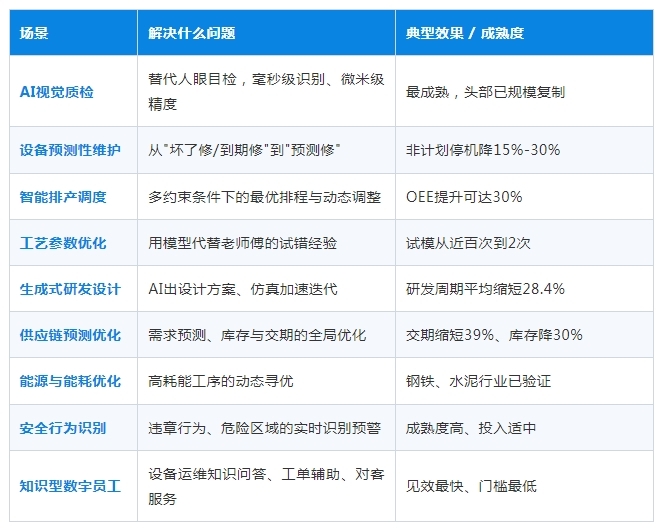
Let's focus on the key parts below.
Scenario 1: AI Visual Quality Inspection — The Most Mature First Stop.
Why is quality inspection the first AI landing scenario for almost all manufacturing enterprises? Because the pain points are prominent (human eye fatigue, inconsistent standards, high missed detection rate), data is easy to obtain (labeled samples are available as soon as cameras are installed), and value is easy to calculate (it is clear how many quality inspectors are replaced). Zhongce Rubber has reduced the defect rate to 0.5%, the AI quality inspection accuracy of Huawei's southern factory reaches 99.9%, and a single device in an air-conditioning factory replaces 8 quality inspectors, cutting labor costs by 87.5%. The current evolution direction is multi-modal quality inspection: it not only analyzes images, but also makes comprehensive judgments combining voiceprint, vibration and temperature — you can even tell if a bearing has internal damage just by listening to its sound.
Scenario 2: Predictive Equipment Maintenance — From "repair after breakdown" to "predictive repair".
Traditional equipment management offers only two choices: repair only after breakdown (unplanned shutdown with maximum loss), or regular maintenance (over-maintenance that wastes costs). The idea of predictive maintenance is to install a "physical examination instrument" on the equipment: integrate multi-source sensor data such as vibration, temperature, current and acoustics, so that the model can predict the fault window in advance. Industry data shows that unplanned shutdown time is reduced by 15%-30%, and maintenance costs are reduced by 10%-25%. For continuous production industries (chemical, steel, glass, cement), the loss of one day of unplanned shutdown of a production line can reach millions of yuan, so the value of this scenario is very easy to calculate.
Scenario 3: Intelligent Production Scheduling — Turning the "experience and intuition" of veteran technicians into "optimal solutions".
Multiple orders, multiple production lines, multiple processes, delivery date constraints, equipment capacity constraints, changeover time... Production scheduling is a typical combinatorial explosion problem. A veteran technician may spend hours making a scheduling table, which is not necessarily optimal. AI scheduling can provide feasible solutions within minutes and support dynamic adjustment: automatic rescheduling after order insertion or equipment failure. After Midea implemented its agent matrix, the overall equipment efficiency (OEE) on the manufacturing side increased by 30%. The higher the degree of flexibility of an enterprise (small batch, multi-variety), the greater the value of this scenario.
Scenario 4: Process Parameter Optimization — Large models begin to "learn" the skills of veteran technicians.
This is the direction with the most imagination space. Processes such as injection molding, vulcanization, welding and heat treatment have long relied on the experience of veteran technicians to set parameters, leading to extremely high trial and error costs. A mold factory uses large models to generate parameter configuration schemes, reducing the number of mold trial runs from nearly 100 to 2, and increasing the qualification rate from 92% to 97%. Going further, it will evolve to the "process world model": feed all historical process data, mechanism formulas and real-time working conditions into the model, so that the optimal parameter window for each product is known before production. The experience is no longer "stored in the veteran technician's mind" but "stored in the model", which is the core knowledge assetization of manufacturing enterprises.
Scenario 5: Generative R&D and Design — The speed of drawing has been completely changed.
AI applications in the R&D and design link have two layers: the first is the efficiency layer, where generative design automatically produces solutions and simulation accelerates iteration, and the average R&D cycle of excellent-level intelligent factories is shortened by 28.4%; the second is the breakthrough layer, where AI can explore design spaces that human engineers cannot think of in material formula and topology optimization. For equipment manufacturing and new material enterprises, the value of this layer far exceeds "faster drawing speed".
Scenario 6: Supply Chain Prediction and Optimization — Looking beyond the workshop.
Demand forecasting, safety stock, logistics routes, supplier risks — the supply chain is a data-intensive link that is naturally suitable for AI. Midea has shortened its end-to-end supply chain delivery cycle by 39% and reduced inventory turnover days by 30%. The feature of this scenario is cross-enterprise collaboration: data needs to connect suppliers and channels, which is highly difficult, but once implemented, it will form a barrier that competitors cannot replicate.
Scenario 7: Energy Consumption Optimization — An Underrated "Hidden Gold Mine".
For high-energy-consuming industries (steel, cement, chemical, papermaking), electricity bills account for the largest part of costs. AI energy consumption optimization dynamically adjusts the production rhythm under the constraints of fluctuating electricity prices and load, uses energy during off-peak hours, and optimizes the operating parameters of high-energy-consuming processes. Against the background of dual carbon goals and market-oriented electricity prices, this scenario is changing from a "nice-to-have" to a "must-have".
Scenario 8 & 9: Safety Identification and Digital Employees — The Lowest Threshold Entry Point.
Safety behavior identification (no safety helmet worn, unauthorized entry into hazardous areas, forklift proximity warning) has mature technology and moderate investment, and many enterprises use it to practice AI capabilities. Knowledge-based digital employees are new species in the large model era: equipment operation and maintenance Q&A, intelligent work order filling and dispatching, after-sales customer service. Midea's conversational AI penetration rate on vehicle-mounted terminals has reached 51%. These scenarios do not touch core processes, with low risks and quick returns, making them particularly suitable as "training grounds" for enterprises to build large model capabilities.
How to choose scenarios? Three judgment criteria: Data availability (whether there is accumulated historical data in this scenario), value quantifiability (whether the effect can be converted into monetary value), and failure affordability (whether AI errors will cause safety accidents). Any scenario that meets all three criteria is your first stop.
04. Calculate the Value: Four Accounts
After reviewing all the scenarios, enterprise decision-making must ultimately fall on financial calculation. It is recommended that managers divide the value of AI into four accounts:
The first account: Efficiency account. 300% increase in production efficiency (Zhongce Rubber), 28.4% reduction in R&D cycle (average of excellent-level intelligent factories), 30% increase in OEE (Midea). AI liberates people from repetitive labor and maximizes the potential of machines.
The second account: Quality account. Defect rate reduced to 0.5%, quality inspection accuracy 99.9%, mold trial runs reduced from nearly 100 to 2. The quality account is the most easily underestimated — the loss of one batch of quality accidents may be ten times the total annual AI investment.
The third account: Cost account. Labor cost reduced by 87.5%, inventory turnover days reduced by 30%, delivery cycle shortened by 39%. The cost account is not only about saving labor, but also reducing capital occupation and time loss across the entire value chain.
The fourth account: Model account. This is the highest-level account. Equipment enterprises are transforming from selling equipment to providing "hardware + software + intelligent services". Product delivery is no longer the end of value, but the starting point of data collection and model iteration. Sleep intervention algorithm + smart bed, precise maintenance based on operation data, cloud AI-based energy consumption optimization — manufacturing enterprises are transforming from "product providers" to "solution providers". The first three accounts are stock optimization, while the fourth account is incremental creation. Most enterprises are currently calculating the first three accounts, but it is the fourth account that truly sets leading enterprises apart from others.
05. The Last Mile: Four Barriers
At this point, you may think that the situation is very promising. But as someone who has been working in the data field for many years, I must pour a little cold water. There are at least four barriers in the "last mile" of AI entering factories:
The first barrier: Weak data foundation. Nearly half of industrial enterprises have adopted large models, but the problem of poor adaptability of traditional data systems is still prominent. The production data of manufacturing enterprises involves core confidential information, and there are barriers to data sharing across enterprises, or even between different branches within the same enterprise. Without high-quality data, industrial AI models have no raw materials to work with. The industry has proposed to build a full-link data system of "collection, purification and injection" — in the final analysis, it is the basic skill of data governance.
The second barrier: Poor matching between models and on-site conditions. Models trained well in the lab show significantly reduced performance after being deployed in real, changeable industrial scenarios. More dangerously, large models still have limitations in understanding physical rules and spatial reasoning. Once AI generates an instructional error, it may cause irreversible systemic risks.
The third barrier: Computing power cost. Some enterprises have calculated that the graphics card cost alone for building a self-owned computing power server reaches 12 million yuan; switching to public cloud will face new problems of data security and network latency. This is why the policy is promoting industrial cluster-level AI empowerment platforms — using public computing power, public data and public algorithms to spread the cost that a single enterprise cannot afford.
The fourth barrier: Compound talents. Skilled talents who understand manufacturing do not understand AI, and cannot translate business requirements into AI application scenarios. The industry has even proposed a new position — "Industrial AI Architect": someone who understands both production processes and AI technology, and can design solutions and promote implementation. Such talents