Zhipu AI has claimed ownership of the "Niulai" model, and practical tests show that it is "Niuma"-friendly.
Over the past weekend, global AI developers have been asking the same question: which lab is the mysterious model Ox Alpha that suddenly appeared on OpenRouter from?
It has no publicly announced developer, no disclosed parameter scale, and no released technical report, and is only available for use as an "anonymous model".
But in just a few days, Ox Alpha quickly climbed to the top of the OpenRouter popular list, and sparked a lot of speculation with its performance in code generation, complex reasoning and long-duration Agent tasks.
The mystery of the "Niu Lai" model has been revealed, it is GLM-5.3-Flash
Now the mystery has finally been unveiled.
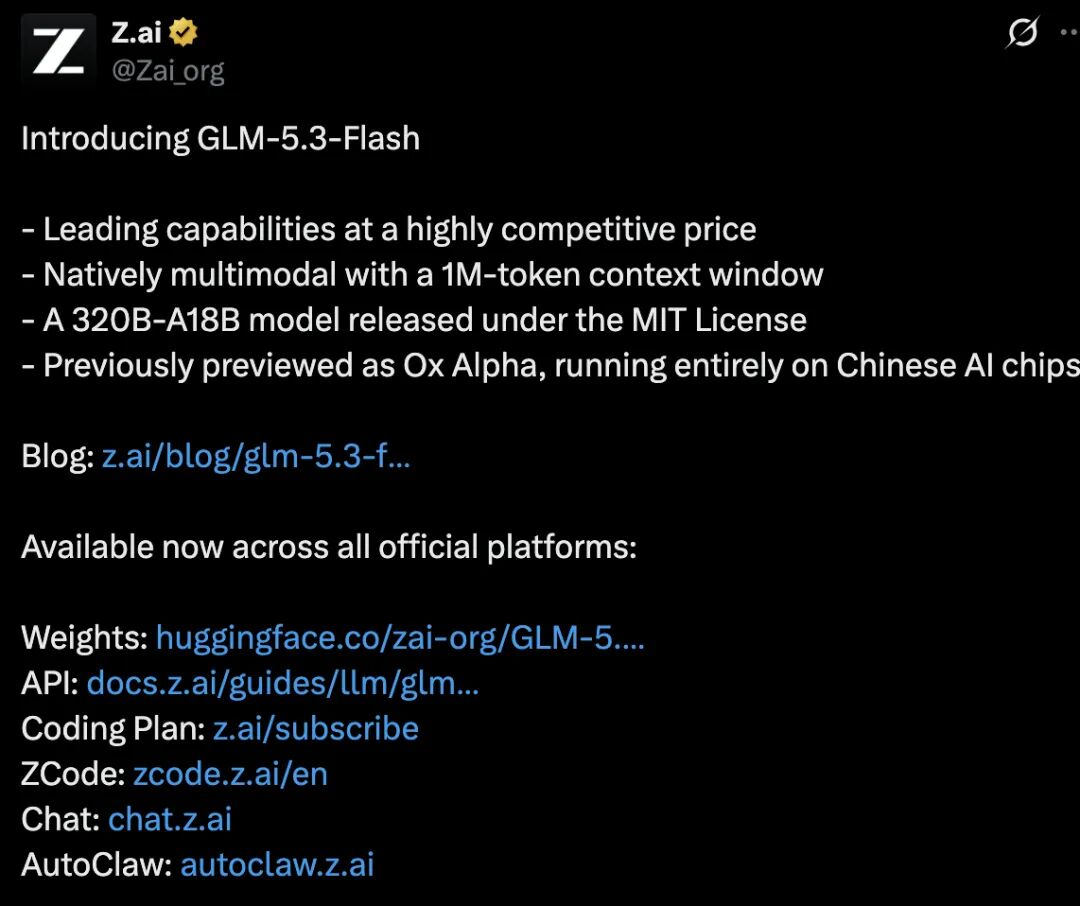
Last night, Z.ai officially confirmed that Ox Alpha is exactly its newly released GLM-5.3-Flash. The "mysterious model" that caused a sensation in the overseas developer community over the past week really comes from Z.ai.
Ox Alpha first landed on OpenRouter anonymously on August 20.
Before its identity was revealed, OpenRouter described it as an inference model designed for code, continuous agent work and production loads, suitable for handling long-term software engineering, complex reasoning, and workflows that combine text and visual information.
It can receive text, image and video inputs, output text, and the anonymous test version provides a 1.04 million token context window.
OpenCode also once announced that it would be open to users for free for a week, claiming that the model provider has prepared a service capacity of 100 trillion tokens per day.
This nearly "unlimited free" testing method allowed Ox Alpha to acquire a large number of real users within a few days.
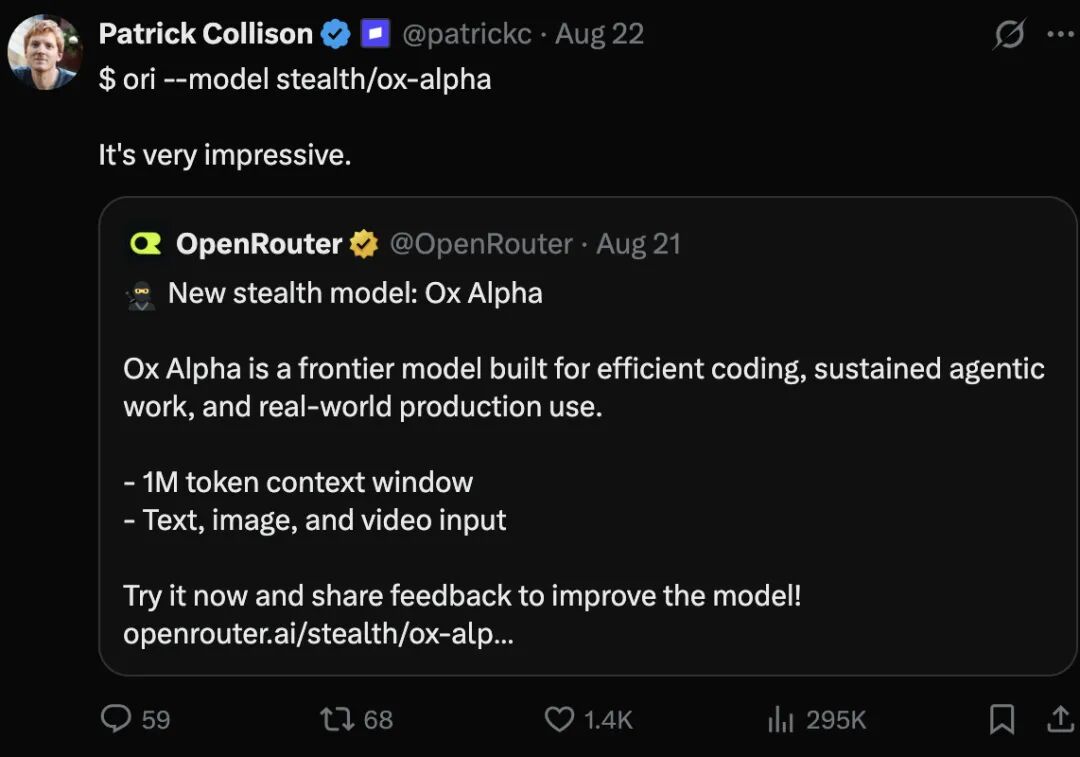
After experiencing it, Patrick Collison, co-founder and CEO of Stripe, said it was "extremely impressive".
Some developers found that Ox Alpha's performance in code modification, front-end generation, understanding of large code repositories, and continuous tool calling is not like that of an ordinary low-cost model.
Public speculation about its identity has also heated up as a result.
Facts have proved that Ox Alpha is not a new project launched by Z.ai outside the GLM system, but a new member of the GLM-5 series - GLM-5.3-Flash. The anonymous launch is more like a large-scale public blind test: first hide the manufacturer and model name, let developers make judgments based on actual usage effects, and then announce the identity and technical details.
Z.ai also used a similar method to test Pony Alpha before. Compared with directly publishing benchmark test results, anonymous testing can reduce the impact of brand perception on evaluation to a certain extent, and can also obtain larger-scale real loads and user feedback before official release.
According to Z.ai's official blog, during the period when Ox Alpha was open on OpenCode and OpenRouter, it once became the most popular model of the week.
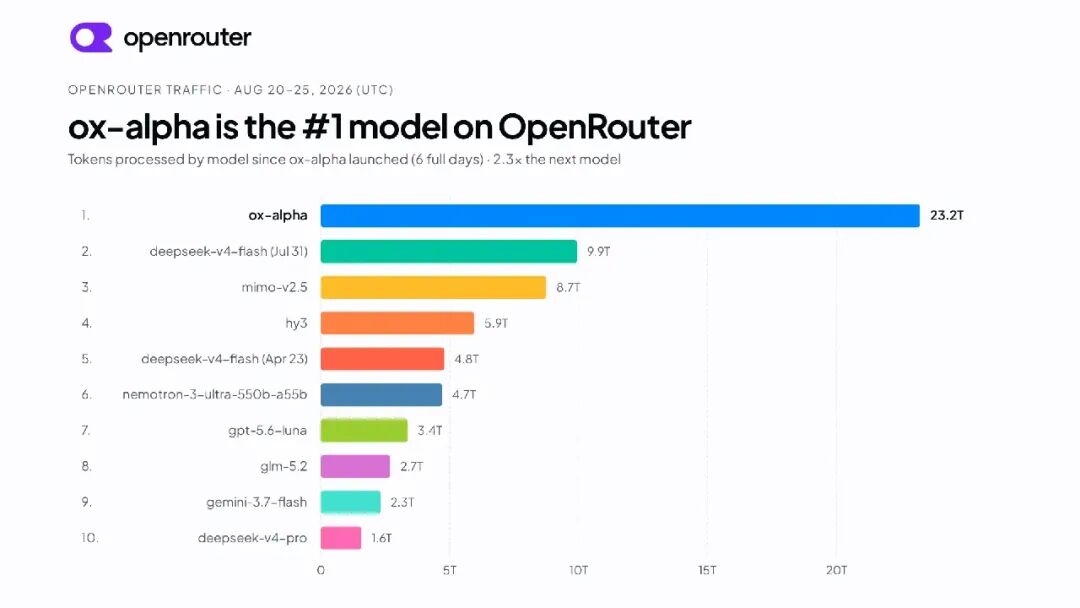
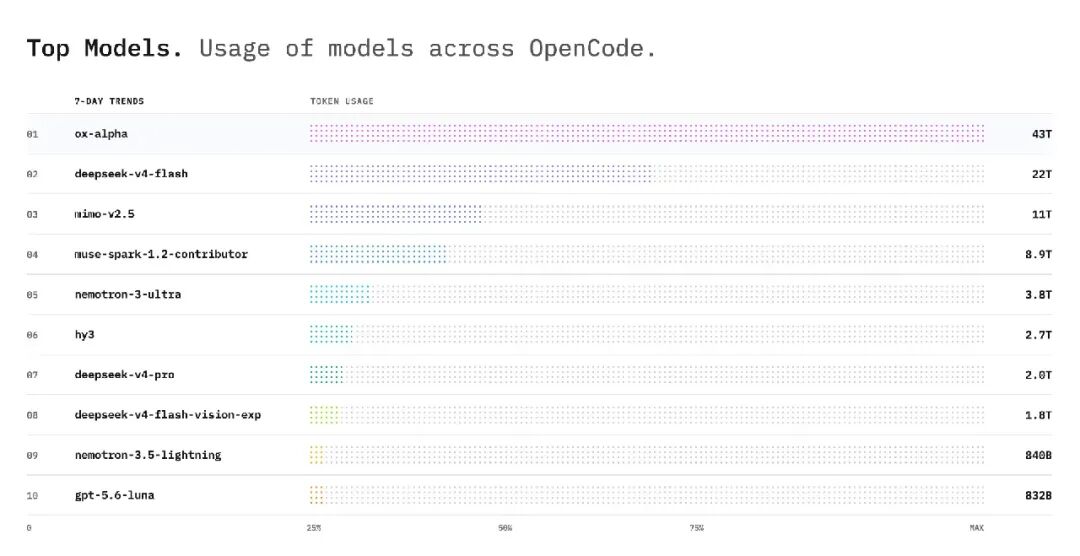
What is more noteworthy is that all the traffic generated during the anonymous test is carried by a large-scale cluster deployed on domestic AI chips.
How is the new model?
GLM-5.3-Flash is a Mixture-of-Experts model with a total of 320 billion parameters, but only about 18 billion parameters are activated each time a token is processed.
This means that it retains the parameter capacity of large models, but does not need to call all 320 billion parameters for each inference.
The model will assign tasks to some expert networks according to the input content, seeking a balance between model capability, inference speed and deployment cost.
Compared with the GLM-4.5 series, the total parameter volume of the two is close, 320 billion and 355 billion respectively, but the activation parameters of GLM-5.3-Flash drop from 32 billion to 18 billion, and the number of model layers is also reduced from 92 to 45.
The reduction of activation parameters and layers can directly reduce the amount of computation required for single token inference.
This is also one of the meanings of "Flash" in the name GLM-5.3-Flash: it does not simply shrink the model, but hopes to retain capabilities close to large models with less actual computation through architectural changes.
GLM-5.3-Flash is also the first native multimodal model in the GLM-5 series, which can process text, images, videos and files at the same time, and provides a context window of about 1 million tokens.
Z.ai said that the model adopts the latest 30 trillion-token multimodal pre-training corpus. This means that its visual capability is not simply externally attached after the pure text model is trained, but text and visual information are incorporated into the unified model at the pre-training stage.
The model weights are now open on Hugging Face under a relatively permissive MIT license. Developers can perform local deployment through frameworks such as SGLang, vLLM, KTransformers and TokenSpeed.
Model address: https://huggingface.co/zai-org/GLM-5.3-Flash
Specifically, what highlights of the new model are worth paying attention to?
Highlight 1: Redesigned attention mechanism
The first is the attention mechanism redesigned for million-token context.
Long context has always been one of the parts with the fastest growing inference cost of large models.
The more content the model needs to remember, the larger the attention computation volume and the video memory occupied by KV Cache. When the context is extended to 1 million tokens, if the traditional attention mechanism is still used, the service cost and hardware pressure will rise significantly.
In order to reduce this overhead, GLM-5.3-Flash adopts a hybrid architecture combining linear attention and sparse attention. Z.ai calls it the first open-source cutting-edge model that adopts this hybrid architecture.
Among them, linear attention mainly captures local dependencies through state modeling; sparse attention finds information related to the current task from a longer context through a lightweight indexer.
In short, the model does not need to make all tokens perform full computation with each other in every generation, but first uses linear attention to process local information, and then retrieves truly relevant global content from the million-token context.
To further reduce the latency and memory footprint of the indexer in the million-token scenario, Z.ai also designed IndexPool, which compresses four indexer key vectors into one through weighted pooling.
According to the measurement given by Z.ai, compared with GLM-5.3, the attention computation volume of GLM-5.3-Flash is reduced to about 1/3, and the KV Cache scale is reduced to about 1/4, which are reduced by 3.01 times and 4.44 times respectively.
However, Z.ai did not avoid the gap between it and other models.
In its comparison of GLM-5.3, DeepSeek-V4-Flash and Kimi-K3, GLM-5.3-Flash has the lowest attention computation volume, but its KV Cache is still slightly larger than that of Kimi-K3 and DeepSeek-V4-Flash, indicating that its video memory efficiency still has room for further optimization.
In addition to hybrid attention, GLM-5.3-Flash also introduces Manifold-Constrained Hyper-Connections, namely mHC, to improve training stability and parameter utilization efficiency during model scaling.
These modifications all point to one goal: GLM-5.3-Flash does not pursue simply making the model larger, but hopes to reduce the actual computation and storage resources required to complete the same task.
Highlight 2: Code and Agent capabilities are the main strengths of the model
Judging from the test results announced by Z.ai, the advantages of GLM-5.3-Flash are mainly concentrated in code, tool calling and long-duration Agent tasks.
In DeepSWE v1.1, GLM-5.3-Flash scored 63.4 points, higher than the 46.2 points of GLM-5.2. DeepSWE does not focus on making the model complete a piece of code, but tests whether it can enter a real code repository, understand the project structure, locate problems and complete modifications.
In AutomationBench, which is used to test automated operation capabilities, GLM-5.3-Flash scored 48.8 points, while GLM-5.2 scored 26.2 points. In addition, it scored 56.3 points on NL2Repo, 78.4 points on Toolathlon Verified, 26.3 points in Agents' Last Exam, and 84.3 points in Terminal-Bench 2.1.
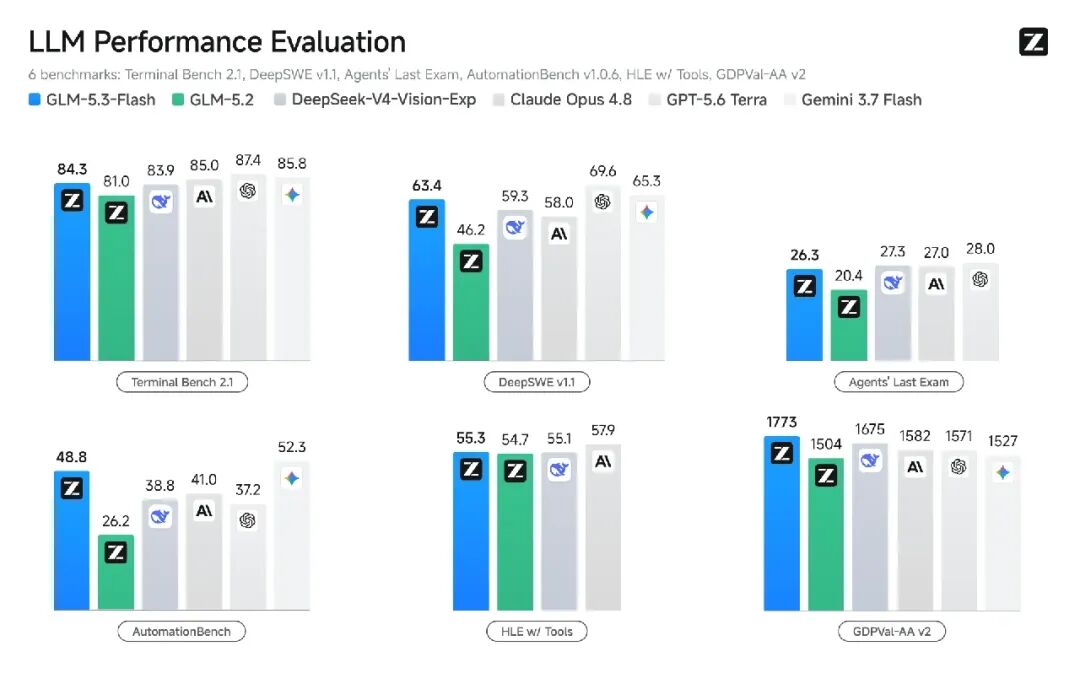
Terminal-Bench mainly tests whether the model can complete software engineering, system management and data processing tasks in a real terminal environment. The model not only needs to give answers, but also actually calls commands, observes execution results, handles errors and continues to advance tasks.
These tests are closer to the current working mode of Coding Agent: the model needs to think and operate continuously instead of generating code at one time.
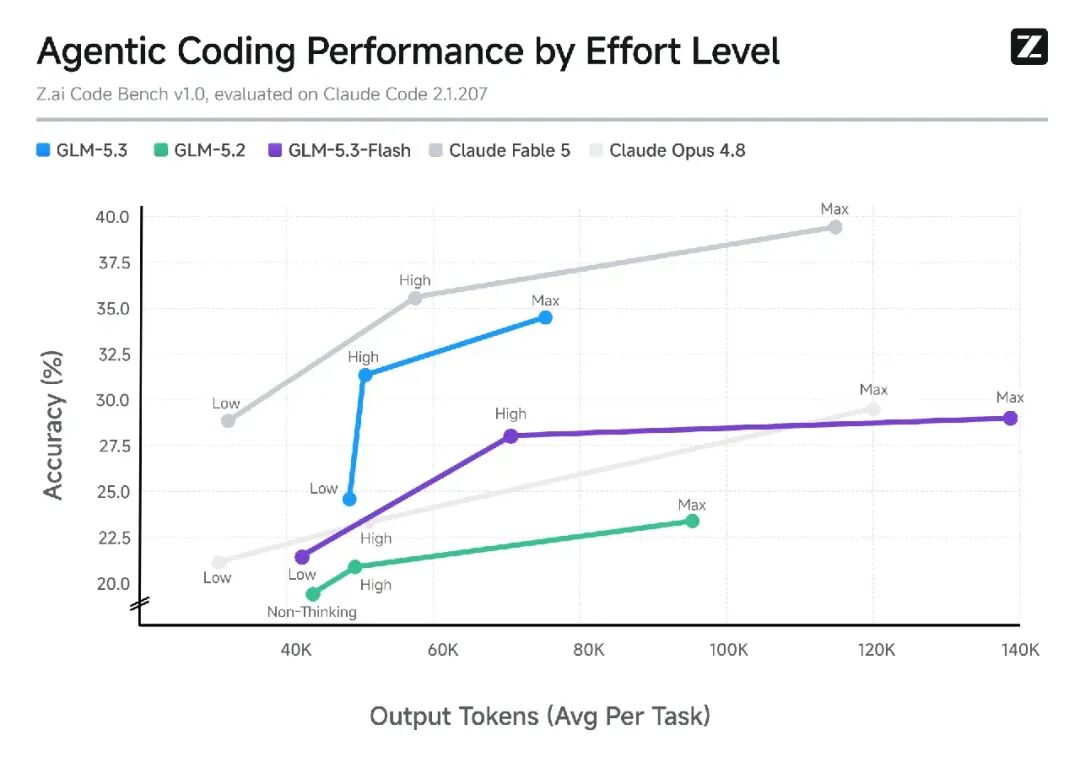
In Z.ai's internal Z.ai Code Bench v1.0 test, GLM-5.3-Flash outperformed GLM-5.2 at different inference intensities. At the highest inference intensity, it scored 29.0 points, close to the 29.5 points of Claude Opus 4.8. This test runs in the Claude Code 2.1.207 environment.
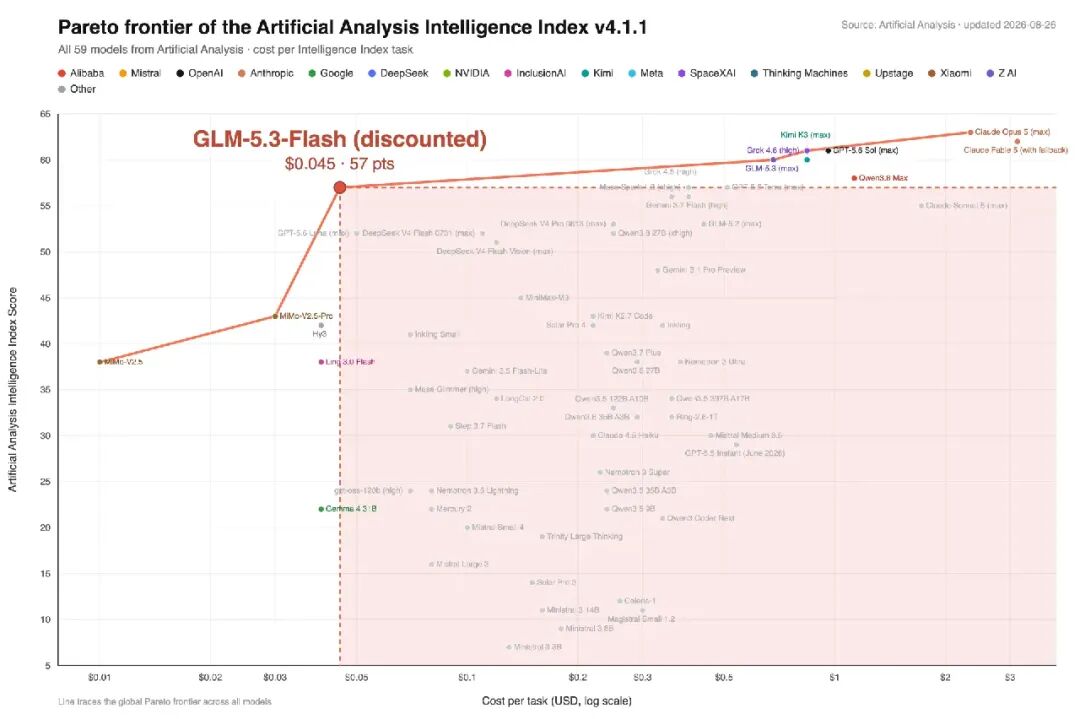
Third-party institution Artificial Analysis gave GLM-5.3-Flash a comprehensive intelligence index score of 57 points.
Under the preferential price standard, the average cost of each task is about 0.045 US dollars. Z.ai said that in the past, it took about ten times the cost to obtain a similar level of comprehensive performance.
Different code and Agent models may have differences in the test frameworks, tool environments, inference budgets, maximum output length and timeout time adopted. For example, in the Terminal-Bench 2.1 test, Z.ai allows the model to run for up to 6 hours, and sets the maximum generation length to 65536 tokens; DeepSWE also adopts a 6-hour timeout setting.
Therefore, benchmark tests can prove that the model has strong code and Agent capabilities under specific settings, but cannot be directly equivalent to its performance in all real production tasks. Z.ai's internal Z.ai Code Bench is also a vendor self-test, which still requires more third-party reproduction.
The significance of the Ox Alpha anonymous test is precisely to supplement the evidence beyond the benchmark scores: when developers do not know the manufacturer and model name, it still obtains high attention relying on real experience.
Highlight 3: Visual capability enters the code execution closed loop
Another change of GLM-5.3-Flash is that it no longer regards visual understanding as an independent image recognition capability, but puts it into the code and Agent execution process.
After traditional code models generate web pages, games or 3D scenes, they mainly judge whether the task is completed by whether the program runs successfully and whether the test passes. But many problems cannot be found only through code inspection.
A web page may start normally, but the buttons and colors are obviously inconsistent with the design draft; a Blender script may run successfully, but the final scene has model interpenetration, proportion errors or abnormal lighting; a game may have no errors, but cannot really complete the interaction.

There are layout problems in the initial version

After visual self-verification
GLM-5.3-Flash tries to form a closed loop of "observe-implement-use-correct": the model first reads screenshots, design drafts, page recordings or real software interfaces, generates code and runs it, then observes the rendering results, compares them with the reference picture, and finally continues to modify.
To this end, Z.ai has built a data synthesis process for visual coding, focusing on training the model's self-visual judgment and improvement capabilities during testing. In the front-end development scenario, the team also introduced environmental feedback reinforcement learning, and improved the model's ability to judge GUI interfaces and interaction results through Agent verification based on real user processes.
This capability can cover tasks such as front-end page reproduction, game development, Blender 3D scenes, CAD modeling and Computer Use.
Domestic chips support all traffic of Ox Alpha
Another noteworthy information in the GLM-5.3-Flash official blog is that all inference traffic during the Ox Alpha anonymous test runs on a domestic AI chip cluster.
Z.ai said that in order to solve the limitations of single domestic chip in computing power and