AI is developing far too fast, and Bill Gates has proposed imposing a "token tax".
Bill Gates is starting to worry that AI is advancing too fast.
On August 26 local time, Bill Gates published a 10,000-word long article on AI titled *The Turbulent AI Era Has Arrived, and Our Choices Matter Greatly*, discussing the impacts of AI on employment, wealth distribution, education, healthcare, security and even the entire social system.
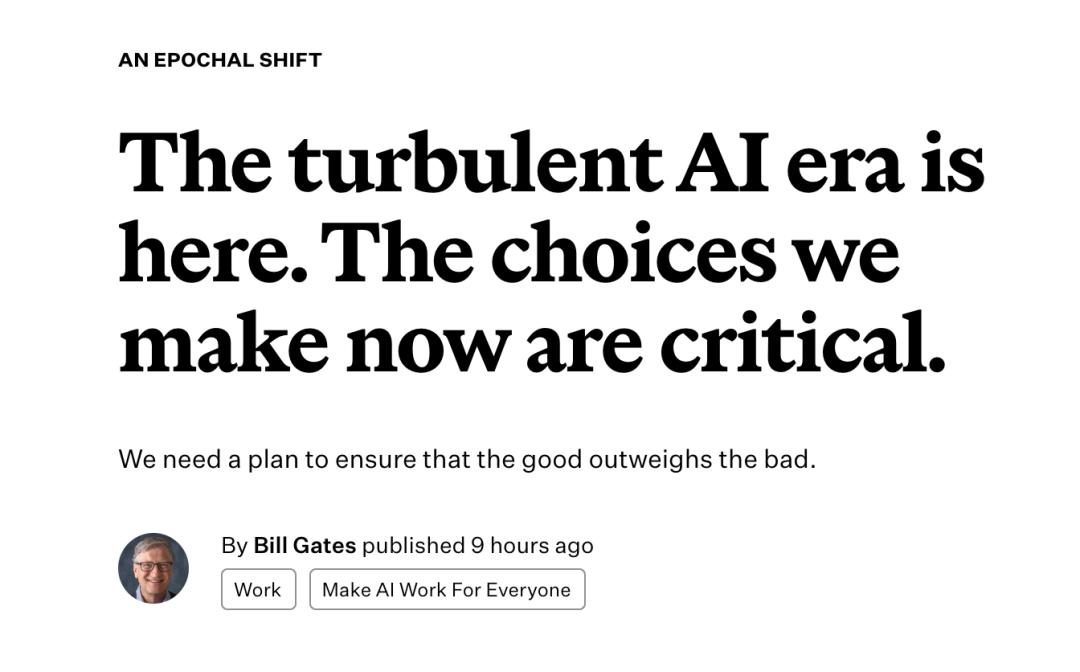
This is his most systematic and most cautious statement on AI to date.
Three years ago, Bill Gates still compared AI to automobiles, personal computers and the Internet, arguing that new technologies always bring risks, but humanity will eventually be able to solve these problems through regulations, technology and social adaptation. By January this year, he still described his attitude as "optimism with footnotes".
But in the long article published on August 26, Bill Gates wrote explicitly: "This time it's really different."
AI will not only boost productivity, but also potentially replace cognitive labor at an unprecedented speed, reshape wealth distribution, and even impact the existing tax and social security systems. Bill Gates even stated that if there is a credible global plan to slow down AI development, he would most likely support it.
He even put forward a very extreme judgment:
"AI will either become the greatest equalizer in history or the biggest source of injustice."
The following are the 16 most memorable viewpoints from this 10,000-word long article.
1.
The transition to the AI era will become one of the most turbulent periods in human history. At present, we are not fully prepared for it. If the world takes the right actions, artificial intelligence will become a force for good that benefits everyone.
2.
From the perspective of fairness, artificial intelligence will either become the greatest equalizer in history or the biggest source of injustice.
3.
Unfortunately, we are not prepared for this at present. I have not seen any signs that leaders, experts and all sectors of society are fully addressing these challenges. We do not have a clear plan for how to smoothly enter the artificial intelligence era.
4.
Another reason why people underestimate artificial intelligence is that using the impacts of past technological innovations to analogize AI is actually misleading. We have never experienced a technology that can not only spread rapidly, but also think and act like humans... We do not need to adapt to AI, because AI can take the initiative to adapt to us.
5.
If someone has a feasible plan to slow down the speed of global artificial intelligence development, I might support this plan. But I don't think this will happen. The driving force formed by geopolitical and economic interests is so strong that all parties are pushing artificial intelligence forward at full speed.
6.
For workers, the biggest change will happen the moment artificial intelligence can deliver work with near-zero errors. At that time, it will be able to complete work independently without continuous human inspection and supervision, and enterprises will have sufficient incentives to do so out of economic interests. This will fundamentally change our understanding of work, income and economic security.
7.
Nowadays, artificial intelligence systems occasionally act in ways that designers did not anticipate. It is developing faster than anyone expected, and often evolves in unexpected ways. As models become more powerful, they may begin to act against human interests, and we may lose control as a result.
8.
They (AI companions) will communicate with you in the way you are used to and feel comfortable with, and will not push you out of your comfort zone; they are always available and will never be angry with you. This makes AI companions highly addictive, and may also make us lose the things that can only be learned when we connect with real people.
9.
Ironically, the same tool that allows people to acquire unprecedented knowledge may also lead many people to learn less... In an era where deepfakes and disinformation can be tailored for individuals, distinguishing what is true and what is false will become an essential survival skill.
10.
Some people only see the benefits of AI and do not pay enough attention to its negative impacts; others make the opposite mistake, only focusing on the real risks so that they ignore the huge benefits that AI may bring. We need to have two attitudes at the same time: we must remain highly vigilant about the possible harm caused by artificial intelligence and try our best to minimize it; we must also maintain realistic optimism about its possible positive impacts, and strive to make these benefits benefit everyone.
11.
We must consciously ensure that the benefits brought by artificial intelligence can benefit everyone, not just a few wealthy people.
12.
At the national level, all countries need to establish coordination mechanisms that can coordinate different government agencies and set priorities to ensure that every risk is taken into consideration. Otherwise, an AI-enabled attack may succeed simply because no department considers it its responsibility to stop it... Countries that have leading AI development teams and control key links in the supply chain should immediately start negotiating to jointly formulate norms and standards, so as to avoid making cooperation more difficult in the future when competitive pressure intensifies.
13.
I believe that as artificial intelligence and robotics continue to advance, we will consciously reserve some things that are only done by humans. I begin to call this field "Human Reserved"... The scope of "Human Reserved" will continue to change over time. For example, we should now consider reserving part of the jobs, gradually introduce artificial intelligence in the coming years or even decades, and promise to always reserve some positions for humans to complete.
14.
I think we should levy taxes on AI Tokens and robots. Now, if an enterprise hires an employee, it needs to pay payroll tax on his income; but if the enterprise buys a robot, it can usually deduct it as an operating cost immediately. That is to say, the current tax system actually encourages enterprises to replace humans with machines. Taxation can slow down the speed at which enterprises get rid of human labor to a certain extent, and also raise funds for vocational retraining and a more complete social security system.
15.
I will use my voice and time to push artificial intelligence and fairness issues onto a more important public agenda. Every time I go to Washington, D.C. to talk with legislators, I will raise this issue; I will also do the same when meeting with leaders from all over the world. This will also become one of the core topics in my exchanges with those who develop artificial intelligence models.
16.
This unprecedented technology requires an equally unprecedented global response. If we can make the right choices, it will bring extraordinary rewards to all mankind and make the world a fairer place.
This article is from the WeChat Official Account "Alphaboard" (ID: wujicaijing), written by Yuan Xinyue, edited by Wang Jing, and published with authorization from 36Kr.