The secret of the computing power of Zhipu's "Niu Lai" model: it is entirely supported by domestically produced chips, and its price is only 1/40 that of Opus 4.8.
After six days of anonymity, "Niu Lai" finally unveiled its last layer of mystery.
On the evening of August 26, Zhipu officially released and open-sourced GLM-5.3-Flash. This model, which was previously anonymously tested on OpenRouter and OpenCode under the identity of Ox-Alpha, has a total parameter count of 320B with 18B activated parameters, making it the first native multimodal model in the GLM-5 series.
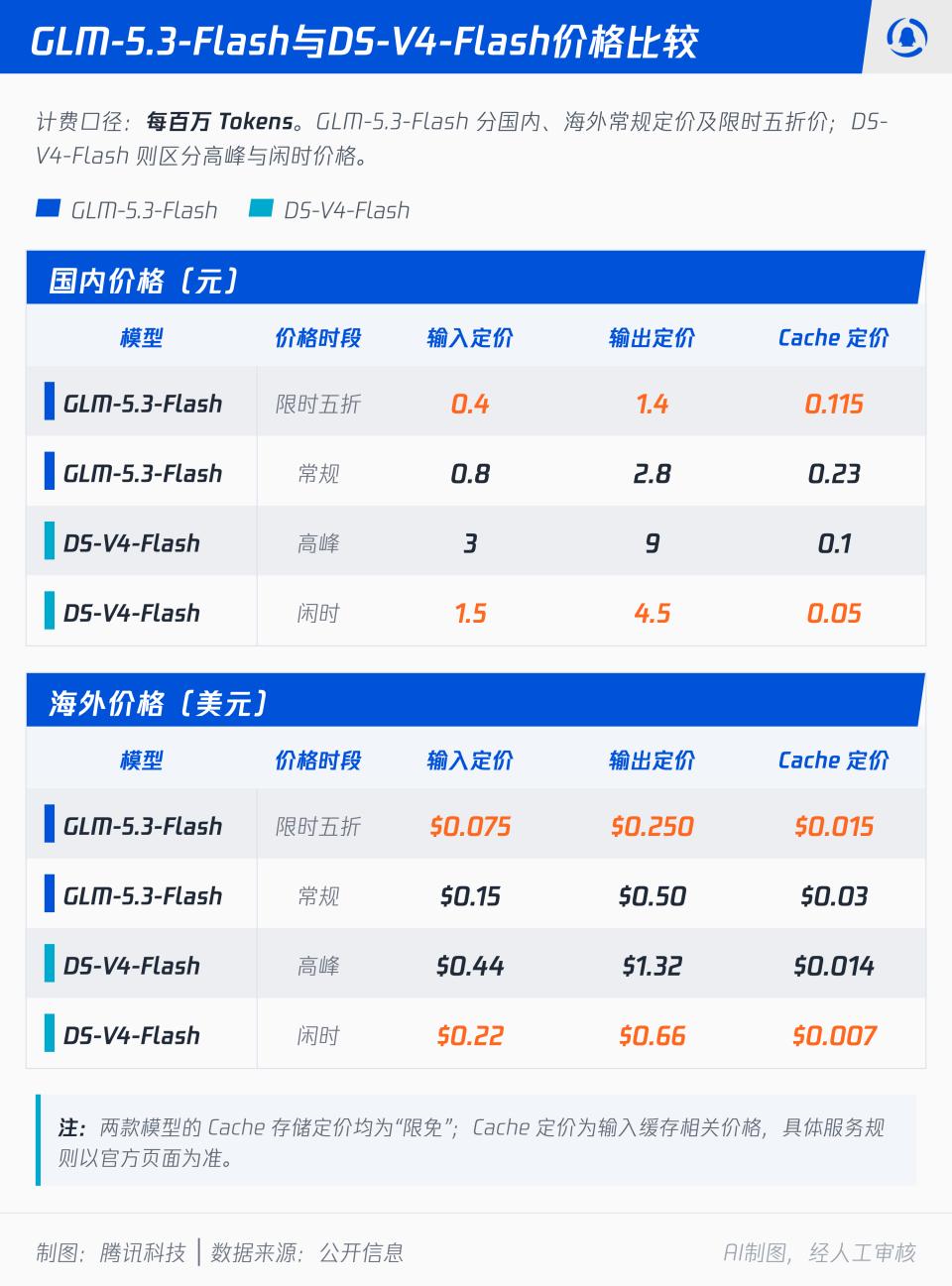
Compared with GLM-5.3, the price of this model is surprisingly low: it is only 1/10 of that of GLM-5.3, and will be further reduced to 1/20 during the limited-time discount period; compared with Anthropic's flagship model Claude Opus 4.8, its price is about 1/40 of the latter.
Artificial Analysis currently gives Claude Opus 4.8 an Intelligence Index score of 57, and its official API standard price is $5 per million input tokens and $25 per million output tokens. Zhipu disclosed that GLM-5.3-Flash also scored 57 on the same index; in Zhipu's self-developed Z.ai Code Bench, the actual coding experience of the two is also at a similar level.
Although this does not mean that GLM-5.3-Flash is "equal" to Opus 4.8 in all tasks, and differences may still exist in individual benchmarks, long-task stability and real Agent tasks, at least from the perspective of third-party comprehensive tests, an open-source model has entered the capability range that was previously mainly occupied by high-priced closed-source flagship models.
More importantly, this low price is not built on overseas GPU inference clusters.
01
Behind "Niu Lai": all running on domestic chips
The release of GLM-5.3-Flash also responds to one of the biggest questions surrounding Ox-Alpha before: where does the computing power come from behind such a large-scale free overseas test?
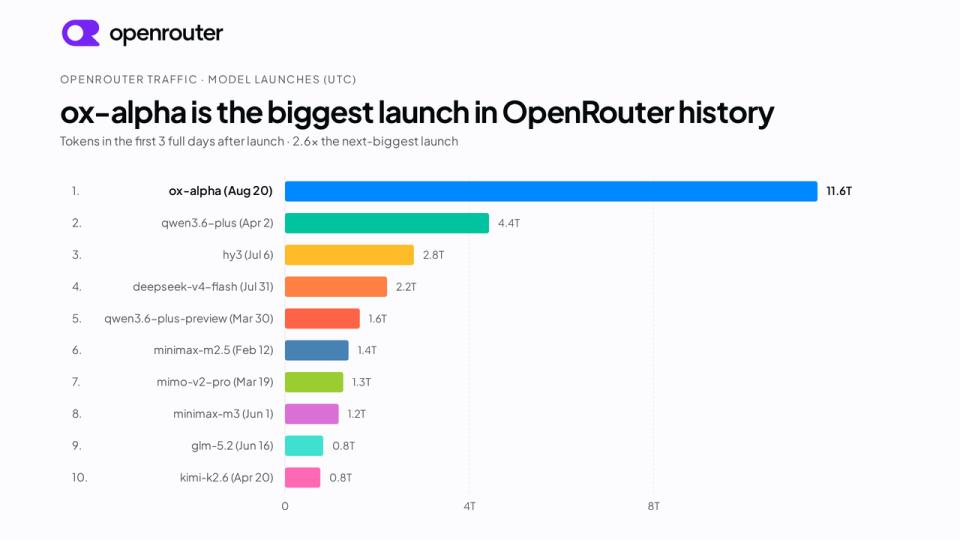
Zhipu confirmed that before the official release, GLM-5.3-Flash was anonymously tested on OpenCode and OpenRouter under the name of Ox-Alpha. The model quickly became the most popular model of the week and set a new record for the call volume of the two platforms.
All these request flows are powered by domestic chips.
It is reported that Zhipu has deployed more than 100,000 domestic chips in clusters to serve this model, but has not announced the specific chip model. This is also the first time Zhipu has tried to use a large-scale domestic chip cluster to directly carry the real online load from global developers.
During the anonymous test period, users did not know who was behind the model or what chips were used, and would only decide whether to continue calling according to speed, stability and effect. As a result, domestic computing power has undergone a continuous real traffic test, rather than a peak performance demonstration in a laboratory environment.
According to official information, Zhipu has made a large number of targeted modifications to the inference system in order to make cutting-edge models truly run on domestic chips.
The main bottlenecks faced by a single domestic chip at present include memory capacity and bandwidth, while GLM-5.3-Flash natively supports a maximum 1M context, which puts higher requirements on video memory and communication.
Zhipu built a dedicated inference engine based on SGLang, and added technologies such as intra-node tensor parallelism, ReplaySSM, W8A8 quantization, INT8/FP8/BF16 mixed cache quantization and Layer Split to reduce hardware limitations through the method of "trading computing power for bandwidth and trading communication for video memory".
At the cluster level, the Encode-Prefill-Decode, namely EPD separation architecture, is adopted. Multimodal encoding, prompt pre-filling and token-by-token decoding are split into three work pools that can be independently scheduled and scaled, allowing different stages to run according to their respective computing power characteristics.
According to the data released by Zhipu, compared with the initial baseline on the same batch of hardware, this solution improves the end-to-end service performance by 3 times. Zhipu stated that the final hardware efficiency and single-token cost have reached a level comparable to mainstream NVIDIA GPUs.
Two concepts need to be distinguished here.
The so-called "1/40" does not mean that the hardware inference cost of domestic chips is only 1/40 of that of overseas GPUs. The current public data is not sufficient to support such a comparison.
A more accurate understanding is: A cutting-edge model service fully carried by a domestic chip cluster has pushed the price for users to about 1/40 of that of Claude Opus 4.8.
02
320B: Why it is more powerful than the previous generation flagship
The other half of the reason for the price drop comes from the model structure.
GLM-5.3-Flash has a total parameter count of 320B, with 18B parameters activated for each token. For reference, GLM-4.5 has a total parameter count of 355B, 32B activated parameters and 92 layers; GLM-5.3-Flash has 320B total parameters, 18B activated parameters and 45 layers. Compared with the early flagship architecture of GLM, the number of parameters actually involved in calculation per token and the network depth have decreased significantly.
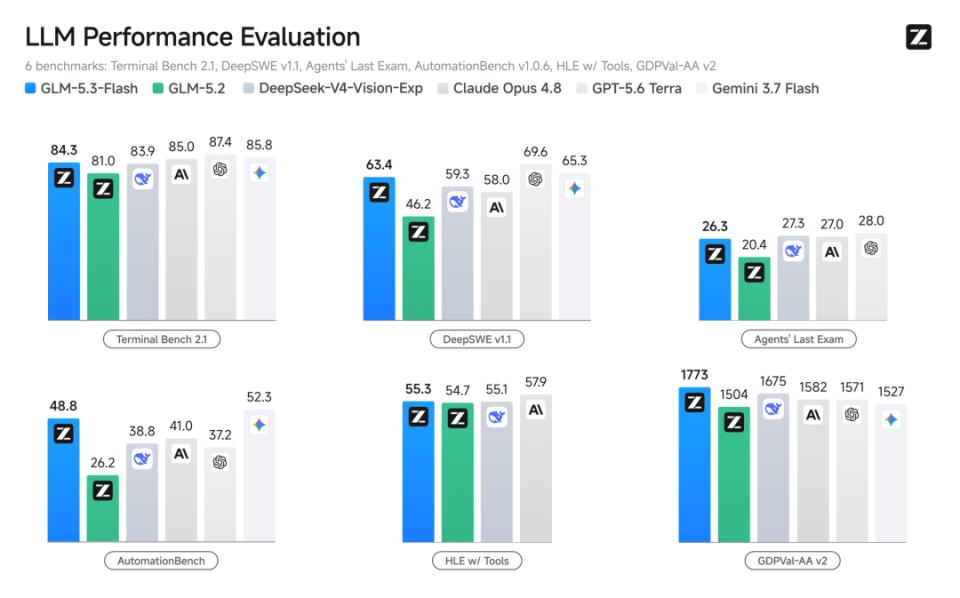
However, according to the benchmark and actual usage results released by Zhipu, the overall capability of GLM-5.3-Flash exceeds that of GLM-5.2 which has a larger parameter scale.
This means that "Flash" is no longer just a simple downsizing of the flagship model this time, it has redesigned the inference cost from the architectural level.
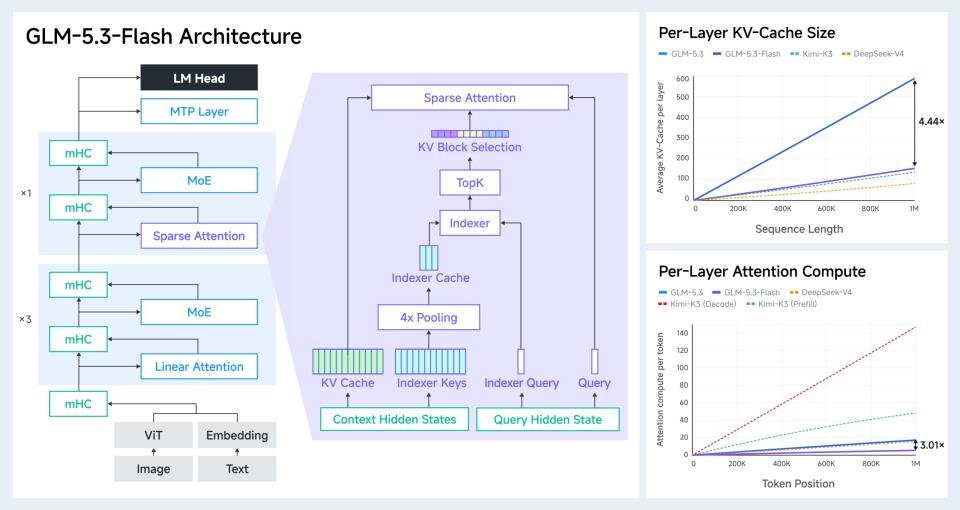
GLM-5.3-Flash is the first open-source cutting-edge model that adopts a hybrid architecture of sparse attention and linear attention.
Among them, linear attention processes local dependencies through a recursive mechanism; sparse attention uses a lightweight indexer to recall the global information that really needs to be calculated in long contexts.
Aiming at the memory and latency problems of the indexer itself under 1M context, Zhipu introduced IndexPool, which compresses the original 4 cache vectors of the indexer into 1 through weighted pooling.
According to Zhipu's estimation, compared with GLM-5.3, the attention calculation amount of GLM-5.3-Flash is reduced by 3.01 times, and the KV cache size is reduced by 4.44 times.
Among the baseline models listed by Zhipu, including GLM-5.3, DeepSeek-V4-Flash and Kimi-K3, GLM-5.3-Flash has the lowest attention calculation amount. However, its average KV cache size per layer is still slightly higher than that of Kimi-K3 and DeepSeek-V4-Flash.
This set of data explains to a certain extent why the price can be "cut down".
Especially for coding and agent tasks, a task may run continuously for tens of minutes or even hours, the model continuously reads in code, historical dialogues and tool return results, and the context continues to grow. The attention calculation amount and KV cache directly determine how much video memory, computing power and inference cost are consumed for long tasks.
GLM-5.3-Flash also introduces manifold constraint hyper-connection mHC, and uses 30T tokens of multimodal pre-training corpus to further improve the model scaling capability while reducing the number of parameters and calculation amount. What is finally formed is not a purely "smaller" model, more accurately, it is a set of model architecture redesigned around low-cost inference.
03
Flash begins to enter the cutting-edge model capability range
Another change is that the positioning of "Flash models" is changing.
In the past, Flash, Mini and Air usually meant faster and cheaper, while accepting obvious capability loss.
GLM-5.3-Flash, with 320B total parameters and 18B activated parameters, scored 57 on the Artificial Analysis comprehensive intelligence index, which is on a par with Claude Opus 4.8, while its price is only about 1/40 of the latter.
It is also the first native multimodal model in the GLM-5 series.
The addition of vision this time is not just a simple addition of the "image recognition" capability, the purpose is to directly serve coding and agents. For tasks such as web pages, games and 3D modeling, what the model finally generates is not only code, but also pages, interactions and virtual scenes that are truly presented on the screen.
Only when the model can "see" the results it generates again, can it know whether the buttons are misplaced, whether the page is rendered successfully, whether the 3D scene meets expectations, and then continue to modify.
Zhipu has therefore specially trained the model's self-visual judgment and test-time improvement capability, allowing the model to continue observing the results after generation and iterate according to environmental feedback.
For example, in a case demonstrated by the official, GLM-5.3-Flash independently ran for 16 hours without external materials, and built a professional chef's residence and test kitchen of about 400 square meters in Blender.

Similar mechanisms are also extended to professional tasks such as PPTX, PDF, DOCX, XLSX, as well as finance and law: the model not only generates content, but also can continue to check and modify its own output through visual results.
For agents, this change is more important than the "multimodal" itself. In the past, coding models mainly judged whether the code was correct; but it is more necessary to judge whether a task has been truly completed in the end.
Looking at GLM-5.3-Flash alone, this is a new model with fewer parameters, lower inference cost, and entering the cutting-edge capability range.
But since the six days of Ox-Alpha's anonymity, the test has verified whether domestic chips can stably and economically carry a cutting-edge model and directly serve real global developers.
At the same time, GLM-5.3-Flash is open-sourced under the MIT license, and the API is opened synchronously.
Cutting-edge model capability, open weights, large-scale online carrying by domestic chips, and extremely low API prices appear at the same time.
This article is from "Tencent Technology", written by Xiao Jing, edited by Xu Qingyang, published with authorization from 36Kr.