The mysterious "Niulai" model has been confirmed to be from Zhipu AI, which is GLM's first native multimodal model and adopts domestically produced chips.
Finally, the mysterious model "Niu Lai" (Ox Alpha), which has been a viral hot topic across the internet these days, has finally revealed its true identity!
And as expected, it comes from Chinese developers ——
It is Zhipu AI's newly released and fully open-source GLM-5.3 Flash, the first native multimodal model in the GLM 5 series.

During the days when "Niu Lai" went viral, quite a number of users have already conducted practical tests on the Ox Alpha version.
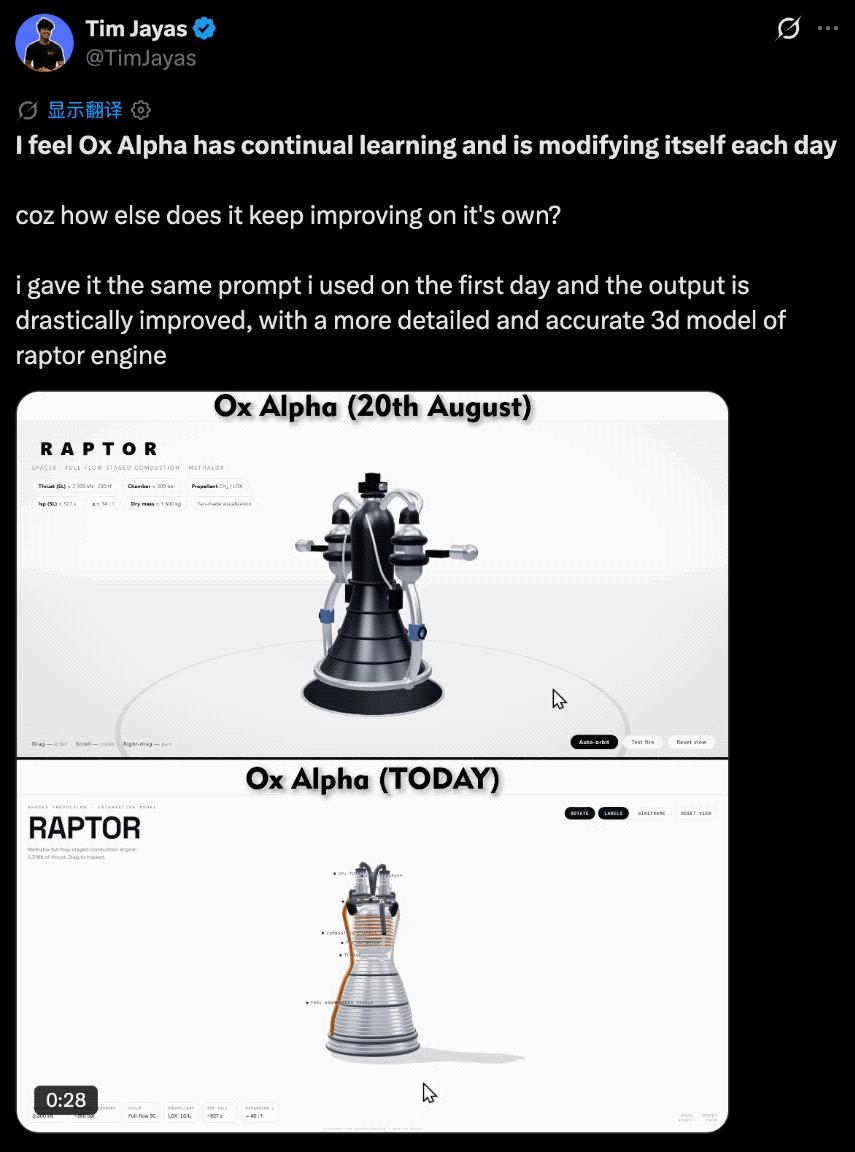
One of the most popular test scenarios is manually building a 3D interactive web page for the SpaceX Raptor engine.
For example, after the content creator Tim Jayas ran this task twice for "Niu Lai" with the same Prompt after a few days, he directly posted this comment:
It feels like "Niu Lai" is a model capable of continuous self-learning.
Coincidentally, we also obtained the internal test qualification for GLM-5.3 Flash and completed the exact same project; after we entered the Prompt, no additional operation was required throughout the whole process:
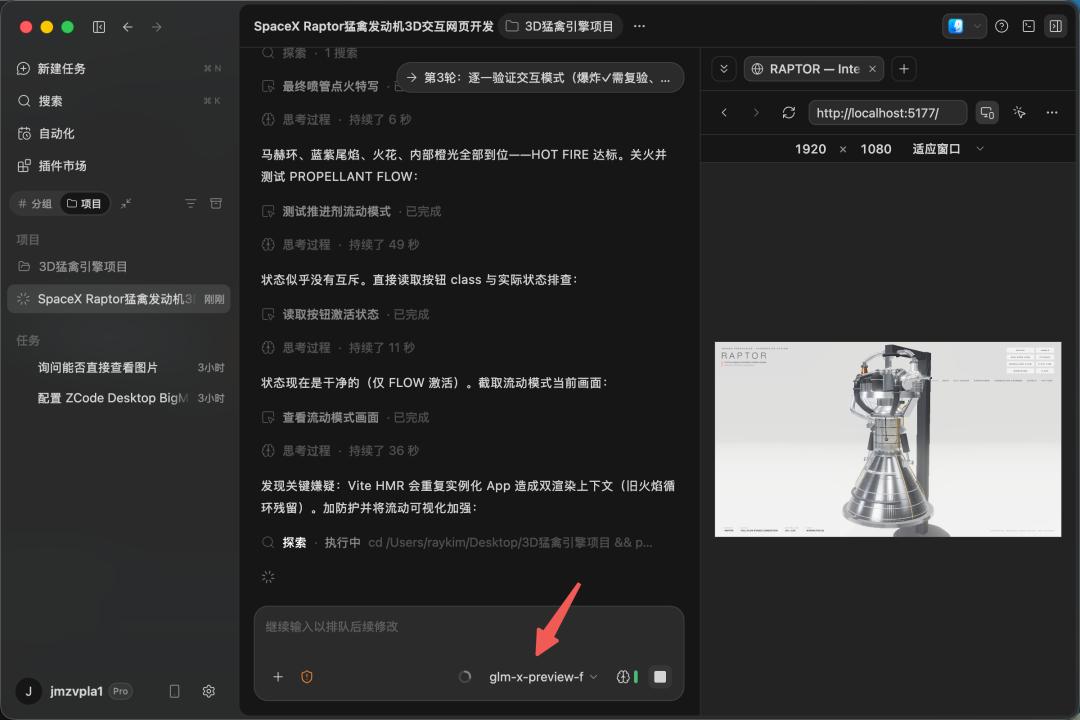
After a short waiting period, the 3D Raptor engine project is fully generated. Let's experience the effect:
From the effect comparison, there is no need for extra explanation — the 3D Raptor engine produced by GLM-5.3 Flash is more refined and advanced.
So why is the "Niu Lai" model so popular?
We can get a glimpse of the reasons just from the official posts on various platforms.
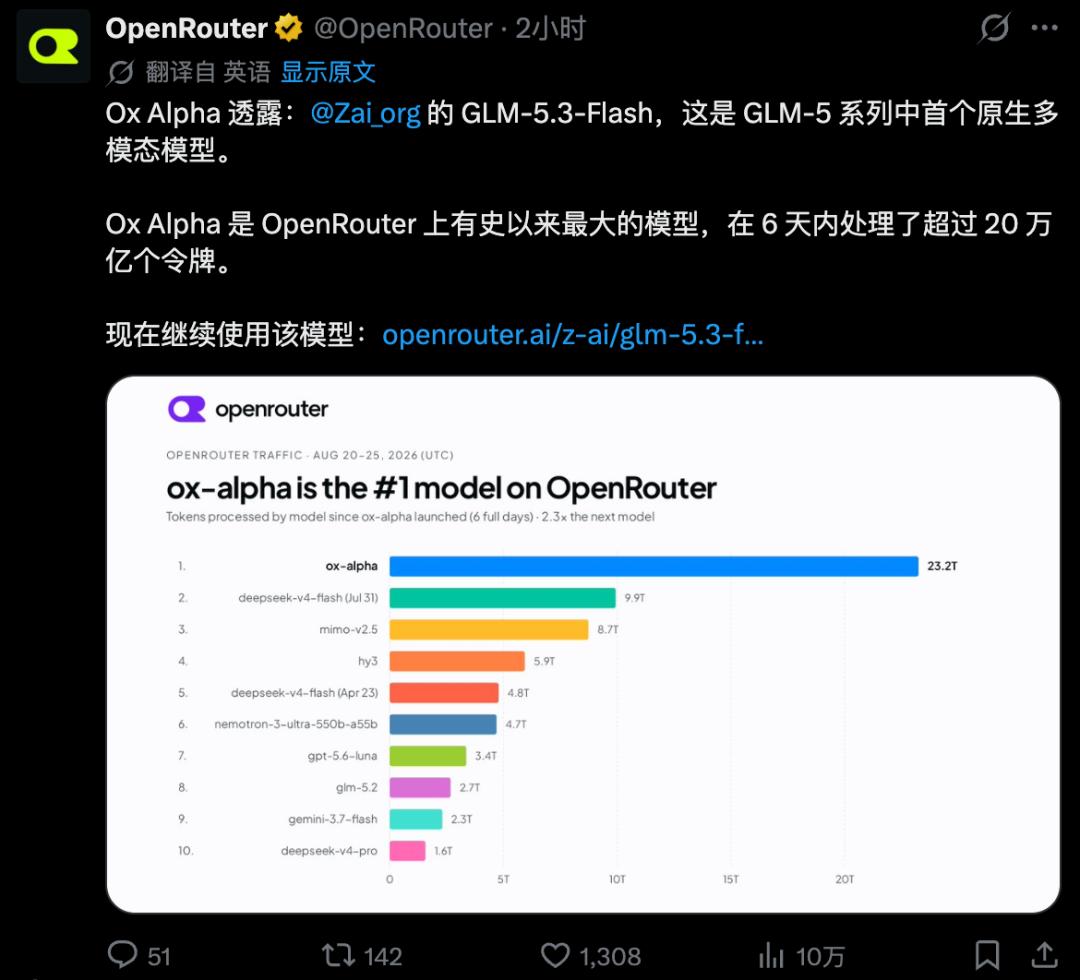
For example, on OpenRouter, "Niu Lai" topped the ranking on its first day, and also broke the historical record of single-day token consumption:
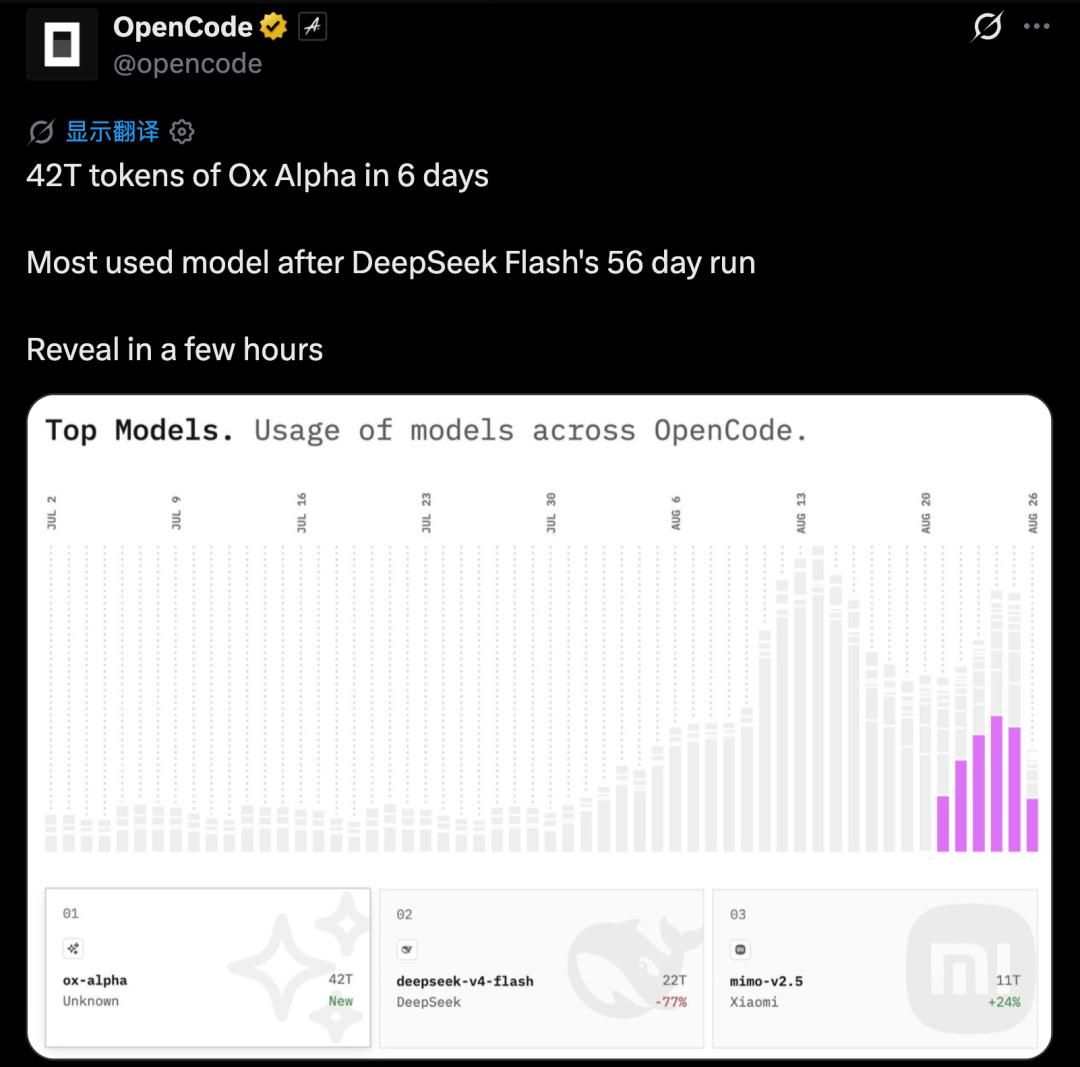
OpenCode stated that as soon as Ox Alpha was released, it ended DeepSeek's 56-consecutive-day streak at the top of the OpenCode ranking:
After Zhipu AI officially claimed ownership of "Niu Lai", we also discovered other highlights of GLM-5.3 Flash.
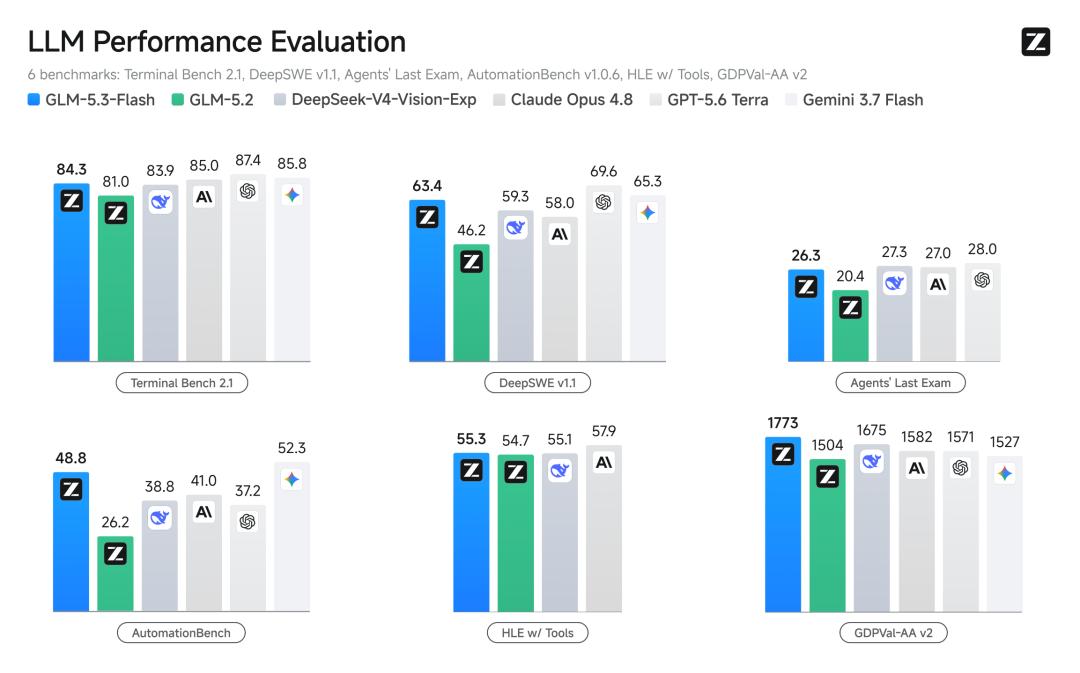
In terms of model size, GLM-5.3 Flash only has a total parameter volume of 320B, but its capabilities fully surpass GLM-5.2 which has a larger parameter size of 753B.
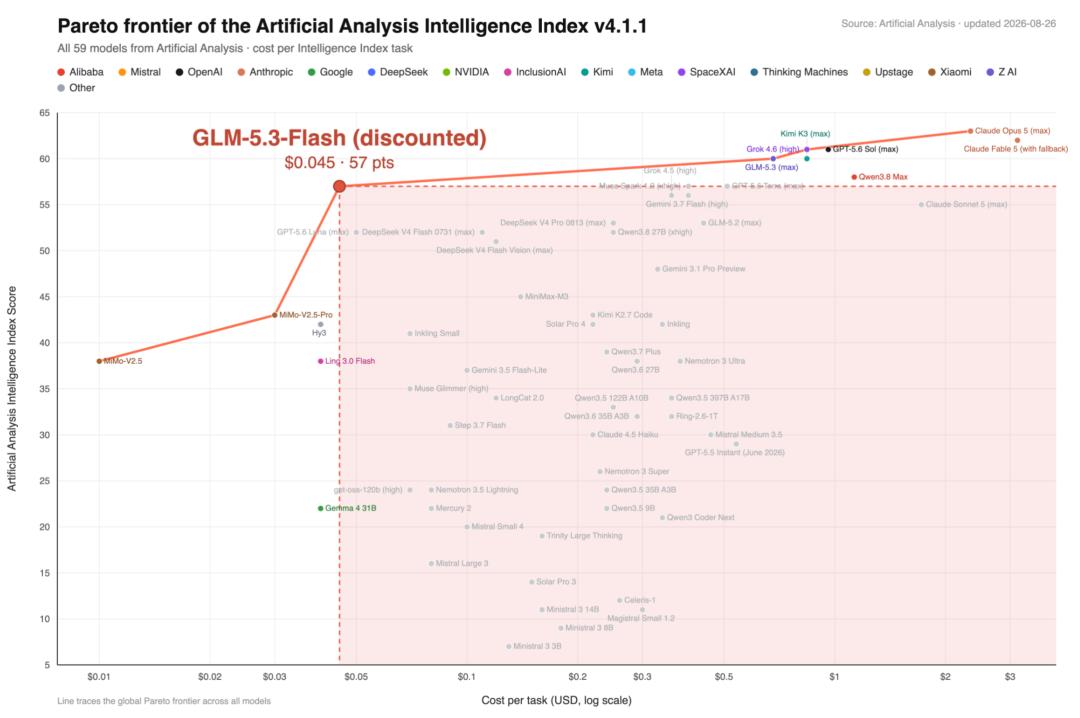
In addition, according to the latest AA benchmark ranking, GLM-5.3 Flash has achieved a score of 57, which puts it at the global cutting-edge level, on par with Claude Opus 4.8.
In terms of pricing, GLM-5.3 Flash is priced at 1/10 of the 5.3 full version, with a limited-time discount making it 1/20 the price of GLM-5.3, 1/40 the price of Opus 4.8, and lower than DS-V4-Flash.
And there is another thing we are proud of ——
All the 62T tokens mentioned above are run on domestically produced chips! The mysterious model that overseas developers have been chasing for a whole month is a 100% pure domestic "bull" model.
Now, as usual, let's start a series of in-depth practical tests~
Zhipu GLM finally gains native visual capabilities
As we mentioned earlier, Zhipu GLM-5.3 Flash is the first native multimodal model in the GLM 5 series.
So our first round of practical tests will focus on multimodal capabilities.
For example, we feed GLM-5.3 Flash a video with multiple speakers, and ask it to distinguish who is speaking based on the original video, and generate accurate subtitles correspondingly.
The Prompt is as follows:
First identify different speakers, then generate subtitles with speaker-specific color coding and karaoke-style follow-along effect: each speaker is assigned a fixed background color, and the currently playing word or phrase is further highlighted. The color scheme uses a high-contrast combination of cyan blue, warm yellow, coral red and white, with the current word transitioning smoothly from low brightness to the highlighted color. Distinguish the main speaker, host and short interrupters; background music, applause and ambient human voices are not classified as separate speakers. The subtitles must be re-aligned based on the final timeline, no edited segments can reuse the old time positions of the source video. Browse the entire video first before making decisions, avoid inferring the subsequent structure only based on the opening samples. Keep the edit points natural, prioritize clear human voice. Place subtitles in the screen safe area, and use stroke or background plate to ensure readability under complex backgrounds.

This task is a great test for the model's multimodal processing capability, for example, it needs to understand the video content first, correctly map different people to corresponding voices, and most importantly, generate highly accurate subtitles.
Let's take a look at the performance of GLM-5.3 Flash:
One detail worth noting is that GLM-5.3 Flash can capture the detail of the name tag that only appears once in the frame, so as to map the corresponding relationship between voices, names and characters.
It can be seen that the multimodal capability of GLM-5.3 Flash is quite qualified for this task.
If you think the subtitle generation task is a little too simple, next, we will feed the entire classic movie The Myth to GLM-5.3 Flash, and ask it to directly generate a movie commentary video.
The Prompt is as follows:
Edit this full movie into a Chinese movie commentary video, sort out the main plot and character relationships, highlight key conflicts and emotional turning points, ensure the commentary content is consistent with the original film, and generate voiceover and Chinese subtitles.
Let's check the final output video:
Compared with the previous subtitle generation task, GLM-5.3 Flash needs to process a much longer video this time, master the full plot, and capture coherent and important key clips.
From the final result, GLM-5.3 Flash can understand and execute all key steps behind movie commentary generation on its own, and the output performance is already fully up to standard.
Next, apart from multimodal capabilities, we will also test its Coding capability.
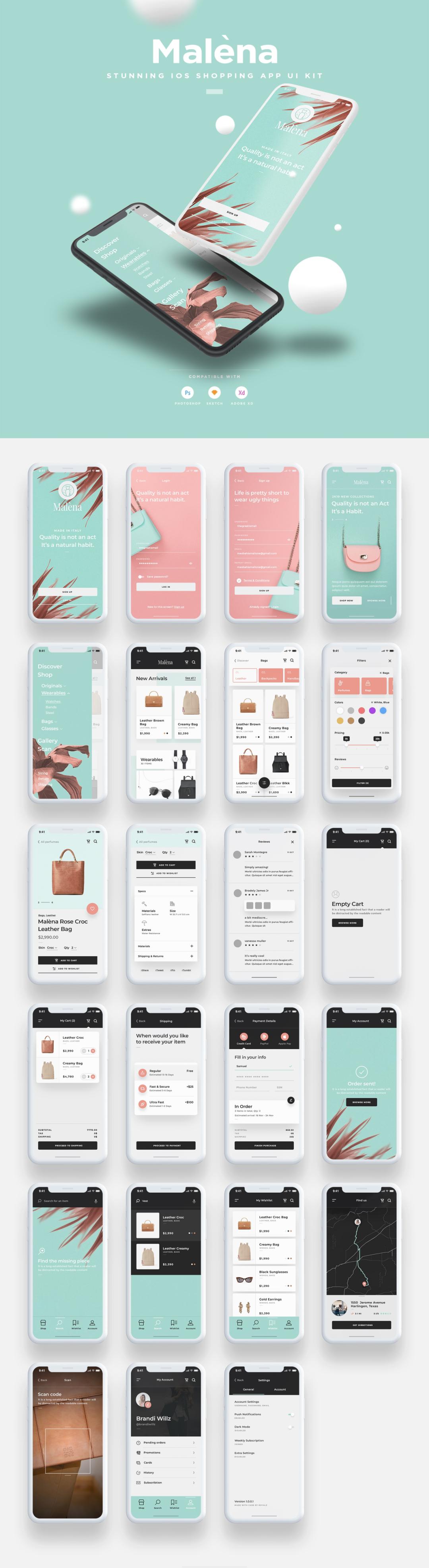
The general task is to provide GLM-5.3 Flash with a complete product design draft, and ask it to generate a fully interactive product user interface based on this single image.
The prepared design draft is as follows (scroll up and down to view the full image):
The Prompt is as follows:
Implement a complete mobile shopping App according to this UI design draft, restore the color scheme, fonts, images, cards and page layout in the original design as much as possible, and turn the main pages and shopping process shown in the image into a practically interactive version. Implement functions including Home/Discovery, product list, filtering, product details, reviews, favorites, shopping cart, delivery, address, payment, order completion, store map, personal center and settings.
Let's check the final interactive effect:
All the required functions can run smoothly and support full interaction as requested in the Prompt.
For more complex tasks, Zhipu AI official demonstrated the effect of a 3D Blender scene construction task that GLM-5.3 Flash independently ran for 12 hours:
Right now, the performance of GLM-5.3 Flash is: as long as you give it enough time, it can complete complex tasks on its own at a very low cost.
Brand New Architecture Design
After seeing the practical test results, you may be curious about one question:
How can a 320B parameter model achieve such outstanding performance?
The answer lies behind the word "Flash".
This time, Zhipu AI has optimized the efficiency from the very core of the model architecture.
The total parameter of GLM-5.3 Flash is 320B, but the actual activated parameter is only 18B, and the number of layers is reduced from 92 layers in GLM-4.5 to 45 layers. After this "slimming" optimization, its capabilities even surpass the previous-generation larger model GLM-5.2. With the latest 30T token multimodal pre-training corpus, Zhipu AI aims to reduce unnecessary computation without reducing output capabilities.
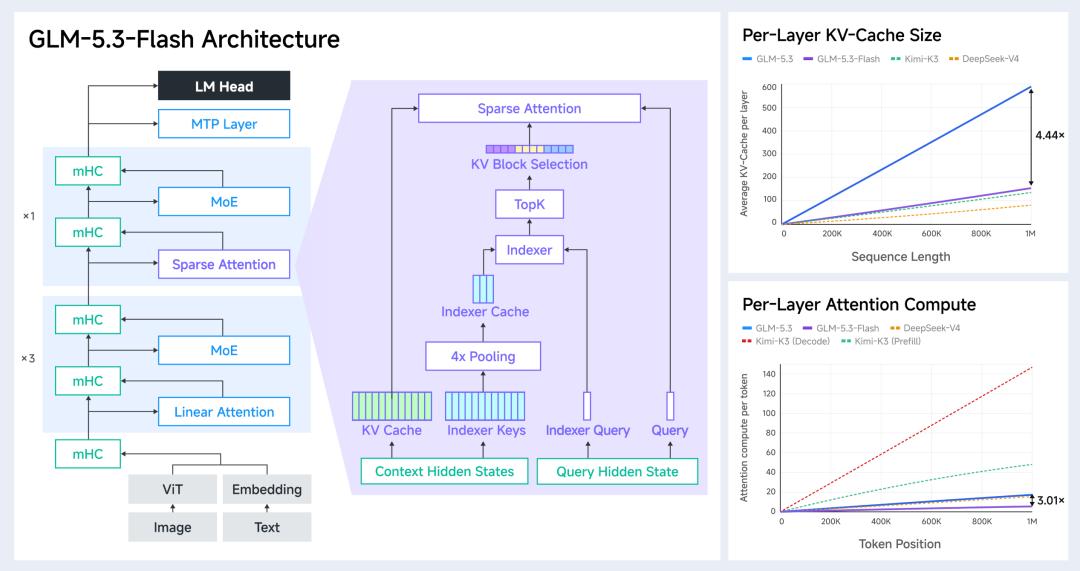
The most critical optimization is applied to the attention mechanism. GLM-5.3 Flash adopts a hybrid architecture of linear attention and sparse attention.
Linear attention is responsible for capturing local information, and sparse attention retrieves the truly relevant global context through a lightweight indexer. When facing an extra-long context of 1M, it does not need to run heavy mutual computation between every pair of tokens.
Zhipu AI also added an IndexPool, which compresses the original 4 cache vectors of the indexer into 1. As a result, compared with GLM-5.3, the attention computation volume of GLM-5.3 Flash is reduced by 3.01 times, and the KV Cache is also shrunk by 4.44 times.
This also explains a very obvious feeling from the previous practical tests: even though it has "Flash" in its name, it does not perform like a "lightweight version" when handling long-running tasks.
Especially for this newly added native visual capability, Zhipu AI specially built a synthetic data pipeline for Visual Coding, which allows the model to view the final page, interaction and 3D scene by itself during task execution, and continue to modify the output according to visual feedback.
This is exactly why it can write code, view the output, and make continuous revisions in tasks such as design draft restoration and 3D modeling that we mentioned earlier.
In addition, all the online real requests processed by GLM-5.3 Flash right now are running on domestically produced chips.
To support multimodal processing and 1M long context on domestic accelerator chips, Zhipu AI split multimodal encoding, Prompt pre-filling and token-by-token decoding into a separate Encode-Prefill-Decode architecture that supports independent scheduling and auto-scaling, and stacked a series of underlying optimizations including Layer Split and hybrid cache quantization.
Finally, compared with the initial baseline on the same hardware, the end-to-end service performance is improved by 3 times, and the single-token cost is at the same level as mainstream NVIDIA GPUs.
Domestic Development, Open Source Release, Backed by Full Confidence
Now, looking back at the sudden global popularity of "Niu Lai" overseas in recent days, the meaning behind it is completely different.
Before Zhipu AI officially claimed ownership, overseas developers on OpenRouter and OpenCode had no idea who developed Ox-Alpha. They just found it extremely easy to use, kept feeding it with various Prompts, and pushed it to the top of the ranking by real usage volume.
When Zhipu AI finally revealed its identity, everyone found there is more to the story:
The model is fully domestically developed, and the computing power that supports this wave of global real traffic is also provided by domestic chips.
As we mentioned earlier, during the anonymous test period, Ox-Alpha set new records for total API calls on both OpenRouter and OpenCode platforms, and all these requests are supported by computing power from domestically produced chips.
The significance of this event is far more than just "another win for domestic models". In recent years, cutting-edge models are facing an increasingly realistic problem: as