After replicating human faces, AI has begun to replicate the brains of experts
Within a year, at least three rounds of financing have been poured into the same category of AI products. They do not pursue more realistic avatars, nor are they busy replicating human voices. Investors are starting to bet on another direction: enabling AI to learn to think and work like professionals, and complete part of their tasks for them.
The latest case took place on August 20. Twin1 AI emerged from stealth with a $20 million seed round, co-led by Bessemer, Tribeca and Aramco Ventures. International law firm Orrick joined this round as both an investor and a client.
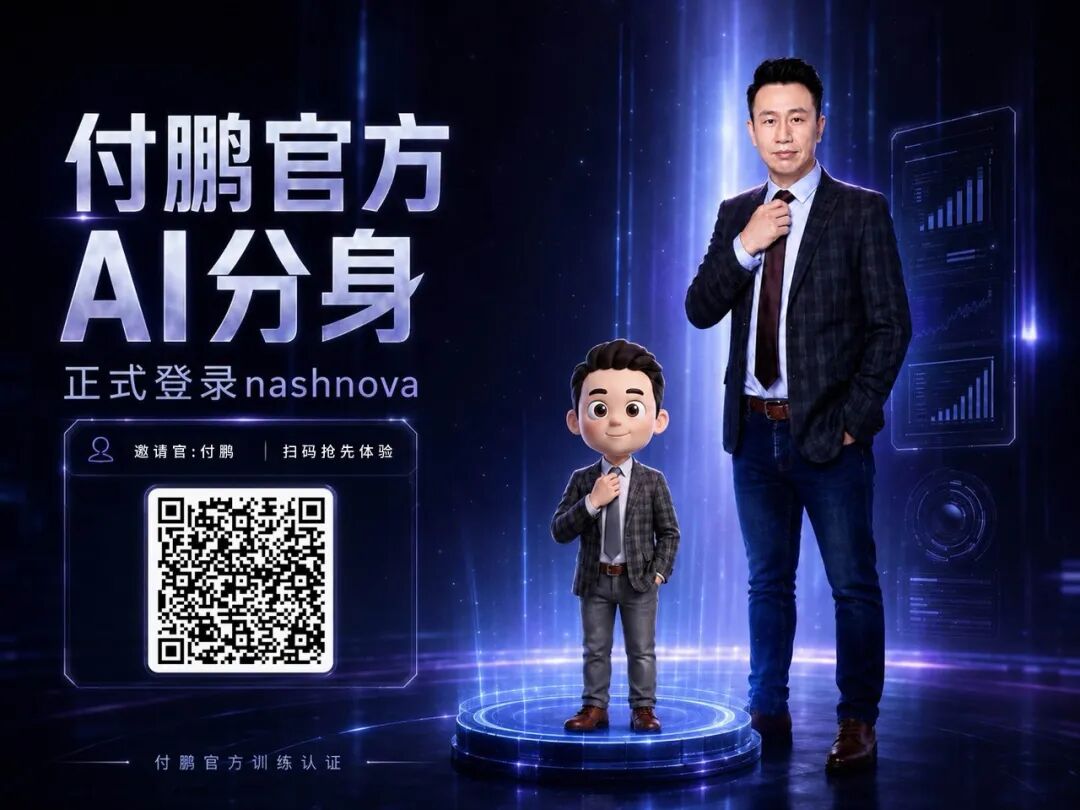
Almost at the same time, the official AI avatar trained by renowned economist Fu Peng was launched on nashnova, and the two sides began to promote it officially. nashnova is an AI investment research assistant that converts the accumulated research materials and analysis frameworks of economists and analysts into agents that can engage in conversations and continuously track the market.

Two years ago, Fu Peng had already tested a version of the digital human that could replicate his image and voice. That attempt did not satisfy him. The digital human looked like him and spoke like him, but could not continue once it deviated from the script.
This time, his summary of the newly launched Fu Peng AI avatar is very straightforward.
"The digital human has a brain now."
Part One
Capital Starts Betting on Human Experience
Over the past year, capital has placed consecutive bets along the same path. The value of AI avatars is shifting from replicating a person's image to duplicating their knowledge, thinking patterns and workflows.
In June 2025, HSG led Delphi's $16 million Series A round, with participation from Menlo Ventures and the Anthology Fund under Anthropic. Delphi helps experts train their own "digital mind", and users can consult these AI avatars on specific issues. The platform already has more than 2,000 creators on its roster, including Lenny Rachitsky, HubSpot co-founder Brian Halligan, and Arnold Schwarzenegger.
Delphi was the first to prove that expert avatars can generate direct revenue. The platform offers three tiers of subscriptions at $79, $399 and $2499 per month, and creators can get more than 85% of the revenue from paid conversations. The AI avatar of relationship expert Matthew Hussey has already generated seven-figure annual revenue in US dollars.
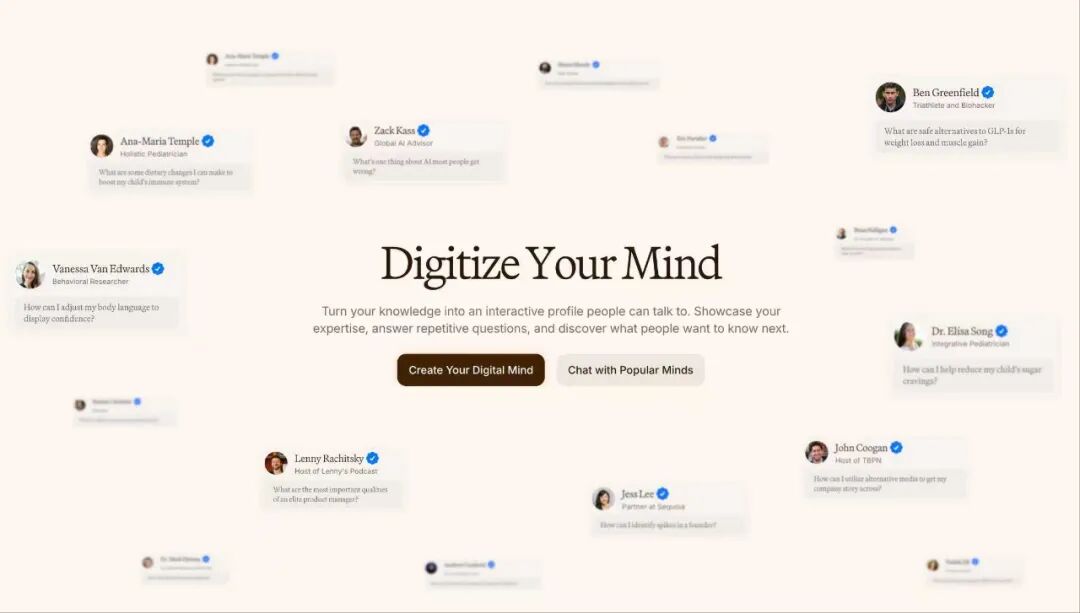
Delphi sells expert knowledge services. Eight months later, Simile extended this logic to enterprise decision-making.
In February 2026, Index Ventures led Simile's $100 million Series A round, with Bain Capital Ventures participating in the investment. Li Feifei and Andrej Karpathy are also on the list of investors. The three founders Joon Sung Park, Michael Bernstein and Percy Liang all come from Stanford University.
Simile trains AI to simulate real people's reactions to new products, new features and market changes, helping enterprises test in advance the possible feedback triggered by a certain decision. CVS Health and Telstra are among the first batch of clients. In a simulated earnings call, the system predicted 8 out of 10 questions raised by analysts in advance.
The latest player to enter this track is Twin1 AI. In August 2026, the company completed a $20 million seed round of financing, and directly integrated AI avatars into the daily work of enterprises.
Twin1 reads emails, meeting minutes, documents and enterprise systems to learn the background knowledge mastered by a professional, then connects to Slack, Teams and Outlook to answer questions and handle communications for them. Law firms such as Linklaters and Dechert have become the first batch of clients. Twin1 claims that the system has handled 30% to 50% of the communication tasks of knowledge workers for some clients.
The three companies occupy three scenarios respectively: expert services, market simulation and enterprise collaboration. Their product forms are different, but what capital values is very similar. Whether a person's knowledge can be converted into subscription revenue, whether their judgment can help enterprises test decisions, and whether their workflow can be taken over by AI, these specific results begin to determine the value of avatars.
This line of development needs to be viewed separately from the video digital human business represented by Synthesia and HeyGen.
Synthesia completed a $200 million Series E round of financing in January 2026, with a post-investment valuation of $4 billion. HeyGen announced in June of the same year that its ARR exceeded $200 million, doubling within eight months. The two companies mainly transform enterprise video production, integrating shooting, on-camera performance, translation and post-production into one interface. The cost saved by clients on production can be directly calculated.
Delphi, Simile, Twin1 and nashnova are dealing with another type of cost. They are trying to reduce the time experts spend on repeatedly answering questions, the time enterprises spend on repeated market research, and the time professionals spend on handling daily communications.
As a result, the competition for digital humans has been divided into two paths. One continues to reduce the cost of content production, while the other starts to enter knowledge services and professional work. In the past, digital humans mainly appeared on camera on behalf of people. Now, capital hopes they can take over part of the work.
Part Two
Private Corpora of Experts Are Becoming New Product Barriers
Capital is willing to pay for expert avatars, and the next question is why such products are hard to replicate.
Basic models can hardly form long-term differences. The models accessible to startups are getting more and more similar. What really widens the gap between products is what materials the models can access, and how much time the experts themselves are willing to invest in training them.
Fu Peng's AI avatar provides a specific sample.
According to Fu Peng, the training materials he handed over to nashnova include articles and diaries dating back to 1999, annual PPT yearbooks of four to five hundred pages each year, research meeting minutes and transaction records over the years, as well as part of the content from his anonymous BBS accounts in the early years.
These materials have not appeared completely on the public network, and general models can hardly obtain them through conventional training. They not only record the views Fu Peng has published publicly, but also include what he referred to before forming his views, how he adjusted them later, and what evidence once made him change his judgment.
This is exactly the limitation of public information.
In articles, speeches and videos, a person usually can only present the conclusions at that moment. A speech is limited by time, and only a section of the complete analysis process can be expanded. After the content is cut into short videos, the assumptions and applicable boundaries will be further lost.
With all these public materials collected, AI can answer "what he said in the past" and imitate his way of expression. When encountering new issues that the person himself has never discussed publicly, it may still not know which variables to check first.
After a Fast Company reporter tested Delphi, he found that some answers repeated similar sentence patterns, and the coverage of time-sensitive topics was not sufficient. This shows that historical content can help AI imitate a person, but it is not enough to restore his complete judgment process.
When nashnova trained Fu Peng's avatar, it tried to go one step further. The system first splits the facts, backgrounds and phased judgments in the long-term materials, then looks for the rules that Fu Peng repeatedly uses when dealing with problems. Which variables he is used to checking first, in what order he eliminates possibilities, and what evidence will make him modify his conclusions.
After the materials are sorted out, Fu Peng will personally test the system. He will ask normal questions, and also deliberately add wrong premises to see if the AI can find the problem, or continue to answer along the wrong track.
Each error correction requires rewriting the training rules and evaluation question banks. Similar problems will be retested before the next version of the product is launched. In this way, the correction brought by one error can be retained and continue to affect the subsequent answers of the system.
This also constitutes a part of expert avatars that is more difficult to replicate.
Getting authorization only requires the expert to sign once. To train an avatar that can handle new problems, the expert needs to continuously ask questions, make corrections, and clearly explain his judgment process. The longer the time invested, the more rules and test cases the system accumulates, and the harder it is for latecomers to complete replication only by crawling public content.
The gap between expert avatars in the future will most likely depend on two things: how much undisclosed long-term materials the expert is willing to hand over, and how much time he is willing to spend personally training this avatar.
Part Three
Expert Avatars Still Need to Address Three Issues
Private corpora and personal calibration make expert avatars harder to replicate, but they cannot guarantee that it will become a long-term business. For products to continue to generate revenue, three issues need to be solved: compliance, user retention, and capability boundaries.
Compliance is the first restriction encountered. The Measures for the Identification of Artificial Intelligence Generated Synthetic Content came into effect on September 1, 2025, requiring corresponding identification for AI-generated texts, images, audios and videos. Service providers and content dissemination platforms must also perform review responsibilities.
The situation faced by financial expert avatars is more complicated. The longer users communicate with the avatar, the easier it is for them to interpret the answers as the expert's own judgment at the moment. Products need to continuously display the AI identity, allowing users to view the cited materials, data dates and content versions. AI can provide information and analysis, but specific investment decisions and their consequences are still borne by users.
When AI speaks in the expert's tone a passage that the expert himself has never said, the division of responsibilities among the platform, the expert and the user also needs to be clarified in advance.
Another issue is user retention. Delphi has proved that some people are willing to pay for expert avatars, but there is still a big gap between one-time payment and long-term subscription.
Judgment-based products are especially difficult to prove their effectiveness in the short term. Users can hardly confirm whether an analysis is effective, nor can they judge whether the value they get comes from the expert's thinking framework or the inherent capabilities of the basic model. If the difference between the two is not obvious enough, users may return to general models again.
Expert avatars need to remember the markets users pay attention to, the questions they have raised, and the judgments they made in the past during the use process. When new data appears, the system also needs to check whether the original judgment still holds. These continuous records are the possible reasons for users to stay. Whether users are willing to pay for this in the long run depends on how many people come back in the second and third months.
Product capabilities have not been fully verified either.
Fu Peng envisioned a further scenario. In the future, the one sitting in the live stream room may be an AI avatar that can understand questions, take the initiative to ask follow-up questions, and communicate naturally with the host. He named this avatar "Little Peng Peng".
Today's products are still far away from this scenario. It needs to handle new problems more stably, reducing factual errors and wrong inferences. This capability will determine the maximum market size that expert avatars can finally enter.
If it can only repeat what the expert has said publicly in the past, what users buy is still a kind of content service. If it can process new information, continuously review old judgments, and take over the work that originally required the expert's personal participation, it is possible for it to enter the consulting, research and enterprise service markets.
In the past few years, digital human companies have been working to make a face more realistic and a voice closer to the real person. Now, the cost of replicating images and voices continues to drop, and capital has started to invest money in the parts that are harder to replicate.
The face of digital humans is getting cheaper, and human experience is being re-priced.
This article is from the WeChat official account "All-Weather Tech" (ID: iawtmt), author: All-Weather Tech, published with authorization from 36Kr.