The birth of a 200-billion-yuan AI search unicorn: Investors have earned a 240-fold return on their investment.
An AI company that was founded just 4 years ago is targeting a $300 billion valuation (approximately RMB 201.6 billion).
On August 23, sources reported that Nvidia is discussing participation in a new round of financing for AI search firm Perplexity. This financing round may reach billions of dollars, which will push the company's valuation to more than $300 billion.
If the deal is completed, Perplexity's valuation will rise by at least 50% again in about a year.
At the start of 2024, the company's valuation was only around $500 million. By the end of 2024, its valuation had reached $9 billion. In June 2025, the valuation further rose to $14 billion; it then crossed $18 billion and $20 billion successively within a few months. Now the latest round of financing has pushed the target to more than $300 billion.
In less than three years, the valuation has soared from $500 million to $300 billion — nearly 60 times growth.
Early investors are even expected to get an excess return of 240 times.
What attractive business opportunities lie behind Perplexity that everyone is scrambling for?
Three Profit Streams
Founded in 2022, Perplexity is the AI version of Google. When you enter a question in the search box, instead of asking you to click links yourself, it directly gives you a well-organized answer with source links for every sentence — which is equivalent to reading more than a dozen web pages for you and extracting conclusions.
Many professionals — journalists, researchers, investors — use it for information collection and preliminary research.
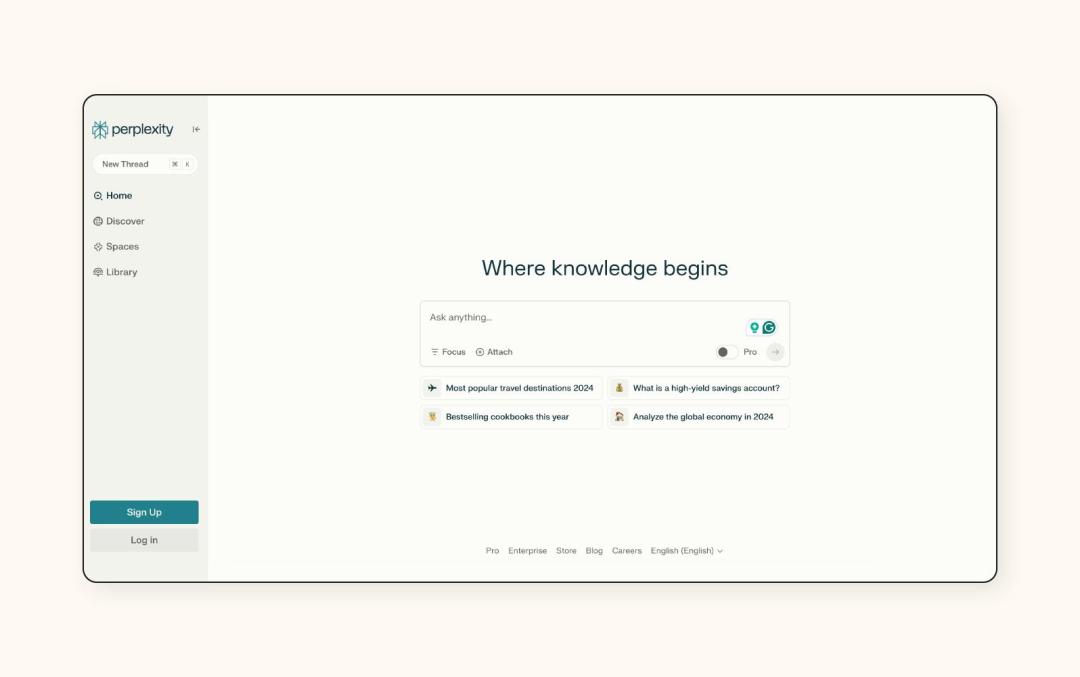
Perplexity AI Search Interface Source: Perplexity Official Website
But Perplexity's real evolution took place this year. It is no longer just a "search box", but moving towards becoming an AI Agent that can directly help you get work done.
The most surprising thing about Perplexity is not how fast its valuation has risen, but that it is actually making profits.
Perplexity's annual recurring revenue (ARR) has exceeded $750 million.
Where does the revenue come from? There are mainly three revenue lines:
The first and most fundamental one is consumer subscription. Perplexity Pro costs $20 per month, and the premium version is more expensive. It collects money on a monthly basis just like Netflix or Spotify. It has reached pre-installation cooperation with major mobile phone manufacturers and operators around the world — pre-installed on Motorola phones, 12-month free access for Samsung Galaxy users, and 360 million users of Indian telecom giant Airtel can get a free Pro version. This model of "operator subsidy + user trial → conversion" has helped it quickly acquire a large number of users.
The second line is enterprise services, which is also the fastest-growing part this year. Perplexity launched Computer for Enterprise, which is essentially an AI office assistant for enterprises, priced at $200 per seat per month. It can connect to the internal systems of enterprises and help employees automatically complete complex tasks — for example, if you ask "summarize all changes in this week's data and mark anomalies", it will directly pull out cited answers from real-time data.
According to reports, on the weekend right after this product was released, more than 100 enterprise customers took the initiative to contact and apply for trials.
The third line is the API business. Its Sonar API allows developers to embed Perplexity's "cited search capability" into their own products. Customers in the fields of finance, healthcare, and enterprise SaaS are using it — which is equivalent to turning its search capability into a public utility like water, electricity and gas, where users pay based on usage.
With less than 400 employees across the three lines, the annual revenue created per capita is close to $1.9 million — an efficiency that ranks among the top in the entire enterprise software industry.
DENG Mingsheng, founding partner of Yushi Capital, told Pencil News: Perplexity's rapid growth is not only because AI search is popular, but more importantly, it has been gradually transitioning from search to an Agent that can directly complete tasks.
"Search is first and foremost a tool. When a user has a question or demand, they find information through search, then judge whether the information is authoritative and comprehensive, combine it with their own needs, and finally get the answer. Throughout the process, the person who actually makes judgments is still the user themselves." DENG Mingsheng said, "Agent follows a different logic. It will replace part of the user's thinking process to a certain extent, act more like an expert to help you complete analysis, judgment, and even decision-making, and finally deliver the result directly to you."
In his view, today's AI search is actually just an intermediate state — because users have not yet fully built trust in large models and Agents. But once this trust is established, the speed may be faster than many people expect.
"Humans essentially want to 'save effort'. If a model can perfectly meet my needs three times in a row, why should I search more than a dozen web pages on my own and spend time making judgments?"
Who Has Actually Made Money?
In the $300 billion valuation feast, the biggest winner is undoubtedly the founding team.
CEO Aravind Srinivas was born in 1994 to an ordinary family in Chennai, India. His father worked in the financial industry, and there was no technology background in the family. He studied electrical engineering at IIT Madras — because he failed to get admitted to the computer science department back then, and failed to transfer to the department later, he taught himself programming and machine learning.
After graduating with his bachelor's degree in 2017, he went to the University of California, Berkeley to pursue his doctorate, with Pieter Abbeel, a leading figure in reinforcement learning, as his supervisor. During his PhD studies, he interned at Google Brain, DeepMind and OpenAI successively, and finally officially joined OpenAI to participate in the R&D of DALL-E 2.
In August 2022, he founded Perplexity in San Francisco with three other people: CTO Denis Yarats, from Meta FAIR and doctoral student of Turing Award winner Yann LeCun; Chief Strategy Officer Johnny Ho, a Chinese American who graduated from Princeton and won a gold medal in the International Olympiad in Informatics; and Andy Konwinski, co-founder of Databricks.
The combined background of the four people — large model experience from OpenAI and Google, search genes from Meta FAIR, engineering capabilities of IOI gold medalist, and entrepreneurship & enterprise service experience from Databricks — is simply the "all-star lineup" for AI startups. No wonder it raised $3.1 million in its pre-seed round, with investors including former GitHub CEO Nat Friedman and Yann LeCun himself.
The specific shareholding ratio of the founders has not been made public, but according to data from the Hurun India Rich List, when the company's valuation was $20 billion last year, Srinivas's net worth was about $2.5 billion, with a rough estimated shareholding of 10%-15%. If this round of financing really reaches $300 billion, his paper wealth may rise to between $3.5 billion and $4.5 billion.
But almost all of his wealth is unlisted equity with very low liquidity. Srinivas himself said in an interview with CNBC in June that Perplexity plans to go public in 2028 — that will be the real realization node for the founders.
In addition to the founders, early investors have also reaped huge returns.
NEA, which invested in the Series A round in April 2023, entered when the valuation was only $121 million. Now at $300 billion, the return has increased by more than 240 times in three years. Nvidia and Bezos, who joined in the Series B round in early 2024, entered at a $520 million valuation, and have also gained 50 to 60 times return in two years. Even SoftBank, which followed up at a $200 billion valuation last September, has a paper profit of more than 50% now.
Nvidia's move is the most thought-provoking. It is not only making financial investments, but also building a "computing power empire" — it invests in Perplexity, and Perplexity buys its GPUs; it invests in companies like Poolside and Groq, which are also its customers. It is equivalent to selling shovels while taking stakes in gold diggers.
However, DENG Mingsheng has a very interesting observation: the charging model of AI in the future may be divided into two layers.
"One is general, daily intelligence, such as common Q&A and daily suggestions. This type of capability is more like water and electricity, a basic utility. It may be more suitable for the subscription model or pay-per-use model." He said, "But the other is more high-end and professional intelligence — for example, I need to deeply study whether a company is worth investing in, study a complex scientific problem, or even design a certain molecular structure. This type of task requires deeper and more professional thinking, and may no longer be charged according to 'how many times it is used', but charged according to task quality or final result."
If this judgment holds, Perplexity, which currently charges via subscription, may only be getting the first layer of the cake.
Is $300 Billion Overpriced?
The $300 billion valuation corresponds to $750 million in ARR, with a price-to-sales ratio of about 40 times. In the traditional software industry, this number is ridiculously high. But in the AI track, many people think it is "not expensive".
Why? Because what it is competing for is not the market of a search product, but the position of the next-generation internet entry.
Comparison between Perplexity and Google Search Source: GenAI Today
Today Google controls more than 91% of the global search market, and earns more than $300 billion from search advertising every year. As long as Perplexity can carve out even a small piece of cake from Google, it is worth the price.
But the reality is harsh. According to data from multiple third-party institutions, AI chat tools currently only handle about 2%-3% of search queries. Traditional search still occupies an absolute dominant position. Google itself is also rapidly integrating AI — AI Overviews has covered more than 25% of queries, and Gemini is built into Gmail, Docs, Chrome and YouTube, giving it a natural distribution advantage that Perplexity cannot match.
The more critical question is: how long can the AI search form itself last?
DENG Mingsheng's judgment is very straightforward — "the window may only last two or three years".
"I think the so-called AI search today is actually just an intermediate state. The core reason for the emergence of this intermediate state is that users have not yet fully built trust in large models and Agents." He said, "When users do not have enough trust in AI, they still want to see the source of information themselves, make comparisons themselves, and make final judgments themselves, so AI search still has value to exist."
But as the number of uses increases, if the results given by the model meet user requirements several times in a row, trust will be established very quickly. At that time, users may no longer be willing to complete the intermediate process of searching, filtering and judging by themselves.
He took buying a computer as an example: "In the past, when buying a computer, you would search for a lot of information, check parameters, read reviews, and then make comparisons according to your own needs. But if I trust the large model enough in the future, I may just tell it: what kind of computer I need, what my budget is, and what I mainly use it for. Leave the subsequent comparison and judgment to it, and it will directly tell me which one to buy, or even help me complete the subsequent procedures."
At this point, what users are really willing to pay for is no longer "search" itself, but the final delivered result.
"So if I look at AI search startups today, I think the opportunities are actually very limited. Startups cannot only make a product of the intermediate state. The reason why AI search still seems to have a market today is that a large number of users have not fully used large models, nor have they built trust in Agents. But once this trust is established, the speed may be faster than many people expect."
Perplexity has obviously realized this. The Perplexity Computer it is vigorously promoting this year is essentially a transition from "search" to "Agent". If the transformation is successful, it will not just be a better Google, but may become the next-generation work entry.
This is why Nvidia is willing to invest billions of dollars in it — it is not betting on how much money Perplexity can make now, but on whether it has the potential to become a new entry in the AI era.
Entry is the most profitable business in the world. Google earns hundreds of billions of dollars a year through its search entry, and Apple collects tens of billions of dollars in toll fees every year through the App Store. If Perplexity can really become an entry in the AI era — even if it is just one of them — $300 billion is really not expensive.
But on the other hand, if the Agent era really arrives and Perplexity fails to successfully transform, and is replaced by a more native Agent product, then $300 billion will be a bubble.
DENG Mingsheng believes: "What is really worth doing is not making another better search box, but going one step further — when users no longer need to search and judge by themselves, can AI directly complete the task for them. I think this is the direction that is truly valuable in the future."
Perplexity is moving towards that direction. But no one knows the answer yet whether it can win the race.
This article does not constitute any investment advice.
This article is from WeChat Official Account "Pencil News" (ID: pencilnews), author: Song Ge, published with authorization from 36Kr.