Is there a Fengge factor in quantitative investment?
After half a year of gloomy market, gold has staged a sharp rebound. When countless investors are looking forward to getting rid of their losing positions, Feng Ge shows up.
Last week, right after Feng Ge settled in JD, he suffered a huge loss of 190,000 yuan at the very start. To hedge the decline of A-shares, he bought gold at the price of 970 yuan. This extremely common operation made financial consumers feel panicked.
Let's sort out Feng Ge's investment track record: On July 8, Feng Ge announced he would never trade again, and the next day the semiconductor index surged by 7%; On July 9, Feng Ge went all in on positions, and the next trading day, the STAR 50 index dived by 5% in late session; On July 21, the market suddenly staged a deep V rebound. After looking for the reason for a long time, people found that Feng Ge uninstalled the Tonghuashun trading app right at the lowest point.
According to rough statistics, from May to July, Feng Ge's 9 public operations had a 100% reverse indication winning rate.
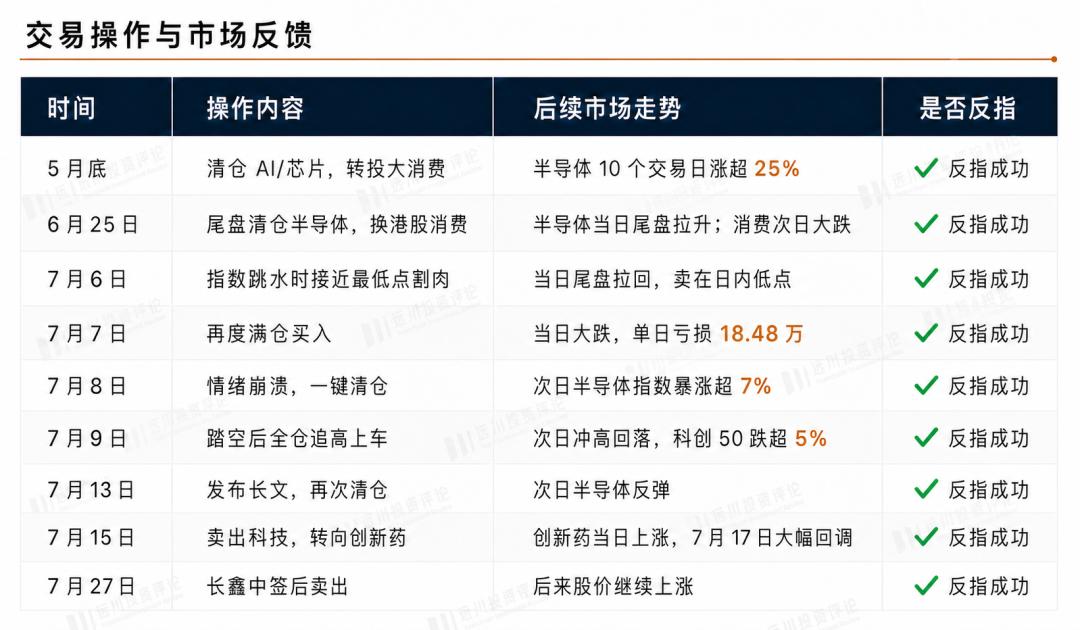
A saying goes around the market that Feng Ge has been made a factor by quantitative trading strategies. At first Feng Ge did not believe it, "How could quantitative strategies target my mere 3 to 5 million yuan of capital?" It was not until July 20 that right after he sent best wishes to US tech stocks, SK Hynix's stock price dived immediately. He then became half-convinced and was so scared that he deleted his Weibo account.
It seems that every word of top financial influencers has become the input material for quantitative trading, and eventually turned into trading signals.
Trump also feels he is being targeted, but he is smarter to monetize his own content: he not only completed 1051 securities transactions in June, but also sold the API access to his posts to hedge funds and high-frequency trading institutions in July, where users need to pay 100,000 US dollars per month to see the president's posts several milliseconds ahead of others.
Since July, the market has experienced sharp surges and slumps, and people always suspect that quantitative trading strategies are secretly using the "Feng Ge Factor" and "Korea Factor". It seems that from people who affect market sentiment, to self-circulating unofficial market stories, even the stock market of a country can be captured and followed by quantitative strategies, and eventually made into factors.
But is that really the case?
Everything Can Be Made a Factor?
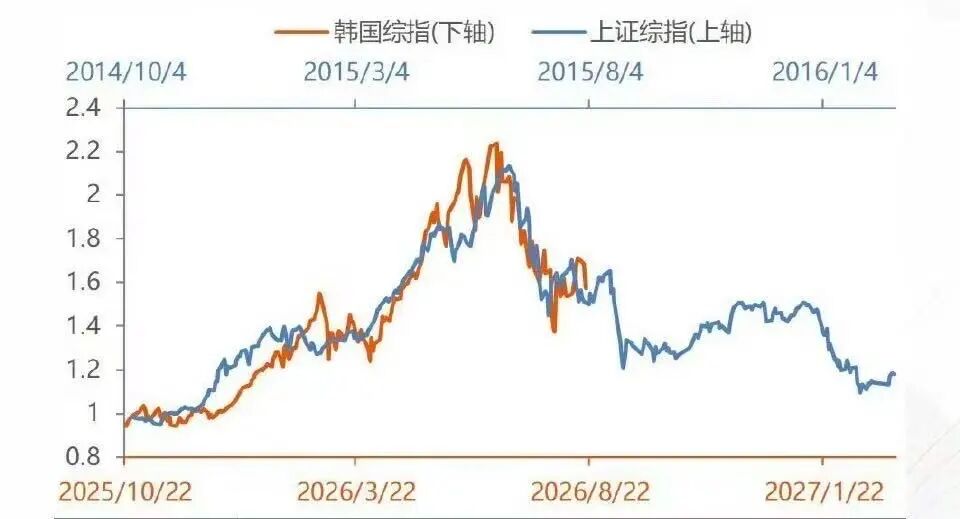
Every once in a while, Chen Guo would compare the trend of South Korea's KOSPI in 2026 with the trend of Shanghai Composite Index in 2015, and find that the two rounds of leveraged bull markets are surprisingly similar. What's more coincidental is that on July 14, the time-sharing charts of South Korean stock market and A-shares staged synchronous deep V rebounds, and public opinion in the market suspected that quantitative strategies are using the South Korea Factor.
After market close, many private equity funds cleared their names publicly: "If quantitative trading is completely based on overseas tech stock transactions, it will inevitably generate negative excess returns in the long run."
I also asked my friends working in the quantitative trading industry whether they had put the South Korea Factor into their models. They said it is completely impossible — most quantitative strategies do not trade in the South Korean stock market, they do not even purchase relevant data, so there is no way to generate the South Korea Factor without data.
A quantitative industry practitioner gave me an analogy: "It's just like I like tall girls and I am attracted to a tall South Korean girl, which does not mean I will also like another tall Chinese girl." Even among tall South Korean girls, liking Karina does not mean you will like Jang Wonyoung.
Then is it possible for Feng Ge to become a factor? The answer is also no.
Feng Ge only posted a few of his operations, while a quantitative factor needs a huge amount of data to support its derived rules.
To test whether a factor is effective, we should not only look at IC (Information Coefficient) to judge the prediction accuracy, but also look at IR (Information Ratio) to measure the prediction stability. In addition, we need to observe whether the returns show monotonicity through grouped backtesting, and pass out-of-sample tests to confirm that it is not a coincidence in history.
A quantitative researcher said bluntly, "Feng Ge's operations are essentially noise with very low information content, far less valuable than the tweets of the US president. Even so, the stocks affected by Trump's tweets are very limited, the signals are neither stable nor sustainable, and the signals will disappear once he leaves office."
Whether you trade in the opposite direction of Feng Ge, or copy the trading pattern of South Korean stocks, the lack of sufficient samples and stable correlation does not conform to the basic laws of quantitative mathematical statistics. Feng Ge can win back his female fans by sending well wishes even if he loses money; but if quantitative strategies lose money following this pattern, institutional investors will redeem their positions immediately, and even writing apology letters will not help.
Zhuang Xi, an investor from Pingfanghe Investment, gave a vivid example: the "3964" formula before the 2006 World Cup[1]:
Argentina won the championship in 1978 and 1986, Germany won in 1974 and 1990, Brazil won in 1970 and 1994, as well as in 1962 and 2002. The sum of each two groups of championship years is 3964. According to this calculation, the 2006 champion should be Brazil, which won the championship in 1958, but the final winner was Italy.
Facts have proved that "3964" is a false rule. The rule supported by more samples is that teams that have won the championship before have a higher probability of winning the trophy again.
Similarly, a few statements from the president do not mean much, but Trump posts thousands of tweets every year, so it is always possible to find some rules.
For example, JPMorgan Chase designed the "Volfefe Index", inspired by Trump's confusing typo tweet with the word "covfefe", to quantify the impact of Trump's tweets on US interest rates. It turns out that 146 out of 4000 tweets can affect the market, with keywords concentrated on words like "China" and "Democrats". In addition, Bank of America Merrill Lynch found that the more frequently Trump posts on social media, the worse the performance of US stocks will be.
For quantitative trading, the common practice is to grab announcements, news and social media information in batches, use NLP technology to extract keywords and score them, for example, give high scores to "major positive news" and negative scores to "plunging performance", then judge the strength of market sentiment combined with view counts and likes, to assist trading decision-making, instead of simply trading against Feng Ge to get huge profits.
A quantitative researcher told me that 200 to 400 of the 1000 listed companies will have news every day. If we extend the time horizon, 1000 stocks will continuously generate information, and they will conduct cross-sectional trading based on this: score and compare every day, then select the best performing stocks.
If there really is no "Feng Ge Factor" or "South Korea Factor", why do we always feel that the stocks we hold jump up and down sharply because of a big V's statement or an unofficial market story this year?
Become the Input Material for AI
The last blogger that attracted collective attention of stock investors was Serenity, the white-haired stock god.
The white-haired stock god has the opposite magic power to Feng Ge. As of June, some people in overseas communities counted that he publicly discussed 35 stocks, 31 of which rose, with a winning rate close to 90%. A casual mention of Green Harmonic and East Power can drive a 20% daily limit.
Some netizens found that the white-haired stock god posted at Asian time, and his speech style has obvious Chinese characteristics. Zhao Piye, an analyst from Guosheng Securities Communication Department, posted on WeChat Moments: "These guys will get into trouble sooner or later, thinking that they can act recklessly just by going abroad."
It is unknown whether the white-haired stock god is Chinese, but the influence of overseas bloggers' remarks on A-shares is growing. Even a tiny disturbance can cause domestic investors to follow and push up stock prices quickly. Recently, some bored people created an account on X to make up stories that NVIDIA intended to invest in Zhongji Innolight and Eoptolink, and the two stocks really rose immediately.
This is a long-existing gray chain in A-share market: market makers create unofficial stories → bloggers post to hype stocks → the content spreads in chat groups → capital follows to push up prices → main players cash out at high positions. The difference is that this year, a large number of unofficial stories are first released on overseas platforms.
People originally thought that the buying orders caused by overseas bloggers' and foreign media's stories mostly come from hot money and retail investors. But after communicating with a quantitative private equity fund, we found that their multi-strategy product lines also build event-driven strategies based on Trump and Serenity's tweets.
In their view, event-driven strategies can be divided into many types. "If grabbing performance preannouncements in batches to score can be classified as quantitative event-driven, then events that can trigger chain market reactions, such as Leopold's forced liquidation, Trump's extreme remarks, and Serenity's bottleneck theory, can also form subjective event-driven strategies, which are also an important part of multi-strategy products."
Interestingly, a subjective fund manager from a public fund told me that he specifically uses AI tools to track the changes of unofficial market stories and analysts' jokes. "Because many marginal changes of information often first appear in these informal channels, AI tools can capture them in advance, then we can verify directly with the companies, so that we may seize the information gap."
In the era of accelerated information dissemination, a post accidentally sent by a financial blogger may trigger capital to follow and hype. Coupled with the natural preference for stories in a tech bull market, market sentiment is often ignited easily. But what is easy to ignore is that a post or a market story is becoming the corpus of AI, and gradually becomes an invisible source amplifying market volatility.
Fidelity's legendary fund manager Gavin Baker mentioned in a recent podcast[2] that almost all investors he knows will input any piece of news into Claude immediately after seeing it.
Claude is a probability model. Facing the same piece of news, the interpretations it gives are often not very different. In the past, the famous news anchor Walter Cronkite was almost the only authoritative voice in the United States. In the stock market, Claude has become the new Walter Cronkite.
Baker believes that Claude gives an interpretation, and a large number of investors trade according to this judgment immediately. As a result, market participants seem to come from different institutions and use different strategies, but behind the scenes they may rely on the same model and get highly similar conclusions.
"A well-known semiconductor expert once demonstrated that the stock price trend of a Japanese capacitor company completed the full three-year cycle of the capacitor industry in just six weeks." In the same AI era, our memory chip stocks have also achieved a rocket-like surging trend.
We always overestimate the future of AI investment targets, but underestimate the impact of AI on investment trading.
Epilogue
Chen Peng from Yuanlan Fund found when doing quantitative macro strategies that AI can enable quantitative strategies to gain the capability of subjective investment.
When traditional quantitative models process macro news, they capture the increasing frequency of words such as "war" and "fierce" as the basis for going long on crude oil. But when encountering words with complex rhetoric, the model will fail. Now, AI can read 1000 pieces of global news in 10 seconds, and summarize whether the event is developing in a positive or negative direction[3].
Facing the rising oil price in both the Russia-Ukraine war and the Iran war, AI can identify the difference in liquidity, perceive people's different inflation expectations, and derive completely different gold trading logic. In his view, traditional quantitative models are relatively rigid, while AI can see derived variables.
But this can not help but make people think: when more and more investors introduce AI, will investment become close to an expression of market sentiment?
At present, quantitative private equity funds that advertise end-to-end capabilities mainly feed volume and price data, and strictly control the input of public opinion information manually. But in the future, purely AI-driven strategies will inevitably become more and more common. Even retail investors are used to asking AI chatbots "what to buy today", so will AI take the operations of Feng Ge, Shen Zi and Sister Wang as sentiment indicators to guide trading?
Li Chao from Zheshang Securities saw the risk, and released a report titled "What is the Impact of Artificial Intelligence on the Market?" yesterday, with a very good concluding sentence:
As artificial intelligence is further embedded in decision-making, trading and risk management, the capital market obtains higher information processing efficiency, but also needs to solve new problems such as model convergence, trading resonance and endogenous risk.
References
[1] Finding Alphas: A Quantitative Approach to Building Trading Strategies, Igor Tulchinsky
[2] "Tech Investment Guru" Gavin Baker's Silicon Valley Stress Test: I Wish I Could Feel Scared, But Except for the Credit Problem, All Conclusions Point to "The Underlying Fundamentals Are Improving", Smart Investor
[3] Being Able to Analyze Data Does Not Mean Truly Understanding the Macro Economy, But AI Is Almost There, Thick Snow Long Wave
This article is from WeChat Official Account "Yuanchuan Investment Review" (ID: caituandzd), Author: Shen Hui, 36Kr is authorized to release this article.