Between HappyHorse and Wan3.0 in the horse race, which one is the Alibaba version of Seedance?
On August 24, after announcing the completion of a rights issue financing of approximately 10.2 billion U.S. dollars (80 billion Hong Kong dollars), Alibaba's latest-generation video generation model Wan3.0 was fully launched after nearly 20 days of public beta testing.
Official information shows that Wan 3.0 can generate 30-second videos in a single generation, doubling the duration of the previous generation, and for the first time supports input of document formats such as doc, xls, ppt, pdf, md, etc. This means that it is no longer just a conventional "text-to-video" tool, but has greater ambition to become a tool that directly processes documents and generates enterprise-level content. From the perspective of product form, Alibaba is trying to push Wan 3.0 to a more clear commercial scenario.
On the leaderboard of the AI evaluation platform Artificial Analysis, among the top 15 series of large models for text-to-video, Alibaba alone occupies two seats: Wan and HappyHorse.
Moreover, Wan 3.0 almost covers all existing capabilities of HappyHorse, including 30-second generation, full-modality reference, native audio, and character consistency, each of which has entered the traditional territory of the latter. More subtly, the two models are on the same Bailian platform, competing for the same group of customers at different prices: for 720P videos, Wan 3.0 charges 0.6 yuan per second, while HappyHorse 1.1 charges 0.9 yuan per second.
One company, two sets of video models, running side by side on the same track, Alibaba's battle in the video generation track is still accelerating.
Continue the horse race after the two teams merge?
When Wan3.0 launched its public beta, the Tongyi Wanxiang team behind it was ushering in a new round of integration within Alibaba.
Tongyi Wanxiang is a well-established multimodal team within the Alibaba system, founded from scratch by Liu Yu, who joined Alibaba in 2015. Before Wan3.0, Wanxiang had iterated multiple versions from Wan2.1 to Wan2.7, which was Alibaba's earliest layout force in the image and video generation track, but its response in the industry was mediocre.
On the other hand, the story of HappyHorse is more tortuous. In April 2026, HappyHorse landed anonymously on the global AI blind test platform Artificial Analysis, topped both lists, and was finally claimed by Alibaba. The HappyHorse project was originally derived from Alibaba's Taobao & Tmall Technology Department, and after several twists and turns in multiple adjustments of Alibaba's internal organizational structure, it was finally assigned to the AI Innovation Business Unit under the business group of ATH (Alibaba Token Hub).
The release time of Wan3.0 is very delicate, it appears in the special window period of the team's "being incorporated" and the group's organizational structure adjustment. On June 8 this year, Alibaba established the Token Foundry Business Unit, which is formed by the merger of the two core sectors of the Tongyi Large Model Business Unit and the Future Life Laboratory. The former, as the technical base of most of Alibaba's AI products, is mainly responsible for the R&D and iteration of Qwen large model, while the latter is mainly responsible for the implementation and commercialization of AI applications.
Only one month later, on July 16, the Tongyi Wanxiang team was officially merged into the Future Life Laboratory led by Alibaba Vice President Zhang Di, which is exactly the R&D team of HappyHorse.
So far, the three multimodal models under the Alibaba Group, the text-to-image and video model Wanxiang (the latest version Wan3.0), the video generation model HappyHorse, and the world model HappyOyster, have all been placed under the leadership of Zhang Di.
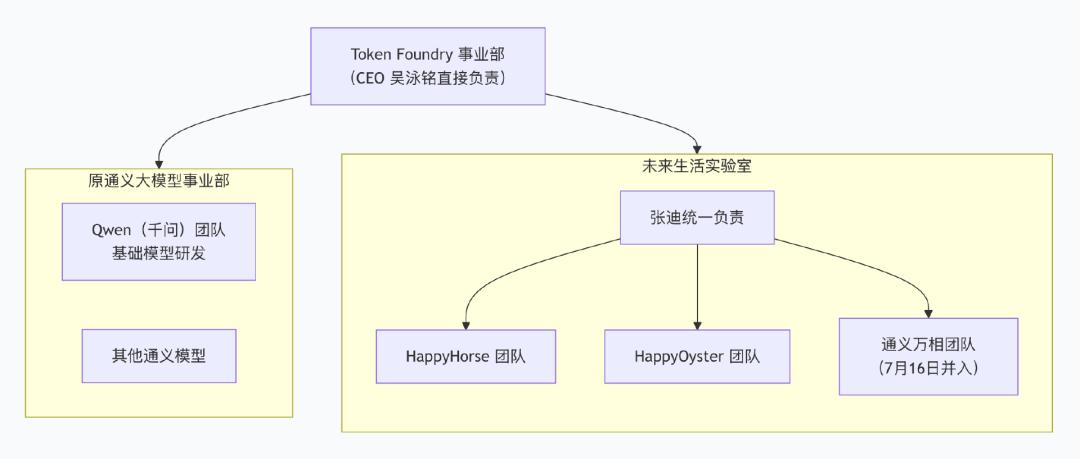
Caption: Alibaba Token Foundry Business Unit
The Token Foundry Business Unit is positioned as Alibaba's "model factory", responsible for transforming model capabilities into implementable products and services.
The architecture has been integrated, but the teams have not been fully merged. According to an Alibaba employee who revealed to Tech Planet, the Wan3.0 team has recently moved from Alibaba's Yungu office area to Xixi Park, but the businesses of the two sides have not been fully merged and are still advancing separately. The two teams have begun to cooperate in the training of HappyHorse 1.2.
According to the report of Yiyu Observation, while Alibaba is integrating the Qwen office system internally, it has also put the merger of Wan and HappyHorse on the table, and it is more likely that HappyHorse will be the main one in the future. However, no one expected that Alibaba would still carry out the "horse race" before that.
In terms of functions, Wan3.0 almost covers all existing capabilities of HappyHorse, including 30-second generation, full-modality reference, native audio, character and scene consistency, and video editing, almost every item has entered the traditional territory of HappyHorse.
Moreover, Wan3.0 is priced lower, at 0.6 yuan per second for 720P video, while HappyHorse 1.1 is 0.9 yuan per second. According to an Alibaba Cloud agent, both of them mainly cover e-commerce customer groups, and it is difficult to shake Seedance's market share in short dramas and comic dramas. In actual sales, they will give priority to recommending Wan3.0 to customers.
This also means that Alibaba not only maintains two sets of video models with highly overlapping functions at the same time, but also allows them to compete for the same group of customers at different prices on the same Bailian platform. With similar functions and two different model products, this is not common in other large manufacturers. For example, the export of ByteDance's multimodal large model is unified as Seedance, while Kuaishou's is Kling.
However, under the background of AI, every large manufacturer has the phenomenon of horse racing. With the shift of strategic goals, the integration of multiple products has become the norm. For example, Doubao has integrated Feishu, TRAE, and Coze. HappyHorse and Wan also have the possibility of being merged into the same export in the future.
Who can become Alibaba's Seedance
After the release of Seedance 2.0, the release of any video model is highly expected — whether it can shake the market pattern with cost performance.
HappyHorse was born precisely in April when Seedance 2.0 was at its peak of popularity, and was led by Zhang Di, the former "Father of Kling", and was once regarded by the outside world as Alibaba's version of Seedance. However, the popularity trajectory of HappyHorse is a typical "high start and low go" curve. When it anonymously topped the charts, it created huge suspense and expectation, but after the gray test started, the actual experience failed to exceed expectations.
HappyHorse's hard power is not bad. With 15 billion parameters, it is almost three times that of Seedance, supporting 15-second multi-shot narrative, multi-aspect ratio adaptation and 1080P super-resolution output. However, the number of parameters cannot fully represent the pros and cons of the model's capabilities. Compared with Kuaishou and ByteDance, which have huge content platforms and creator ecosystems, in many subsequent industry actual tests, HappyHorse with e-commerce genes is considered to be more adapted to e-commerce scenarios.
A short drama practitioner introduced to Tech Planet that there are still obvious shortcomings in the facial texture of HappyHorse's characters, with severe skin smoothing, unrefined skin, and the picture is easy to get out of control under complex shots, which is difficult to meet the needs of making high-quality short dramas. In contrast, he showed a produced tea-picking advertisement scenario, and the effect was much better.
In his view, HappyHorse is basically seizing the market of Vidu, which is an AI video model under Shengshu Technology. In April this year, Shengshu Technology received 300 million U.S. dollars of investment led by Alibaba. From the timeline, at that time Vidu originally planned to release Q4 reference-to-video, and soon after, HappyHorse went online. In his view, the common feature of HappyHorse and Vidu is that they have severe skin smoothing, and compared with real-person short dramas, they perform better in animation scenarios.
This is not an isolated case. Guolian Minsheng Securities also listed the strengths and weaknesses of HappyHorse: it has a high degree of completion in environmental richness, spatial hierarchy, material texture and picture fullness. However, when the action complexity increases, the model is prone to problems such as inadequate action understanding, disordered limb relationships, and reduced coherence.
Before the launch of HappyHorse, the Wan series did not have a high sense of presence. This is because the core task of the Wan series before was to build a technical base and open source ecosystem. Wan3.0 did not continue the previous open source tradition, but closed the model weights, which means that it is no longer a "technical evangelist" serving the developer community, but has directly embarked on the path of commercial realization.
The popularity of Wan3.0 has also increased because it launched a "pixel-level benchmarking" against HappyHorse in terms of product capabilities. Moreover, Wan 3.0 is launched to the market with lower pricing (0.6 yuan per second) and a stronger commercial positioning (document-to-video), and the popularity of HappyHorse in industry discussions is quickly covered by its own products.
The above practitioner compared and believed that Wan3.0 is more delicate than HappyHorse, "At present, the feeling is that it can reach a level close to Seedance 2.0". However, he also pointed out, "The character performance of Wan3.0 feels like acting, and it can be seen that a lot of TV drama materials have been fed for training."
According to the function introduction of Wan3.0, it can generate 30-second videos in a single generation, and for the first time supports input of document formats such as doc, xls, ppt, pdf, md, etc.
Regarding the direct generation of videos from documents, the above practitioner said that this function is very convenient, but the accuracy is not as good as manual work. For example, the generated image with text will have garbled characters, such as generating a newspaper spread out on the table, the text on this newspaper is garbled. But the price lower than Seedance is still the key for many users to choose. After comprehensive comparison, his judgment is that the performance of Wan3.0 is much better than that of HappyHorse 1.1.
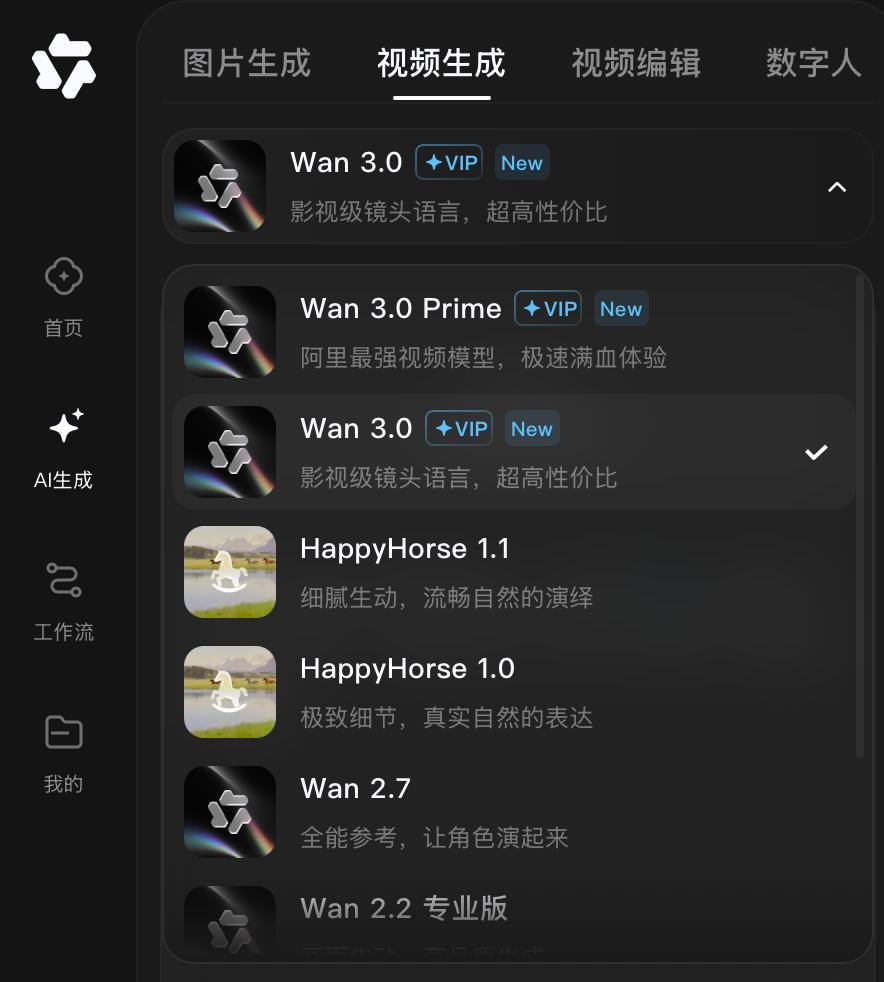
Caption: Screenshot of Qwen Creation Web Client
In addition, from the official introduction of Wan3.0 and HappyHorse1.1 by Qwen, from Wan2.7 to Wan3.0, they are all closer to the usage scenarios of TV dramas and short dramas, and Wan3.0 is defined as Alibaba's strongest video model.
Alibaba is waiting for a truly competitive hit product
At the Q4 earnings call of Alibaba's 2026 fiscal year held in May this year, when the management elaborated on the strategic advantages of multiple models, they mentioned video models twice. First, in terms of revenue composition, the self-developed model revenue of Bailian platform includes Qwen basic model, voice model, video model, etc.; second, when listing Alibaba's multi-domain model layout, the management directly named the specific product names of video models, which include two products: Wanxiang and HappyHorse.
This also means that the two products are not only competing on technical routes, but also conducting parallel trials of two commercialization paths.
By August, in the Q1 earnings call of Alibaba's 2027 fiscal year, video models were placed in a more macroscopic narrative framework. The management stated that "the performance of the recently successively released cutting-edge language, programming, video, voice, image, and music models are all in the first echelon".
In the view of a cloud agent, whether it is the basic model or the video model, Alibaba lacks a truly competitive hit product. "DeepSeek has V4, Kimi has K3, and Alibaba still does not have a product that can go viral." He said that although Alibaba holds two cards of Wan and HappyHorse, it has always lacked a dominant product like ByteDance's Seedance and Kuaishou's Kling, which has been verified by the market as a benchmark that can fight tough battles.
According to the above agent, Alibaba's decision-making chain on the TO B side is relatively long, and there is still room for improvement in response speed and product implementation rhythm. This is also a common challenge for large Internet manufacturers.
In addition, in the e-commerce scenario, Alibaba is currently also increasing its efforts on the AI e-commerce product "Huiva", which was launched as early as 2024.
At present, the three products of Wan 3.0, HappyHorse and Huiva can all realize functions such as image-to-video in e-commerce scenarios, with highly overlapping capabilities. But they belong to three different teams respectively: Wan 3.0 belongs to the Wanxiang team, HappyHorse is created by Zhang Di's Future Life Laboratory, and Huiva is within the Taobao & Tmall system. Three products and three teams are fighting on their own in the same e-commerce scenario.
The AI video generation track is already full of smoke. From domestic large Internet manufacturers to overseas OpenAI and Google, the giants are frantically seizing positions, launching head-on competition in multimodal input, native audio, generation speed, product pricing and commercialization.
Alibaba is also waiting for a hit product. Wan3.0 and HappyHorse may be two paths leading to that hit product, or they may just be two horses running side by side in the same horse race. The key is whether Alibaba can run out a real champion at the end of the track.
This article is from the WeChat official account "Tech Planet" (ID: tech618), author: Lin Jing, published with authorization from 36Kr.