Resolutely refusing to use the industry-standard AGENTS.md, Claude Code has sparked a "ban order": Anthropic finally responded, yet developers are even more furious.
When all AI programming tools are converging toward industry standards, Anthropic's Claude Code chooses to go its own way. It refuses to support the AGENTS.md format that has been adopted by over 60,000 open source projects, stubbornly sticking to its proprietary CLAUDE.md format.
This "nonconformity" has finally hit a wall. Tobi Lütke, CEO of global e-commerce giant Shopify, publicly threatened: either support AGENTS.md, or Claude Code will be fully banned within Shopify.
The ban controversy sparked by a single file
Shopify CEO Tobi Lütke argues that Claude Code's refusal to read AGENTS.md forces large R&D teams to bear an avoidable "complexity tax".
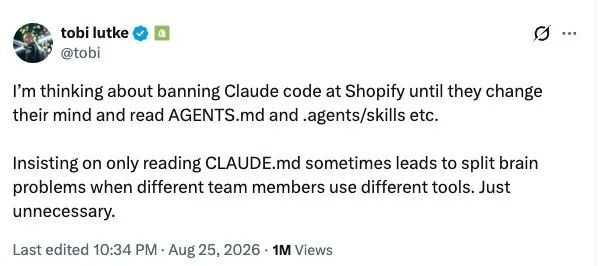
"I am considering banning Claude Code at Shopify until they change their mind and are willing to read AGENTS.md, .agents/skills and other files," Lütke wrote on X.
This may seem like a minor dispute over the configuration method of AI programming tools, but in a large R&D organization like Shopify, a single format difference can quickly evolve into a platform engineering problem.
Shopify has thousands of developers maintaining a huge monorepo, using different AI programming tools. Each agent needs to read the project instructions in the corresponding directory according to the code it is currently processing. Once a tool fails to read the same instructions as other tools, the agents used by developers may follow different rules.
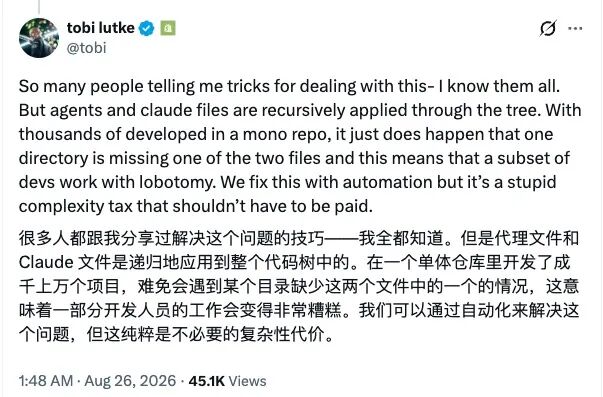
Lütke later explained in another post: "Both AGENTS.md and CLAUDE.md take effect recursively along the directory tree. When thousands of developers maintain a monorepo together, it is inevitable that one of the files will be missing in a certain directory. As a result, some developers end up using agents that are 'missing a piece of their brain'."
Shopify has used automated mechanisms to compensate for this discrepancy, but Lütke believes that the company's engineers should not have spent extra energy on this in the first place.
"We solved this problem with automation, but this is a stupid complexity tax that should never have been paid," he wrote.
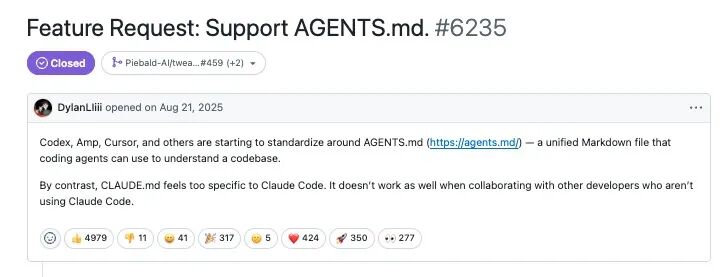
Over the past year, developers have been asking Anthropic to support AGENTS.md. Among them, the main feature request submitted in August 2025 has received nearly 5,000 likes from GitHub users, making it one of the most widely received compatibility appeals in the Claude Code community. However, related issues have been closed one after another without fully responding to community doubts, and "won't fix" has become Anthropic's answer to thousands of developers.
Developers then advanced the request to recursive loading, which is most needed for large codebases: let Claude Code automatically find AGENTS.md in the root directory and all levels of subdirectories, prioritize the file closest to the current code, and display exactly which instructions were read for this task. In this way, the root directory can store global rules, and subprojects can define their own build commands, test specifications and operation boundaries, so the team does not need to copy a set of CLAUDE.md across the entire directory tree. This request was also eventually closed and marked as "no plans at the moment".
It was not until Shopify CEO Tobi Lütke publicly stated that he would ban Claude Code within the company that Anthropic, which had remained silent for nearly a year, finally responded.
How many "useless" scripts have developers been forced to write for compatibility?
As programming agents become more and more capable, engineering teams also need a way to store project instructions for a long time. Files such as AGENTS.md and CLAUDE.md emerged under this background.
Developers can directly write build commands, test requirements, coding specifications and other content into the instruction files in the code repository. The agent will automatically read this information when working, without requiring developers to re-explain it every time. The trouble is that programming tool vendors have not yet adopted a unified file format.
OpenAI launched AGENTS.md in August 2025 to provide project-level instructions for programming agents. By December that year, OpenAI stated that more than 60,000 open source projects and agent frameworks had adopted this format, and tools that support it include Codex, Cursor, Gemini CLI, GitHub Copilot, Jules and VS Code. Later, OpenAI transferred this format to the Agentic AI Foundation under the Linux Foundation.
Claude Code took a different path. It uses CLAUDE.md to store project instructions, and can read CLAUDE.md in different directories of the repository when processing code. It does not natively read AGENTS.md at present, even though developers have repeatedly asked Anthropic to add this capability.
Anthropic has provided some workarounds, such as importing AGENTS.md through CLAUDE.md, or creating symbolic links for the files.
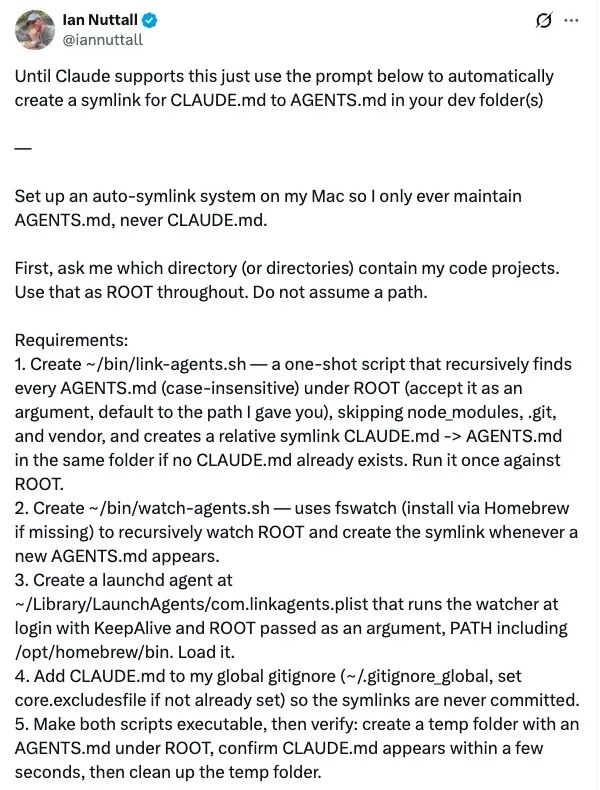
Developer Ian Nuttall shared a rather complex prompt to let Claude build a set of automated compatibility mechanisms on Mac: recursively find all AGENTS.md, create CLAUDE.md symbolic links pointing to them in the same directory; use fswatch to continuously monitor new files; set up a launchd agent to run automatically on startup; then add the generated CLAUDE.md to the global Git ignore list to avoid accidental commits.
This solution seems to solve the compatibility problem, but it just confirms the "complexity tax" mentioned by Lütke — in order to make Claude Code read AGENTS.md that other mainstream tools already support natively, developers have to additionally maintain lookup scripts, file monitoring, auto-start configurations and Git configurations, and ensure that this mechanism remains consistent on all team members' machines.

But not everyone can get this to work. Some netizens tried many methods to make Claude Code read the AGENTS.md file, but Claude Code never responded, and eventually they had to switch to Cursor.
Moreover, in large codebases, teams also need to ensure that instructions scattered in different directories and for different tools are always synchronized.
Because in large codebases, project instructions may be distributed across the entire directory tree, and agents need to follow different requirements in corresponding directories when processing code at different locations. Claude Code implements this mechanism through CLAUDE.md: when it processes code in a certain directory, it reads the instruction files associated with that directory.
This is exactly the key to the case cited by Lütke. If there is an AGENTS.md in a certain directory for other tools to read, but there is no corresponding CLAUDE.md prepared for Claude Code, developers using Claude Code may work without the same context.
Shopify is not the only company that has encountered this problem. A 2026 study of 2926 GitHub code repositories found that context files have become the most common way for developers to provide instructions to programming agents, and AGENTS.md has been adopted by a variety of tools.
Shopify has built a set of automated mechanisms to handle this discrepancy. As enterprises introduce more and more programming agents into the same code repository, how to ensure that all tools read the same instructions and follow the same rules will also become an additional task for the platform team.
Escalating dispute: Anthropic's response angers developers
Thariq, a member of the Claude Code team, responded that they are improving the customizability of Claude Code, and in the future will allow developers to use AGENTS.md more conveniently, or modify other system prompts.
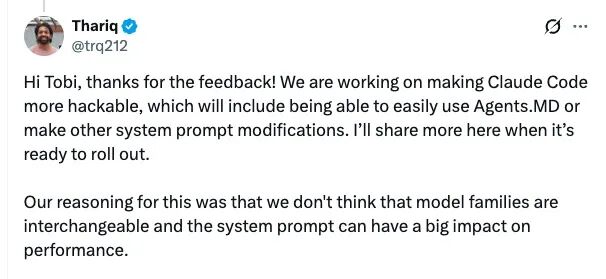
At this stage, it is still necessary to write @AGENTS.md in CLAUDE.md to import AGENTS.md. This step may be simplified in the future, but this reply did not clarify whether AGENTS.md will be recognized by default like tools such as Codex and Cursor.
He also explained part of the reason why Anthropic adheres to the existing solution: the team believes that the context and instructions required by different models are not exactly the same.
Thariq previously revealed that Anthropic has deleted about 80% of the Claude Code system prompts for the latest generation of Claude 5 model, so Anthropic is more inclined to adjust system prompts, Skills and CLAUDE.md according to model characteristics, rather than directly adopting a set of cross-model general project instructions.
A developer immediately retorted that he usually uses five models, and other contributors to the code repository use even more models. If each model requires a separately optimized instruction file, does a project have to maintain 17 AGENTS.md files at the same time, and continuously re-evaluate and rewrite them as the models are updated every few weeks?
"No one will do that," he argues. Developers of mainstream Harness can adapt to different models within the product, just like Claude Code has done, but this maintenance cost should not be passed on to ordinary developers.
According to the logic of "each model must be equipped with a dedicated instruction file", teams that only use Claude may need to maintain a series of files such as CLAUDE_FABLE_5.md, CLAUDE_OPUS_5.md, and CLAUDE_OPUS_4_8.md.
Every time the model is updated, the enterprise has to invest a large amount of tokens for re-evaluation, and even arrange a full-time team to maintain these Markdown files.
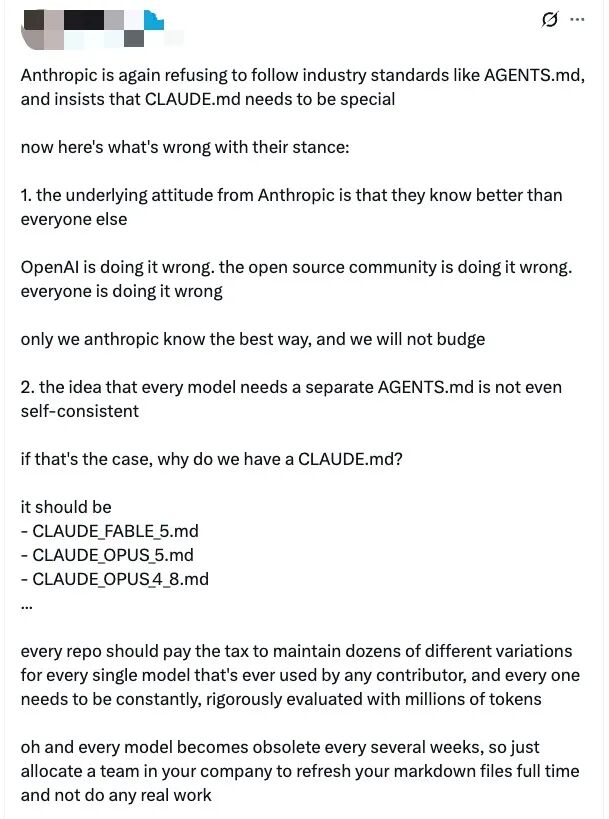
"Anthropic once again refuses to follow industry standards such as AGENTS.md, and insists that CLAUDE.md needs to be different."
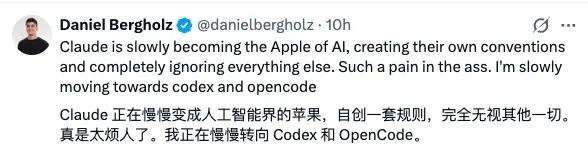
Many netizens also believe that this is purely a problem with Anthropic's product culture. Anthropic's refusal to follow common industry conventions like AGENTS.md and insistence on keeping CLAUDE.md in a special position conveys the attitude that "only we know the best solution": OpenAI's approach is wrong, the open source community's approach is also wrong, and only Anthropic knows how models should receive instructions.
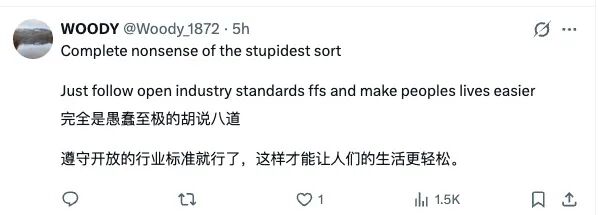
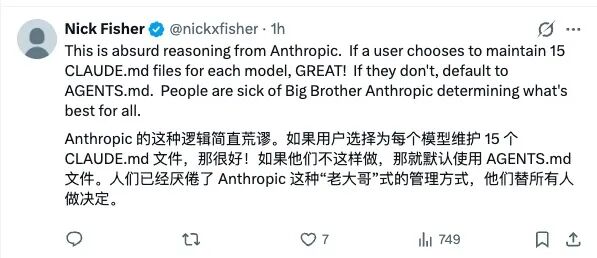
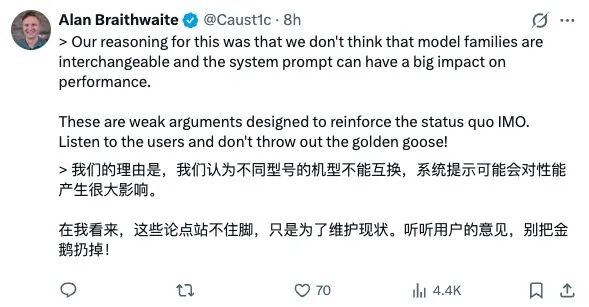
Anthropic is willing to open up more customization capabilities, but allowing users to customize on their own and following industry standards are two different things. A more reasonable approach is to let Claude Code read AGENTS.md by default, while keeping CLAUDE.md as a backup entry for special adaptation needs.
"I love many of Anthropic's products, especially Fable," the netizen wrote at the end, "but I hope they can realize that there is a cultural problem here, and they are gradually losing the attention of developers because of it."
Reference Link:https://x.com/trq212/status/2092302273099796842
This article is from the WeChat official account "InfoQ" (ID: infoqchina), author: Tina, published with authorization from 36Kr.