Claude crashed three times within one day, with its API, App and Cowork all down, leaving all the office workers totally at a loss what to do.
Who on earth can put up with this?
On August 24, Claude crashed three times in a row.
Anthropic's status page lit up with glaring red warning lights three times that day, and the official announced three times that the service had been fully restored.
But every time the page just turned green, wails still flooded X, with a large number of users complaining that the service was completely inaccessible on their end.
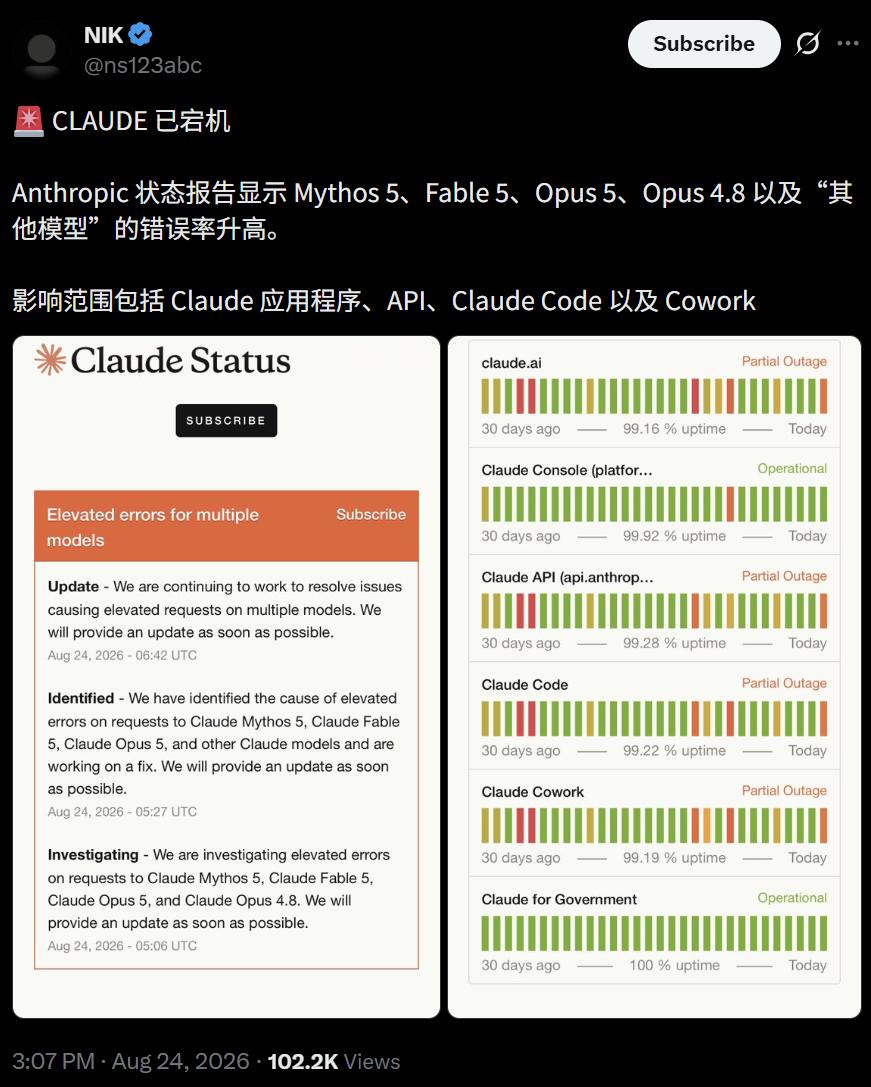
This marked the 13th outage day Anthropic had recorded in August alone.
Good grief, only 24 days of this month have passed in total.
Yet you're telling me Claude has been out of action for more than half of those days.
A Reddit user even joked that he ran an automated process that took nine hours of hard work, only for it to be completely interrupted by this massive outage, wasting all his effort for nothing.
529: The Backend Is On Fire
When the failure fully broke out, 529 Overloaded popped up on users' screens in unison.
Anyone who has used APIs is familiar with 429, the rate limit, which is like a restaurant telling you that you ordered too fast and asking you to wait a moment.
But 529 means the entire system is completely overloaded, which is equivalent to a restaurant staff rushing out to tell you: Sorry, our back kitchen is on fire.

According to the records on the status page, this "fire" burned from 12:50 PM Beijing time on August 24 all the way to 3:36 PM, lasting for nearly three hours.
21 minutes after the alarm was raised, the official was quite confident, saying that the root cause had been located.
And then? Nothing else happened. Anthropic neither disclosed the technical cause nor gave a timeline for full recovery.
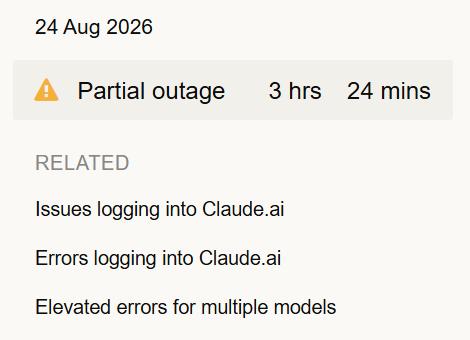
The list of affected users was extremely long.
Mythos 5, Fable 5, Opus 5 and Opus 4.8 all went down, and claude.ai, API, Claude Code and Cowork all faced critical service issues.
In the end, only the two services of Console and Claude for Government barely avoided the disaster.
The entire Claude tech stack was basically compromised this time.
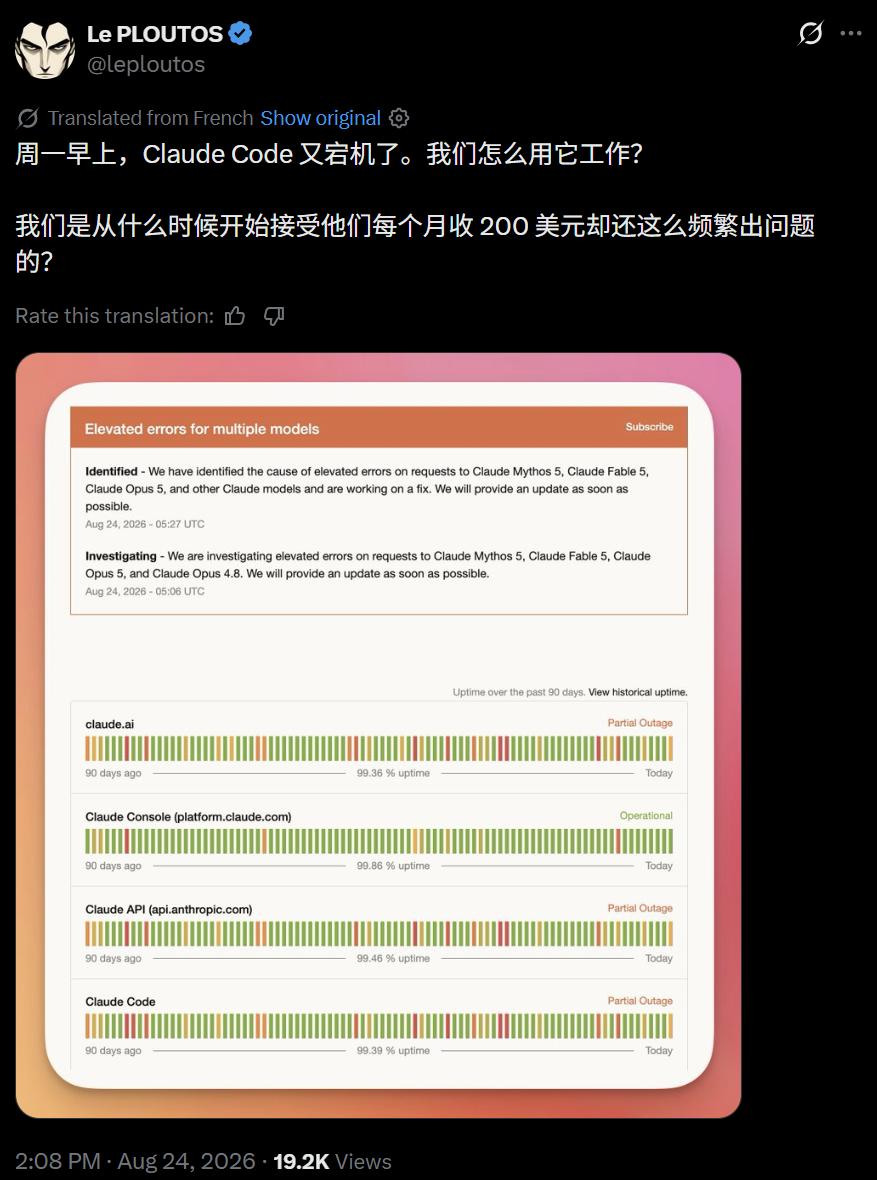
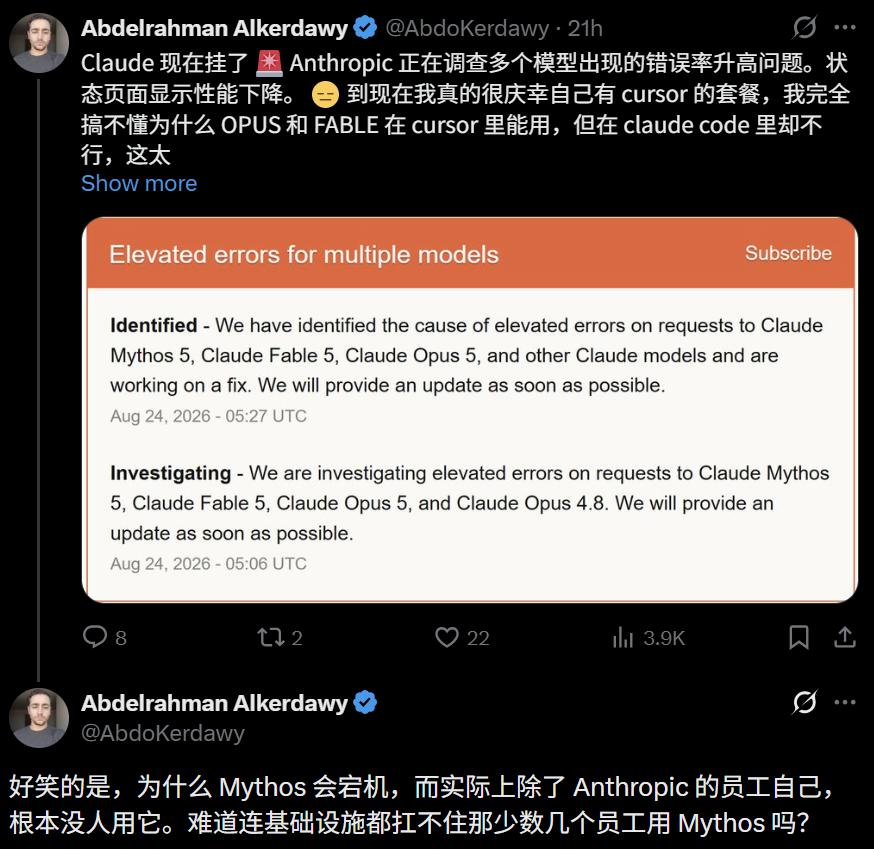
Repeated On-Off Cycles: Red to Green, Then Back to Red
Even more absurd plots followed. Every time the official just announced the repair was completed, the service would crash again immediately.
The full model error lasted for nearly three hours before the service was restored.
But just after midnight on August 25, the login system failed again. The subscriptions of claude.ai and Claude Code were all affected, and it took six minutes to recover.
Before the service was stable for a few hours, it crashed again at 4 a.m., and this time it was stuck for eight minutes.

isclaudedownbot, a monitoring bot that specifically tracks Claude's login status, posted a tweet at 4:11 a.m. with no extra words, only one word.
Yes.
You couldn't find a more emotionless and precise announcement than this.

Anthropic's official statement was as decent as ever, saying that services had been fully restored on Claude.ai, Claude Code and Claude API, the company knows how much users rely on Claude, and thanked everyone for their patience while the team investigated the issue.
That said, the status page turning green never means your account can be used normally.
The tweet posted by user elstar that day no longer sounded like a complaint, but more like a cry for help.

The actual situation was that the official status showed everything was normal at that time, but residual authentication and frontend failures made the settings, usage and skills pages of some unlucky users turn into a glaring white screen.
The two contradictory things of "everything is normal" and "page white screen" happened at the same time at this moment.
Until late at night, there were still unlucky users roaring online that Claude was down again.

Failures Are Occurring At An Alarming Frequency
This day was far from an isolated incident.
Third-party monitoring service StatusGator shows that from January 2026 to now, Claude has accumulated 184 failure records.
It is worth noting that we are only in August now.
Looking back through the status page, the list of failures for the entire August is as dense as a daily schedule.
Two failures broke out on the 20th, one failure happened every day from the 16th to the 19th, Fable 5 crashed for about four hours on the 15th, on the 14th there were three consecutive failures in one day, and there was no surprise that there was one failure each on the 13th and 12th.
The most severe of these was the outage on August 5, which lasted for 7.5 hours without any service recovery.

The original error message users saw on the screen at that time was "Due to unexpected capacity constraints".
Computing Power Exhaustion: Who Drained My Inference Performance
The phrase "capacity constraints" appeared more than once in the error messages this month.
On X, another phrase that was repeatedly mentioned was "ran out of compute".
Some developers pointed out bluntly that Opus 4.6 used to be surprisingly capable, but later it seemed that they completely ran out of computing power and weakened all the model performance.
User Eason also felt that Claude had suffered the most unprecedented and severe performance degradation. Opus 5 was completely unusable, and he had even gone back to using Opus 4.8.
Rolling back to an older version on purpose is extremely rare in the highly competitive AI industry.

Of course, these are at most users' subjective perceptions, without solid evidence.
So someone ran a comparative test between Claude and another model.
For the same difficult task, Opus 5 at the xHigh level took a full hour to complete, while the same level of model from another manufacturer finished the task in only 15 minutes.
The full 4x difference is shocking.

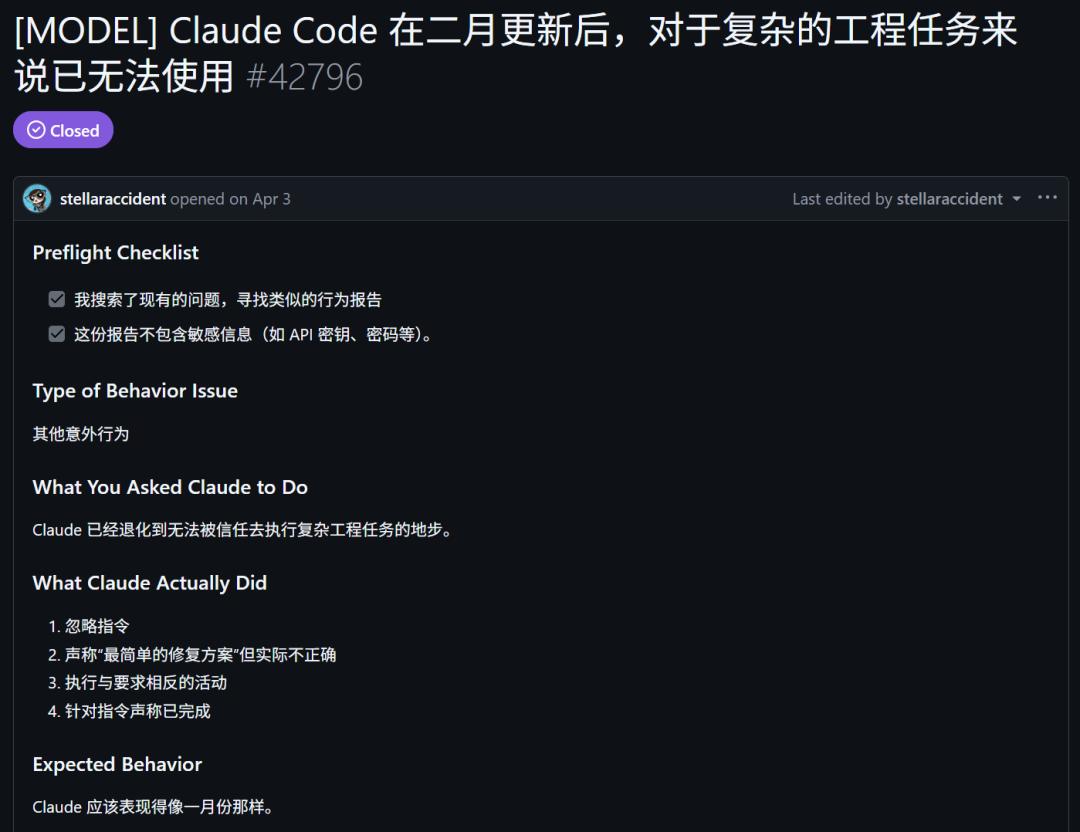
Even Stella Laurenzo, director of AI at AMD, personally reviewed as many as 6852 Claude Code sessions from her team.
The results showed a clear cliff on the performance curve.
At the end of January, the model's thinking depth was about 2200 characters, but by early March it had dropped to a mere 560 characters, a plunge of 75%.
The even more eerie coincidence is that during the same period, Claude Code's thinking content began to be hidden from users quietly. In just one week, the hiding ratio rose from 1.5% to 100%.
In other words, while the model was visibly getting dumber, you couldn't even see how exactly it got dumber.
Agent Tasks That Ran For 9 Hours, Only Recorded As A Few Minutes On The Status Page
The 90-day availability data posted on Anthropic's official website is as follows: claude.ai 99.33%, API 99.43%, Claude Code 99.35%.
At first glance, it looks like a perfect score. But the pass line for enterprise-level services is 99.9%.
What's more, in the early days of the classic Internet when the availability metric was created, service interruption only meant that the web page could not be opened. You could refresh the page and continue working immediately, and the loss was only a few seconds of refresh time.
However, for an Agent, once a long-running task is interrupted, the loss is never just the few minutes of interruption, but all the time, context and computing power it has already consumed. This loss can never be fully recorded on the status page.
Up to now, Anthropic still has not explained what exactly happened in those three hours on August 24.
And this August, which has seen 13 days of red warning status, still has 7 days left.
References:
https://x.com/ns123abc/status/2091784366519193852
This article is from the WeChat public account "AI Era", author: ASI Revelation, editor: Moses, published with authorization from 36Kr.