Japan has blocked the export of 3-micron five-axis machine tools, and the remarks Dong Mingzhu made ten years ago, which no one believed at that time, have come true now.
On August 16, the revised *Export Trade Control Order* of Japan's Ministry of Economy, Trade and Industry officially took effect. High-end 5-axis machine tools with positioning accuracy of 3 microns or less, together with high-precision rotary tables, grating scales, CNC systems, and even underlying algorithms and manufacturing process parameters, have all been changed from "bulk licensing" to "case-by-case review".
The approval period has been extended from 15 days to a maximum of 180 days, and the rejection rate for procurement in sensitive fields exceeds 80%.
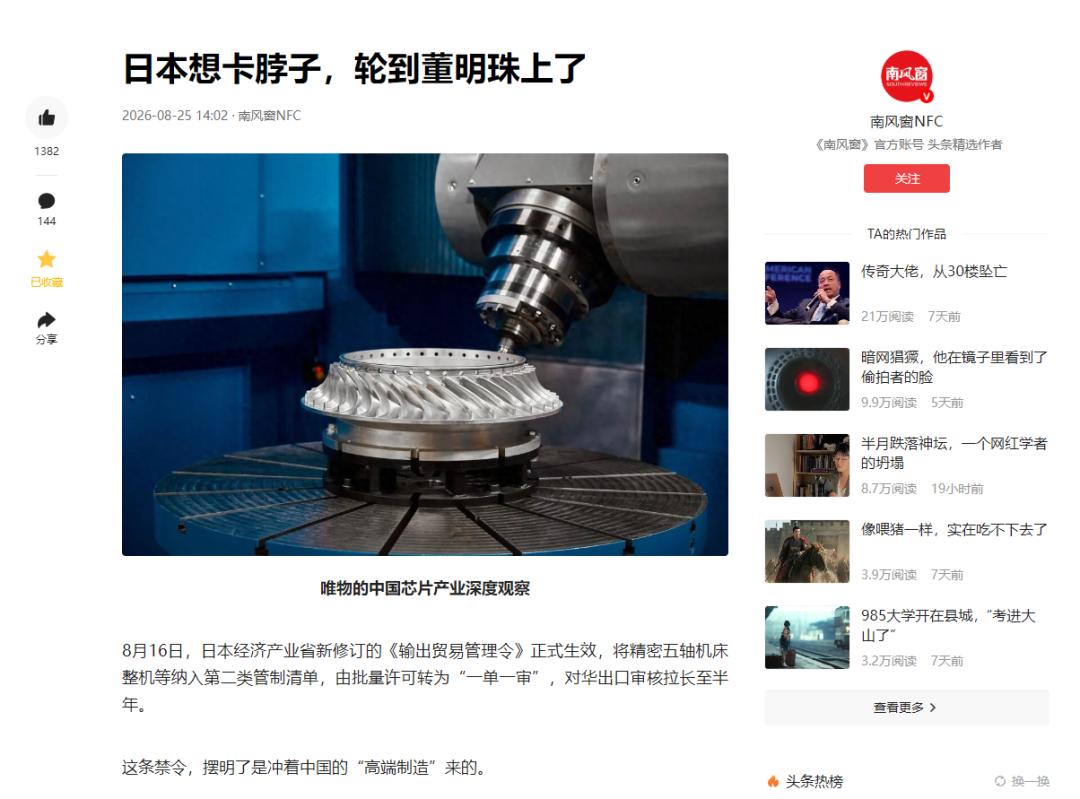
Ten years ago, Dong Mingzhu said a remark that no one took seriously at the time: "Sooner or later, we will not be able to purchase any high-end machine tool."
Back then, most people who heard this thought Dong Mingzhu was being alarmist. The procurement process was going smoothly, it was a problem that could be solved with money, so why bother worrying about it? Today, this remark has come true.

Dong Mingzhu Made the Final Decision to Take Solid Action, GREE Has Been Tackling the Hardest Core Challenges for Over 10 Years
In 2013, GREE knew better than anyone what the "procurement" predicament was like.
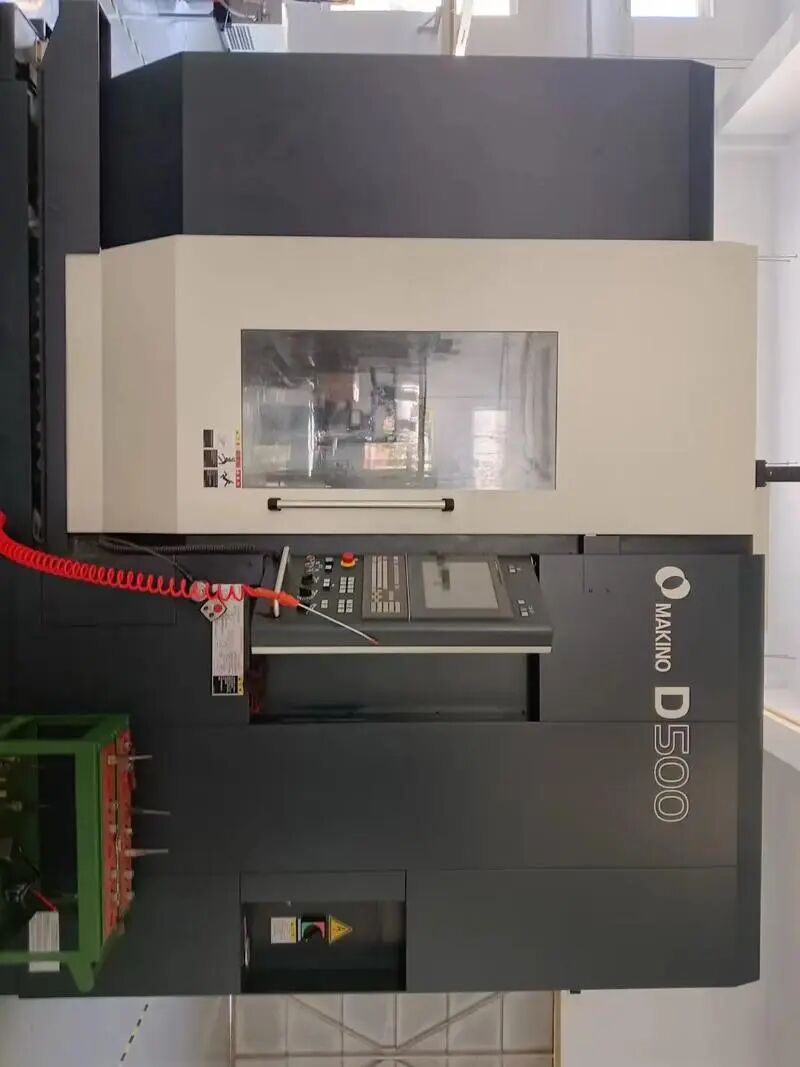
There is a core component called impeller in air conditioning compressors, which requires extremely high surface precision and must be processed with a 5-axis simultaneous machine tool. At that time, GREE only had two choices — suppliers from Germany or Japan.
One piece of equipment cost tens of millions, and it was normal to queue up for 18 months to get the delivery. What was even more outrageous was that the seller installed GPS positioning and remote lock systems in the machine tools. If the equipment was moved a few centimeters in the workshop, the system would lock up directly. GREE had to contact the supplier's engineer to apply for unlocking and pay a considerable fee.
The supplier would casually ask: "You are moving the machine, are you going to use it for other purposes?"
Anyone in this situation would feel extremely aggrieved.
Dong Mingzhu did not put up with it. Around 2013, she made the final decision: to invest funds in developing machine tools on its own. In 2015, Zhuhai GREE Intelligent Equipment Co., Ltd. was officially established, and machine tool R&D was listed as a core strategy. An air conditioner manufacturer was going to tackle the hardest core challenge of industrial mother machines, and there were widespread pessimistic voices at that time.
This tackling process lasted for 10 years. All core components are independently developed. Motorized spindles, linear motors, CNC systems, 5-axis milling heads, high-precision rotary tables, all hardware and algorithms were rewritten line by line.
In order to overcome the thermal stability problem of motorized spindles, the team transplanted the heat dissipation technology of air conditioners, controlled the temperature rise within ±1℃, and reduced the thermal deformation to less than 1 micron. The linear motor drive replaces the traditional ball screw, with an acceleration of 1.2G, and the efficiency is increased by more than 30%.
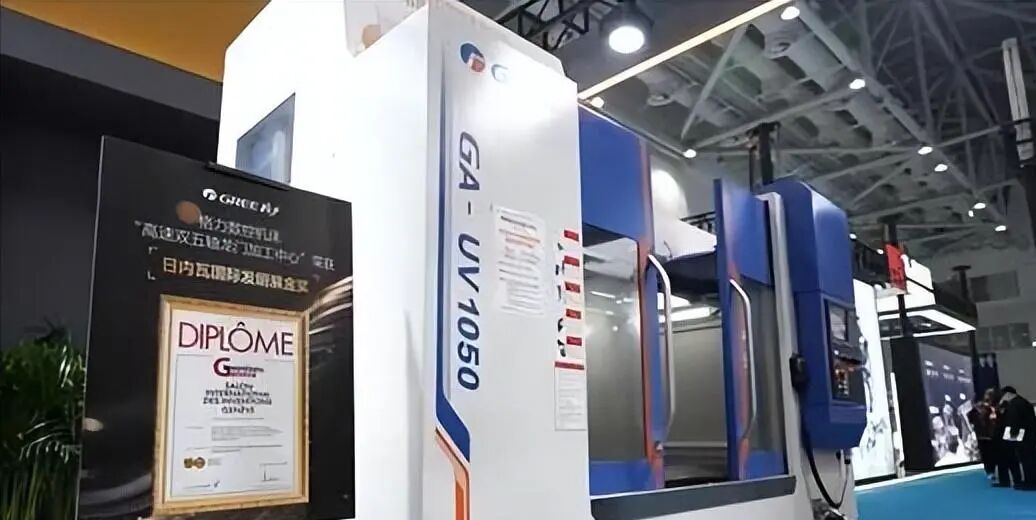
In 2017, the first fully independently developed 5-axis simultaneous CNC machine tool GA-F500 was launched. In 2025, the high-speed dual 5-axis gantry machining center was officially unveiled at the CIMT exhibition, and won the gold medal of the 50th Geneva International Exhibition of Inventions — which is one of the world's three major invention exhibitions as famous as the Pittsburgh and Nuremberg invention shows, with extremely strict evaluation criteria.
By 2026, the export proportion of GREE's 5-axis machine tools has exceeded 75%. GREE's flagship product is the high-speed dual 5-axis gantry machining center GA-FMB3020D specially designed for new energy vehicles, focusing on the batch processing of large aluminum alloy parts such as integrated die-casting parts, battery trays, and front and rear base plates, ranking among the top three in domestic shipment volume in this segmented track.
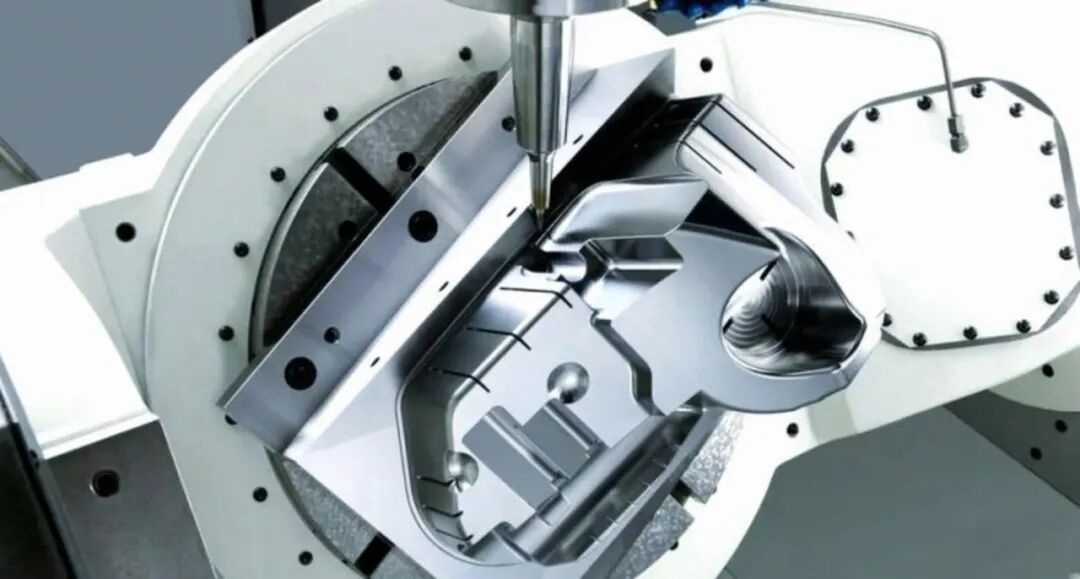
Compare the parameters with the same type of Japanese models, the nominal performance is completely competitive:
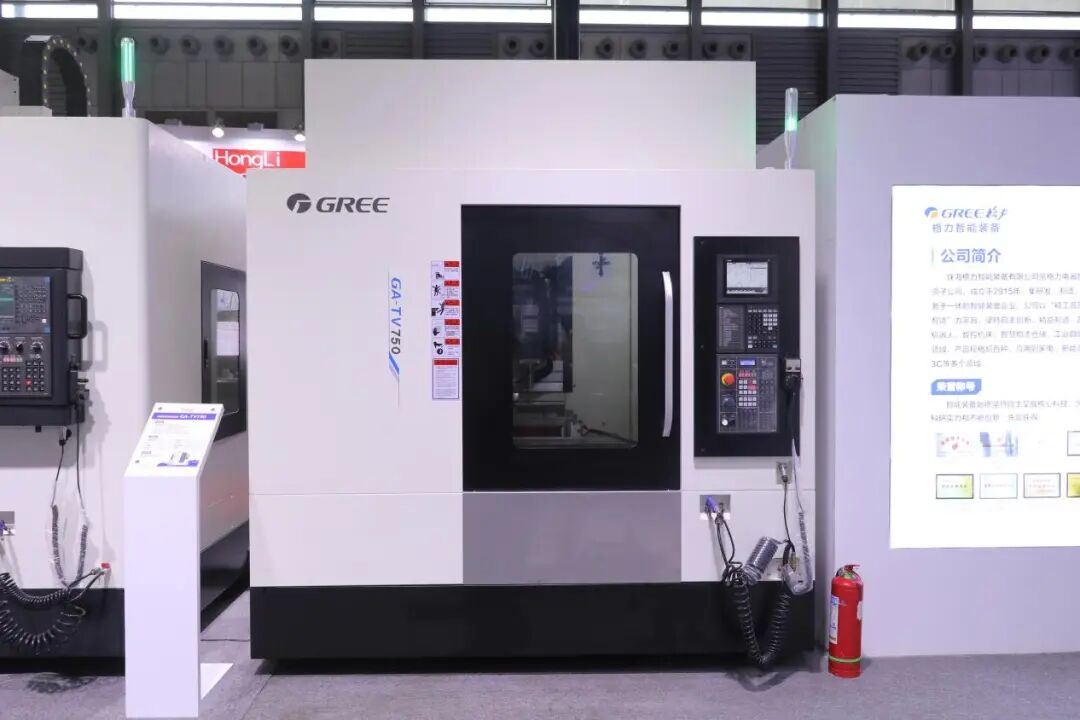
This GREE model has a rapid feed speed of 120m/min, acceleration of 1.1G, spindle speed of 20000rpm, and repeated positioning accuracy of ±0.012mm. It can complete 6-sided processing in one clamping, and the processing efficiency is 80% higher than that of traditional single 5-axis machine tools.
The same specification gantry 5-axis machine tool from Mazak has a slightly higher precision index by half an order of magnitude, but it has no advantage in aluminum alloy processing speed and mass production efficiency, while the price is doubled.
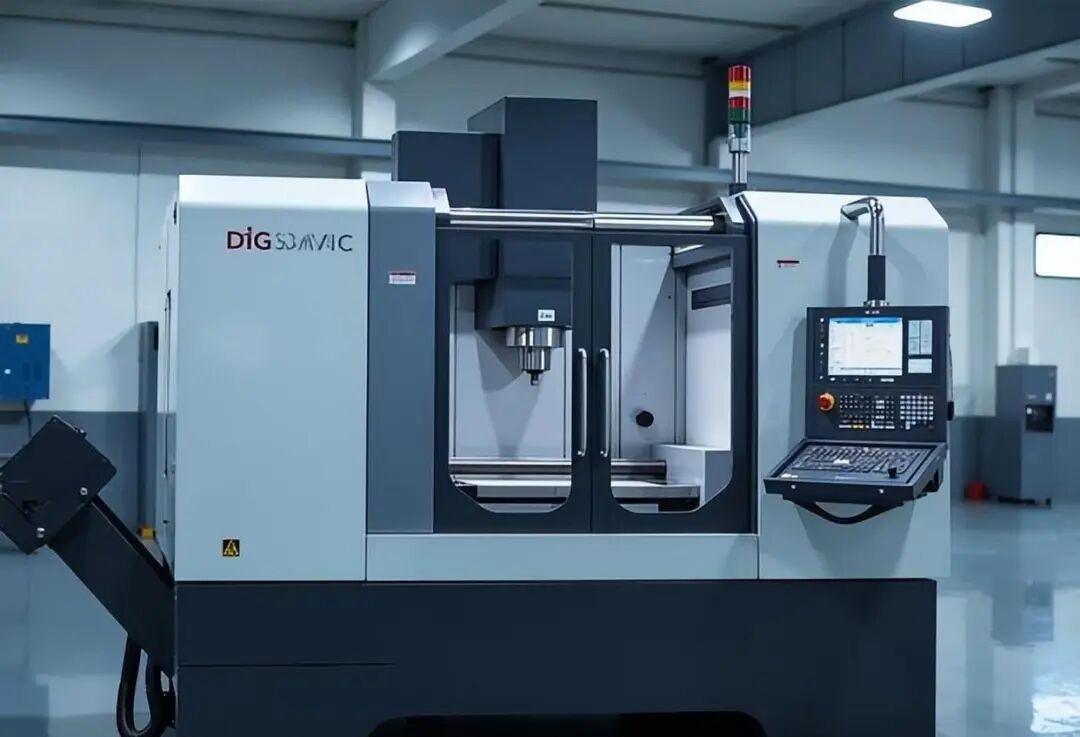
In 2026, GREE's equipment is supplied in batches to BYD, Tesla, and BMW, with an export proportion of over 75%. Its cost is only 40% to 60% of the same level products from Germany and Japan, and the delivery cycle is 90 days — while Japanese products usually take one year.
At present, GREE's CNC machine tool product line has covered main models such as horizontal machining centers, 5-axis simultaneous machining centers, and turning-milling compound machining centers, providing solutions for 3C, automotive, mold and other industries. Objectively speaking, GREE has not yet fully replaced the top-level equipment of Japanese brands.
But Dong Mingzhu's layout has filled a short board in China's industry. Relying on GREE's manufacturing scenarios, stable cash flow and continuous iteration, it can stand in the gap when the industry is blocked by external restrictions.
Above 3 Microns, The Domestic Machine Tool Substitution Puzzle Has Been Basically Completed
Japan set the red line at 3 microns this time after precise calculation. In the range from 3 microns to 50 microns, the localization rate of China's 5-axis machine tools has approached 60%, and the overall localization rate reached 59.5% in 2025, exceeding that of imported brands for the first time.
But for products with accuracy above 3 microns — the higher precision segment — there is still a gap in domestic products. Kede CNC and Beijing Jingdiao are the two leading domestic representatives, one focusing on large-sized equipment and the other on small-sized equipment, both have entered the mass production substitution period as core main suppliers.
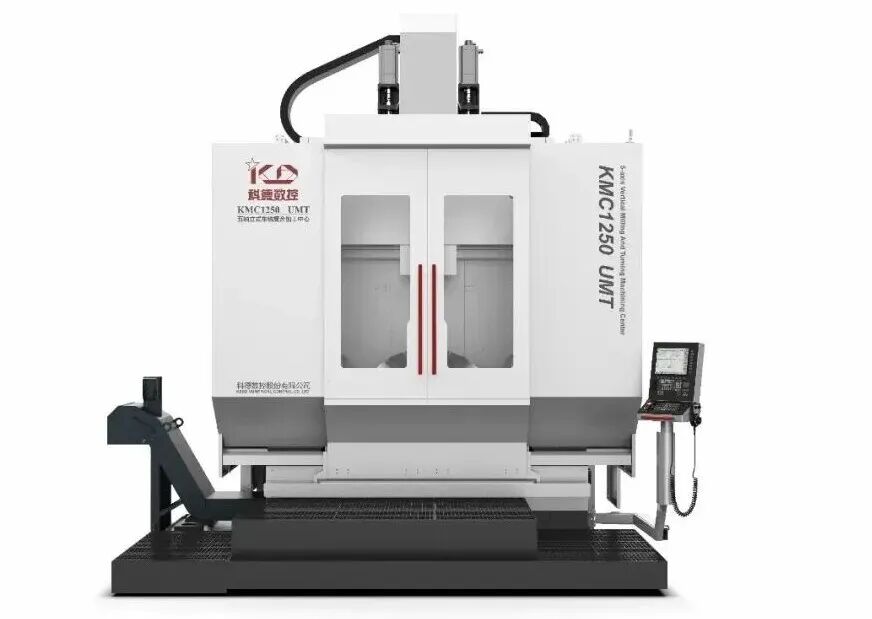
The first "ace" of Kede CNC is its high-grade CNC system. Its GNC62 is the only high-grade CNC system in China that is independently developed with full source code, the localization rate of the 5-axis complete machine exceeds 90%, and 1047 sets of 5-axis machine tools were delivered in 2025.
Kede CNC does not rely on Siemens or FANUC, and has realized full independent R&D covering underlying algorithms, servo motors and high-precision dual-axis rotary tables.
Beijing Jingdiao specializes in micron-level ultra-precision processing — for extremely small parts with a tolerance of 1-2 microns, which in the past could only be completed by Japan's Makino or Switzerland's Mikron.
With its self-developed 30000-40000 rpm high-speed motorized spindle and on-machine measurement system, Beijing Jingdiao can achieve continuous processing with zero drift for hundreds of hours, automatically detect the thermal expansion of the workpiece during the cutting process and make micron-level reverse compensation, to ensure that "the first finished part is qualified".
The three enterprises focus on their respective segments, and jointly form a complete domestic substitution landscape.
Kede CNC and Beijing Jingdiao have achieved breakthroughs in laboratories and specific models, and can carry out large-scale commercial mass production. However, in terms of precision retention under long-term operation, the three Japanese giants (FANUC, Yamazaki Mazak, Makino) still have a generational gap advantage.
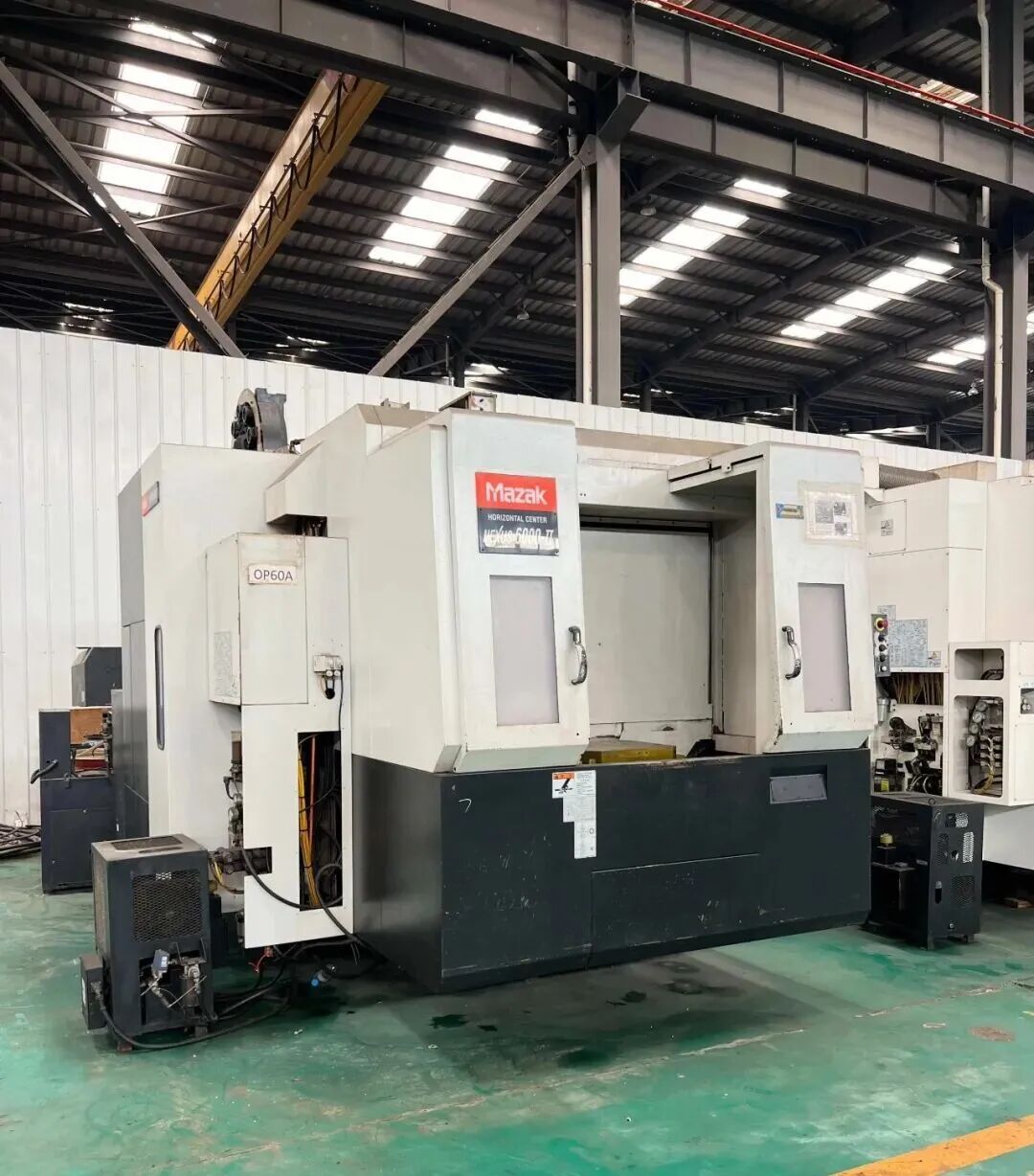
FANUC's CNC system still accounts for 31.7% of the installed capacity in China's 5-axis system market, and Siemens accounts for 24.8%, the two together account for more than half of the market. Many domestic machine tool manufacturers have produced complete machines on their own, but the "brain" still has to be purchased from FANUC.
GREE's strengths lie in the processing of large aluminum alloy parts for new energy vehicle integrated die-casting, 3C precision parts and humanoid robot parts. But for long-period heavy-load cutting of extremely hard and difficult-to-process materials such as titanium alloy and high-temperature nickel-based alloy, there is still a gap of more than 10 years in the thickness of the process database compared with the three Japanese giants.
The three Japanese manufacturers have been developing machine tools for nearly a hundred years. Makino's ultra-precision mold machines can process hardened high-hardness mold steel to achieve mirror-level surface roughness, and the precision attenuation is controlled at the micron level after thousands of hours of continuous operation.
Mazak's heavy-duty 5-axis machine tools can process aviation-grade hard materials such as titanium alloy and high-temperature alloy, with tool life and processing stability as the industry benchmark.
GREE performs well in processing ordinary molds, 3C thin-walled parts, and compressor impellers, but cannot handle aviation-grade hard materials such as hardened hard molds and high-temperature alloys.
In short, GREE has solved the problem of "whether we have the equipment and whether we will be restricted", while the decades-accumulated process of Japanese manufacturers solves the problem of "whether the equipment is stable and how long it can last".
The precision drift of the spindle after running for 10,000 hours, the adaptability of the cutting parameter library to different materials, and the reliability under extreme working conditions, there are no shortcuts for these things, which can only be accumulated over time.
Fortunately, GREE has invested more than 2 billion yuan in 10 years, Kede CNC has in-depth cooperation with C919, and Beijing Jingdiao's machine tools have been used in aerospace production lines, making domestic equipment the only choice.
Take Kede CNC as an example, its revenue in the first half of 2026 surged 44.8% year-on-year, and new orders increased by 37.5%.
After the ban was issued, domestic enterprises accelerated the replacement of old German and Japanese 5-axis machine tools with domestic equipment, and the orders are "too many to handle". Massive real processing data is quickly filling the stability short board of domestic machine tools.
Dong Mingzhu said ten years ago that "you can buy equipment, but you can't buy industrial security", no one took it seriously. Ten years later, after the Japanese control order came into effect, everyone found that the most sober person had already taken action long ago.
China's manufacturing industry never lacks people who shout slogans, but lacks people who are willing to invest tens of billions of yuan and tackle hard problems for 10 years in places that no one pays attention to. Dong Mingzhu's sense of crisis is worthy of learning by every Chinese manufacturer — do not wait until the knife is on the neck to think about independent R&D, but prepare for the worst situation when the business is in the best state.
The 3-micron line set by Japan is very precise, trying to restrict the development of China's industrial mother machines, but at the same time, it has lost the 70% market share that it has held for more than 10 years.
GREE, Kede, Jingdiao and other manufacturers have passed the stage of "whether we can make it", and the next step is to solve the problem of capacity expansion and long-term stability. There are no shortcuts on this road, we can only move forward step by step.
No matter for enterprises or the national manufacturing industry, real sense of security never comes from imported procurement. Only by firmly mastering our own core technology and holding core technologies in our own hands can we rest assured.