The city with the largest population growth in northern China is fully committed to pursuing the strong provincial capital development path to the very end.
01
Responding to Hefei's Catch-up, Jinan Begins to Step Up Efforts
Over the past week, Jinan has continuously demonstrated its determination to build a strong provincial capital, which is reflected in repeated emphasis on the "strong provincial capital" strategy at multiple meetings.
First, the standing committee meeting of the Jinan Municipal Party Committee held on August 3 pointed out that we should do a good job in assisting and benefiting overseas Chinese, attract overseas Chinese talents, overseas Chinese enterprises and merchants to participate in the construction of a strong provincial capital, and amplify the supporting role of overseas Chinese affairs resources in the development of the provincial capital.
Second, the 10th plenary session of the 12th Jinan Municipal Party Committee held on August 5 mentioned that in accordance with the work requirements of the provincial party committee, we will conscientiously carry out the study and education on establishing and practicing the correct view of political achievements, take the "Project Empowerment Year" as the general guide, accelerate the promotion of green and low-carbon high-quality development, actively promote coordinated regional development, solidly promote the comprehensive revitalization of rural areas, continuously improve the functional quality of the city, comprehensively deepen reform and expand opening-up, continuously enhance people's well-being, better coordinate development and security, push forward comprehensive and strict governance of the Party in depth, and make new progress in the construction of a strong provincial capital... We will solidly carry out all work in the second half of the year, avoid fighting "confused battles", refrain from putting on "empty postures", refuse to be "peace-seeking officials", and make new and greater contributions to building a strong modern socialist provincial capital in the new era that is "strong, new, excellent, prosperous, beautiful and high-level"!
Third, the city-level meeting on the leadership team transition of districts, counties and towns held on August 6 mentioned that it is a strong guarantee to further promote the construction of a strong provincial capital... to serve and support the construction of a strong provincial capital.
Fourth, the symposium for financial institutions stationed in Shandong held on August 13 mentioned that solid steps have been taken in the construction of a strong modern socialist provincial capital in the new era that is "strong, new, excellent, prosperous, beautiful and high-level".
Fifth, the special meeting on the work of technical and skilled talents held on August 17 pointed out that we should anchor the city's "13+34" key industrial chain system, systematically deploy key tasks for the construction of technical and skilled talent teams, and help the high-quality development of the strong provincial capital... Technical and skilled talents are the "hard core foundation" for the construction of a strong provincial capital, the "key puzzle" for the construction of the Jinan-Qingdao talent gathering platform, and the "important support" for consolidating the foundation of the industrial chain system.
Sixth, the Secretary of the Shandong Provincial Party Committee mentioned during his investigation in Jinan on August 21 that the new era and new Jinan are facing major opportunities to implement the major national strategy of ecological protection and high-quality development of the Yellow River Basin, and shoulder the important mission of accelerating the construction of a strong modern socialist provincial capital in the new era that is "strong, new, excellent, prosperous, beautiful and high-level".
In summary, both Jinan City and Shandong Province have made it very clear that they will implement the strong provincial capital strategy to the end.
This is the key to solving the problem of Shandong's continuously decreasing population and Jinan's response to Hefei's catch-up.
02
For Shandong, the Strong Provincial Capital Strategy Is the Key
I have analyzed the past development achievements of many provincial capitals before, and many of them are inseparable from the strong provincial capital strategy.
For example, the strong rise of Chengdu is mainly driven by the full support of Sichuan Province with the whole province's resources. Behind the rapid development of Hefei in the past two decades, it is the comprehensive result of fortune, efforts, vision and concentration, among which the fortune includes Anhui's strong provincial capital strategy.
Another example is Fuzhou, the fastest rising provincial capital in the past five years. Its ranking among provincial capitals has jumped from 10th to 8th in the past five years, surpassing Xi'an and Jinan. Behind this, in addition to industrial upgrading, the more important factor is also the strong provincial capital strategy.
In addition, Jinan's permanent resident population increment ranked first in northern China and fifth in the whole country last year, which is also attributed to the strong provincial capital strategy.
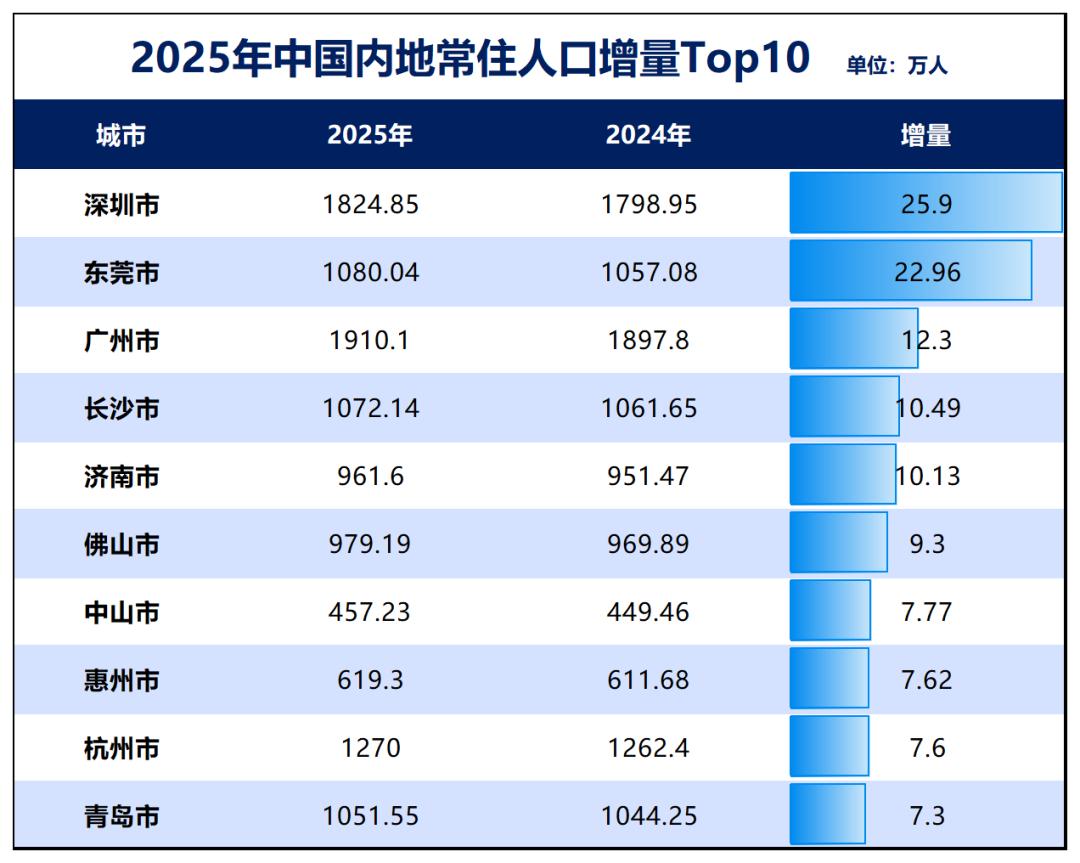
Cartography: Urban Finance; Data Source: Municipal Bureau of Statistics of each city
It is indeed unexpected that Jinan's population increment ranks first in northern China this time.
Let's review the population increment of northern cities in the past five years: In 2024, the city with the largest population increment in northern China was Xi'an, Zhengzhou ranked second, and Jinan ranked third. In 2023, Zhengzhou ranked first in northern China in terms of population increment, while Jinan's increment only ranked sixth in northern China, lower than Xi'an, Shenyang, Changchun and Qingdao. In 2022, Jinan's increment ranked fourth in northern China, Xi'an ranked first in northern China, followed by Zhengzhou and Qingdao. In 2021, Jinan's increment ranked fourth in northern China, Xi'an ranked first in northern China, Qingdao ranked second, and Zhengzhou ranked third.
It can be seen that in the first four years of the past five years, Jinan's population increment was not significant enough, but there was a clear upward trend in 2024. Its increment in 2024 has surpassed Qingdao, making it the city with the strongest population competitiveness in Shandong Province.
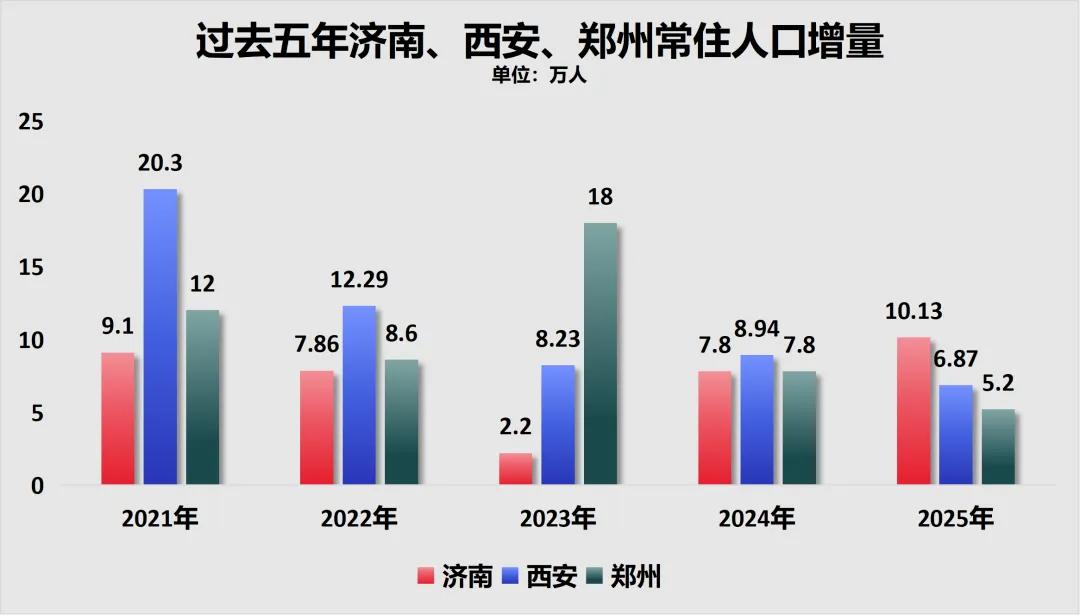
Cartography: Urban Finance; Data Source: Municipal Bureau of Statistics of each city
The logic behind this is, on the one hand, the continuous decline of population increment in Xi'an and Zhengzhou, and on the other hand, the strong provincial capital strategy of Shandong assists Jinan.
In 2021, Shandong Province officially wrote the "strong provincial capital strategy" into the government work report. The reason why Shandong Province made this adjustment is that Shandong has found that although it is the third largest economic province in China and the largest in northern China, it lacks a truly super central city.
Before 2020, Jinan's GDP just exceeded 1 trillion yuan, while Chengdu, Wuhan and Hangzhou in the same period had already formed a strong siphon capacity for capital, population and scientific innovation. Although Shandong has a large total economic volume, its urban hierarchy is relatively scattered, and resources are averaged across 16 prefecture-level cities, resulting in the situation of "a large province without a strong core". Eventually, the population of Shandong Province cannot be gathered by a strong provincial capital, leading to a continuous decreasing trend.
Facing this situation, Shandong's determination to build a strong provincial capital is obvious. In 2021, the "strong provincial capital strategy" was first written into the Shandong provincial government work report. Subsequently, Jinan held the "mobilization meeting for accelerating the construction of a modern strong provincial capital in the new era", proposing that by 2025, the proportion of GDP in the whole province will reach about 16%, and the permanent resident population will reach 10 million.
In order to achieve this goal, Shandong Province has taken a number of actions in the past five years:
First, administrative division adjustment. In 2019, Laiwu was merged into Jinan, the area of Jinan expanded from 8177 square kilometers to over 10000 square kilometers, and its permanent resident population quickly approached the 10 million level.
Subsequently, Shandong promoted the construction of "Jinan-Zibo urban integration", "Jinan-Tai'an integration" and "provincial capital economic circle", further incorporating surrounding cities such as Zibo, Tai'an and Dezhou into the radiation scope of the provincial capital. By 2025, the GDP of the provincial capital economic circle is targeted to reach 3.6 trillion yuan, with a permanent resident population of about 38 million.
Second, resources are tilted to Jinan. In the past five years, Shandong has prioritized the layout of a large number of new and old kinetic energy conversion projects, high-end manufacturing, scientific research platforms and financial resources in Jinan. For example, the national-level new and old kinetic energy conversion pilot zone is located in Jinan; the Jinan Area of Shandong Pilot Free Trade Zone is established; the Jinan Science and Innovation City of the Chinese Academy of Sciences is under accelerated construction; industries such as aerospace information, quantum technology, integrated circuits and biomedicine are intensively distributed.
The effect is also very remarkable. In 2020, Jinan's GDP exceeded 1 trillion yuan for the first time; in 2021, it reached 1143.2 billion yuan, with a year-on-year growth of 7.2%; in 2025, it further reached 1421 billion yuan, crossing multiple 100-billion-yuan steps continuously in five years, and its ranking among national cities is stably in the top 20.
It was disclosed in the article "5 Years of Transformation! Jinan Hands Over the Hardcore Answer Sheet of Strong Provincial Capital" published on the official website of Jinan Municipal People's Congress earlier this year about the industrial performance in the past five years:
1. The Jinan Base of the National Quantum Laboratory has been put into operation and achieved results, the Jinan Science and Innovation City of the Chinese Academy of Sciences has thrived, the number of national key laboratories has increased from 5 to 20, the number of provincial key laboratories has increased from 98 to 126, the number of high-tech enterprises has exceeded 7000, and the proportion of R&D investment in the whole society has increased from 2.62% to 3%.
2. It ranked 27th in the list of top 100 global scientific research cities published by the British journal *Nature* in 2025, rising 30 places compared with 2021.
3. The total amount of human resources in the city has reached 3.1 million, an increase of nearly 800000 compared with the end of the 13th Five-Year Plan. Jinan has been rated as "China's Best Talent Attracting City" for 4 consecutive years, and selected as "National Talent-Friendly City" for 2 consecutive years.
4. The construction of Digital Jinan is systematically promoted, the number of 5G base stations reaches 60000, the computing power scale reaches 6451P, of which the intelligent computing power is 5365P, the total index of digital ecology ranks 7th in the country, rising 12 places compared with 2021. Jinan has become a city with "four zones overlapping" such as the national pilot zone for artificial intelligence innovation and application.
5. The reform in key fields is further promoted in depth, the construction of the country's first science and innovation finance reform pilot zone is accelerated, the balance of local and foreign currency deposits and loans has increased by 8.5% and 10.8% annually on average respectively, 19 new listed enterprises have been added, and the reform of "All Affairs Handled in Quancheng" is being accelerated for iterative upgrading.
6. The pace of opening-up is accelerated, there are more than 6600 enterprises with actual import and export performance, the total import and export volume has doubled, the degree of economic extroversion has increased from 13.6% to more than 20%, and the national-level Cross-Strait New and Old Kinetic Energy Conversion Industrial Cooperation Zone has been approved for construction.
In addition, in terms of industrial strength, Jinan's industrial revenue also exceeded 1 trillion yuan in 2024, and continued to grow to 1078.65 billion yuan in 2025. This industrial strength has surpassed Xi'an and Changsha in southern China. When industrial upgrading is superimposed with the provincial capital strategy, the population flow will naturally begin to change.
03
How Shandong Builds a Strong Provincial Capital of Jinan
Although Jinan has taken the throne of the city with the largest population increment in northern China, its development is still relatively slow under the fierce attack of southern provincial capitals.
Its GDP was surpassed by Fuzhou in the past five years, and was caught up by Hefei at the end of last year. In the first half of this year, Hefei officially surpassed Jinan, laying the foundation for surpassing Jinan for the whole year.
Facing this situation, Jinan, which does not have an advantage in provincial resources, of course needs policy and resource tilt from the Shandong provincial level, and must rely on the strong provincial capital strategy.
Of course, as I emphasized in my previous articles analyzing Shandong Province and Fuzhou City, neither Shandong nor Fujian can imitate the strong provincial capital strategy of Sichuan, Wuhan, Shaanxi, Hunan, Jilin and other regions to fully support the provincial capital with all resources.
The reasons are as follows: First, the balanced development model of Shandong and Fujian has become a established situation, and it is a model that other provinces admire. Neither Shandong nor Fujian can fully support the construction of Jinan and Fuzhou with all resources like Sichuan. Second, Shandong and Fujian are not weak provinces, but strong economic provinces in the southeast coast. The strong provincial capital strategy should be adjusted to local conditions, and there is no need to imitate inland regions.
Third, Shandong and Fujian are not provinces dominated by a single city. Shandong has the leading city of Qingdao, and in Fujian, not to mention Xiamen has the highest administrative level, in terms of economic strength, Quanzhou, Xiamen, Zhangzhou and Ningde are all very competitive cities. This pattern makes it impossible for Shandong and Fujian to over-support the provincial capital with all resources.
In summary, there is actually only one sentence: Shandong and Fujian can only moderately strengthen the provincial capital, and it is unnecessary and impossible for them to fully support the construction of the provincial capital with all resources.
Then, under this background, how should Shandong continue to implement the strong provincial capital strategy?
From the perspective of Shandong's 15th Five-Year Plan, the idea given by Shandong Province is "two circles linkage, three cores leading, land and sea coordination, comprehensive efforts". At the same time, it clearly proposes to "vigorously implement the strategies of 'strong provincial capital' for Jinan and 'strong leading city' for Qingdao", and promote the linked development of the two metropolitan areas of Jinan and Qingdao.
It clearly mentions that we should enhance the leading force of core cities, vigorously implement the "strong provincial capital" strategy, promote the accelerated development of Jinan's new and old kinetic energy conversion pilot zone, and support Jinan to build an important central city in the Yellow River Basin.
We will further implement the "strong leading city" strategy, promote the upgrading and development of Qingdao West Coast New Area, support Qingdao to accelerate its total economic volume to 2 trillion yuan, and build a modern international metropolis.
I summarize it into four sentences:
First, Jinan should be stronger, not by "siphoning resources", but by "functional upgrading". The task of Shandong for Jinan is not to simply pursue the scale of GDP, but to enhance the functions of a central city. In the next five years, Jinan will focus on supplementing high-end functions such as industry, science and technology, finance, headquarters economy, transportation and digital economy, and build an important central city in the Yellow River Basin, an advanced manufacturing base in northern China, a regional scientific and technological innovation highland, and a national comprehensive transportation hub.
In other words, what Shandong really needs is a stronger Jinan, not just a "larger Jinan".
This is also consistent with Jinan's own plan: in the next five years, Jinan will focus on strengthening the "13+34" industrial chain, and at the same time strengthen the functions of scientific and technological achievement transformation, science and innovation finance, comprehensive transportation, and digital economy.
Second, Jinan should not "eat up" the development space of