A "voice input method" is valued at 2 billion U.S. dollars: What Wispr sells is not transcription, but the next-generation portal.
If a "voice input method" is valued at 2 billion US dollars, your first reaction may be: Has the capital market gone crazy again?
After all, converting speech to text is not a new technology. From mobile phone voice input, Siri, Alexa to various meeting transcription tools, speech recognition has existed for more than a decade.
But in August 2026, AI voice company Wispr announced the completion of a 280 million US dollars Series B financing, with a valuation of 2 billion US dollars, and total financing of about 361 million US dollars.
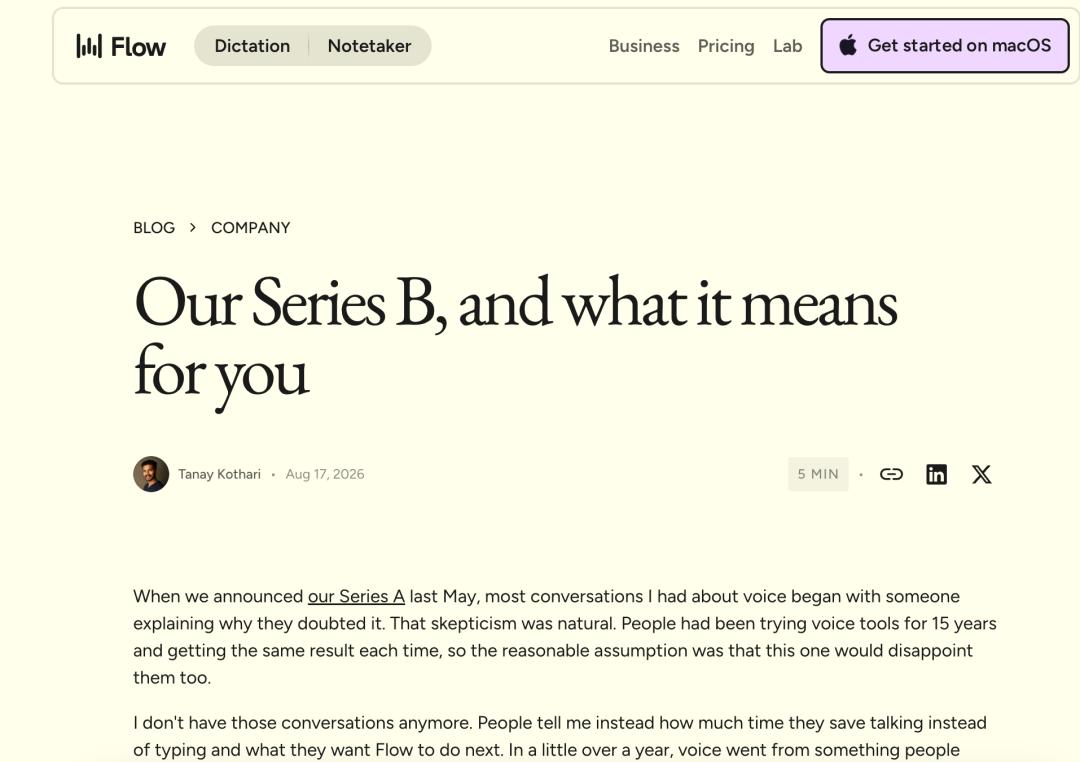
This round of financing was led by Menlo Ventures, with continued participation from existing shareholders including Notable Capital, NEA, and 8VC. The list of investors also features sports stars such as Shaun White, Klay Thompson, Paul George, and Trae Young.
What the capital is actually buying is obviously far more than just higher transcription accuracy.
They are betting that after decades of the keyboard dominating human-computer interaction, voice may become the primary entry point for humans to control computers, call AI, and complete work.
01
Why is an input method worth 2 billion US dollars?
Wispr's core product at present is called Wispr Flow.
It does not require users to open a separate recording software, but covers all scenarios where text input is needed. Users can speak directly in emails, documents, chat applications, browsers, and AI dialog boxes. Flow is responsible for removing filler words, correcting grammar, adding punctuation, and organizing spoken content into text that can be sent directly.
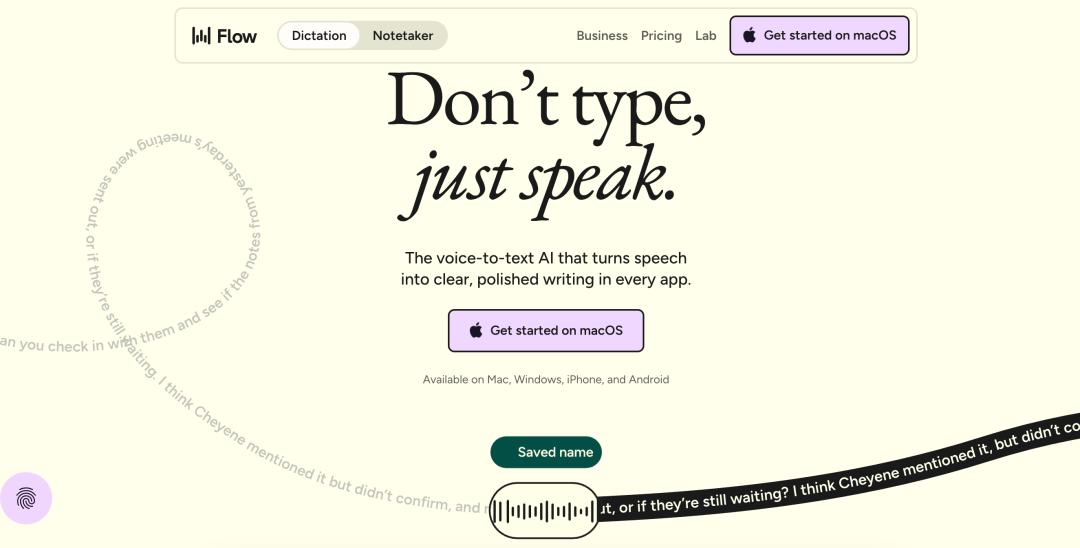
In terms of product form, it is like a cross-application AI voice input layer.
However, Wispr does not define itself as a speech transcription company, but calls itself "The Voice Interface Company".
There is a completely different valuation space between these two definitions.
If Wispr were only an input method, it would face free built-in features on mobile phones and computers, as well as similar products such as Superwhisper, Willow, and Aqua.
But if it can become a universal interaction interface between humans and AI, what it is competing for is no longer the input method market, but the "intention entry point" in front of every AI model, every office software, and every smart device.
According to data disclosed by Wispr, users have generated more than 60 billion words through Flow, with its user base distributed across more than 10,000 enterprises, covering almost all Fortune 500 companies.
Lead investor Menlo Ventures stated that Wispr's revenue has grown more than 30 times in the past year, it has entered 162 countries, and supports more than 100 languages.
However, these data mainly come from the company and its investors, and have not been independently audited. Wispr has not disclosed specific revenue figures, paying user numbers, and customer acquisition costs.
The 2 billion US dollars valuation given by the capital market is more like an advance pricing for growth speed and future entry point value.
02
They spent three years building the future first, and finally retreated to the input box
Wispr's two co-founders, Tanay Kothari and Sahaj Garg, met in their undergraduate dormitory at Stanford University.

When Kothari watched Iron Man as a child, what attracted him the most was not the Iron Man armor, but the AI assistant JARVIS that could understand intentions, manage devices, and complete tasks.
In 2021, the two founded Wispr, initially wanting to directly solve a very futuristic problem: how to let people communicate with computers without making a sound.
They spent about three years researching wearable devices, brain-computer interfaces, and "silent speech", trying to recognize what people want to say through nerve and muscle signals. Later, they also developed voice assistants that could order food, arrange schedules, and send invitations.
These products are suitable for demonstrations, but have not formed high-frequency usage habits.
People do not repeatedly book restaurants every day, nor do they continuously create schedules. The problem is not whether the technology can be implemented, but that the products cannot be integrated into daily life.
In the end, Wispr made a decision that seemed almost regressive: stop rushing to build JARVIS, and start with the most ordinary input box first.

Because typing is an action that people repeat dozens or hundreds of times every day. Emails, messages, documents, searches, codes, and prompts all rely on input.
Once users start using voice to replace the keyboard every day, Wispr may evolve from an occasionally opened tool to a continuously existing work entry point.
Let users first believe that voice can accurately write a paragraph, and then let users believe that voice can complete a task for them — this has become Wispr's new product path.
03
What investors are buying are three options
Large models have provided increasingly powerful intelligence, but for most ordinary people, the way to express their intentions to AI is still a text box.
Models can generate codes, reports, and solutions in a few seconds, but humans still need to describe what they need word by word. The stronger the model, the more prominent the problem of input efficiency becomes.
The 2 billion US dollars valuation that the capital market has given to Wispr essentially represents the purchase of three options.
The first option: High-frequency entry point
Input is one of the most frequent behaviors that occur on computers.
Compared with meeting minutes, smart speakers, and voice customer service, cross-application input is easier to form a daily usage habit. High frequency means retention, which can be converted into subscription revenue and also lay the foundation for Wispr to enter more work scenarios.
Wispr's publicly released business plan shows that its personal subscription price is about 12 to 15 US dollars per month, and the enterprise version is about 24 US dollars per person per month.
If it can only obtain a group of professional users willing to pay for efficiency, this is a decent subscription business; but if it can become the default input method for a large number of users, its business boundaries will be completely different.
The second option: Model-agnostic interaction layer
Apple, Google, OpenAI, and Anthropic all have the ability to develop voice functions, but their voice entry points usually serve their own systems, models, or applications.
Wispr hopes to become an agnostic layer spanning different platforms.
No matter whether users are writing emails, operating office software, or calling ChatGPT, Claude, and other AI tools, they can express their intentions through the same voice entry point.
This gives Wispr a short but important window: when giants regard voice as a product function, it can take voice as its entire business.
But this window will not exist forever. Once operating system manufacturers truly value this layer, Wispr must prove that there is a sufficiently large experience gap between professional tools and free features.
The third option: Migration cost formed by personalization
Traditional input methods memorize word frequency, while Wispr hopes to understand how a person expresses ideas.
It can gradually learn the user's professional vocabulary, names, tone, sentence patterns, and common expressions. Every modification may make the system better understand how the user wants to convert spoken language into text.
If this kind of personalization continues to accumulate, when users switch tools, what they lose is not just an input method, but a "language agent" that is already familiar with their way of expression.
This is what could truly become Wispr's moat.
04
Business: From "speech to text" to "speech to task completion"
Wispr's most important internal metric is called "zero-editing rate".
It does not measure how many words the system has correctly recognized, but whether users can directly send the text generated from a piece of speech without any modification.
Traditional speech recognition solves the problem of "what did you say", while Wispr wants to solve the problem of "what do you really mean".
For example, a user says: "Help me tell the client that we are probably not available on Wednesday, let's reschedule to Thursday afternoon, and keep the tone polite."
An ordinary transcription tool will record this spoken content. A real AI input interface needs to understand the intention and directly organize it into a business message that can be sent.
To improve this capability, Wispr launched its self-developed speech model Canto at the same time as the financing. The company claims that in complex environments such as noise, accents, and mixed multilingual scenarios, the new model can significantly reduce the error rate and reduce subsequent user modifications.
Wispr has also established the Advanced Interfaces Lab, led by Ariya Rastrow, who participated in the early development of Alexa. The research goal is no longer limited to speech recognition, but to enable the system to understand the user's current work, retain context, and directly convert speech into actions.
Its roadmap can be summarized into three stages: First, reliable voice input; Second, directly trigger actions from speech; Third, make the voice entry point always available through wearable devices such as earphones and glasses.
The input method is just a wedge to enter the user's workflow. The real goal is to become an intelligent layer that can understand intentions, call models and software, and finally complete tasks.
05
Entry point or a feature that is easy to replicate?
Wispr's story is very appealing, but it has not yet proven that it has won the next-generation entry point.
First of all, voice is naturally limited by usage scenarios.
It is very natural to speak to a computer at home, but it may not be the case in offices, cafes, meeting rooms, and public transport. Privacy concerns, noise, and interference to others may all make users pick up the keyboard again.
Secondly, voice has an extremely low fault tolerance rate.
Users may accept minor flaws in an AI image; but if a name, amount, or negative word is written incorrectly in an email, trust in the product may disappear instantly. Only when "basically correct" becomes "no modification required" can voice truly replace the keyboard.
The third problem is privacy.
Voice input may contain business plans, client data, private messages, and even users' unorganized raw ideas. The more an entry point understands the user, the more sensitive the data it holds.
Wispr states that its privacy mode can be set to not save voice recordings and not use them for training, and the enterprise version can also adopt zero-retention processing. But for a company that wants to become a long-term personal entry point, privacy is not just a feature, but also a continuous credit test. Wispr Privacy Statement
Finally, the 2 billion US dollars valuation still runs ahead of financial disclosure.
Investors announced 30-fold revenue growth, and the company released huge usage data, but did not disclose absolute revenue, user retention, and customer acquisition costs.
Growing 30 times from a very small base is a completely different matter from growing 30 times from a mature revenue scale.
The premise for this valuation to hold is not that Wispr becomes the easiest-to-use voice input method, but that it can successfully cross the three stages of "input - action - operating system". Stagnation at any stage may turn this voice interface company back into an overpriced efficiency tool.
06
Capital is betting on the control of intention
In the past decade, the biggest misunderstanding of voice products is that they wanted to become almighty assistants from the very beginning.
They can answer weather queries, play music, and set alarms, but it is difficult for them to enter complex, continuous, and high-value work processes.
Wispr has chosen the opposite path.
It does not rush to do things for users, but first strives to accurately write down what users want to say; after voice becomes a habit, it moves from text to action, and from action to devices.
Therefore, Wispr's 2 billion US dollars valuation is not the market's pricing for a voice input method, but a "post-keyboard era option" purchased by the capital market.
If AI in the future becomes powerful enough, what is truly scarce may no longer be models, but who can most accurately understand what humans want models to do.
The keyboard solves the problem of how humans input characters into computers.
What Wispr wants to solve is how humans deliver intentions to AI.
The distance between these two is the gap between a voice input method and a next-generation entry point company.
2 billion US dollars is not the answer, it is just the latest price marked by the capital market for this question.
This article is from the WeChat Official Account "NewMang xAI", written by Ge Lin and Dong Yizhen, and published with authorization from 36Kr.