The internal rate of return (IRR) of standalone energy storage in Europe is as high as 16%. Where exactly does China fall short?
China Energy Network learned that BloombergNEF recently released a report stating that the expected leveraged internal rate of return (IRR) for standalone battery energy storage projects in Europe that have signed lease agreements and reached the Commercial Operation Date (COD) can reach up to 16%.
Such high investment returns have made developers of standalone energy storage projects in China extremely envious.
In June this year, Changyuan Power (SZ: 000966), a subsidiary of China Energy Investment Corporation, released the third version of the *Investment Management Measures*, which specifies the investment threshold as only: for new and expanded domestic standalone shared energy storage projects, the capital IRR ≥ 6.5% and the pre-tax IRR of total investment ≥ 6%. Other data shows that in 2025, the average IRR of standalone energy storage projects across China is around 6% to 8%.
The *China New Energy Storage Development Report (2026)* jointly compiled by the National Energy Administration, the National Development and Reform Commission and other institutions shows that by the end of 2025, the installed capacity of standalone energy storage reached 177.26 GWh, accounting for 51.2% of the country's total new energy storage installed capacity. In the same period, the total installed capacity of all new energy storage in Europe, including standalone energy storage, was only 77.3 GWh.
Then, as a major country with large installed new energy storage capacity, why is the rate of return of standalone energy storage projects in China so much lower than that in Europe? Is there room for improvement in the return of China's energy storage projects in the future?
Why is the IRR of energy storage in Europe so high?
BloombergNEF stated in the report that the capture of falling electricity prices is pushing up return expectations for standalone renewable energy projects, so investors are shifting capital to the battery energy storage sector. Standalone energy storage assets can deliver a leveraged equity IRR of 8% to 12%, and the rate of return for purely commercial projects can reach around 15% or even higher. In some regions, such as Spain, this figure can reach 18%.
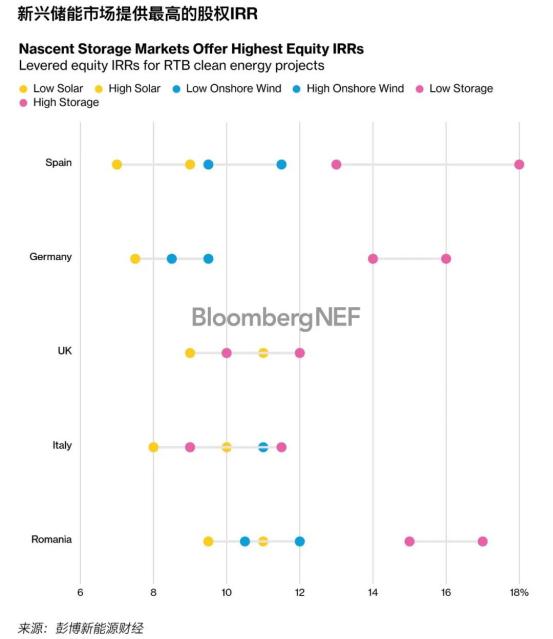
So why are the returns of standalone energy storage projects in Europe so good? This is inseparable from Europe's unique power system structure and power market policies:
First, Europe has a mature and complete power spot and ancillary services trading market, which can provide multiple revenue sources for standalone energy storage.
Centered on the EPEX Spot market, European power markets generally adopt a 15-minute granularity spot settlement mechanism, and various ancillary service markets such as frequency modulation are open to energy storage assets. Energy storage power stations can participate in multiple trading segments such as spot arbitrage, ancillary services, and capacity compensation at the same time, with diversified revenue sources.
Second, the transmission and distribution tariff exemption policy directly reduces the rigid operating cost of standalone energy storage.
Before 2020, energy storage systems in many parts of Europe had to pay fees whether they were charging from the grid or discharging to the grid. In 2020, the European Commission argued that "double charging" for grid access fees should not apply to energy storage, and pushed for transmission and distribution tariff exemptions across countries.
After that, Germany's *Energy Industry Act* clarified that standalone energy storage connected to the grid before August 2029 can enjoy a maximum of 20 years of transmission and distribution tariff exemption. In 2025, Romania's energy regulatory authority issued a special document to eliminate double charging for energy storage power stations.
Third, rising natural gas prices have created arbitrage space for energy storage.
In terms of power supply structure, natural gas power generation is an important part of Europe's power mix. In recent years, due to continuous geopolitical shocks such as the Russia-Ukraine conflict and the US-Iran confrontation, European natural gas prices have fluctuated at high levels for a long time. For example, at the beginning of this year, the benchmark price of natural gas in Europe was still 25 euros per MWh, but by August it once exceeded 60 euros per MWh. When gas prices rise, peak electricity prices rise accordingly, while the marginal cost of new energy (wind power, photovoltaic) during off-peak hours is almost zero, and the price difference expands sharply, giving energy storage huge arbitrage space.
The combined effect of the above major factors has made Europe a "value depression" and "highland of returns" for global energy storage investment.
It is worth mentioning that although the average rate of return of European energy storage power stations is relatively high, it varies from region to region. In comparison, energy storage power stations in countries such as Spain, Germany, and Romania have high investment value, while those in France, Norway, Sweden, Finland and other countries have limited investment value, because these countries are either rich in nuclear power or rich in hydropower, which can maintain stable electricity prices and have insufficient demand for energy storage.
Can China's energy storage IRR catch up with Europe's level?
In China, energy storage has become an indispensable part of achieving the "Dual Carbon" goal. As an integral part of the new power system, energy storage is on an equal footing with source, grid and load. The outline of the 15th Five-Year Plan also positions new energy storage as the core support of the new energy system, and incorporates it into the country's strategic emerging pillar industries. The *White Paper on Energy Storage Industry Research 2026* released in April this year clearly states that by 2030, the cumulative installed capacity of new energy storage in China will exceed 370 million kilowatts, an increase of more than 1.5 times over the end of the 14th Five-Year Plan period.
Policy support is strong and the scale is not small, but the revenue of China's energy storage power stations is not optimistic - it is a full 10 percentage points lower than that of Europe. If the IRR of China's standalone energy storage power stations remains at a low level, it will seriously affect the development of the energy storage industry.
So, is there any hope that China's standalone energy storage IRR can catch up with Europe's level?
China's power market started later than Europe's, but now the national policy level is vigorously promoting its development. With the gradual improvement of the power market, the revenue sources obtained by energy storage power stations may no longer be single, which will greatly promote the development of the energy storage industry.
However, there is no sign of hope at present to significantly narrow the IRR gap between China's and Europe's energy storage power stations.
The factor mentioned in BloombergNEF's report that pushes up the return expectation of standalone renewable energy projects is the "frequent occurrence of zero and negative electricity prices" and "capture of falling electricity prices". That is to say, the relatively high IRR of energy storage in Europe is built on the basis of large-scale zero and negative electricity prices.
The root cause of the emergence of negative electricity prices is that the excess electricity generated by wind and solar power cannot be stored, which exactly provides development opportunities for energy storage. Energy storage can absorb a large amount of electricity when negative electricity prices appear, and then sell a large amount of electricity when the sun sets, the wind stops, or electricity prices reach their peak, to earn the price difference.
Data shows that in the first quarter of this year, the number of negative electricity price hours in the day-ahead power market of the 27 EU countries reached 1223 hours, while the figure in the same period of 2025 was 593 hours, the duration directly doubled. This is most obvious in countries such as Spain, Portugal, and Greece.
At present, negative electricity prices have also appeared in some regions of China, but the proportion is still very small, and the duration of negative electricity prices is also very limited. If large-scale negative electricity prices similar to those in Europe appear in China, the IRR of China's energy storage power stations may also rise rapidly.
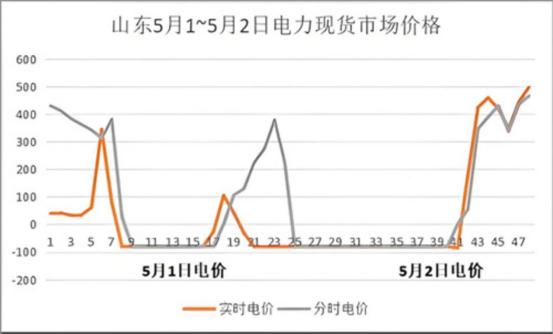
From May 1 to 2, 2025, the Shandong power spot market saw 22 consecutive hours of negative electricity prices
However, large-scale negative electricity prices are almost impossible in China, and the competent authorities will not allow them to occur.
First, large-scale negative electricity prices will cause heavy losses to the new energy industry.
From the situation in Europe, negative electricity prices have already dealt a heavy blow to the local new energy industry. The large-scale emergence of negative electricity prices has led to the situation that wind and solar power stations "generate more, lose more", and eventually become negative assets, causing heavy losses to developers, owners, and capital parties. More seriously, if this situation is not improved, capital will shy away from the new energy industry, which is the last thing China's new energy industry wants to see.
Second, the vulnerability of the power system will give rise to large-scale negative electricity prices.
The frequent occurrence of negative electricity prices in Europe is closely related to the fragility of local traditional base power sources and backward grid facilities. Although the installed capacity of new energy in China is growing rapidly, thermal power still acts as the main guaranteed power source and is the "ballast stone" of China's power system. At the same time, China's power grid is also the most complete and strongest power grid in the world, which is the key reason why it is difficult for China to have large-scale negative electricity prices.
Overall, with the continuous improvement of the power market in the future, the IRR of China's energy storage power stations will increase to some extent, but it is difficult to achieve a large increase, let alone catch up with Europe's level.
In the long run, the investment return of energy storage power stations is not necessarily the higher the better. Only by keeping it in a reasonable return range, neither too high nor too low, is it more conducive to the development of China's new energy industry.
This article is from the WeChat official account "China Energy Network", author: Jiang Bo, editor: Han Chenggong, published with authorization from 36Kr.