From courseware to embodied intelligence laboratories, AI has begun to help teachers generate teaching applications.
By Yang Yuan
Edited by Peng Xiaoqiu
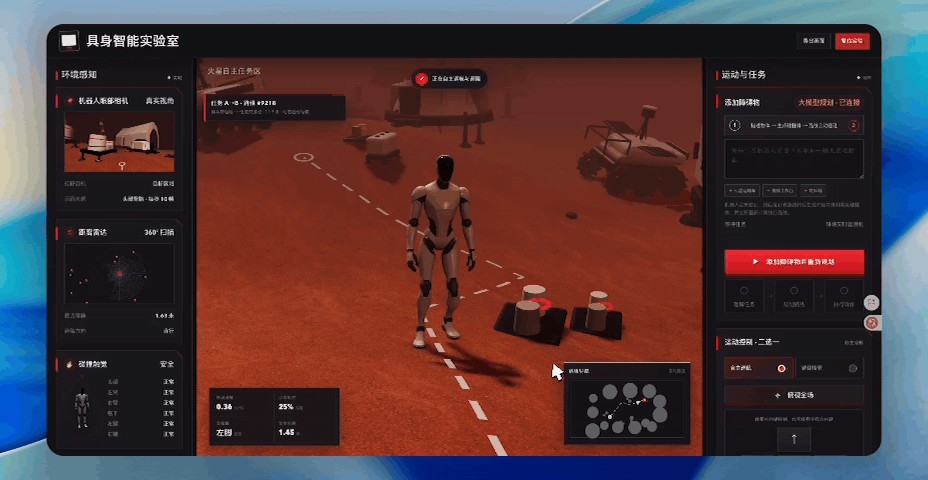
A middle school student who wants to understand embodied intelligence does not necessarily have to start with abstract concepts such as "perception", "decision-making" and "execution". In the "Embodied Intelligence Lab" of Feixiang Teacher, robots themselves become the learning objects. In a simulation or task-driven environment, students can observe how robots perceive the environment, make decisions and execute actions through route planning, behavior control and task collaboration.
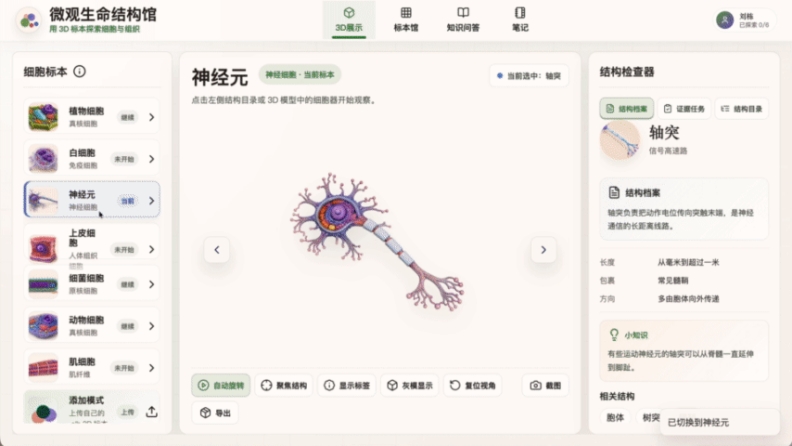
Cells in biology class can also "walk out" of the textbook illustrations. In another "Microscopic Life Structure Museum" of Feixiang Teacher, microscopic life structures such as cells, neurons and white blood cells are transformed into 3D specimens. Students can rotate, disassemble and observe different structures, and switch between 3D display, knowledge Q&A and notes. These interactive teaching tools that required special development in the past are now becoming educational applications that can be generated through natural language.
Recently, Feixiang Teacher, an education large model product, launched its 3.0 version. Compared with the version three months ago, the most obvious change this time is that the form of generated content has further extended from animations, courseware and teaching resources to directly runnable educational applications.
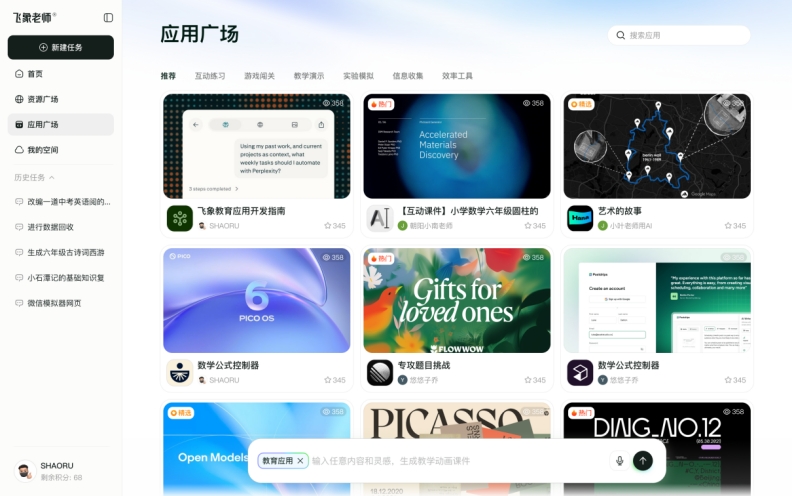
According to the product design of Feixiang Teacher, users only need to describe their needs in natural language, and they can get an application with an independent access link in a few minutes, without writing code or deploying it by themselves. The generated application can call the AI model, support user registration and data saving, and can be further modified and iterated.
From generating a courseware to generating a continuously usable application
In the past two years, generating teaching plans, PPTs, exercises and teaching animations has become a common product form for large models entering the education scenario. However, such products mainly solve the problem of content production: AI helps teachers get teaching materials faster.
Feixiang Teacher 3.0 tries to go a step further.
For example, if a teacher wants students to memorize words by clearing levels every day, he only needs to describe his teaching idea, and the system can generate an "English Adventure Island", which includes course maps, learning levels, listening and speaking exercises, point rewards, continuous learning records and personal progress. After students complete the tasks of the day and re-enter the application the next day, they can still continue from their previous learning progress.
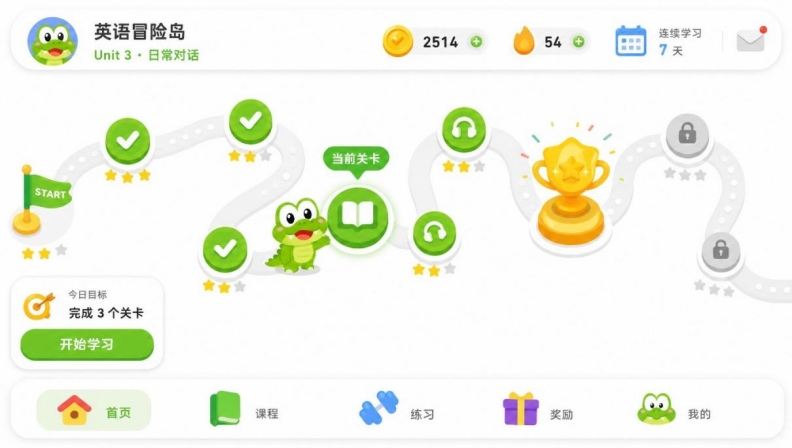
This means that what AI generates is no longer just a piece of teaching material that ends after use, but a set of applications that can be accessed repeatedly, record user status and run continuously.
Similar logic can also be applied to more specific teaching tasks. In the case demonstrated by Feixiang Teacher, "Class Error Question Archive" can automatically collect all wrong questions of the whole class, and precipitate the error causes according to the dimensions of knowledge points, question types and students; "School-wide Homework" can generate three levels of exercises: basic, advanced and challenging around unified knowledge points, and adapt them according to the levels of different students.
The work that used to require teachers to find tools separately, sort out data and even rely on software systems to complete, can now be re-encapsulated into an application generated on demand. AI is no longer just producing a piece of content, but trying to build a set of continuously operating teaching processes.
When applications can be generated instantly, teaching content is also changing
However, lowering the development threshold of educational applications may not only bring teachers a new tool to improve efficiency. A more noteworthy change is that when the cost of making a teaching application drops, some teaching content that used to have high development costs and slow update speeds also has the opportunity to appear in a more lightweight way.
The Embodied Intelligence Lab is a typical case.
Embodied intelligence itself is still in a stage of rapid development, involving multiple links such as robot perception, decision-making, execution and task collaboration. The "Embodied Intelligence Lab" demonstrated by Feixiang Teacher tries to transform these concepts into an operable and observable learning process. What students face is no longer just a set of concepts, but a robot task scenario: observe the actions of the robot, and understand the underlying operation logic through route planning, behavior control and task collaboration.
This at least demonstrates a possibility — when educational applications can be generated faster by AI, new technologies and new knowledge that are constantly emerging in the real world may also be reorganized into interactive learning tools faster.
Another change is taking place within traditional disciplines. The cell structure in biology, the dynamic process in physics experiments, and the spatial geometry in mathematics are not new in themselves, but for a long time, a considerable part of this knowledge has relied on 2D pictures and text explanations.
Feixiang Teacher 3.0 enhances the capabilities of 3D interaction and professional schema generation. A 2D cell structure diagram can be transformed into a 3D model that can be rotated, disassembled and clicked to view annotations; complex physical processes can also be further transformed into dynamic demonstrations. The "Microscopic Life Structure Museum" is a concrete presentation of this capability. Students can switch between different cell structures and observe their morphology and functions from the whole to the part.
Similar products also include 3D Planet Knowledge Graph, Planet Texture Lab and so on. The former can reorganize the chapters and knowledge points in the textbooks into a knowledge graph composed of planets and satellites, while the latter displays the planets, satellites of the solar system and their surface textures through 3D models.
From this perspective, the change brought by AI-generated educational applications is not just that "it has become easier to develop an App". Educational content itself has also begun to extend from standardized, static and prefabricated forms to more instant, interactive and visualized forms.
Education-oriented "Vibe Coding": The difficulty lies not only in developing the application
From the perspective of technical form, this is not a completely unfamiliar story. With the improvement of AI coding capabilities, the threshold for generating web pages and simple applications with natural language is decreasing. What Feixiang Teacher 3.0 does can be understood as further integrating similar capabilities into the education scenario.
But the problem with educational applications is precisely here: an application that can run does not mean it can be used for teaching. A general model can generate a page for wrong-question notebooks and draw a beautiful cell structure diagram, but after entering the teaching process, it still needs to answer another set of questions: which knowledge point does a question examine? Why did the student make a mistake? How should it be explained? What difficulty level of exercises should be provided next?
Therefore, compared with simply generating the application interface, the differentiation that Feixiang Teacher tries to establish is to embed educational capabilities into the underlying layer of application operation.
According to Feixiang Teacher, the applications it generates can call the question bank and educational resource library, and further call capabilities such as question grouping, proposition, homework grading, error cause diagnosis and personalized question generation. The model not only needs to know the answer to a question, but also needs to understand what it examines, where the student made a mistake, and what learning content should be provided next. This is also the question that vertical education models must answer when facing general large models.
When basic models are getting better and better at generating web pages, PPTs, images and even complete applications, the simple "generation capability" can hardly form the long-term barrier of educational AI products. What really determines whether a product can stay in the teaching scenario is still the understanding of textbooks, questions, student status and teaching processes.
Focusing on this, Feixiang Teacher 3.0 has synchronously upgraded its capabilities in high-fidelity document parsing, 3D interactive schemas, audio and video understanding, and educational data and resource invocation. For example, in the document parsing process, the original questions, formulas and illustrations in textbooks, test papers and teaching plans need to be preserved as much as possible; the courseware, materials accumulated by teachers and schools in the past, and data in other software can also be further integrated into the new application generation process.
Feixiang Teacher has also added capabilities such as layered memory, personal resource library, and historical versions, so that the system can call the materials used in the past, and continuously modify and roll back the generated applications. All these capabilities ultimately serve the same goal: to make AI generate not just a web page that "looks like an educational product", but a tool that can continuously handle teaching tasks.
When teachers can also become creators of educational applications
Another change brought by application generation is that the producers of educational software may begin to change.
In the past, a set of educational software required the participation of product managers, designers and engineers from the proposal of requirements to the official launch. Front-line teachers who truly understand the problems in the classroom mostly play the role of requirement proposers and end users.
Now, a teacher who finds that there are large differences in the levels of students in the class can generate a layered homework tool; a student who thinks the existing periodic table of elements is not easy to use can recreate one according to his own learning logic; a parent can make a reading check-in tool for his child; schools can also generate management applications for club registration, equipment maintenance and data collection.
Feixiang Teacher hopes to further open up this capability to teachers, students, parents, researchers and educational institutions. This means that the next stage of educational AI competition may not just be "who can make an educational product covering more users". Another possibility is that the platform provides models, educational capabilities and infrastructure, and people who are truly in the teaching scene complete the last mile of product definition by themselves.
Of course, there is still a long way to go from "can generate" to "someone really uses it for a long time". The requirements of education scenarios for content accuracy, data security, teaching effect and compatibility with existing school systems are far higher than making an ordinary web page. Whether teachers are willing to continuously maintain the applications they generate, whether students will really use them for a long time, and whether a large number of fragmented applications can form a stable product ecosystem, all still need to be verified by real usage data.
But at least, the way AI enters education is changing. When educational applications can also be generated instantly, it is not just the tools in teachers' hands that are changing. What knowledge can enter the classroom, how knowledge is understood, and who has the ability to create a new teaching method, may all change accordingly.