AI has started to invoke AI on behalf of humans, and its token usage is already 5.2 times that of human beings.
On February 6, 2026, humans outperformed AI for the last time.
On that day, the number of tokens consumed by humans on OpenRouter was matched by intelligent agents for the first time.
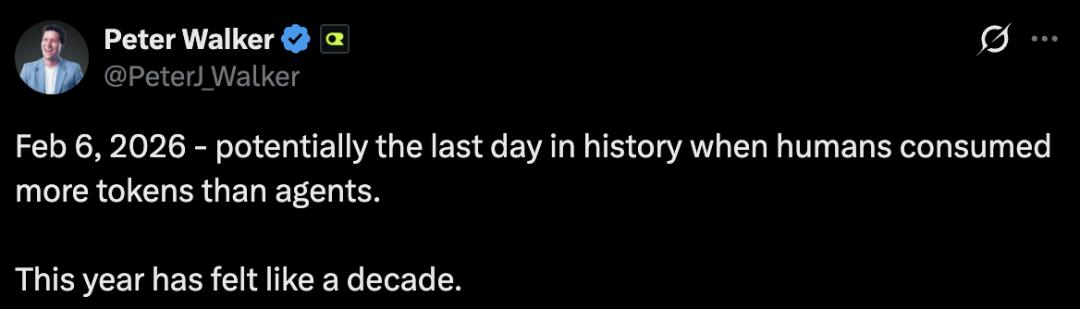
Only half a year later, the gap between the two lines has widened by 5 times.
According to OpenRouter's statistics, as of August 10, the token consumption of Agent category has surged from about 0.51 trillion to 7.3 trillion, a 14-fold increase; the human line has also risen to 1.4 trillion, but only a 2.8-fold increase.
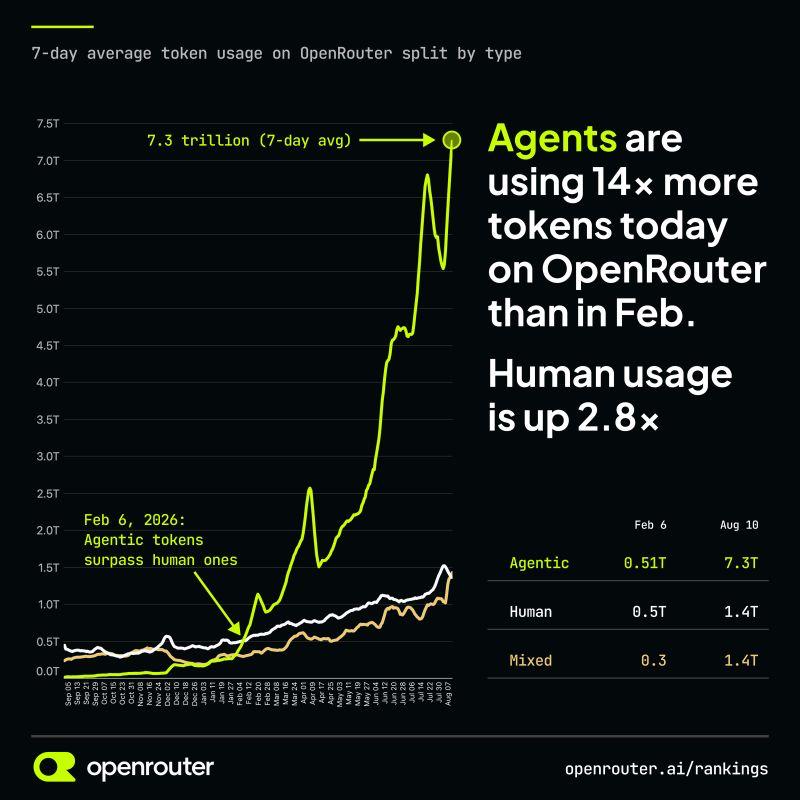
Such a huge gap made Peter a little trance: it feels like 10 years have passed, but February 6 was actually only half a year ago.
It does not matter who you are, only how you use it matters
First, make it clear where this set of data comes from and how it is calculated.
OpenRouter is one of the world's largest model gateways, connecting about 70 model suppliers on one end and developers on the other, processing 28 trillion tokens per week.
According to estimates by Chris Clark, its co-founder and COO, this accounts for roughly 1% of the global inference volume, half of which comes from the United States.
How does this 1% of tokens distinguish between those generated by humans and those by Agents?
OpenRouter does not look at who you are, only at how you use it. The specific method is to track behavior through API keys:
It tracks 7 signals in total, including how frequently tools are called, the interval between two responses, and the number of rounds in a conversation, then assigns a weighted score to divide the traffic into three categories: Agentic, Mixed, and Human.
Why can people be distinguished just by observing behavior?
The logic is simple: when humans use AI, they send a query and pause for a while to read, think and type; while Agents run non-stop, calling tools continuously and looping through rounds, a rhythm that is clearly not from carbon-based creatures.
So this is an estimation model, but the general direction is absolutely correct.
One human goal can now trigger dozens of rounds of model calls and tool calls. The token statistics do not count how many people are using AI, but how deeply AI has worked on behalf of humans.
One Agent task equals a hundred chat sessions
The huge gap between humans and Agents comes from the different usage patterns of the two sides.
What do human requests look like?
Open the dialog box, type a prompt, wait for a response, copy the content and close the window.
From start to finish, you and the model exchange less than ten sentences, with at most several thousand tokens on the account.
But requests from intelligent agents are completely different.
Once you give it a goal, it will move forward on its own: read files, call tools, generate results, re-read, modify, and iterate round after round until the task is completed.
Humans fill the initial prompt with goals, specifications and context, and then the model continuously performs incremental reading and writing based on this context.
When you are still in a question-and-answer pattern, an Agent can run for a whole day with just one sentence!
Therefore, the same person, who was manually copying and pasting in the dialog box in the morning, will immediately reach a new order of magnitude in token consumption after launching an intelligent agent to run in the afternoon.
Peter's words hit the nail on the head: the behavioral change that truly unlocks the huge consumption volume is that people begin to let intelligent agents run autonomously for a long time.
Even the cheapest tokens can burn through your budget
Seeing the 14-fold increase, your first reaction might be that it is burning money.
It is indeed burning money, but not in the way you think.
Peter added a point: because intelligent agents are inherently multi-round, nearly 70% of the tokens in an average intelligent agent request come from cached prompts, and the pricing of cached tokens is usually much lower.
The logic is easy to understand.
Agents repeatedly read and write around the same goal: the first time you input a large amount of context (code specifications, operation manuals, tool lists) and pay the full price; then each subsequent round only performs incremental updates, and the part that hits the cache is charged only a small fraction of the normal input price.
In other words, nearly 70% of that steep curve comes from the same segment of context that is reused repeatedly.
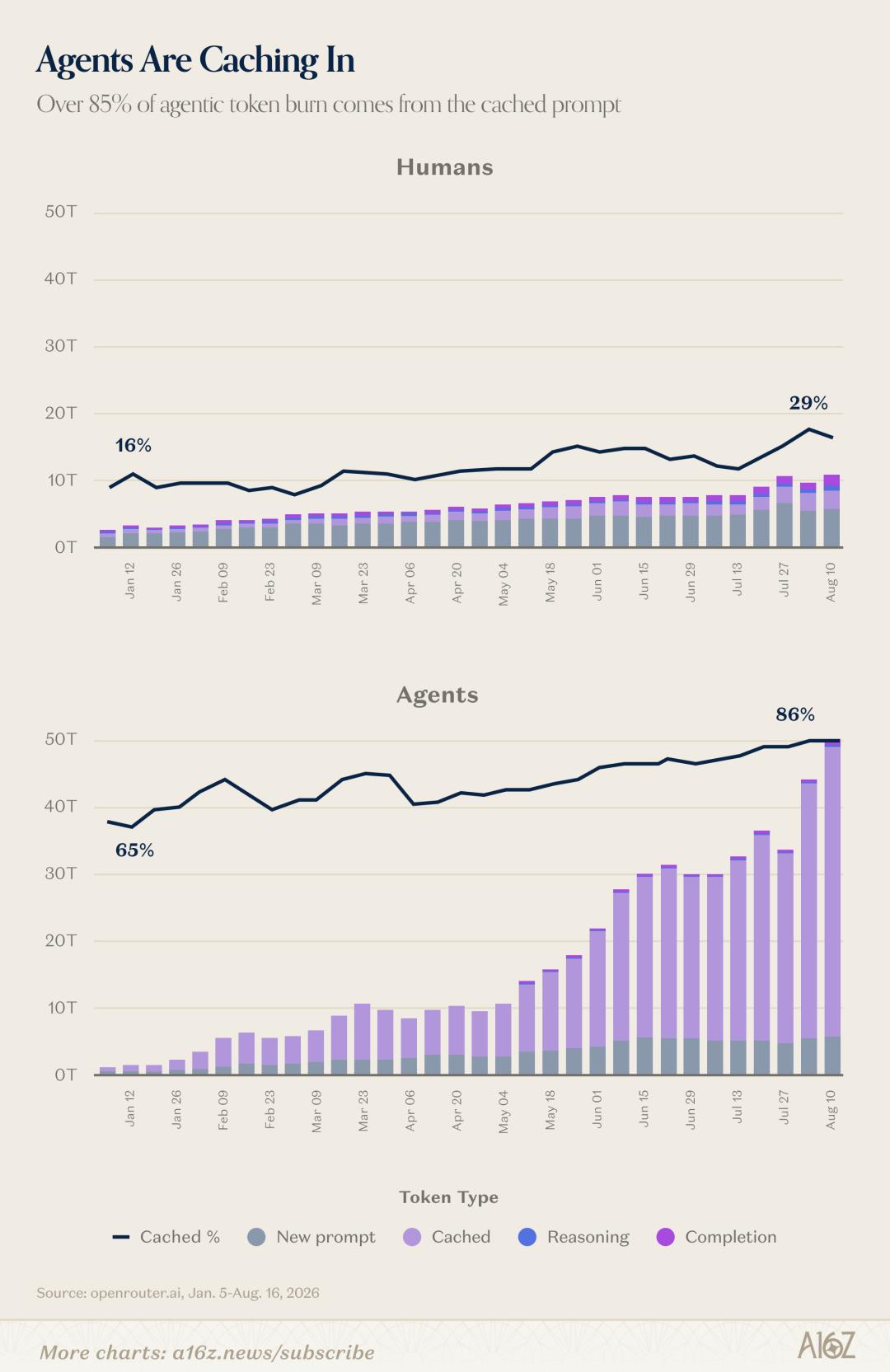
Comparison of token composition between Agent and humans, cached tokens contribute almost all the increment. a16z states that the proportion is over 85% based on the total volume caliber, while Peter's original post puts the average proportion per single request at nearly 70%.
Although the unit price has indeed decreased, it cannot offset the skyrocketing usage.
Praveen Neppalli Naga, CTO of Uber, revealed earlier this year that the company's engineers burned through the full-year Claude Code budget in just four months.
According to media reports, his own two-hour demonstration cost $1,200.
The unit price is discounted by 30%, but the usage has increased 14 times, and the result of this multiplication is not hard to calculate.
EY calculated a more intuitive account: the cost of one customer service interaction was about $0.04 in 2023, and it rose to about $1.20 in 2026, a 30-fold increase.
It is not that the models have become more expensive.
In the past, the customer asked one question and the system gave one answer, following a single straight line to the end.
Now the customer still asks the same question, but behind the scenes, the system has checked work orders, called inventory, reviewed records, iterated and modified for more than a dozen rounds before finally outputting a reply.
For the same thing, the way of doing it changes, so the cost changes.
Goldman Sachs estimates that Agentic AI may push the 2030 token consumption up by 24 times.
When any cost increases by 14 times in half a year, people will start to count every penny. Peter says this is exactly why open-weight models and low-cost token services have suddenly attracted widespread attention.
Moreover, although cached tokens are cheap, they consume a lot of memory.
Intelligent agents can run for hours without restarting from scratch, relying entirely on memory to hold the entire context.
This also explains half of the reason why high-bandwidth memory is in such tight supply recently.
The watershed is not which model you use
So is the way to save money to switch to a cheaper model?
The real watershed does not lie in which model you use.
Using the same model as a search box will only generate thousands of tokens a day; but connecting it to your own files, tools and a continuously running workflow, tens of millions of tokens a day is not unusual.
The gap is not in the model, but in whether you have applied it to real business scenarios.
OpenAI provides a set of reference data showing how huge this gap is:
The top 10% of companies that use AI most deeply generate 8.3 times more tokens per active user than typical companies. Back in January, this gap was only 2.6 times.
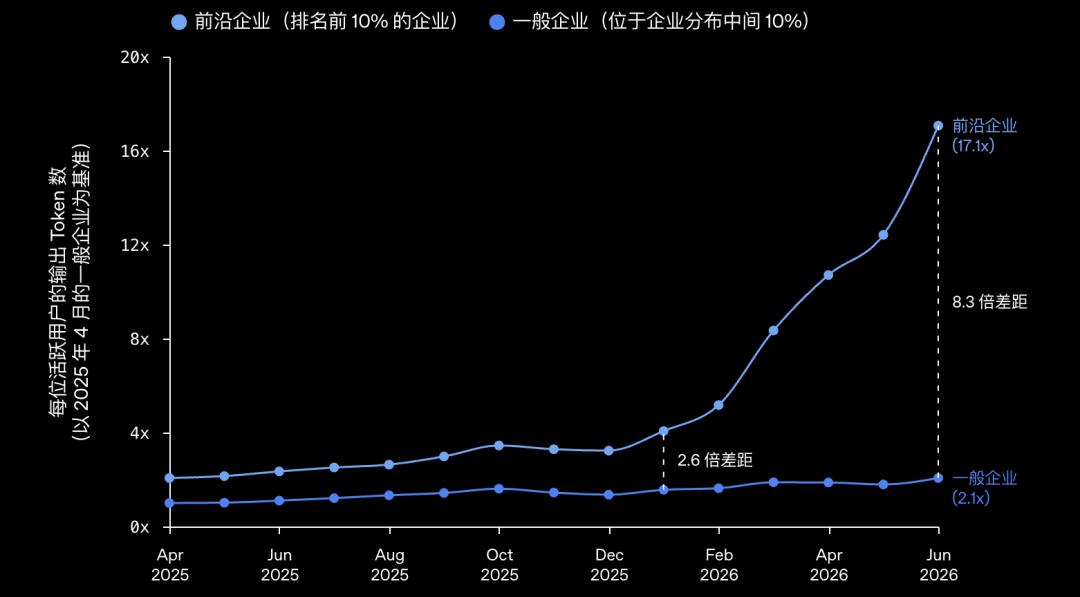
In half a year, the gap has expanded to more than three times the original.
It is not the model but the supporting facilities that widen the gap.
In the same set of statistics, 21% of active users in leading companies use plugins every week, while the figure for typical companies is only 9%; the adoption rate of skills is 19% versus 3%. Inside OpenAI itself, this figure is 95%.
Package the few things you do often into a set of reusable skills, so that the intelligent agent does not have to start from scratch every time.
Fewer searches and fewer reworks mean more cost savings.
After the tokens are spent, who will verify the results
However, no matter how carefully you calculate the accounts, it does not mean that the work is done reliably.
The surge in intelligent agent traffic does not mean that AI is acting fully autonomously. A large number of tasks are still initiated by humans, and manual approval is often stuck in the middle.
A developer who serves service industry clients in the comment section of Peter's original post mentioned that the bosses he serves never think about letting go of control, and every step including procurement, sending and signing has to return to humans.
But the problem is, you may not be able to find the relevant person when the process returns to humans.
Another practitioner said that their intelligent agent deleted 18 videos in the advertising account, and no one found out until a full day later.

This is not a very outrageous mistake made by the model, but that no one checked that step at all.
Token consumption can increase 14 times in half a year, but the number of personnel for verification cannot increase by that much. This is probably the most easily overlooked and most expensive cost in this round of growth.
Repetitive execution actions such as analysis, research, draft writing and solution design will all become surplus in the future.
What is truly scarce is verification, judgment, and the decision of what is worth doing.
AI has become the main consumer of tokens, but up to now, it still cannot sign documents on your behalf.
In the future, the real problem will no longer be whether you use AI or not.
Instead, it will be who verifies the work done by AI on your behalf, and who makes decisions on the next step.
References:
https://www.linkedin.com/posts/peterjameswalker_february-6th-2026-potentially-the-last-share-7493029881841344512-IK89/
https://the-decoder.com/ai-is-becoming-ais-biggest-customer-as-agentic-token-usage-jumps-14x-on-openrouter/
https://openai.com/signals/enterprise-data/
https://www.a16z.news/p/charts-of-the-week-winds-of-thematic
https://www.ey.com/en_us/insights/ai/agentic-ai-token-costs
This article is from the WeChat official account "AI Era", author: ASI Apocalypse; editor: Yuan Yu, released with authorization from 36Kr.