A group of the strongest county-level cities in China
Around the globe, the development of all countries, regions, cities, and even districts and counties has not escaped the Matthew Effect.
Whether between regions, between cities within a province, or even inside a city, everything operates following the law of "the strong get stronger".
We have seen far too many cases where the GDP of one city exceeds that of an entire province. For example, the GDP of Shenzhen alone surpasses that of 18 provincial administrative units including Shaanxi, Jiangxi, Chongqing and Liaoning. As a prefecture-level city, Suzhou, if its economic strength is included in the ranking of provincial-level administrative units, can also rank 20th in the country.
There are also many cases where the GDP of one district exceeds that of an entire province. A couple of days ago we wrote about the top 10 districts nationwide, not to mention the three trillion-yuan districts of Pudong, Haidian and Nanshan, even Chongqing Liangjiang New Area, which ranks 10th, can match the strength of some provinces and autonomous regions in western China.
There are also a considerable number of counties and county-level cities at the same administrative level as districts that can rival the strength of provinces and autonomous regions.
Twenty years ago, it was unthinkable for the GDP of a county or county-level city to exceed 100 billion yuan. However, against the backdrop that the number of trillion-yuan cities will reach 30 by the end of this year and the number of trillion-yuan districts will also reach 4 by the end of this year, the number of 100-billion-yuan counties exceeded 70 by the end of last year.
At the end of 2024, there were 62 100-billion-yuan counties across the country.
In 2025, the GDP of 15 counties including Anxi, Xinzheng, Linhai, Qianjiang, Pingdu, Baoying, Boluo, Feicheng, Xiangshan, Yidu, Guangrao, Daye, Feidong, Changxing and Jiashan exceeded 100 billion yuan, bringing the total number to 77.
Among them, 13 counties have a GDP exceeding 200 billion yuan, and 6 counties have a GDP exceeding 300 billion yuan. Kunshan, the top county-level city, and Jiangyin, the second top county-level city, are both at the 500-billion-yuan level.
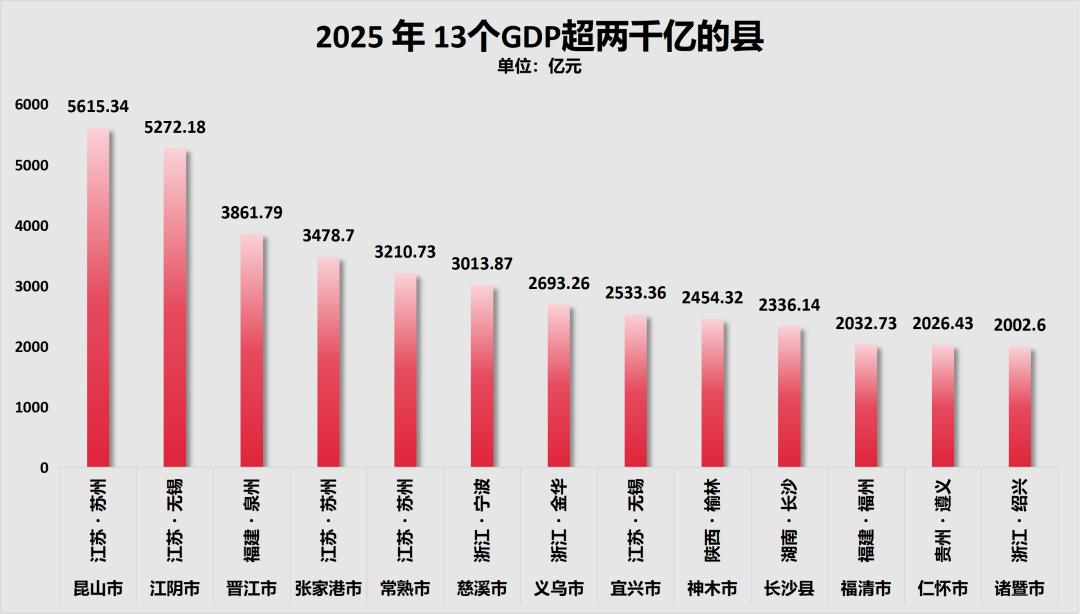
Illustration: Urban Finance; Data: Statistics bureaus of various cities
If Kunshan and Jiangyin are included in the ranking of provincial-level administrative units, their strength is on par with Ningxia, surpassing Qinghai and Tibet.
Kunshan and Jiangyin overtake 8 provincial capitals
The GDP of both Kunshan and Jiangyin has exceeded 500 billion yuan. What does the 500-billion-yuan level mean?
If included in the ranking of cities at prefecture level and above, Kunshan can rank 59th nationwide, and Jiangyin ranks 61st nationwide.
More importantly, as county-level cities, they have outperformed 8 provincial capitals and capital cities of autonomous regions, and are about to outperform Guiyang.
Not only their GDP is comparable to that of prefecture-level cities and provinces, but the fiscal strength and number of listed enterprises of many county-level cities are also very impressive.
In 2025, 20 counties and county-level cities had fiscal revenue exceeding 10 billion yuan, among which the last-ranked Yueqing had a fiscal revenue of 10.572 billion yuan.
Kunshan, which ranks first, has a fiscal revenue as high as 46.504 billion yuan. If this scale is included in the ranking of provincial-level administrative units, it is higher than that of Qinghai and Tibet.
From the perspective of the number and market value of listed enterprises, according to the ranking of the number of A-share listed enterprises sorted out by Yicai:
Jiangyin, Wuxi has the largest number of listed enterprises among all county-level cities, with 39 at the end of last year and a total market value as high as 589.324 billion yuan.
Kunshan ranks second, with 34 listed enterprises and a market value of 426.972 billion yuan. Xinchang, Liuyang, Zhangjiagang, Yuyao, Rudong, Yixing, Cixi and Yueqing rank top 10 in terms of market value among county-level cities. The number of listed enterprises in Zhangjiagang, Yuyao, Changshu, Haining, Yueqing, Xinchang, Yixing, Cixi, Zhuji, Linhai, Dongyang, Longkou, Wenling, Tiantai, Jiashan and Haiyan are all in double digits.
This is only the statistics of A-share listed enterprises. If all listed enterprises at home and abroad are counted in full caliber, Jiangyin had 66 listed enterprises at home and abroad at the end of last year, and Kunshan had 50 listed enterprises at home and abroad.
The number and market value of listed enterprises in these county-level cities can compete with those of many provinces.
Then two key questions arise:
First, why are there very few counties from Guangdong among these strong counties and county-level cities?
Among the counties with GDP exceeding 100 billion yuan in 2024, there was not a single one in Guangdong. It was not until Boluo County, Huizhou, broke through 100 billion yuan in 2025 that Guangdong achieved its first 100-billion-yuan county. The reason is very simple: most of the strong counties in Guangdong have been "reorganized into districts", they have joined the economic competition among districts and are no longer in the category of county-level cities.
Therefore, if it is a competition among all districts nationwide, you will see that Guangdong leads with an absolute advantage. Among the top 10 districts by GDP in 2025, Guangdong accounts for 4 alone, and accounts for 8 among the top 20 districts.
Second, what supports these strong counties and county-level cities?
The answer is only two words: industry. How strong is Kunshan's industry? In 2025, Kunshan has one industrial cluster with an output value exceeding 800 billion yuan and 11 industrial clusters with an output value exceeding 10 billion yuan, an achievement that many cities can hardly reach. In 2025, the total industrial output value of Kunshan above designated size was 1302.79 billion yuan, which outperforms a number of provincial capitals.
In addition, according to the 2025 statistical yearbook released by Jiangsu Province, the industrial revenue of Kunshan in 2024 was as high as 1.27 trillion yuan.
What does 1.27 trillion yuan mean? It is higher than that of Changsha and Xi'an. The industrial revenue of Xi'an above designated size in 2025 was 1012.278 billion yuan. The 2025 data of Changsha has not been released, and its industrial revenue in 2024 was 977.567 billion yuan.
In addition, the industrial revenue of Hefei in 2025 was 1.6 trillion yuan, and the figure of Kunshan is not much lower than that of Hefei. The most well-known industry in Kunshan is the computer, communication and other electronic equipment manufacturing industry with an output value exceeding 800 billion yuan.
Around 2010, one out of every three laptops in the world was produced in Kunshan. However, under the impact of the 2008 financial crisis, many industries in coastal cities shrunk. At that time, cities in central and western regions took this opportunity to make bold investment promotion by taking advantage of lower labor costs than eastern regions. Against this background, a large number of Kunshan's electronic information industries were transferred to Chongqing.
Later, Chongqing replaced Kunshan and became the largest laptop production base in China.
Even though Kunshan is no longer the world's largest laptop production base, it has gathered a number of high-end electronic information enterprises and developed into one of the important electronic information production bases in China and even across the globe.
Strong industries have laid the foundation for Kunshan to be the top county-level city. Last year, Wuhan went to the Yangtze River Delta to learn from advanced experience, and paid a visit to Kunshan. It proposed to thoroughly learn from Kunshan's experience, focus on 25 key industrial chains of Wuhan's manufacturing industry, accelerate the construction of a modern industrial system, and strive to improve industrial scale and development level.
Then look at Jiangyin, the second top county-level city. The industrial strength of Jiangyin is much weaker than that of Kunshan, but it is also very strong.
Jiangyin's signature industries are metallurgy, high-end textile and garment, petrochemical new materials, metal new materials, etc.
Among the national demonstration bases for new industrialization approved by the state, Jiangyin, Kunshan and Liuyang each have two, among which the two bases of Jiangyin correspond to its pillar industries: equipment manufacturing and new materials (special steel manufacturing).
The real core advantage of Jiangyin is advanced manufacturing and new materials. Especially in the fields of iron and steel, new materials and equipment manufacturing, Jiangyin has formed a relatively complete industrial chain.
For example, wind power equipment is one of the key industries Jiangyin has been developing in recent years. A complete industrial chain covering key materials, core components, complete machine manufacturing and intelligent operation and maintenance has taken shape locally, with a number of leading enterprises such as Xingcheng Special Steel, Envision Energy and Hengrun Heavy Industry gathered here.
Yueqing is also a typical example, it has almost pushed the "electrical" industry to the extreme. In 2025, the output value of Yueqing's electrical industry above designated size reached 136.674 billion yuan, a year-on-year increase of 8.9%. More impressively, Yueqing has more than 14,000 electrical enterprises, its low-voltage electrical products occupy over 65% of the national market share, and the local supporting rate of the industrial chain exceeds 85%.
Moreover, Yueqing's electrical industry cluster is the only national advanced manufacturing cluster dominated by counties in China. What does this mean? More than 6 out of every 10 low-voltage electrical products in the national market are related to Yueqing.
A county-level city can push one industry to occupy more than 60% of the national market share, which is the most powerful part of the county-level industrial cluster.
The same is true for Cixi.
Many people may not know that the real "signature advantage" of Cixi is small household appliances. In 2025, the revenue of the core area of Cixi's modern and smart home appliance industrial cluster has reached 108.38 billion yuan, exceeding 100 billion yuan for the first time.
According to reports from Xinhua News Agency, Cixi can produce about 100,000 small household appliances per hour. One out of every 3 electric irons in the world is made in Cixi, and 60% of the heaters and 80% of the double-cylinder washing machines in the world have the mark of "Made in Cixi". The small home appliance industry has been developed into a 100-billion-yuan level industry.
Then look at Zhuji.
Zhuji's signature industries are more distinctive: one is the pearl industry, the other is the sock industry. Among them, the scale of Datang sock industry has exceeded 70 billion yuan, with tens of thousands of sock enterprises, forming a complete industrial chain covering sock machines, raw materials, design, production and sales. And Zhuji's pearl industry accounts for more than 70% of the global pearl trading volume.
So when you look back at these county-level cities, you will find a very obvious common point: Kunshan has electronic information, Jiangyin has new materials and advanced manufacturing, Yueqing has electrical industry, Cixi has small household appliances, Zhuji has sock industry and pearl industry.
Their industries are different, but their development paths are highly similar.
First find an industrial breakthrough, then push this industry to the extreme; after the industry grows larger, attract all upstream and downstream enterprises, and finally form a complete industrial chain and industrial cluster.
This is the real underlying logic of strong county economy. A county does not need to have all kinds of industries like a provincial capital.
As long as it can take the lead nationwide in a sufficiently large track, it is enough to support hundreds of billions of yuan in GDP. It can even be said that: The competition of county economy, on the surface, is the competition of GDP, but what is really compared behind it is whose "signature advantage" is stronger.
This is also why these 100-billion-yuan counties and strong county-level cities we see today, many of which look unremarkable, can have hundreds of billions of yuan in GDP, tens of billions of yuan in fiscal revenue, and even dozens of listed enterprises.
Because what stands behind them is never just a single county, but a complete industrial chain, a huge industrial cluster, and an "industry champion" that has a say in the national and even global market.
Why are the provinces and districts in western China less competitive than the top strong counties in eastern China
The last question is, some provinces and autonomous regions in western China, let alone compared with the cities in eastern coastal areas, even have a certain gap with the top strong counties. Where is the problem?
This is actually a big proposition. China has a vast territory, and terrain conditions, resource endowments, transportation costs and policy orientation determine that the development gap between different provinces and cities is destined to be huge.
Plain areas (such as the eastern coastal areas and the North China Plain) have low transportation construction costs, which is convenient for the formation of industrial clusters and logistics networks, and more conducive to the development of manufacturing and service industries. Mountainous and plateau areas (such as some provinces in southwest and northwest China) have inconvenient transportation, great difficulty in infrastructure construction, and restricted industrial development.
Coastal provinces rely on the advantages of ports to participate in global trade at the earliest, forming an export-oriented economy. Inland provinces need to make up for their location gap step by step through strategies such as "Western Development" and "Rise of Central China".
The combination of natural factors and acquired policy orientation has formed the current pattern of "strong southeast, weak northwest", which leads to the famous Hu Huanyong Line.
Data from the 7th national census in 2020 shows that the population of the area west of the "Hu Huanyong Line" accounts for 6.5% of the total population, and the population of the area east of the line accounts for 93.5%.
In order to narrow the development gap, the central government has adopted a fiscal adjustment method to transfer resources from the over-sufficient areas to the under-sufficient areas. That is what we often call the central fiscal transfer payment: all regions submit fiscal revenue to the central government according to the actual situation, and the central government allocates funds to local governments according to their development needs. This forms the fiscal transfer payment system in which the central government allocates funds to achieve equal levels of public services in all regions.
In the past three years, the scale of the central government's transfer payment to local governments has exceeded 10 trillion yuan every year. In terms of the scale of transfer payment received, Sichuan and Henan have consistently ranked top two. Last year, Sichuan received 683.997 billion yuan in transfer payment, an increase of 12.464 billion yuan over 2024. Henan received 596.789 billion yuan, an increase of more than 10 billion yuan over 2024. The top 10 regions in terms of transfer payment scale also include Hunan, Hubei, Hebei, Heilongjiang, Yunnan, Anhui, Guangxi and Xinjiang.
In previous years, these regions also basically ranked top 10, only the order of the 3rd to 10th places varies.