Distressed real estate developers are collectively fighting their way through key hurdles.
In 2026, the debt restructuring of troubled real estate enterprises has entered a concentrated implementation period.
Since the second half of this year, Powerlong Real Estate, Fantasia, Logan Group have successively completed their overseas debt restructuring, and the debt risks of a large number of enterprises have been resolved in an orderly manner.
Every coin has two sides.
While good news of breakthroughs in restructuring keeps coming, another set of phenomena is equally worthy of vigilance: CIFI and Aoyuan have suffered second defaults after their restructuring was implemented; other enterprises that have successfully completed restructuring such as Country Garden, Sunac, and Sino-Ocean have also added new overdue debts.
This round of industry debt resolution is about to enter the final stage, so what exactly is the missing step for those troubled real estate enterprises that have experienced second defaults or new overdue debts?
01
Since 2026, corporate debt resolution has continued to see breakthrough progress.
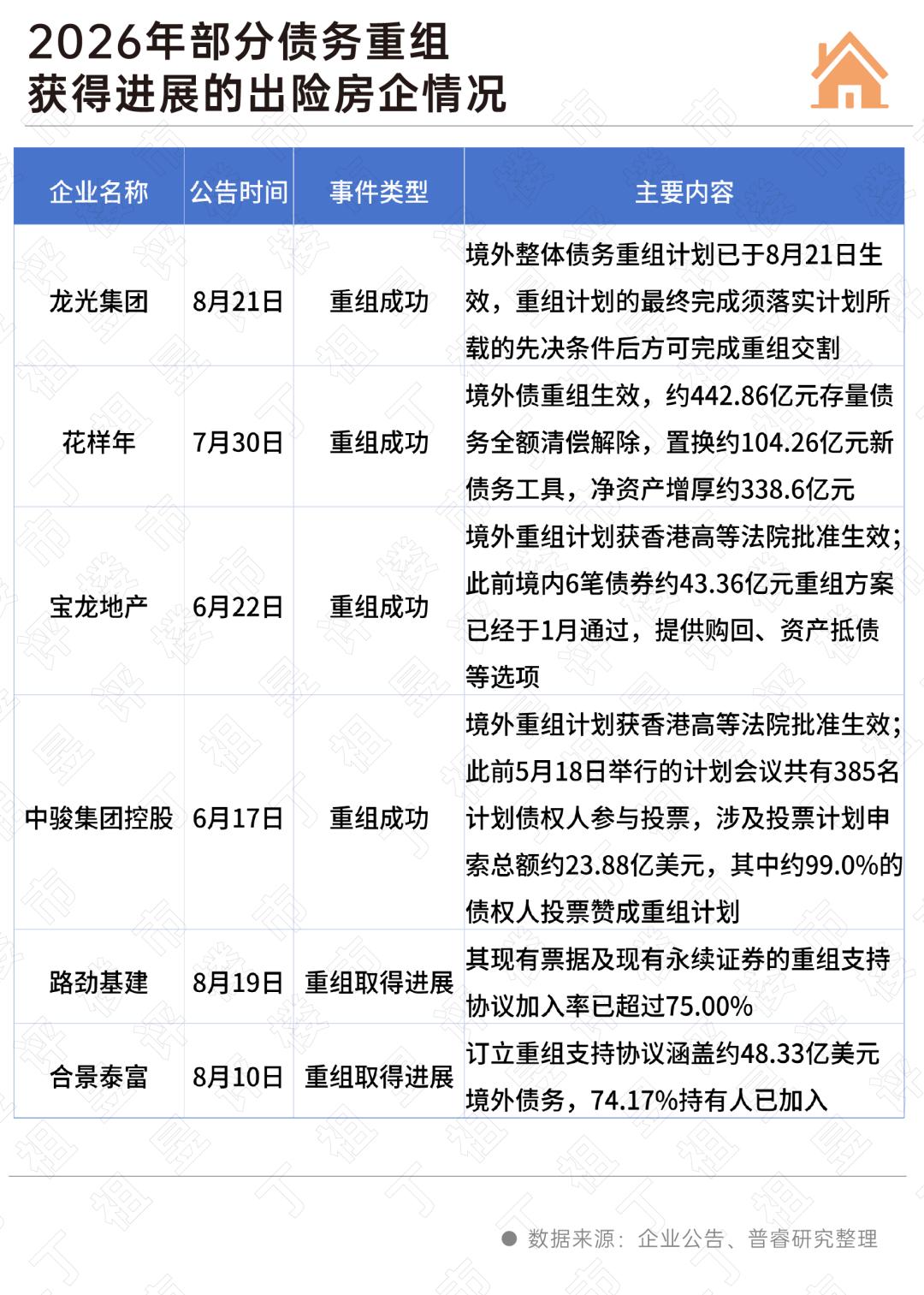
On August 21, Logan Group issued an announcement stating that its overall overseas debt restructuring plan has taken effect. After the completion of both domestic and overseas restructuring, the enterprise will continue to make efforts to stabilize operation and ensure housing delivery.
Logan is not the first troubled real estate enterprise that successfully passed the restructuring checkpoint this year.
On July 30, the overseas debt restructuring of Fantasia Holdings was officially implemented and took effect. Fantasia's "self-rescue" has almost run through the entire timeline of the industry's debt restructuring. Since it defaulted on a US$205 million note in October 2021, Fantasia has embarked on a long and tortuous self-rescue journey. After five years, the restructuring of overseas debts of about US$4.018 billion has finally gone through all legal procedures.
In late June before that, the overseas debt restructuring of Powerlong Real Estate was implemented, and the restructuring plans for 6 domestic bonds totaling about RMB 4.336 billion were also approved at the beginning of the year.
Earlier on June 17, China SCE Group Holdings issued an announcement that its overseas debt restructuring plan has been approved by the High Court of Hong Kong, and the restructuring of US$2.388 billion in overseas debts officially took effect. The creditor voting approval rate was as high as 99%, far exceeding the legal standard.
One enterprise after another successfully passed the restructuring checkpoint, which gave the market a shot in the arm, indicating that creditors and the judicial system no longer take a wait-and-see attitude towards the restructuring of troubled real estate enterprises. More troubled real estate enterprises will follow the same path to complete restructuring and regain the opportunity for normal operation in the future.
In addition, the overseas debt restructuring agreements of enterprises such as Road King, KWG Group Holdings have basically received high approval rates from creditors, and the debt restructuring is sprinting towards the "finish line".
On August 19, Road King issued an announcement that holders of more than 75% of the total principal of the existing notes and existing perpetual securities have joined the restructuring support agreement. This marks an important milestone in the successful advancement and implementation of the restructuring.
Earlier on August 10, KWG Group Holdings disclosed that holders accounting for about 74.17% of the total principal of the corresponding debts have joined or agreed to join the restructuring support agreement, which is only one step away from the court approval threshold. This restructuring covers its overseas debts of about US$4.833 billion.
Behind the accelerated implementation of this round of debt restructuring is a key signal: After several years of stalemate, creditors' confidence is recovering, and they no longer tend to continue to delay. "Making mutual concessions for certainty" has become the common choice of both parties.
02
A "successful" restructuring only settles old debts. A clean balance sheet does not mean the recovery of cash flow. After the restructuring is implemented, whether the enterprise can truly stand firm is a greater test.
Take Fantasia as an example. Although its overseas debt restructuring is successful, it still faces RMB 13.99 billion of matured and unpaid domestic debts as of June 5, and its contracted sales in 2025 was only RMB 788 million, so the operating pressure remains high.
The overall overseas debt restructuring plan of Logan Group has been implemented, but as of July 31, 2026, the total amount of debts it failed to repay as scheduled reached RMB 41.6 billion.
In addition, some real estate enterprises with successful restructuring are also facing the situation of "second default".
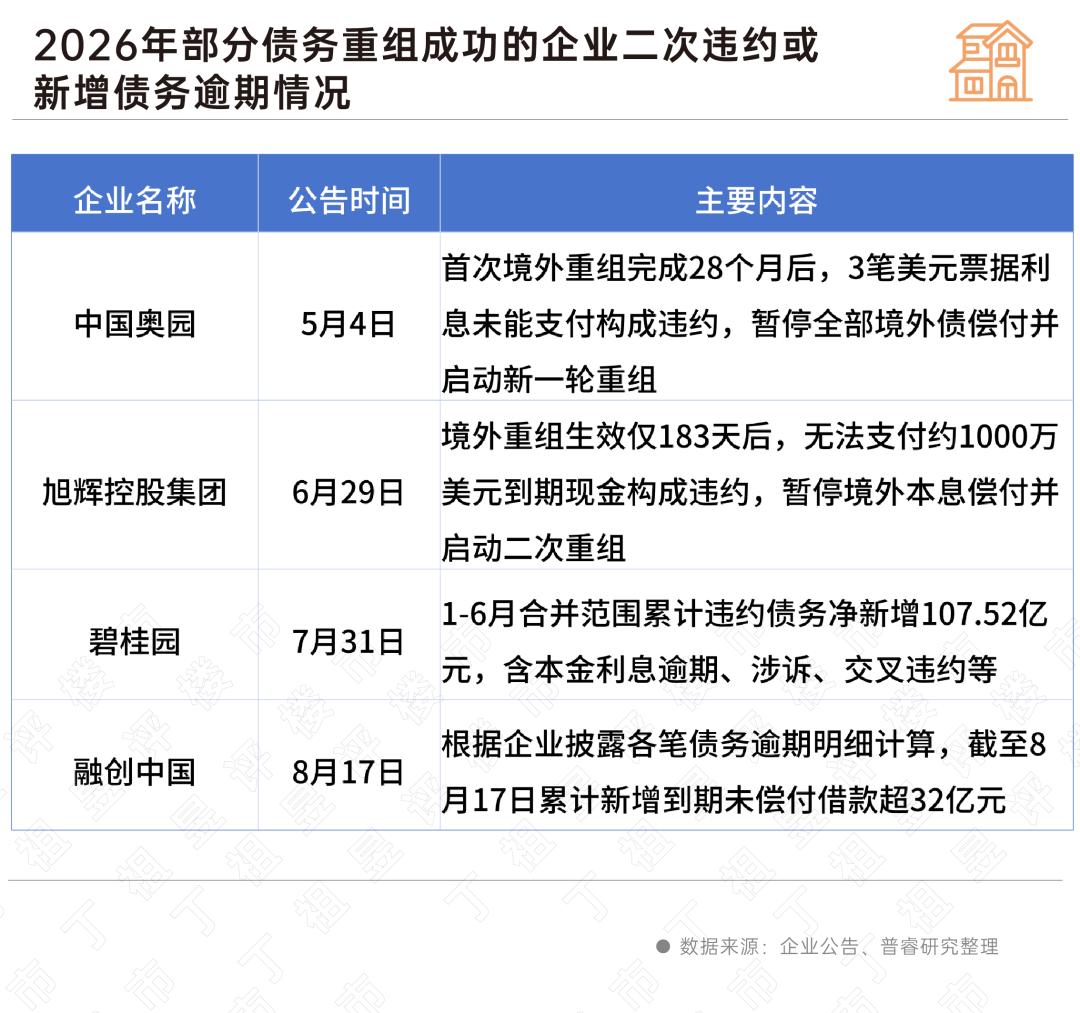
A typical example is China Aoyuan Group. After the completion of its first overseas restructuring in March 2024, the enterprise announced in May 2026 that it failed to pay the maturing interest of three US dollar senior notes, which constituted a default and triggered a cross-default, leading to the full suspension of overseas debt repayment, while launching a new round of restructuring.
In addition, new debts of some other enterprises are still being generated continuously. Country Garden is a typical case. From January to June, the cumulative net increase of default debts within its consolidated scope reached RMB 10.752 billion, with overdue principal and interest, litigation, and cross-default intertwined.
The frequent occurrence of second defaults and new overdue debts after successful restructuring essentially lies in the fact that several preconditions on which the restructuring plan is based have not been fulfilled in the subsequent operating environment. In other words, restructuring only delays debt repayment rather than creating a hematopoietic capacity, and the fundamental of the success of debt resolution lies in the substantial recovery of operation.
From the perspective of the complete chain of debt resolution, the key link of transition from debt reduction to operational hematopoiesis is still missing at present.
First, the stabilization of the sales end is the common premise of the repayment arrangements of all restructuring plans. If the market fails to recover, the reduced debts are only delayed rather than digested.
Second, troubled real estate enterprises generally hold stock assets but cannot clear them at a reasonable price. After the debt resolution enters the second half, it is urgent to form a market environment that supports the clearance of stock assets at a discount.
Third, the scattered game of domestic creditors leads to low disposal efficiency. It is necessary for the debt resolution mechanism to gradually upgrade from case-by-case negotiation to an industry clearance arrangement with unified rules.
The accelerated implementation of real estate enterprise debt restructuring in 2026 sends a positive signal. In addition, the maturing debt pressure within the year has also weakened, coupled with a series of policy guidance, the environmental support for real estate enterprises to return to the normal operation track is more solid, and the most difficult time of the industry has passed.
Successful debt restructuring is not a once-and-for-all solution. To avoid the occurrence of situations such as second defaults, troubled real estate enterprises still need to achieve substantial recovery at the operational level. The recovery of sales proceeds and asset liquidity determines whether troubled real estate enterprises can shift from phased debt relief to sustainable operation, and it is also the key to measuring the effectiveness of this round of real estate industry risk resolution.
This article is from the WeChat official account "Ding Zuyu Reviews Real Estate Market", written by the Editorial Department and Pury Research, and authorized for release by 36Kr.