The world's first Level 5 AI engineer has arrived, and the chip design industry has entered the autonomous era.
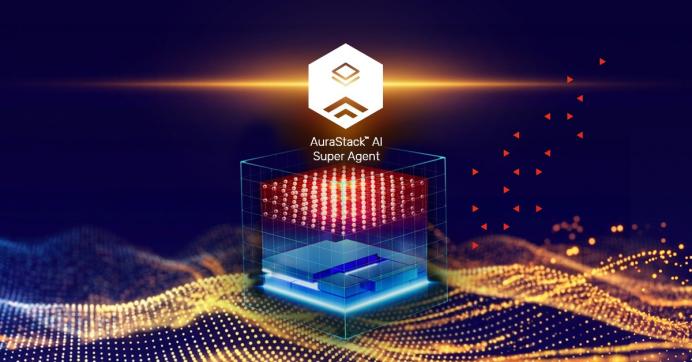
At Computex 2026, Cadence unveiled the world's first Level 5 (fully autonomous) virtual chip engineer, and announced that its ChipStack AI Super Agent has officially entered the fully autonomous phase. This is not just a product innovation, but also points out a new direction for the exploration of AI autonomous engineering in industrial software.
01 What does the "Level 5" AI engineer mean?
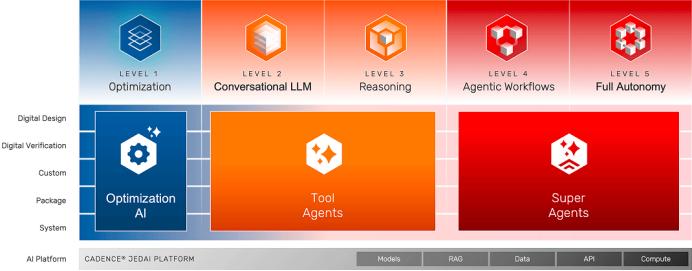
At present, Agentic AI in the engineering field is evolving from concept to reality at an unprecedented speed. The previously scattered AI-assisted workflows are rapidly developing into autonomous systems capable of reasoning, planning and executing complex engineering tasks.
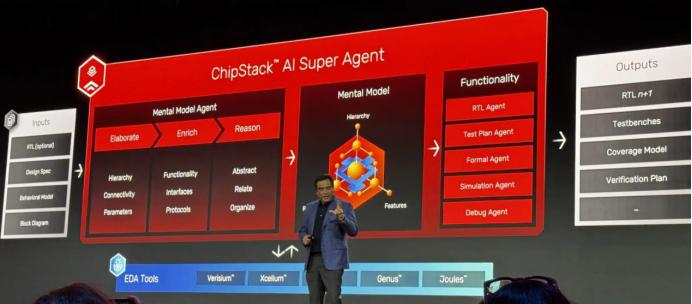
In the past, AI played an auxiliary role, helping engineers generate code, optimize parameters, organize documents and more. With Level 5 autonomy, it can independently complete the entire engineering process from design specifications to verification closed-loop with minimal human intervention, including understanding design specifications, generating and optimizing RTL, building testbenches, formulating verification plans, performing formal verification and simulation, as well as completing defect localization and debugging.
Of course, the "autonomous era" does not mean that engineers will be replaced. Engineers still hold the final control right, can observe, guide and intervene in the whole process at any time, and complete the final sign-off. Under this division of labor, AI is responsible for performing heavy and repetitive tasks, while engineers are in charge of supervision, decision-making and final confirmation.
02 The real breakthrough lies in autonomous reasoning
Many people regard Level 5 as a higher degree of automation, but Cadence explains that: there is an essential difference between the two.
The automation of traditional EDA only executes pre-set processes, and tools complete established tasks according to fixed rules. The biggest difference of an autonomous system is that besides executing processes, it can reason across the entire engineering workflow, continuously evaluate the design status, independently determine the next task, continuously adjust strategies, solve problems and carry out iterations based on intermediate results, and finally achieve design results that meet sign-off requirements.
In short, its core lies in autonomous thinking and dynamic decision-making, and coordinating the most appropriate tool capabilities according to different engineering environments to complete tasks. To achieve this capability, Cadence does not make AI run independently from EDA tools, but deeply integrates AI reasoning capabilities with mature physical engineering engines.
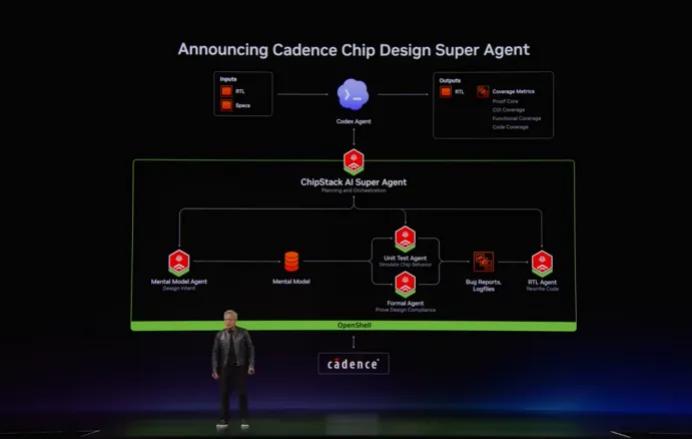
Cadence believes that every decision made by AI is based on mature design and verification tools, which ensures that the generated results are both fast and accurate. At the same time, ChipStack AI Super Agent runs in the NVIDIA OpenShell secure sandbox environment, and provides security guarantees for enterprises to deploy autonomous engineering systems through policy constraints, behavior auditing and intellectual property protection mechanisms.
03 Why does chip design take the lead in entering Level 5?
Nowadays, advanced chips often contain trillions of transistors, which require 3D circuits to work together at the micro scale. Every logic gate and every connection must maintain precise synchronization at the picosecond level, leaving almost no room for error. Therefore, a large number of R&D work can only be completed by digital design and verification.
Take NVIDIA as an example. It needs thousands of engineers to run millions of simulations and formal verifications every year, consuming billions of computing hours, and a single design cycle lasts for several weeks. That is why NVIDIA cooperated with Cadence to develop the ChipStack AI Super Agent.
Based on this platform, engineers only need to give simple instructions, and the system will automatically start the complete RTL verification closed-loop, independently call multiple professional Agents in a secure environment to complete RTL generation, testbench creation, regression testing, formal verification, simulation analysis and bug fixing, without the need for engineers to manually switch between tools repeatedly throughout the process.
According to official materials, with the help of mature verification engines such as Xcelium Logic Simulator and Jasper Formal Verification, ChipStack AI Super Agent can schedule hundreds of dynamic simulation tasks at the same time and continuously optimize verification strategies. According to its public data, the efficiency of testing and verification can be increased by more than 40 times, and the verification process that originally took five weeks to complete now takes less than one day.
04 Level 5 may just be the starting point
Looking at Cadence's AI evolution path, it can reflect the development trend of the entire EDA industry.
In 2021, Cadence launched products such as Cerebrus, using machine learning to help engineers explore the design space and optimize engineering decisions. After acquiring ChipStack in 2025, it began to have the ability to perform specific engineering tasks. Since the beginning of this year, Cadence has successively launched AI Super Agents including ViraStack, InnoStack and AgentStack, extending AI to analog design, digital implementation and cross-process collaboration.
At the same time, Cadence is also expanding Agentic AI from chip design and verification to packaging, PCB and system-level design through acquisitions and other means, to realize an AI intelligent system covering the complete electronic design process.
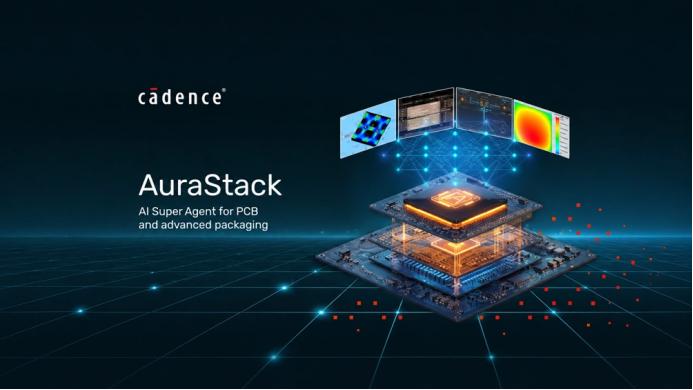
Nowadays, as ChipStack enters Level 5, the industry has begun to enter the full stage of independently completing chip design and verification. To this end, Cadence emphasizes that the goal of this revolution is not to replace human beings, but to shift the core value of human beings to defining objectives and boundaries, reviewing and verifying results, and making decisions with professional judgment. Engineers will also devote more energy to these high-value tasks, form complementary advantages with AI, so as to more effectively improve innovation capabilities and overall work efficiency.
For the entire industrial software industry, what is really worth noting is that for the first time, the "AI engineer" has been pushed to Level 5. From assisted engineering to autonomous engineering, the role of AI in EDA has undergone fundamental changes. It not only brings improved capabilities, but also promotes the formation of a new collaboration mode between engineers and AI.
This article is from the WeChat official account "Kun Shao Says", written by Kun Shao, and authorized for release by 36Kr.