WRC Closing Review: How to Watch the World Robot Conference Like an Insider? | On-site Notes

"Workplace Bonus" (ID: ZhiChangHongLi)
Written by / Chen Tong Art Editor / Chen Tong
Visit the exhibition by scenario: Who is delivering real results, who is just putting on a show? · 01
Review of embarrassing incidents & anti-scam guide for exhibition visitors · 02
The hidden undercurrent off the WRC venue · 03
Quick reference for key companies at WRC 2026 · Appendix
What does this year's WRC look like in the eyes of a "veteran visitor" who has attended the exhibition for 10 consecutive years?
"I basically know all the companies here, and I mainly come to meet old friends." At the 2026 WRC site, *Workplace Bonus* met a senior industry practitioner nicknamed "Old C". This is his 10th year attending the event, and he has even changed jobs several times during this period. In his eyes, WRC rarely has moments that surprise frontline practitioners, but it is the window with the highest information density for the general public and people who follow industry trends.
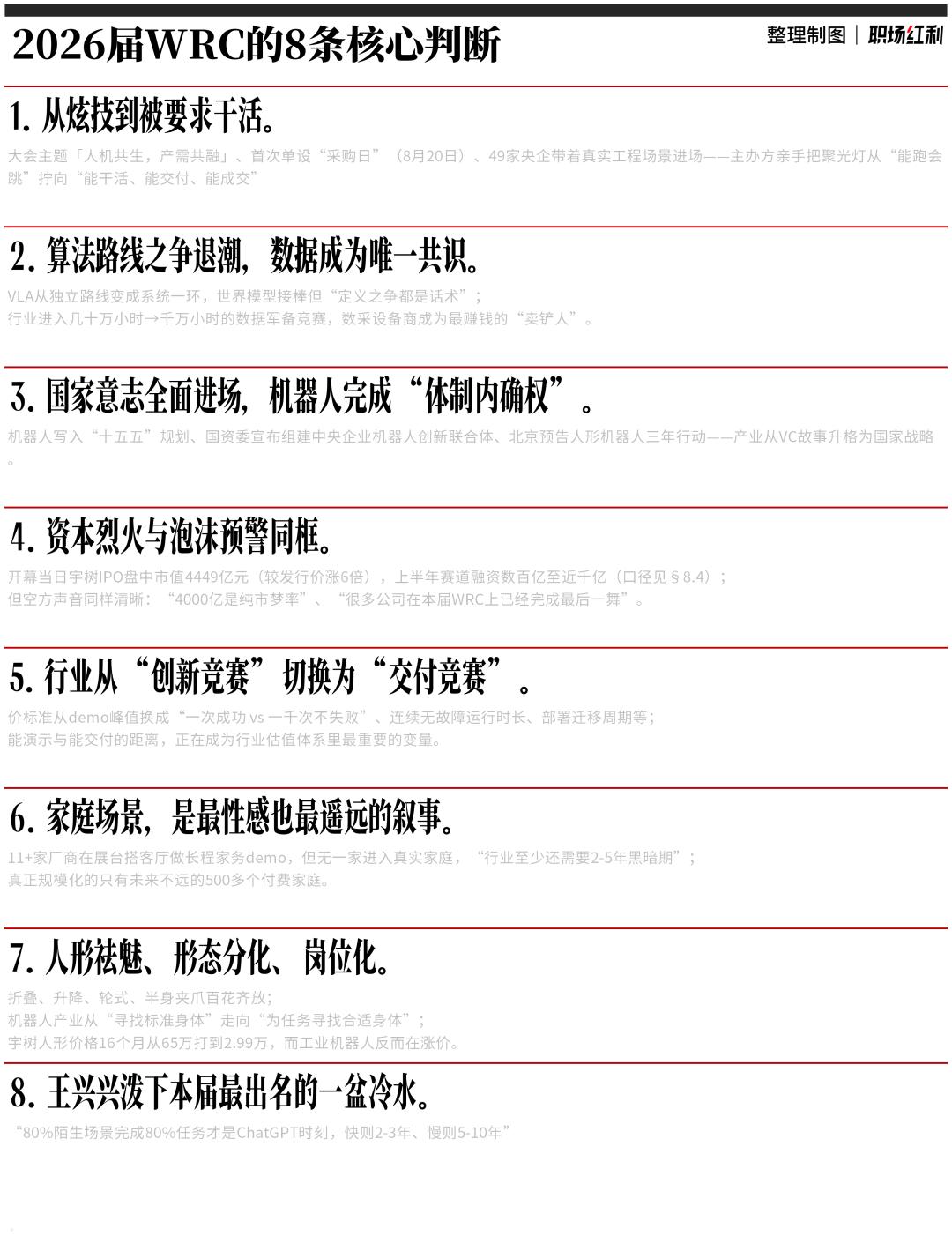
This year, the organizer has set up a dedicated Procurement Day, with dozens of central state-owned enterprises entering the venue with real scenario checklists for acceptance. More company executives and engineers can be seen gathering in the exhibition halls. The buzzwords have been replaced with "Physical AI" and "World Model" — the most widely discussed topics at this time last year were still "VLA End-to-End" and "The ultimate route for robot brains". The debate over algorithm routes is fading, because without hundreds of thousands of hours of real data, "all models are nothing but empty talk".
For the household scenario that is often used to "paint a rosy picture" for the market now, you can always catch a glimpse of the real situation from the details: many manufacturers have built demo booths, but judging from the turtle speed of robots folding clothes and the overloaded network in Hall C that is crowded with demonstration displays, it is still very difficult to deliver products to residential buildings this year.
The To-B and industrial scenarios, by contrast, are more verifiable. Zibianliang and Star Era have achieved an efficiency of over 1,000 pieces per hour in the logistics sorting sector; Yunshenchu's quadruped robots have entered more than 100 substations, with the average mean time between failures exceeding 1,000 hours; Galaxy Universal's smart retail and urban service capsules have set up points in more than 40 cities across the country.
Old C's impression is that the industry seems to be shifting from emphasizing "innovation" to emphasizing "delivery". It is hard to tell whether this is a good thing or not. You can interpret it as the industry is trending back to rationality, "Under the bubble, the inspectors have already arrived." The product deployment cycle, continuous operation time, efficiency improvement, repurchase rate and return rate are being asked over and over again. Will anyone still cheer for a perfect demo performance?
This weekend is the public open day of WRC, with tickets starting at 60 yuan and the largest number of visitors. For readers of *Workplace Bonus*, it is obvious that performances like robot dancing, fighting, lion dancing and robot bands are not the focus (unless you bring children to visit). After exploring the exhibition, we have sorted out some information about dynamic changes and true/false identification. No matter whether you come to the exhibition this time or not, you can get a glimpse of the key information of this WRC through this note.
"Workplace Bonus" (ID: ZhiChangHongLi)

"Workplace Bonus" (ID: ZhiChangHongLi)
[Visit the exhibition by scenario: Who is delivering real results, who is just putting on a show?]
"A demonstration only needs to succeed once, but delivery requires a thousand times of no failure." This is what Yunshenchu, which focuses on power inspection robots, said.
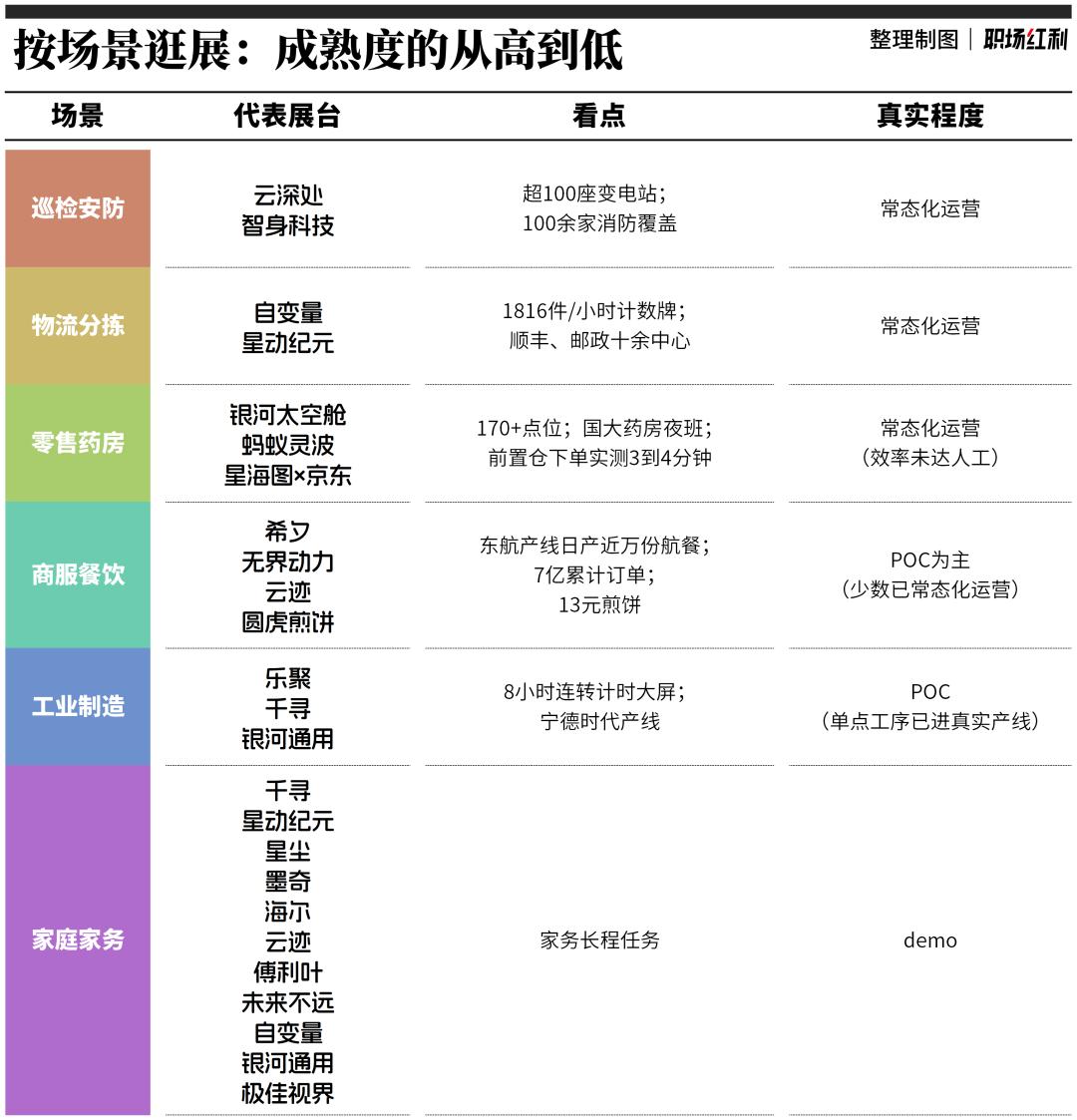
First of all, we divide the current commercial implementation of robots into three tiers.
① Normalized operation, running continuously at the real customer site;
② POC pilot, deployed in real scenarios but not yet scaled up;
③ Pure demo, only performed on the exhibition booth.
"Workplace Bonus" (ID: ZhiChangHongLi)
● Inspection and security: High delivery maturity
The Jueying quadruped robot from Yunshenchu has entered more than 100 substations of State Grid and China Southern Power Grid, with an overall recognition accuracy of 96.5%, and the average mean time between failures exceeds 1000 hours. It has entered the IPO acceptance and review process of the stock exchange. There is another security-focused line in the same track: as of June this year, Zhishen Technology has cumulatively mass-produced more than 15,000 embodied robots, thousands of quadrupeds are deployed on the front line of security, and its emergency products cover more than 100 fire brigades, detachments and units.
● Logistics sorting: The most crowded track of this exhibition
In addition to inspection, this is also the track with more solid evidence of "real delivery" across the venue, with nearly ten companies participating on the same stage (see the table for details).
Among them, Zibianliang's dual robotic arms equipped with standard grippers can sort 1816 pieces per hour, with an accuracy rate of over 98%. Many media reports compare it with the publicly disclosed average performance of Figure AI in the United States (1248 pieces per hour). In fact, the two companies work in their respective scenarios and use their own timing methods, with different task settings, which is not the same competition. It can only be used as a speed reference, and it cannot be directly said who is leading who. Moreover, the source of both figures is the actual measurement of the manufacturer, and there is no third-party recheck. The company said that their products have been running in a normalized way on the real production line of a global leading logistics enterprise.
Star Era is the first enterprise in the industry to complete PMF verification for logistics solutions. It has cooperated with SF Express and China Post to operate in a normalized way in more than ten logistics centers across the country; the on-site efficiency reaches 1200 pieces per hour, and the company said the internal limit test reaches 2000 pieces, and the deployment and migration time has been reduced from about two months to less than one week.
● Industrial manufacturing: Compared with the single machine accuracy, the continuous operation time deserves more attention
There is still a gap between normalized operation and large-scale deployment. At present, companies including Figure, Tesla and Apptronik can complete concept verification, but few of them can achieve large-scale deployment.
The Kuafu 5W robot from Leju Robot can currently work continuously for 8-10 hours at three stations: carton depalletizing, material box handling, and small part feeding, without remote control or engineer on-site support. Its carton and plastic box depalletizing solutions have been applied to real warehouses and automotive production lines respectively. The Moz1 robot from Qianxun Intelligence has been deployed on the battery PACK production line of CATL to complete the plugging of high-voltage test connectors, and the company said its single-day workload is 3 times that of skilled workers. The Galbot S1 dual-arm robot from Galaxy Universal has a load of 50kg, which is also used to carry heavy materials on the CATL production line.
But the efficiency bottleneck has not been broken yet. In the simulated automobile factory, the humanoid robot takes about 90 seconds to move a box for 20 meters, and its efficiency is about 30% of that of humans; in the bearing factory, it takes 70 seconds for the robot to pick up a bearing, while a human only needs 2 seconds — even if the speed is increased tenfold, it still cannot meet the access standard of factories.
● Retail and pharmacy: Highlights of this exhibition
The "capsule" of Galaxy Universal has set up more than 170 points in over 40 cities across the country. Its smart pharmacy has deployed more than 170 instant retail warehouses in over 40 cities. The drug sorting robot of Ant Lingbo has been put into use at Shanghai Guoda Pharmacy, working the night shift.
The front warehouse of Xinghaitu and JD claims to be the world's first one that supports online order placing. Its display board marks four indicators: 100% full-process autonomy, 99%+ order execution success rate, tens of thousands of SKUs, 100 orders every 8 hours. A media reporter placed an order for two bottles of Pulse on the spot for actual test: the robot failed to put the bottle on the counter for the first time, and adjusted itself several times before succeeding. The whole process took about 3 to 4 minutes. It took two and a half minutes to pack the bottles into a bag, and occasionally the staff needed to give a hand. The packaging bag is suspected to be "specially made": harder and thicker than the ordinary packaging bag used in daily life.
● Commercial catering services: Finally achieved stable operation
The solution of Xixi Intelligence has been applied to the production line of China Eastern Airlines Catering, producing nearly 10,000 airline meals per day. The robot coffee space jointly built by Wujie Power and South Korea's HOLLYS Coffee, the K15 model can continuously complete tasks including food delivery, table cleaning, garbage collection and seat reset in the open customer area, with a cumulative order value of about 700 million yuan (note: this is the order value, not the revenue).
Visitors who want to taste the food can go to the robot consumption street. The Jianbing pancake from Yuanhu costs 13 yuan for one egg and 15 yuan for two eggs, and it takes an average of two to three minutes to make one. The noodle cooking robot from Yunji claims to have withstood the real morning peak test, and you can also queue up to try it.
● Household chores: The most attractive narrative, the biggest gap
Some industry insiders believe that the industry bubble of robots will not burst until robots enter ordinary households.
At this exhibition, at least 11 manufacturers have built living room scenarios on their booths: Qianxun, Star Era, Xingchen, Moqi, Haier, Yunji, Fourier, Weilai Buyuan, Zibianliang, Galaxy Universal and Jiajing Vision. Almost all of them are pure demos, and a single task generally takes 10 to 15 minutes. Industry insiders judge that there will be at least 2 to 5 years of "dark period" before robots can enter households.
Among them, Zibianliang said that it cooperated with 58 Home Services at the beginning of this year to provide robot home housekeeping services; Moqi's KINO has completed a 15-minute full long-distance housework task: cleaning the tabletop, checking the refrigerator inventory, replenishing water, drying clothes and folding clothes, and autonomously scheduling to "dry the wet clothes first and then fold the dry ones", with no human command in the whole process, but it has not entered real households yet; Weilai Buyuan said it has provided services for more than 50,000 hours and entered more than 500 paying households. Its F2 model can autonomously make bolognese pasta on site (according to the 90% success rate of each step, after multiplying the success rate of 7 steps, the overall success rate is less than half — the so-called long-distance task is exactly difficult in this law of multiplicative attenuation).

"Workplace Bonus" (ID: ZhiChangHongLi)
[Review of embarrassing incidents & anti-scam guide for exhibition visitors]
The household scenario is just the beginning of the loopholes exposed. As for the embarrassing incidents that the audience loves to see most, there are roughly three categories in summary:
The first category, accidents and failures. The remote control equipment of Zhishen Technology broke down in public, and several attempts failed. The host had finished all his lines but the equipment still did not recover. For another example, the retail robot of Galaxy Universal was stuck on the spot by a box of "Tongrentang Liuwei Dihuang Pills" from the exhibition explorer of Tech Planet. When a customer buys two units of the same product, the robot cannot take both at one time and has to make two trips.
The second category, extreme slowness. A robot failed to grab a pen for five consecutive times. A pharmacy robot takes 1 to 2 minutes to pick up a bottle of drink. Some housework robots move at a speed similar to a 0.5x speed movie shot.
The third category, suspected cheating and conditional restrictions. A manufacturer demonstrated the "embodied weaver" threading a needle on the Qixi Festival. A close look found that there was glue on the tip of the thread. The blogger @Fengge Wangming Tianya did a balance test with the mountain climbing robot on the booth. Finally, he ignored the staff's warning and kicked the robot to the ground, which "twitched" after the violent impact.
Apart from the embarrassing incidents, the pricing side is even more opaque. An investor at the scene said that when he heard any quotation during the exhibition tour, his first reaction was "Is this the actual selling price, or just a story?" You can see that the full set of massage robots from Luoshi costs about 120,000 yuan, with middle-aged and elderly people queuing up in long lines to experience it. "Our own cost is only 30,000 yuan." A massage robot of a certain brand leaked the secret to the solution provider. On the other hand, the Unitree R1 has been priced at 29,900 yuan and above — this price has dropped from 650,000 yuan in 16 months, with a decline of over 95%. The new consumer product T1 from Xingchen Intelligent starts at 89,900 yuan, and the bionic robot of Songyan Power which was the same model used in the Spring Festival Gala is priced from 99,000 yuan to over 130,000 yuan.