Embodied Intelligence 2026: Farewell to Narrative Hype, Practical Deployment Reigns Supreme
The World Robot Conference held in Yizhuang, Beijing is growing more popular year by year.
Judging from the on-site situation, UBTECH, known as the "first public stock of humanoid robots", still stays at the forefront of the industry. This year, it brought demonstrations of applications in three major scenarios: industrial, commercial, and household consumption. The commercial service humanoid robot Walker C1 undertakes guest reception, hosting and explanation, performance interaction, and teaching work, while the super-realistic humanoid robot U1 provides emotional value. Nearly 10 industrial humanoid robots including Cruzr Y1 and Cruzr S2 form a miniature robot factory, which completes real-world operations such as carrying boxes, depalletizing and stacking, loading and unloading auto parts, and sorting small express parcels throughout the process...
Further in-depth research shows that behind this is the full-stack self-developed technology system of "Foundation Model — World Model — Action Model" built by UBTECH, with the same embodied intelligence base supporting the three major scenarios at the same time.
Coupled with numerous landing cases and cooperation cases highlighted at the booth, this is likely one of the very few booths at this year's World Robot Conference that can fully present a complete closed loop of technology, products, scenarios, and delivery.
"In the past, people might have preferred to make the stories more attractive and sensational. But starting from this year, what matters are real orders, deliveries, and data," JIAO Jichao, Vice President of UBTECH and Dean of Embodied Intelligence and Humanoid Robot Research Institute, told 36Kr.
In 2026, as embodied intelligence kicks off its first year of marketization, UBTECH, a 14-year-old enterprise with verified market orders and full-stack technologies, is also one of the few players that can translate "technological leadership" into "industrial leadership" at the earliest stage.
Industry, Commerce, Household Consumption: Three Scenarios, Progressing Gradually and Interconnected Closely
2026 is widely recognized by the whole industry as the first year for large-scale implementation of embodied intelligence. At present, the biggest bottleneck of the industry is shifting from "whether there is a qualified robot body or a usable model" to "whether there are high-value landing scenarios".
Specifically for UBTECH, it has placed its bets on the three major scenarios of industry, commerce, and household consumption.
The first is the industrial scenario. Industries such as manufacturing, automotive, 3C, and logistics are highly standardized with clear processes and repetitive tasks. The value created by robots can be directly calculated through efficiency, stability, labor cost, and return on investment, making it the easiest starting point for the embodied intelligence industry to form a commercial closed loop at the current stage.
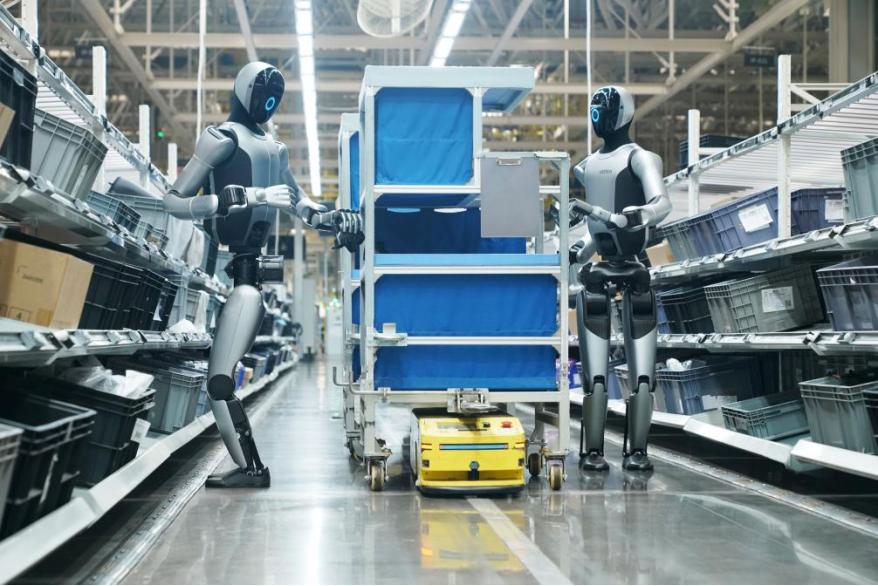
Walker S2 performs collaborative sorting in a real factory scenario
As early as around 2024, UBTECH has started to deploy its self-developed Walker S series humanoid robots in factories, covering many industrial fields such as automobile manufacturing, 3C manufacturing, smart logistics, semiconductor manufacturing, aviation manufacturing, and industrial data collection, which forms the core cornerstone for the implementation of UBTECH's embodied intelligence technology.
According to UBTECH's 2025 annual performance report, the company's total annual revenue exceeded 2 billion yuan, and the full-size embodied intelligence humanoid robots (non-remote-controlled and non-toy products with a height of more than 160cm) designed for factory scenarios generated a revenue of 820 million yuan with sales volume of 1079 units, ranking first in the world. This milestone is widely regarded by the market as the key node for embodied intelligence to move from "proof of concept" to "real large-scale implementation".
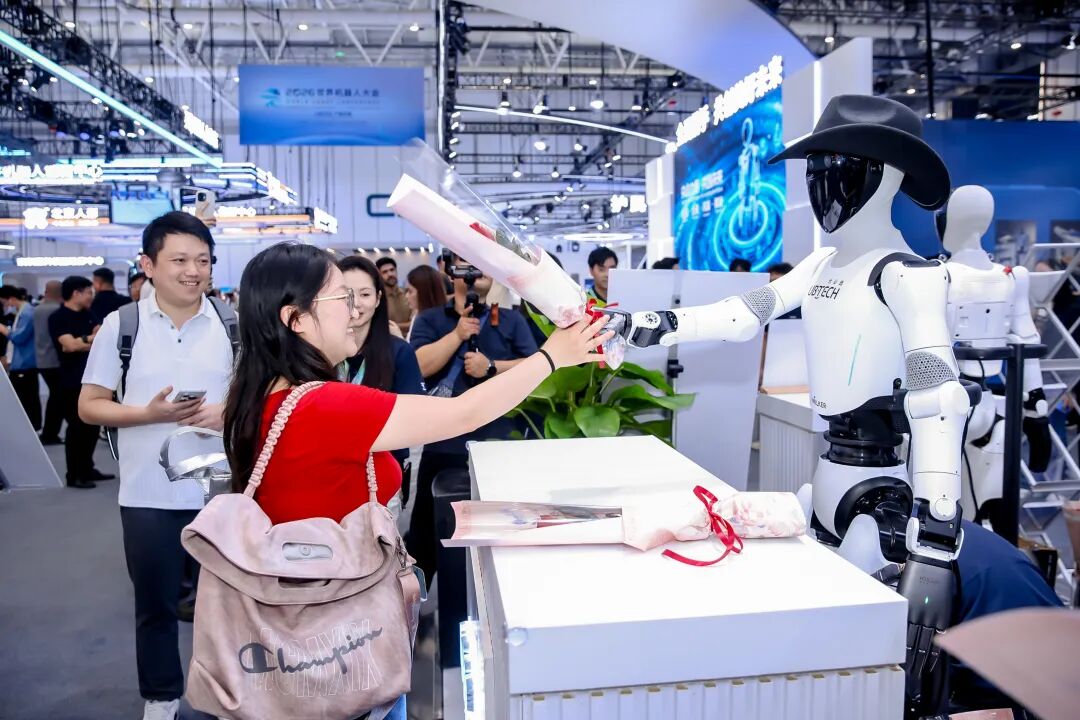
The second is commercial service scenario. Factories require robots to "do things correctly", while commercial scenarios require robots to further learn to "understand people, serve people, and interact and collaborate with people".
In this context, the newly released full-size commercial service humanoid robot Walker C1 of UBTECH is equipped with capabilities including navigation, inquiry, language understanding, whole-body coordination, and multi-modal interaction, which enables humanoid robots to have the core capabilities for landing in fields such as supermarkets, exhibition halls, scientific research, and basic education.
In addition, UBTECH also premiered the Walker C1 EDU Tutor for basic education scenarios at this World Robot Conference. Equipped with the UIRO intelligent teaching assistant system, it can independently complete teaching tasks such as autonomous lecturing, problem shooting and explanation, intelligent Q&A, and multi-modal classroom interaction, targeting the intelligent upgrading of the basic education industry.

The household consumption scenario is the most special one, and the super-realistic humanoid robot is also the most viral product of UBTECH this year.
In June this year, at UBTECH's annual global launch event, the company officially released the U1 super-realistic humanoid robot series, including three configurations: the half-body version U1 Lite, the high-end full-body version U1 Pro, and the high-dynamic full-body version U1 Ultra. U1 Lite and U1 Pro were exhibited at the WRC site with prices of 119,800 yuan and 169,800 yuan respectively, while U1 Ultra is positioned for commercial scenarios.
This is almost the first time in the industry that a well-known robot enterprise breaks away from the thinking of "pursuing practical functions" and "involving in low-price competition", takes the initiative to enter the emotional companionship track, and launches a consumer-grade humanoid robot product that users can actually purchase.
This series of super-realistic humanoid robots is equipped with a 33-axis facial tendon network, which can realize more than 30 composite micro-expressions with an emotion recognition accuracy of over 90%. It is also equipped with UBTECH's self-developed Resonance-LM emotional large model, which can identify more than 20 fine-grained emotions. Instead of focusing on tool attributes, the product is designed to truly bring robots into families and daily life.
The three scenarios of industry, commerce, and household consumption progress gradually and are closely interconnected.
The industrial scenario not only has the clearest demand and the highest implementation certainty, but also serves as an indispensable technical reserve for robots to perceive the physical world and understand the real world. It is equivalent to obtaining customers, revenue, and a real-world entrance that continuously generates training data at the same time, and then gradually spills over the software and hardware capabilities such as robot body, supply chain, and embodied intelligence model to commercial and household scenarios.
The three major scenarios have already allowed UBTECH to seize the positions in all three major markets that humanoid robots are expected to enter. The uniqueness of UBTECH lies in that it not only occupies the industrial scenario that generates revenue at the earliest stage, but also makes early bets on the two larger long-term markets of commercial services and household consumption, owning a rare cross-cycle scenario portfolio.
Full-stack Self-developed Embodied Intelligence Technology Enables Full-scenario Implementation of Humanoid Robots
"Many companies working on embodied intelligence large models often assemble an off-the-shelf robot body to run the model, but this cannot maximize the hardware efficiency. As a robot body manufacturer, we define the capabilities from the very beginning of product design, and then combine with algorithms to achieve deep integration of software and hardware," JIAO Jichao told 36Kr.
He gave an example: without deep adaptation of software and hardware, the hardware efficiency of an ordinary embodied intelligence large model that "runs" can only reach 60%-70%, which is undoubtedly a huge waste in the era of scarce computing power.
This is also why in the field of basic technology, UBTECH has chosen the most difficult path — full-stack technology layout.
At present, UBTECH has built a complete full-stack robot technology system covering servo drives, joints, motion control, body control, operating system, world model, and "brain/cerebellum". By the end of 2025, UBTECH owned 2985 authorized patents, including 1742 invention patents and 508 overseas authorized patents, and it has taken the lead in formulating 8 national standards for humanoid robots.
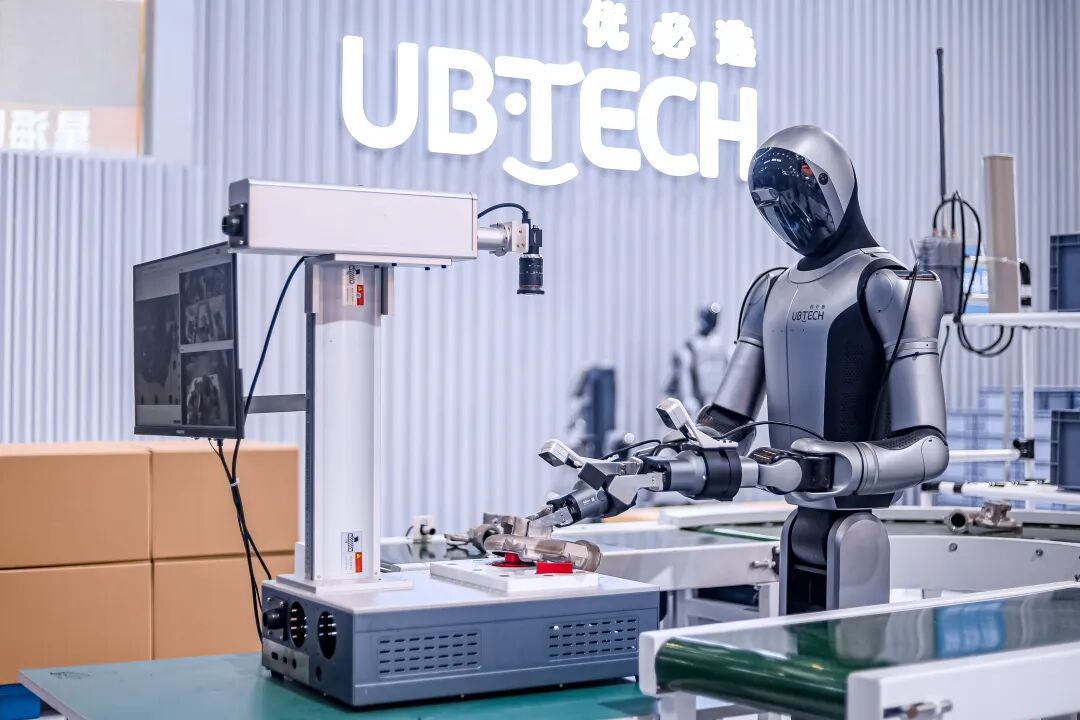
Especially in the field of embodied intelligence large models that has attracted the most attention at present, UBTECH has built a complete model system of "Foundation Model — World Model — Action Model". Its self-developed large foundation model Thinker breaks through the industry's technical bottleneck with the features of "small parameters, high performance, and full open source"; its Thinker-WM world model ranks first in the authoritative embodied intelligence evaluation benchmark Libero, and the Thinker-VLA model can increase the reasoning efficiency by 176% in industrial scenarios, endowing robots with multi-dimensional interaction capabilities such as dialogue, inquiry, expression, eye contact, and memory in commercial and household environments.
The current embodied intelligence industry is gradually shifting from competition of "single-point capability" to competition of "system capability".
Different from large language models that highly rely on software performance, for robots in the real physical world, any short board in the brain, body, motion control, sensors, computing power, battery, data, and manufacturing may directly lead to task failure.
More than ten years of accumulation in robot system technology has made UBTECH significantly different from most of the current embodied intelligence and robot manufacturers. It not only has a powerful motion control system covering joints, robot body, and motion control, but also has cutting-edge research on VLA, Foundation Model, and world model, as well as pioneering exploration such as the U1 Resonanc-LM emotional large model, owning the most comprehensive and system-level "practical and forward-looking" technology stack.
The real value of this powerful full-stack capability is to regard robots as a systematic project, continuously optimize and improve system efficiency, obtain continuous feedback between technology and scenarios, form a technology flywheel, and finally realize the landing of products in various scenarios and integrate into people's daily life.
Embodied Intelligence 2026: Bid Farewell to Empty Stories, Implementation is the Top Priority
In the past few years, the embodied intelligence industry has never lacked empty stories.
Capital, resources, entrepreneurs, and technical talents have poured into the industry rapidly, the performance of robot bodies has been continuously refreshed, and breakthroughs in technologies such as VLA and world model have further raised the market's expectations for general-purpose robots.
However, all technology industries will eventually go through the same process: from verifying "whether the technology is feasible" to verifying "whether the business model is feasible".
In 2026, embodied intelligence is exactly at this critical node.
At this year's World Robot Conference, the industry trend has completely shifted. The dance performances, somersault demonstrations, and stunt shows that can be seen everywhere in exhibition halls in previous years have been greatly reduced, and "getting to work on real tasks" has become the main theme. Most manufacturers no longer prioritize showing off technologies, but directly display application scenarios and compete for the autonomous continuous operation capabilities of robots.
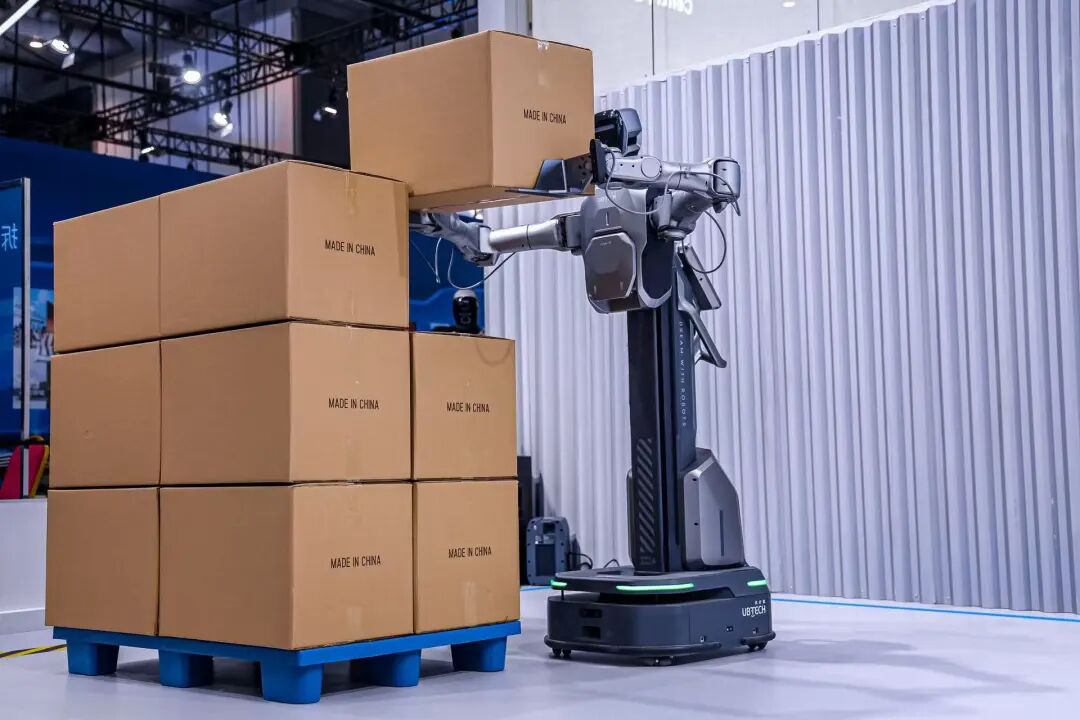
To achieve continuous operation at production line level, the requirements of humanoid robots for hardware and computing power are completely at a different dimension from those of performance robots.
The "dancing robots" focusing on dynamic performance are mostly about 1.2 meters in height, with a lightweight design; their joints adopt planetary reducers to prioritize instantaneous explosive force; they are equipped with low-computing-power chips to run motion control models, and only need to execute pre-programmed motion trajectories. The whole set of movements is preset for playback, without the function of the robot's brain to understand the environment in real time and independently handle unexpected situations.
While the "working robots" for industrial scenarios are about 1.7 meters in height, with multiple sets of visual sensors and force sensors mounted on the body, as well as end effectors such as dexterous hands and grippers; their upper limb joints adopt harmonic reducers with high positioning accuracy, which supports the robot to carry out long-term continuous load and high-frequency force interaction with the environment; the robot's main brain is equipped with NVIDIA Thor high-computing-power chips with more than 250T computing power, running the embodied intelligence large model locally, which can independently complete environment perception, task decomposition, dynamic strategy adjustment, and retry after operation failure, truly realizing autonomous work in the real physical world.
Different scenarios lead to great differences in products from the hardware body, cerebellum to the brain, which cannot be directly reused across scenarios.
UBTECH's choice is very clear: not to pursue the short-lived amazing performance on the stage, but to focus on the application scenarios that can be truly implemented, continuously reduce the cost of the robot body through large-scale manufacturing. At the same time, when robots enter real environments such as factories, commercial spaces, and households, they can continuously generate real-world data, which can be used to train the model in reverse, continuously improve the robot's capabilities, and spill over to other scenarios.
The valuable flywheel of an embodied intelligence company can only start to operate in this way.
When the industry is generally still looking for the Product-Market Fit (PMF) of humanoid robots and debating when they will be applied on a large scale, UBTECH has already taken the lead in operating in the three major application scenarios, starting to solve the problems of production capacity, delivery quality, and large-scale replication, and targeting the competition at the next dimension.
This is also the key to understanding why UBTECH enters the three markets of industry, commerce, and household consumption at the same time: what it is looking for are the three key variables of embodied intelligence in markets at different maturity levels: revenue for today, data for tomorrow, and general capabilities for the day after tomorrow.
There is no doubt that 2026 will be a major watershed for the embodied intelligence industry.
When the industry moves from the technology-intensive period to the stage where technology, manufacturing, and business value are realized simultaneously, the player who can take the lead in translating "technological leadership" into "industrial leadership" will have the opportunity to lead the industry pattern in the next stage.