DeepSeek Harness is here: Is AI starting to create AI?
"The first ultraintelligent machine will be the last invention of humanity."
This quote comes from the 1965 paper "Speculations Concerning the First Ultraintelligent Machine" by mathematician I.J. Good. The implication is that once machines become smarter than humans, they will be able to design even smarter next generations on their own.
The first step of this cycle is to enable machines to start improving themselves, which is the meaning of RSI (Recursive Self-Improvement) that has recently drawn widespread attention in the AI industry.
Simply put, RSI refers to the scenario where AIs participate in building more powerful AIs, and the more powerful AIs in turn accelerate the improvement of the next round of AI, forming a continuous cycle.
After Codex, Claude Code, Kimi and Hy all launched their own Harness, DeepSeek finally released DeepSeek Harness (DSH) last week.
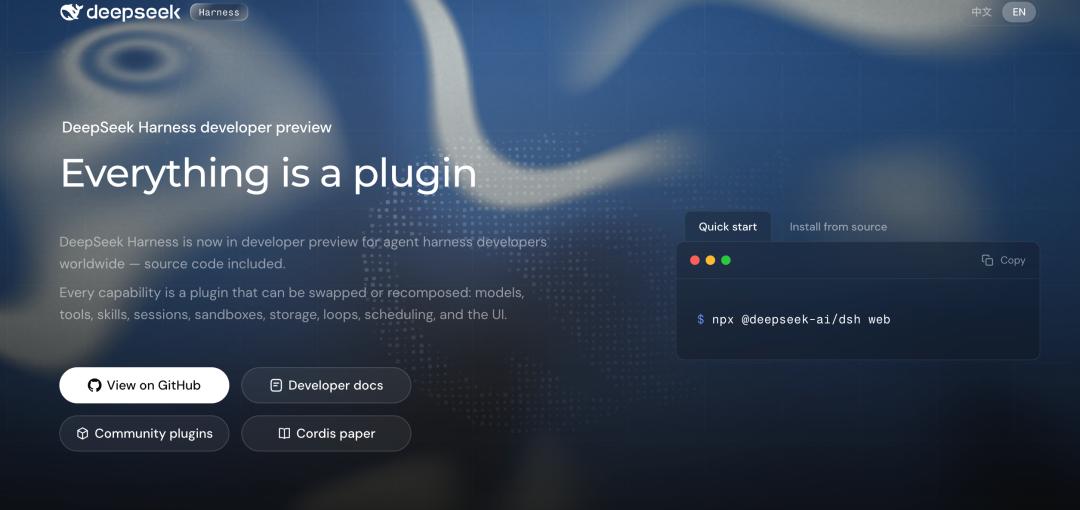
Although DSH was launched later than expected and is still only a developer preview version, it has still attracted huge attention. This is because Liang Wenfeng's roadmap for the RSI path has begun to show clearly.
In his four-hour internal speech at the end of July, Liang Wenfeng compared the development of AI to a series of steps: LLM — CoT — Agent — Continuous Learning — Self-iteration — Embodied Intelligence. In his view, the self-iteration of AI will lead the industry to a singularity.
Of course, DSH is only a milestone for DeepSeek on its path of exploring RSI, and it is far from reaching the singularity. A few days after its release, some users complained that its deployment is cumbersome, the configuration is complex, and the experience feels like a "half-finished product". But as a response to the industry's exploration of RSI, it still excited the entire AI circle.
So what kind of solution does DeepSeek provide to realize RSI? When all players are pursuing RSI, what kind of transformation has taken place in the direction of industry competition?
I. How does DeepSeek enable AI to self-evolve?
In his internal speech, Liang Wenfeng said a rather peculiar sentence. He said that the first goal of the models developed by DeepSeek is "not to make them easy for the public to use, but to make them easy for our own team to use".
Aren't models built for users to use? Liang Wenfeng further explained that letting models serve DeepSeek first is the fastest way for DeepSeek to achieve AGI.
RSI is not equal to AGI, and having RSI does not necessarily mean that AGI can be achieved. But RSI solves a key problem on the way to pursuing AGI: who will accelerate the evolution of AI capabilities themselves?
Therefore, AGI is the goal, and RSI is the means. Letting AI help itself get stronger continuously will eventually push AI capabilities to the level of AGI.
Specifically, how does RSI help DeepSeek move towards AGI?
While releasing DSH, DeepSeek and Peking University jointly published the paper "a programming paradigm for spatiotemporal composability", revealing more ideas about this architecture.
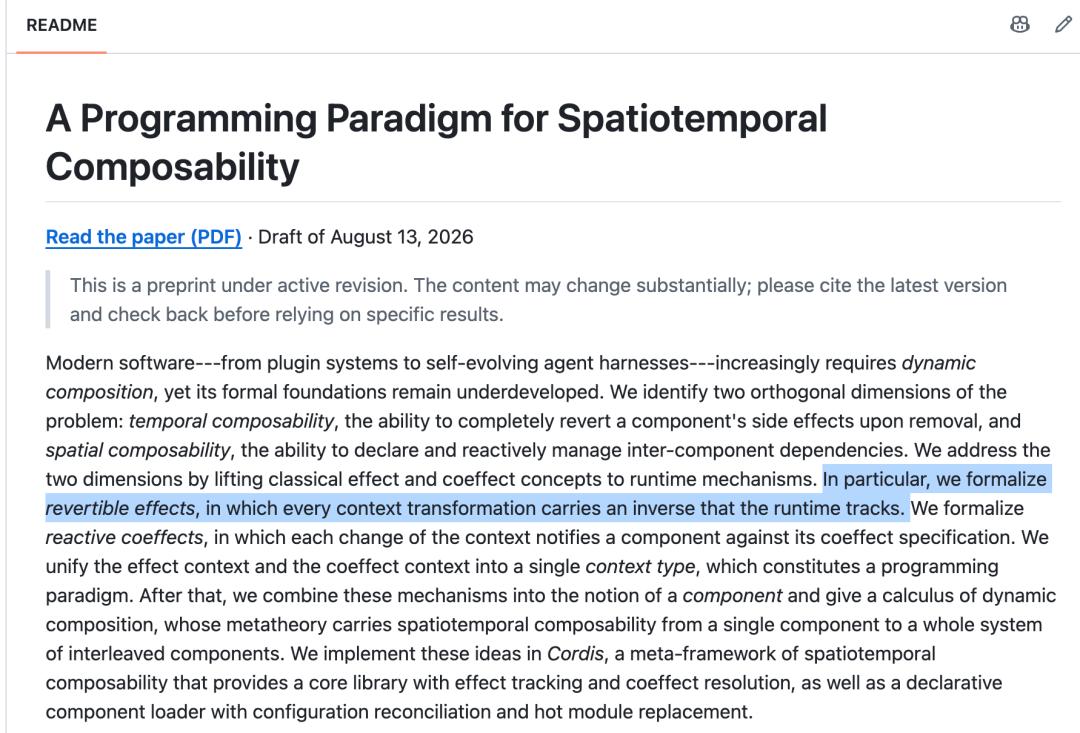
In the underlying operating framework of DSH, there is a core mechanism called Cordis. It tries to solve a long-standing problem in the industry: traditional plugin systems are generally good at installing plugins, but it is difficult to completely remove the impact left by a plugin without restarting the entire process.
This problem is fatal for an AI Agent that requires the ability to self-evolve.
The operating environment of an Agent is usually full of components such as tools, permissions, sandboxes, memories, and session states. Imagine that if the Agent needs to continuously modify these plugins to improve its capabilities in the future, each modification requires the entire system to restart, and the originally continuously running state will be interrupted. Worse still, a failed modification may bring the system to an unrecoverable intermediate state.
Therefore, it is crucial to create an environment where AI dares to carry out self-evolution. Cordis tries to solve this problem from two dimensions of time and space: first, when a plugin exits, its previous impact can be tracked and revoked; second, when the dependencies between plugins change, the system can automatically re-coordinate. This refers to the temporal composability and spatial composability mentioned in the title of the paper.
This is not just theoretical research. This mechanism has been running for 4 years in the open-source chatbot framework called Koishi, which has more than 4,000 community plugins. Of course, this mechanism still needs to be verified in larger-scale plugin systems in the future.
Now it is not strange to look back at Liang Wenfeng's sentence. He said that the model must be easy for his own team to use first. In terms of engineering, this means that the model must first be given a base that allows it to modify itself continuously: new components can be installed, old components can be completely removed, failures can be recovered, and the relationship between components can be automatically reorganized.
When this self-modification becomes a sustainable, failure-tolerant and rollbackable engineering process, the self-evolution of AI will have a solid foundation to take root.
II. Major Tech Players' Layout in RSI
As one of the most attractive milestones in the AI industry, RSI has attracted far more pursuers than Liang Wenfeng.
In July, Demis Hassabis, head of Google DeepMind, said in an exclusive interview that most cutting-edge laboratories are committed to researching RSI. A month later, Jasjeet Sekhon, Chief Strategy Officer of Google DeepMind, also publicly stated that RSI is becoming the core investment logic of AI capital expenditure.
"It was the steam engine that humans used to build the next generation of steam engines back then." Jasjeet Sekhon believes that using AI to build AI does not sound that incredible.

Figure: Demis Hassabis in the exclusive interview
DeepMind already has a practical case close to RSI called AlphaEvolve, which has been running for more than a year.
The core mechanism of AlphaEvolve is not complicated. It first lets Gemini generate a batch of programs, and then the automatic evaluator runs, verifies and scores them. Solutions with good performance will be retained and continue to become the basis for the next round of generation and combination. This process can run continuously without the intervention of engineers.
The most critical part of this method is that the evaluation link is also automated. As long as a relatively objective evaluation standard can be established for a problem, AI can carry out a large number of trial and error by itself: generate a solution, run it, check the score, and then continue to find a better solution according to the result.
Google has begun to use AlphaEvolve to optimize its own computing infrastructure. Google said that AlphaEvolve has found a new algorithm for data center scheduling, which recovers about 0.7% of computing resources worldwide on average; during the training process of Gemini, it accelerated a key matrix multiplication kernel by 23%, reducing the overall training time of Gemini by about 1%.
In August this year, Google's AI team experienced a high-profile upheaval. Although many members left the team, their goals are still the same: to pursue RSI in the next stage.
Jeff Dean, who has worked at Google for 27 years, left and took several researchers to found Discovery Loop, whose core direction is RSI. Sergey Brin, co-founder of Google, is also vigorously promoting the flow of internal resources to RSI.
The two star AI companies OpenAI and Anthropic have also bet heavily on RSI. In July, OpenAI added a new indicator called RSI-Index in the release notes of GPT-5.6, which is specifically used to measure the degree of self-evolution of the model.
Anthropic Institute, established by Anthropic this year, also lists RSI as one of its key research directions. In an experiment called Automated Weak-to-Strong Researcher, Anthropic has allowed multiple Claude-driven AI agents to independently put forward research hypotheses, design and run experiments, analyze results, and iterate the next round of solutions based on the results, achieving better results than human researchers on an AI alignment problem.
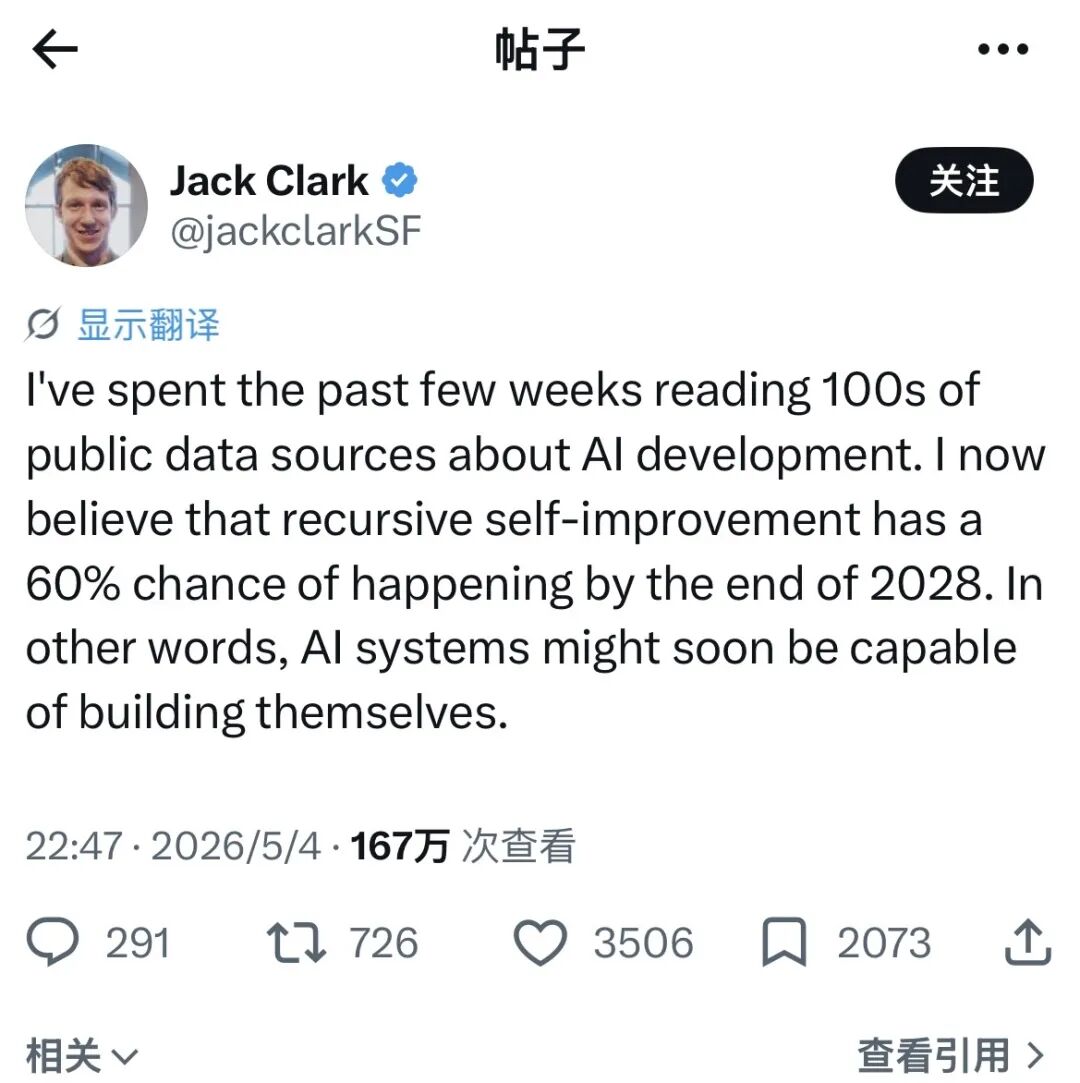
Jack Clark, co-founder of Anthropic, even made a prediction that there is a 60% probability that RSI will be realized before the end of 2028.
In China, some players started exploring technologies close to RSI even earlier than DeepSeek. For example, Tencent launched Hyra-1.0 in July. The official said that it is an agent capable of recursive self-improvement, specially built for performance-oriented research and engineering tasks. In addition to public benchmarks, it can generate value in more than a dozen different real scenarios.
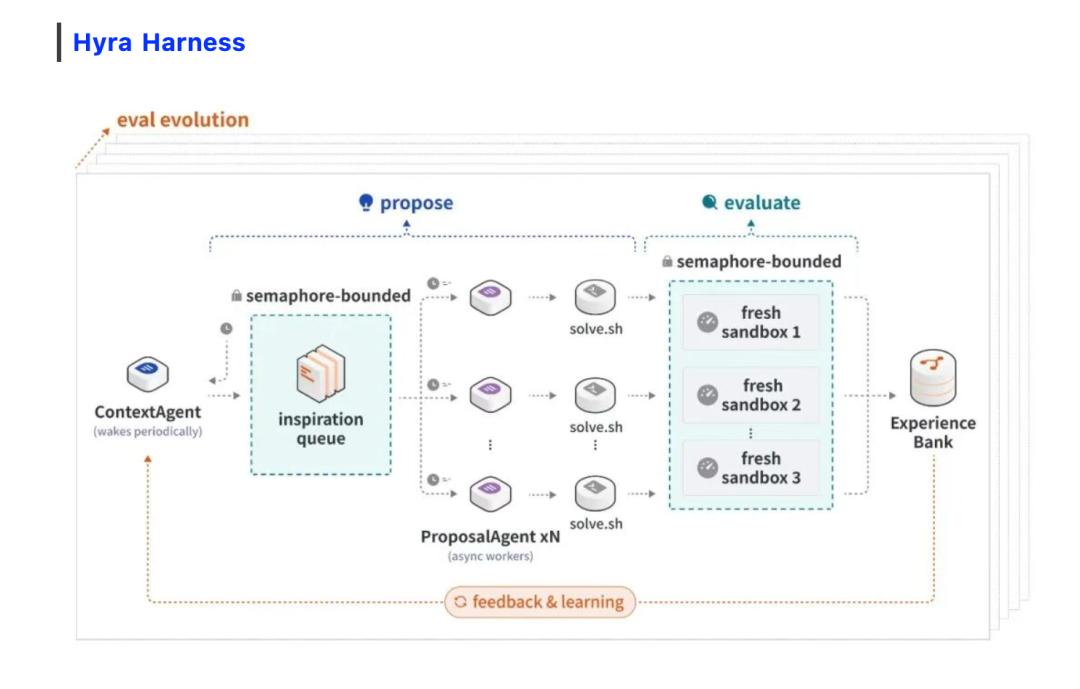
Figure: Tencent Hunyuan released Hyra-1.0
MiniMax moved even earlier. When it released M2.7 in March, the official title was "Early Echoes of Self-Evolution". It allowed the early model to build a set of harness by itself, analyze failure trajectories, plan modifications, modify scaffold code, run evaluations, and decide whether to retain or roll back the changes. After this cycle ran for more than 100 rounds, the score of internal evaluation increased by 30%.
III. Environment, Feedback and Loop Have Become the Core Competition Track
When RSI becomes an important path to AGI, it begins to change the competition direction of AI companies.
In the past, the industry used to take model release as the time node of capability change. When a company's new model goes online and runs through the public benchmark, the industry will re-sort the capability ranking. Now, the release of new models is still important, but the leading cycle between models is shortening, and a single release is increasingly unable to represent the long-term capability of a company. At the same time, the path to realize RSI also takes place after the model is released.
The basic idea of RSI is to let AI enter a continuously improving cycle. This puts forward new requirements for AI infrastructure.
First of all, models cannot only access pre-organized training data, but also need to enter real tasks, have an environment where they can act, modify and verify, and continuously expose problems in actual work.
Secondly, the system also needs a reliable feedback mechanism, which can judge whether a modification solves the problem or only temporarily improves a certain indicator, and convert these results into the basis for the next action.
Finally, this process must be able to circulate continuously to form a Loop. In this way, the results of the previous round can be passed to the next round, new solutions can be run, compared and iterated repeatedly, and failures will not make the whole experiment unable to recover and restart.
In short, the three core elements are environment, feedback and loop. These are also the conditions that DeepSeek, Google and other companies mentioned earlier are trying to create.
This also explains why after Elon Musk spent 60 billion US dollars to acquire Cursor recently, Grok has shown a strong momentum of catching up.

Cursor is a code editor. The acquisition reason given in the SEC filing is that software development has high-quality structured data, fast feedback cycle and high-frequency usage at the same time. The work trajectory left by AI programming can in turn improve the training and performance of the model.
Simply put, when users use AI to write code, Cursor will record at which step it gets stuck and how to fix it, etc. Engineers then process these behavior trajectories and feedback results into data for training the model.
Therefore, what Elon Musk really wants to acquire is the feedback and loop after AI enters the real working environment. And these feedbacks and loops will also be the focus of competition for AI companies in the next stage. Perhaps more companies will begin to copy Musk's approach to obtain these resources through acquisitions. At the same time, companies that already have high-value business scenarios, product entrances and user scale will also show greater advantages.
Of course, RSI is still a distant goal at present, and there are still doubts in the industry. Pedro Domingos, a professor at the University of Washington, believes that AI has had a certain ability to build itself since LISP appeared in the 1950s. In his view, there is not enough evidence to prove that this self-improvement will bring increasing rather than diminishing returns.
In addition, there is a far-reaching problem. 60 years ago, when I.J. Good called the ultraintelligent machine the last invention of human beings, he put forward a prerequisite: the machine must always obey human beings, and humans can turn it off at any time.
So if AI can really accelerate continuously through RSI and achieve exponential growth in capabilities, will human beings still hold the switch?
This article is from WeChat Official Account "Deep Flow Research Institute", author: Zhi Feng, published with authorization from 36Kr.