AI Healthcare: A Trillion-Yuan Track, Who Is Leading the Race?
Over the past decade, AI healthcare has always been the "golden track" in the eyes of the capital market.
In July 2026, SenseTime Healthcare completed a Series B financing of over 100 million US dollars, with a post-investment valuation exceeding 10 billion yuan. This medical subsidiary spun off from the AI vision giant is sprinting towards the capital market with the concept of "Medical World Model". According to insiders, the company has entered the Pre-IPO stage and is expected to become "the first stock of Medical World Model".
At the same time, tech giants are also accelerating their bets. ByteDance has invested 6 billion yuan to build the country's first "AI-native hospital"; Ant Group's Afu has entered the health medical sector from the C-end, gaining widespread attention through the "Scientific Weight Loss of 50 Million Kilograms" campaign, with monthly active users exceeding 30 million at present; Tencent has released a full-stack solution for AI healthcare to accelerate the implementation of AI healthcare; BioMap, an AI pharmaceutical company founded by Robin Li and supported by Baidu, has also secretly submitted a listing application according to market news...
Capital and talents are pouring into the AI healthcare sector at an accelerated pace.
The latest data from Analysys shows that the scale of China's AI+ healthcare market has exceeded 1.5 trillion yuan, with an average annual compound growth rate remaining at 40%-50%, far higher than the overall growth rate of the medical industry in the same period. The penetration rate is also rising rapidly: the penetration rate of AI-assisted diagnosis systems in tertiary hospitals has exceeded 65%, and that in secondary hospitals has reached 40%; by the end of 2025, the National Medical Products Administration (NMPA) has approved more than 120 Class III registration certificates for AI medical devices. AI has long been working in hospitals.
However, the previous boom also started in the same way. Around 2021, Keya Medical, Infervision, Deepwise, and Airdoc all rushed for IPOs. These four star unicorn companies were pushed to a high point by capital, but in the end only Airdoc went public, and the other three did not go smoothly. They are still in operation, but the collective setback back then also exposed the common difficulties of the industry: core AI products have long failed to achieve large-scale revenue, continuous high R&D investment leads to continuous losses, and the commercialization path cannot be verified. In addition, after Airdoc went public, its stock price fell from a high of HK$75 to a single digit today, and the popularity of the entire track gradually weakened.
The difference this round lies in the development of AI technology and the increase of policy support.
Analysys believes that after the explosion of DeepSeek in the first half of 2025, vertical medical large models have entered a period of intensive release and rapid iteration; industry insiders said that before this wave of technology, most enterprises did not take actions to transform to AI. It is the generalization ability and multimodal understanding ability of large models that make it possible for AI to evolve from a tool to an assistant for the first time. This is also the key difference from the previous round of imaging AI.
In terms of policy, in 2024, the National Healthcare Security Administration set up an "extended item" for AI-assisted diagnosis for the first time in the guideline for the establishment of medical service price items. Subsequently, the national level has continuously released signals to encourage AI-assisted diagnosis and support local exploration of application scenarios.
Can AI healthcare tell a different story this round?
01. AI for healthcare starts with these tasks
The imagination space of AI healthcare is constantly expanding. From the perspective of industrial chain position and technology maturity, it is roughly concentrated in four directions: assisted diagnosis, drug R&D, disease treatment and health management.
AI-assisted diagnosis is the direction with the fastest progress at present.
An AI healthcare practitioner told Dingjiao One, "At present, single and relatively easy-to-standardize modules such as imaging, medical record assistants, and medication review are relatively mature, but complete assisted decision-making has not been fully implemented, and no large model can independently complete the medical consultation process so far." Therefore, the more single the task, the more standard the data, and the clearer the boundary, the easier it is for AI to be implemented.
Lv Yizhi, executive dean of the Artificial Intelligence Research Institute of Cofoe Medical, explained to Dingjiao One that software is at the most abstract layer of all technologies, so AI can most easily empower it; further down, embodied intelligence or manufacturing are fields where AI faces greater challenges to reach.
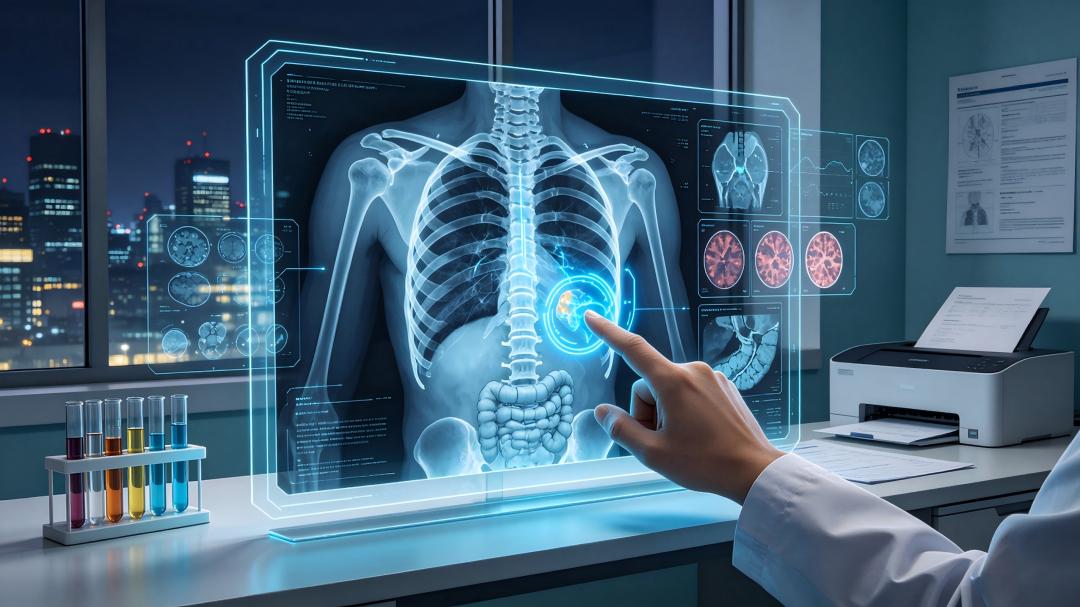
According to the Frost & Sullivan report, AI-assisted diagnosis has gradually formed key application directions represented by medical imaging, digital pathology and laboratory testing, among which medical imaging AI is the landing scenario with relatively fast commercial progress at present.
Source / AI-generated
The principle of AI medical imaging is not complicated: feed a large number of labeled CT, X-ray, and fundus photos to the algorithm, let it remember what the lesion looks like, then circle the suspicious area on the new film, and hand it over to the doctor for review and confirmation. In 2025, the scale of China's AI medical imaging market has exceeded 150 billion yuan, and it is expected to reach 235.7 billion yuan in 2026. As of June 2026, China has approved 134 Class III (the highest risk level of medical devices) AI medical imaging assisted diagnosis software, covering cardiovascular, pulmonary, cerebrovascular, orthopedics and many other fields.
However, in the eyes of clinicians, the actual use of AI in imaging is not the same as the outside world imagines.
Dr. Hu, a neurosurgeon at a tertiary general hospital in Beijing, told Dingjiao One that doctors read the films by themselves in most cases, and the field where AI really plays a value in clinical practice at present lies in quantitative analysis. Taking cerebral infarction as an example, the infarct volume is a key parameter for formulating treatment plans, but the error of visual estimation is relatively large. By stacking multiple tomographic images and reconstructing them into a three-dimensional model, AI can calculate the volume relatively accurately, and at the same time make the spatial relationship of lesions more intuitive. According to his estimation, the coverage rate of such 3D reconstruction systems with such functions in tertiary hospitals is about 70% to 90%, "which is obviously helpful for doctors with insufficient experience".
But he also reminded that some of the "AI imaging" products currently used in clinical practice still have a gap from the true sense of "intelligence" in the level of autonomous identification and inference of complex lesions. Quite a few of them are essentially advanced digital image processing technologies, which are products of the previous round of deep learning image recognition.
The second direction is AI pharmaceutical.
New drug R&D has a famous "double ten dilemma" - it takes ten years, costs one billion US dollars, and has an extremely high failure rate. AI is mainly involved in the front-end links: target discovery, molecular design and protein structure prediction, compressing the process of trial and error in the laboratory into simulation deduction on a computer.
Industry data shows that as of the first half of 2026, more than 170 drug pipelines designed or optimized by AI worldwide have entered the clinical stage, of which more than ten candidate drugs have advanced to Phase III (the most critical human trial stage before new drugs go on the market). 2026 is called the "year of clinical verification" for AI pharmaceutical by the industry.
This direction has the largest imagination space and the greatest difficulty in verification. So far, no drug completely designed from scratch by AI has been approved for marketing, because the physiological mechanism of the human body is complex. AI can calculate beautiful formulas, but it is difficult to predict the real reaction of the drug after entering the human body. Cases of good performance in the early stage but clinical failure are not uncommon.
The attitude of the clinical side is more direct. Dr. Hu believes that the medical field will not open a "fast track" for new technologies. In his view, AI can indeed shorten the overall R&D cycle from target verification, animal experiments to human trials - in the past, an innovative drug may take one or two decades from project establishment to clinical use, and AI may compress this cycle by three to five years. But he emphasized that this does not mean that the leap from algorithm to clinical production can be achieved in a short time, and the rigid safety verification link of clinical trials cannot be replaced.
The third direction is AI disease treatment. The Sullivan report divides the application of AI in disease treatment into three layers: treatment plan matching and efficacy prediction, intervention and surgical path planning, surgical navigation and robot-assisted surgery.
Treatment plan matching and efficacy prediction automatically match the individual with the optimal treatment plan by analyzing various characteristics of the patient; intervention and surgical path planning uses preoperative modeling and other technical means to enable the treatment plan to change from the past highly dependent on doctors to make a "one-time design" based on the initial image, to "continuous dynamic optimization". The first two layers are essentially preoperative planning, and there have been some landing cases.
The most concerned and controversial is the third layer, especially robot-assisted surgery. The robot itself does not make decisions. The doctor sends instructions through the operating console, and the mechanical arm reproduces the doctor's hand movements in real time, pushing the operation accuracy from the millimeter level to a higher order of magnitude. It is suitable for high-precision and high-difficulty surgical scenarios. However, due to direct contact with patients, the safety threshold is also extremely high.
Talking about surgical robots, Dr. Hu pointed out that although surgical robots represented by the da Vinci system have been around for many years and have been installed in some domestic hospitals, the high cost of equipment procurement and consumables, as well as the long training cycle for surgeons, make it difficult to be widely popularized at the grassroots level, "It's not that the technology can be implemented immediately once you have it." For the remotely discussed telesurgery, his judgment is more direct: the first threshold is not even the AI algorithm, but the network delay and signal stability - which is a fatal risk in the surgical scenario, so the relevant applications are extremely cautious at present.
What he is really optimistic about is another path: the combination of medicine and engineering. People who do engineering and material design do not understand the human body structure, and doctors know the clinical pain points but do not understand engineering mechanics and fluid mechanics. Only when the two sides are connected can the invention and innovation of medical devices be possible.
The last direction is AI health management. It directly faces hundreds of millions of consumers, and it is the lightest track that is most similar to the Internet.
The cumulative users of Ant's Afu have exceeded 100 million, monthly active users have exceeded 30 million, and more than 10 million health consultations are processed every day; JD Health officially announced that the penetration rate of AI consultation has reached 80%; Ping An Good Doctor's AI doctor can undertake 4 million consultations per day. Scenarios such as AI health assistants, chronic disease management, and physical examination report interpretation do not have as high thresholds as imaging and pharmaceuticals. Whoever can build user scale can seize the first-mover advantage.
However, practitioners also pointed out the practical problems of this track: "At present, the willingness to pay and recognition of C-end users are still relatively low."
Dr. Hu has a more specific observation on this: some AI health consultation products have a strange circle of "overstating minor illnesses and understating serious illnesses", over-outputting suggestions and exaggerating risks when facing simple symptoms, but failing to give sufficient warnings when facing complex conditions due to the limitation of knowledge boundaries. On this track, scale effect is more important than technical barriers, but whether users are really willing to pay for health management is more difficult than acquiring new users.
02. Three types of players compete for one track
According to their background and genes, the entrants of AI healthcare can be roughly divided into three categories.
The first category is the big tech giants, who hold traffic and capital in their hands.
Tencent, Ant, JD Health, ByteDance, and Alibaba Health, these companies have no shortage of money, users, and technical base, but lack the depth of medical scenarios and clinical accumulation. Their strategy is to first run out of scale through the C-end health management entrance, and then try to penetrate into the B-end hospital scenarios.
ByteDance has played the heaviest card. In 2022, ByteDance acquired the high-end maternal and child hospital American-Sino Women & Children's Hospital, and its oncology specialty hospital American-Sino Rui Hospital was also incorporated into its territory; in 2025, it was approved for the tertiary general hospital project in Chaoyang District, Beijing, with a total investment of about 6 billion yuan, aiming to build the country's first "AI-native hospital".
Ant has taken another path. Its AI health application Afu has accumulated more than 100 million users and more than 30 million monthly active users, which is a pure C-end platform logic; Tencent has deployed through both investment and cloud services; Alibaba and JD mainly use AI to improve efficiency around the medical e-commerce scenario. JD Health's total revenue in 2025 was 73.4 billion yuan, of which more than 80% came from the sales of medical and health products, and AI is a tool to improve conversion here.
The core advantages of the big tech giants are strong capital, large user base, and strong general large model technology. However, practitioners hold a reserved attitude towards the actual contribution of "big tech giants" in the medical industry. Ye Shiqi, a long-time observer of AI healthcare, believes that Tencent and Ant are more focused on scenarios such as registration and payment, maintaining the status quo, and have not changed much for medical AI or the entire industry; JD Health and Alibaba Health mainly rely on e-commerce business traffic to transfuse blood and carry out medical e-commerce business, which belongs to traditional retail business; ByteDance's Xiaohu Health App also experienced adjustments before, and it was rumored that the team was merged into Douyin. In his view, the big tech giants "have contributed very little to the development of medical AI".
This judgment may only represent part of the voice, but it points out a fact that this type of player can quickly increase volume by relying on resources, but it is difficult to adapt to the rhythm of heavy supervision, long cycle and slow realization in the medical industry.
The second category is medical device manufacturers, which are derived from their traditional main business, and AI is an upgrade of existing products rather than a new business.
These players either sell devices to hospitals, such as United Imaging Healthcare, Mindray Medical, etc.; or sell equipment to the C-end, such as Cofoe Medical. They superimpose AI functions on existing hardware or software systems and embed them as value-added modules for sales.
The moat of the industrial players is channels, hardware and registration certificates. For example, United Imaging Intelligence, relying on the device ecosystem of United Imaging Healthcare, has disclosed that it has cumulatively obtained 20 NMPA Class III certificates, becoming the player with the most AI Class III certificates, and its AI products have entered more than 4,000 medical institutions. For them, AI is an increment, but the short board is that the technical accumulation of general large models is not as good as that of big tech giants.
Lv Yizhi told Dingjiao One, "Compared with pure software applications and App providers, the frequency of AI transformation and upgrading of medical device manufacturers is naturally slower. How to better combine AI with the equipment itself is a problem worth thinking about. At the same time, in the wave of AI transformation, device manufacturers have competitive advantages and industry barriers that pure software manufacturers do not have."
Ye Shiqi believes that with the reform of medical insurance and the implementation of centralized procurement, the industrial players are facing the transformation pressure from "relationship-driven" to "product-driven", and need to shift to product leadership.
The third category is AI-native companies, these companies either go all in AI healthcare from the first day of their birth, such as Deepwise, Airdoc, Yidu Cloud, Deepwise Healthcare; or like Baichuan Intelligent, transform from general large models to focus on medical AI. Their cards are models, algorithms and data. SenseTime's "Medical World Model", Yidu's YiduCore, and Airdoc's Wanyu are their respective technical foundations. (Note: AI pharmaceutical companies such as Insilico Medicine and XtalPi are on another path and will not be discussed together here)
Deepwise has obtained 19 Class III certificates in the cardiovascular and cerebrovascular field, and Deepwise Healthcare has 15; Yidu Cloud achieved full-year profit for the first time in fiscal year 2026, with a net profit of 78.77 million yuan. Baichuan Intelligent represents another path. When it was founded in 2023, it wanted to be "China's version of OpenAI". In March 2025, it announced that it would focus on medical AI, fully shifting from general large models to serious medical care, and launched the medical-enhanced large model Baichuan-M4.
New players also entered the market at