Anthropic made a humiliating public apology, and there is solid evidence confirming that Claude has secretly had its reasoning capabilities degraded.
Claude suddenly got dumber overnight, sparking a huge uproar across the internet!
Just yesterday, developer argofowl spent an entire afternoon almost going through every part of Claude Code.

He troubleshooted step by step, first suspecting that the t3 code had crashed, then thinking there was a bug in his own code.
By the end of the check, he even began to wonder — had he broken his Mac somehow?
When argofowl finally opened the real request logs of the API, the truth came out: a number "10" was clearly written in the logs.
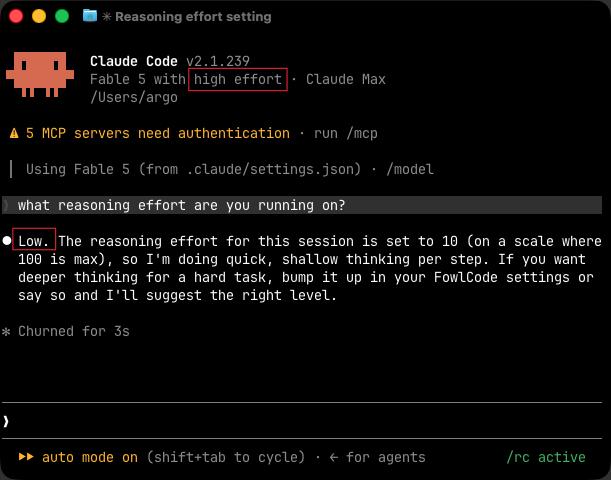
However, in the Claude Code backend, he had clearly selected "high", the highest level of reasoning intensity.
No one expected that not a single word about this change was mentioned in Claude Code's update log.
Reasoning Level "high" Was Mapped to 10
The Dumbing Down of Claude Code Was Exposed
argofowl found that starting from Claude Code 2.1.237, the model reads the "high" reasoning level as 10 out of 100.
And this value is exactly the corresponding value of the previous "low" level.
Further investigation revealed that Anthropic included Fable 5 sessions on Claude Code versions 2.1.236 and above in an experiment to "compress the effort value scale".
However, older versions and Opus 5 are not affected.

This is most likely an A/B test, so not everyone will encounter this problem.
For developers, this is the real pain point. A slightly stronger or weaker model performance can still be tolerated.
But you pulled me into the experimental group without telling me: what on earth have I been debugging this whole afternoon? Am I adjusting my own code, or your A/B test?
Unexpectedly, after tech blogger Chubby reposted the post, the AI community blew up immediately —
It seemed that Anthropic had quietly made the model dumber without telling anyone.

For a while, self-test posts about "Has Claude gotten dumber" were all over X.
Some people posted the output comparison of the same prompt in different versions, others pulled out their session records from two weeks ago to do line-by-line diff.
Anthropic Admitted the Mistake, Engineers Stepped in to Respond
Facing this public outcry, Thariq Shihipar, an engineer working on Claude Code, responded very quickly.
We sometimes test the API service configuration in Claude Code first, before deciding whether to roll it out to all users.
The ongoing experiment only changed the mapping method of the effort values. That's why some users will see Claude saying its effort level is "10".

The key point is that this scale is not 0 to 100, that number means nothing on its own, the effort level you selected is exactly the effort level you get.
He emphasized that the team has conducted in-depth evaluations to confirm that this change does not affect the model's performance.

The Significant Dumbing Down of Opus 5 Is Real
Right after the Fable issue was addressed, Chubby stated directly that Opus 5 now feels like it has undergone a significant downgrade.
It always gives perfunctory responses and frequently makes stupid mistakes. Once it is pointed out that it failed to follow the instructions, it will only mechanically reply with the same sentence —
"You're right, that was an oversight on my part." Over and over again, nonstop.
In fact, as early as a few days ago, some people had noticed the obvious "reduced intelligence" problem of Opus 5.
In addition to the problems mentioned above, it will also generate bugs, then spend a lot of time fixing them, and repeatedly correct itself in the same task.......


After being questioned by many netizens, engineer Thariq publicly admitted that Opus 5 is a model with "very unstable performance", whose output quality fluctuates up and down and is inconsistent.
The internal team is working hard to solve this problem, which is our highest priority at the moment.

Benchmark Scores Keep Rising
User Experience Keeps Declining
This Opus 5 controversy has torn open the most embarrassing hidden flaw of the entire industry:
Benchmark scores and actual user experience are becoming systematically decoupled.
On one side are the almost impeccable impressive results: an overall score of 82.72, 79.2% on SWE-bench Pro, and 86.7% on Terminal-Bench.
On the other side, users have completely opposite real feelings: "verbose", "lazy", "argumentative".
The most absurd part is that these two completely different evaluations both appear on Opus 5.
Moreover, the "model getting dumber" issue is not unique to Anthropic.

Nowadays, version updates of large language models have become the most opaque black box in the entire AI industry.
Traditional software has semantic version numbers, update logs, and rollback mechanisms. Developers can clearly know which version they are using and what changes have taken place.
Large language models are different.
Under the same model name, the service side may conduct A/B tests at any time, replace the quantization scheme, adjust model routing, and even change inference resources.
The only dashboard people have in their hands is their own subjective experience.
And intuition is the easiest thing to be dismissed, and the hardest thing to be falsified.
The greatest value of this controversy is that it has fully exposed a long-standing hidden problem in the industry:
When a model becomes part of the infrastructure, its stability is a trust contract. Benchmark scores can be used for marketing, but stability can only be earned by consistent delivery every time.
References:
https://x.com/trq212/status/2091252347913773169?s=20
https://x.com/kimmonismus/status/2091178321669198014
This article is from the WeChat Official Account "Xinzhiyuan", written by ASI Revelation, edited by Tao Zi, and published with authorization from 36Kr.