The mysterious "Niu Lai" has taken Silicon Valley by storm, and Google scrambled to claim ties to it, only to be thoroughly ridiculed across the entire internet.
Just in the past couple of days, the AI community has been blown up again by an unidentifiable "bull" model!
On August 21, a model named Ox Alpha quietly appeared on OpenRouter and OpenCode.
It is available for free for one week, supports 1M context length, and can process text, images and videos.

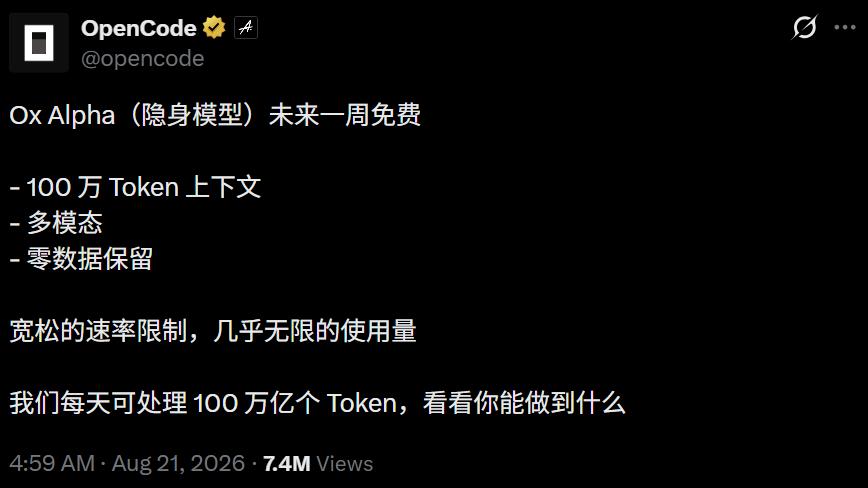
Ox means bull, and coupled with the recent viral meme of the abstract film "Bull Arrives" that has taken the whole internet by storm, Chinese netizens simply gave it a friendly nickname: the "Bull Arrives" large model.

Then, this "bull" immediately turned the whole industry upside down.
A free-to-use "bull" model, users around the world are scrambling to experience it
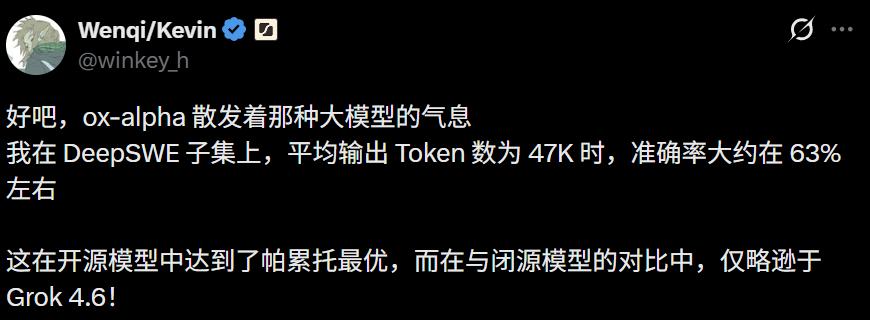
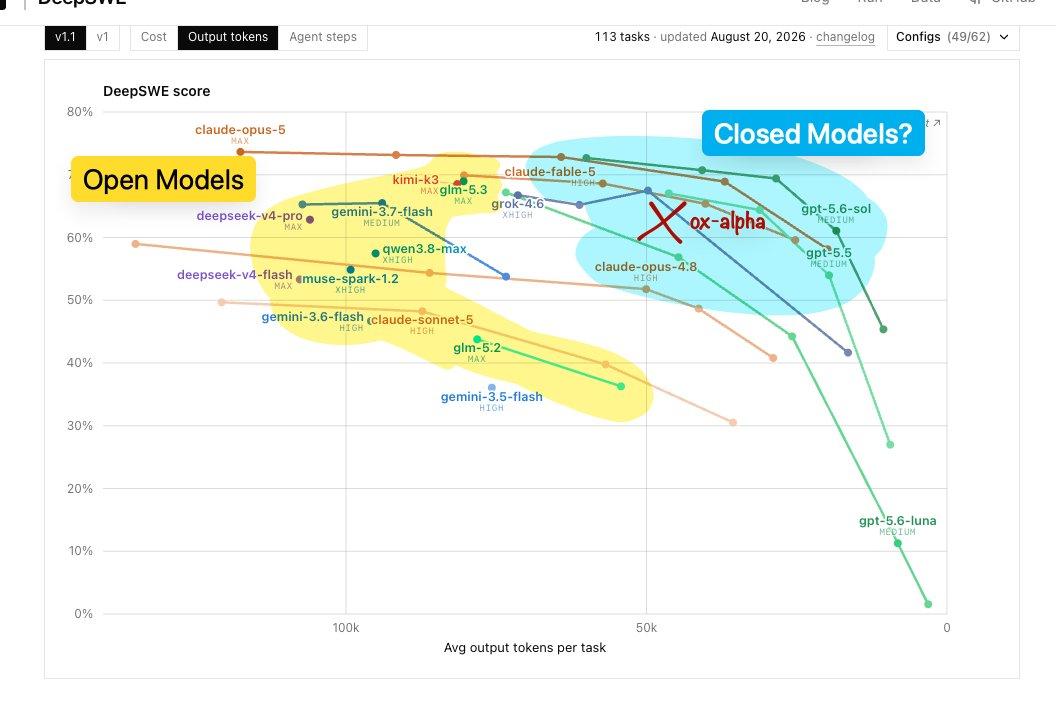
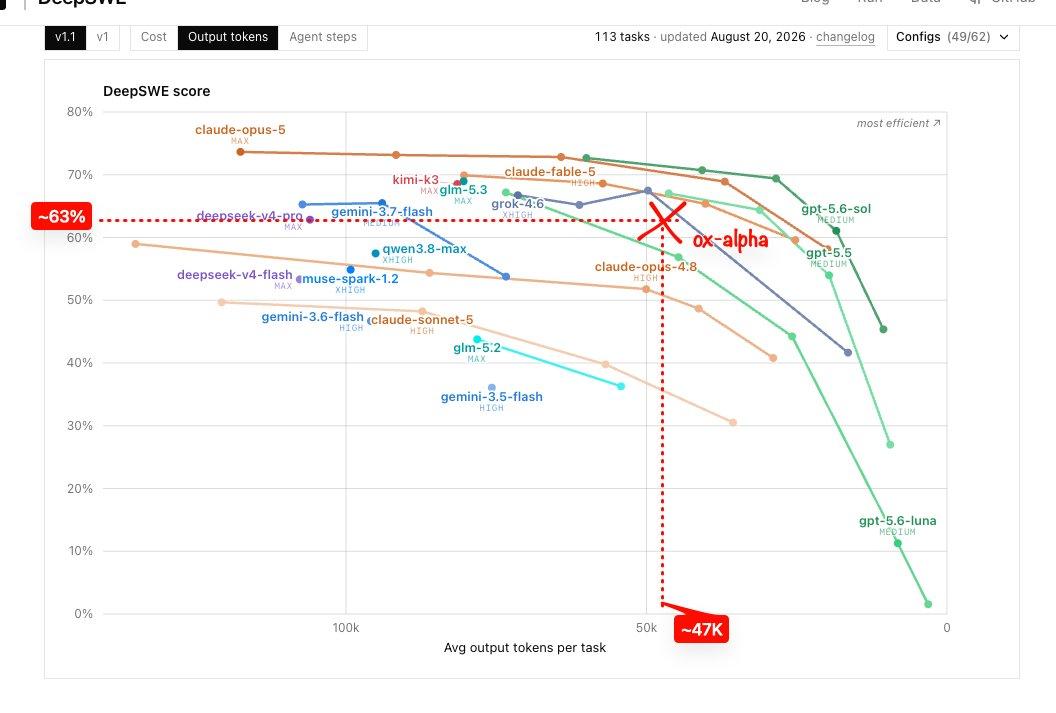
Wenqi Huang, the first author of DeepSWE, ran it through their own test immediately after it was released.
This set of tests requires the model to read the code repository by itself, locate bugs, modify the code, and run the test. If it fails, it has to go back and fix the problem, with full real-scene operation throughout the process.
The accuracy of the model directly hit 63%, which is only slightly lower than Grok 4.6 when compared with closed-source models.
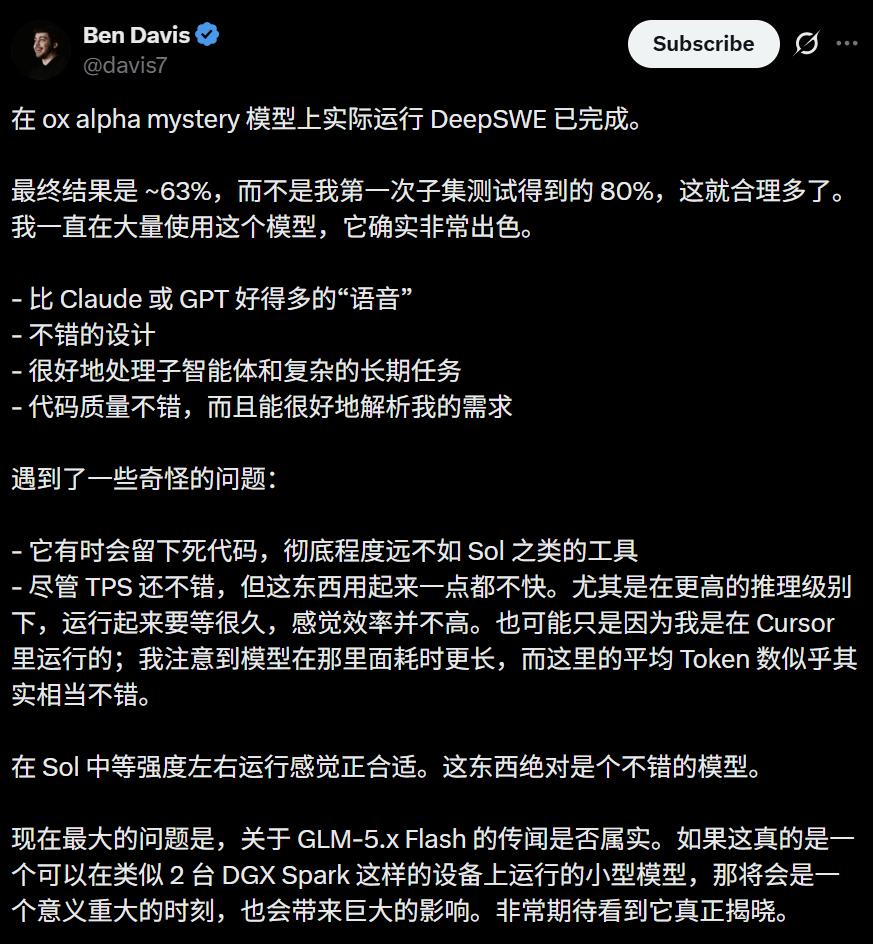
Another developer Ben Davis gave a more detailed evaluation —
Its voice performance is much better than Claude and GPT, its design capability is acceptable, it can handle subagents and long-cycle complex tasks, its code quality is good, and it can accurately understand what users really want.
As for its overall level, he thinks it is roughly at the medium tier of GPT-5.6 Sol.
What makes him even more surprised is that if the rumor that "Bull Arrives" is a small model is true, the inference cost calculation standard of the whole world will be completely rewritten.
Wow, this is far more than just releasing a new model.
Developer Ziwen directly integrated Ox Alpha into Codex.
Then the whole team changed their working habits. Previously, they had to select which files were important and then import them one by one, but now they directly throw the entire repository to it.
If they did this in the past, the inference cost bill would be extremely high.

Patrick Collison, CEO of Stripe, tried it out and only left four words: it's absolutely amazing.
The founder of Hermes Agent praised it even more, saying that it has exceeded all their internal evaluation standards. The CEOs of OpenRouter, T3 Chat and Box also reposted related content one after another.

A model whose developer is unknown has attracted almost half of the top executives in Silicon Valley to test it personally.
This kind of scene has not been seen in the past six months. People in the industry simply call it "Bull Model King".
Then all kinds of tricky tasks were sent to it for testing.
Ivan Fioravanti paired it with Hermes Agent to run his own "Frogger" game.
As a result, the model added extra content to the game: several iPhones rushing around on the road to hit the frog, and several flies that give extra points when eaten.

Netizen Hamza asked it to make a web page introducing itself.
Then it produced five versions in one go, including classified confidential file style, art gallery curation style, luxury brand style, each version playing with the meme of its anonymous identity.

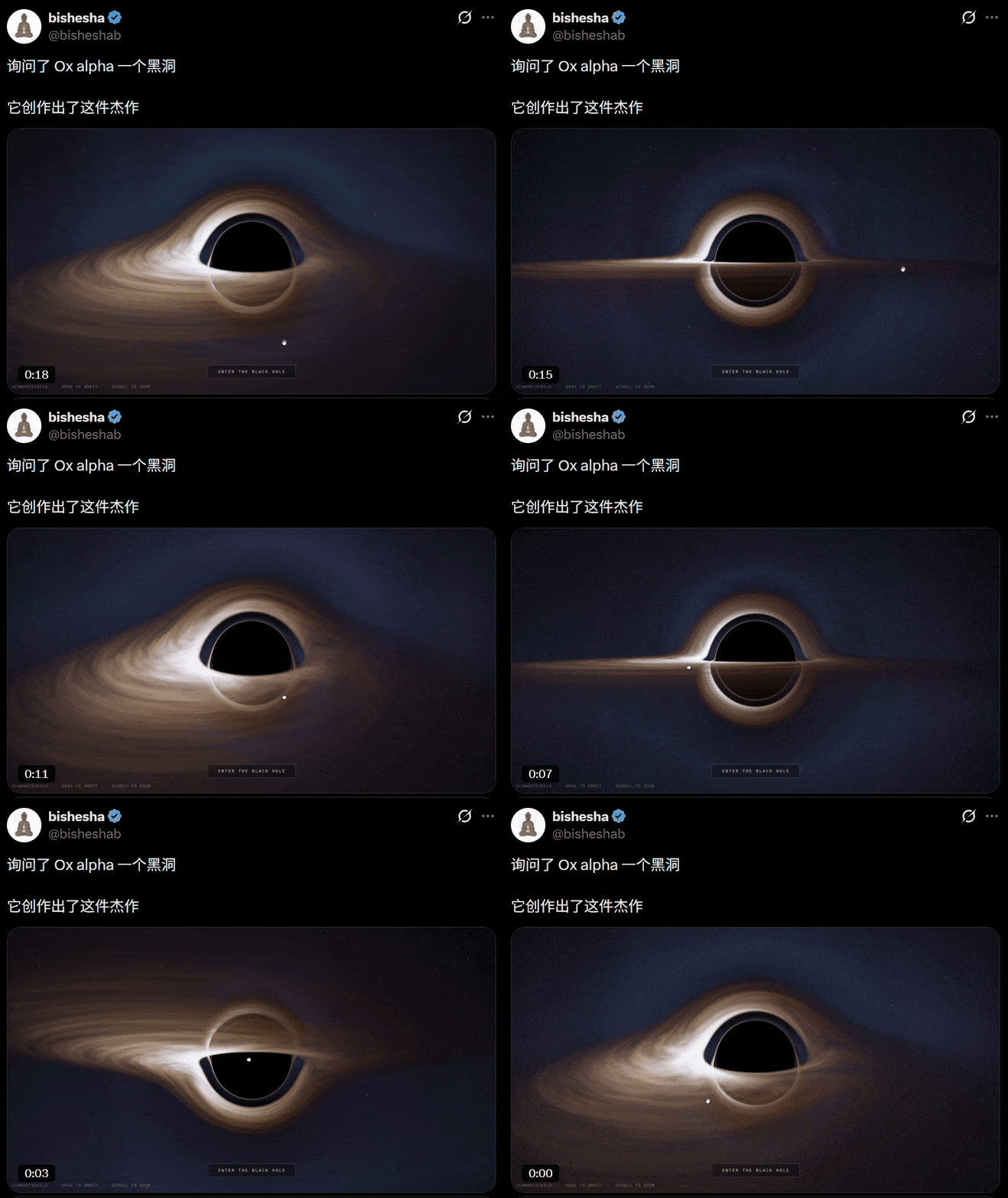
Netizen bishesha only put forward one requirement: "Show me a black hole". It sounds simple but very difficult to implement. After seeing the final result, he directly called it a masterpiece.
Google claimed the model, the whole internet is laughing out loud
Since the model is so powerful, everyone will ask a question: who on earth developed it?
Then all kinds of speculations emerged, with little evidence but full of enthusiasm.
The most absurd statement is that Cursor trained an open-source model by themselves and packaged it with this "bull" identity.
This description is extremely vivid.

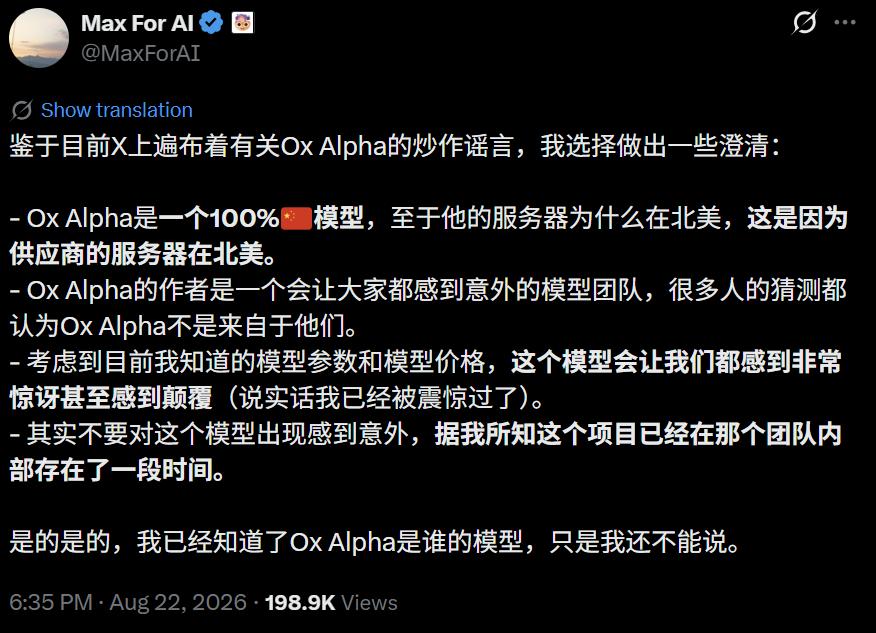
Max For AI added fuel to the fire.
He said Ox Alpha is a 100% Chinese model, and its developer is a team that will surprise everyone. He added that he already knew the answer, but could not disclose it.
What a riddle maker.
The whole internet became more curious. Podcast host Theo Jaffee's reaction is the most typical: he said this can not be the Flash model, if this is really a Flash model, the US AI industry will be in big trouble.

When everyone was guessing enthusiastically, Google came forward publicly and kept giving hints.
Evan Otero, a researcher at DeepMind, first posted a single word: Gemini.
After a while, he added: What if Ox Alpha is the friend we have been meeting along the way?

Shortly afterwards, Vamsi Batchu, who also works at DeepMind, also commented: Google is back, trust the process.
They were being sarcastic and insinuating, and no one gave a definite answer.

What's the effect of this operation?
Google was ridiculed by the whole internet.
The top comment is very classic: GLM stands for Google Language Model.
Just this sentence is enough to make Google embarrassed.
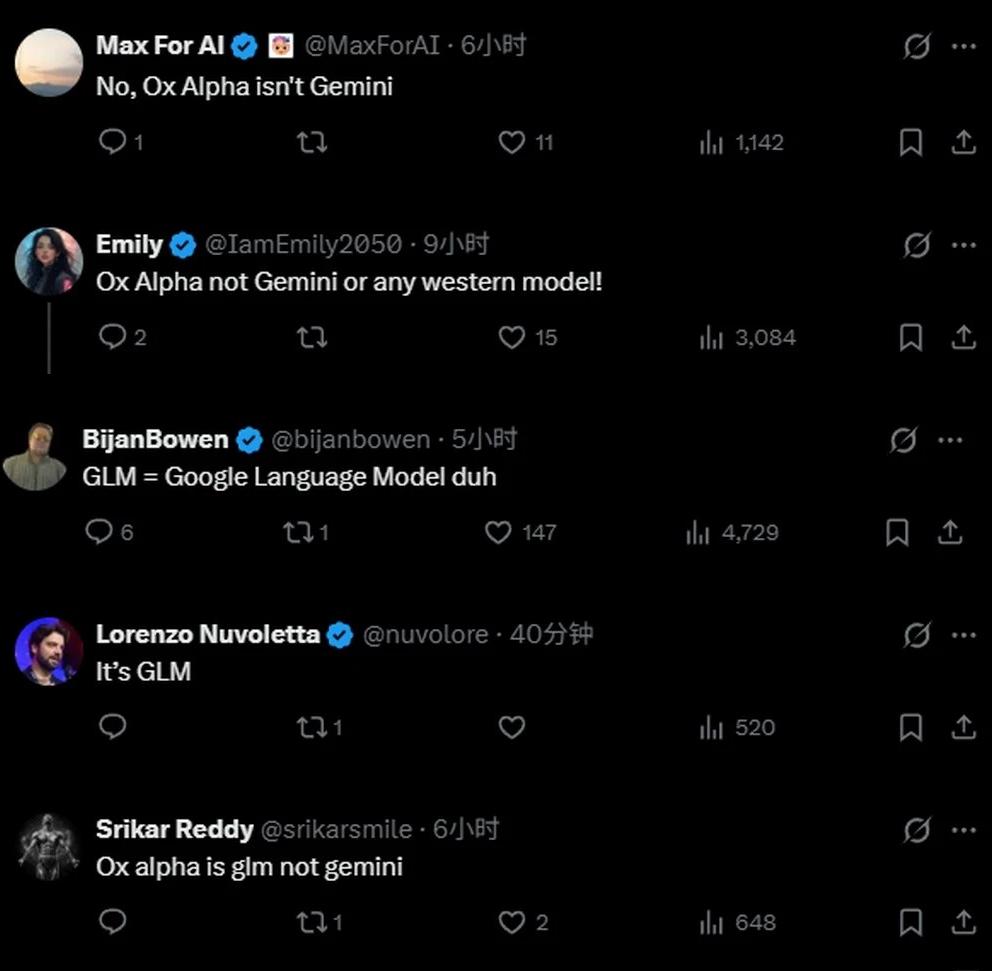
The most sharp comment says Google is just riding the wave to gain traffic for itself.
After all, Noam Shazeer, co-leader of Gemini, has now gone to OpenAI, and John Jumper, winner of the Nobel Prize in Chemistry, has joined Anthropic.
Employees remaining in Google are also complaining publicly, and some of them said directly: We are falling behind.
At this critical moment, seeing an unowned "bull" model suddenly become popular, they probably only have one thought in mind: take the opportunity to get some traffic if possible.
We asked it to build a jet engine
After seeing Google's farce, let's get back to the model itself — what is the maximum capability of this "bull" model?
Just watching others test it is not satisfying, we also tried it ourselves.
The first task we gave it was very difficult: build a dual-rotor turbojet engine with voxels, which should not only look realistic, but also support operation simulation.
This "bull" model really made it: the compressor, combustion chamber and turbine are all complete. Drag the throttle lever and the engine can actually run, with parameters changing in real time.

Since it can build an engine, we took a step further to the industrial field and asked it to make a 3D visualization of an aircraft engine.
The result it returned can be directly used as a teaching material.
The nose cone, fan blades, high and low pressure turbines are marked one by one, and parameters including 11:1 bypass ratio and 24 wide-chord titanium alloy blades are all written accurately.
