Embodied intelligence has begun to be sold as consumer goods.
At 10:08 on August 23, the pre-order channels for Qiyuan Q1 and Qiyuan T1 were officially opened. There are four online entry points: the official WeChat mini-program of Sunway Qiyuan Robotics, three official stores on Tmall, Douyin and Bilibili, plus offline experience activities.
Pay a deposit of 1000 yuan, which can be deducted as 2000 yuan from the final payment for the robot. Within 30 days after purchase, the Care protection package, official accessories and peripheral products are available at a 30% discount for selection. Pre-order users will receive a limited-edition debut gift box, which contains an autographed letter from Peng Zhihui (Zhihui Jun), a founding user collection card and a debut limited-edition figure, and can also get priority access to the exclusive customization right for Qiyuan Q1's outer shell. In addition, an extra half-year full-machine warranty is provided, paired with a 1-on-1 exclusive customer service priority response channel. The estimated debut delivery time is September 2026.
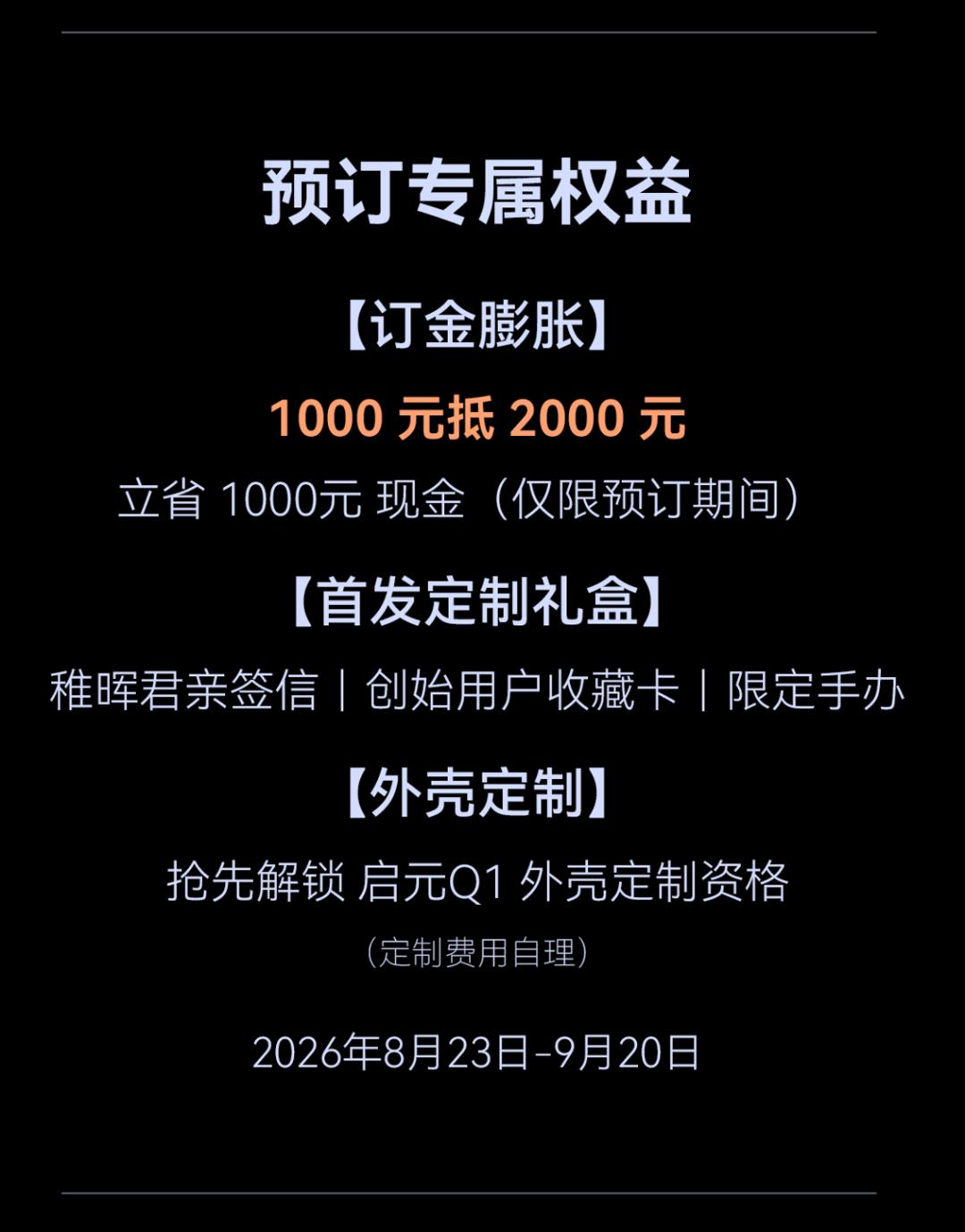
None of these terms are particularly eye-catching. Compared with robots dancing, transforming and performing boxing moves on exhibition booths, the deposit, final payment, delivery time, warranty period and customer service channels barely have communication power, and cannot even make it to the trending search lists. But what robots are exactly missing to become consumer products are these very details.
The timing is very well chosen. From August 19 to 23, the 2026 World Robot Conference was held in Yizhuang, Beijing for five days, with more than 300 enterprises participating in the exhibition, over 2000 exhibits on display and more than 150 new products making their debut. The pre-order channel for Qiyuan Robotics was opened exactly on the morning of the last day of the conference.
Also on August 19, Unitree Technology was listed on the Sci-Tech Innovation Board with an issue price of 150.8 yuan. It closed at 845 yuan on the first trading day, up 460.34%, with a total market value of 341.8 billion yuan.
In the same week, Unitree's IPO refreshed the valuation anchor for embodied intelligence, while Qiyuan Robotics under Sunway New Materials launched pre-orders to enter the household consumption scenario. The former proves the high popularity of this industry, while the latter is going to answer a question that the entire industry has avoided before: whether ordinary people are willing to pay for a robot.
From Exhibition Booth to Order
In the past two years, embodied intelligence companies have adopted a highly consistent way to prove their strength: participating in exhibitions. Dancing, backflips, combat, anthropomorphic interactions are extremely ornamental, and have indeed turned humanoid robots into a national topic. What exhibitions verify is communication power, not purchasing power.
Experience stores have taken a step further. On June 17, 2026, the wall of Qiyuan Robotics' authorized experience store at Zhuoyue Center in Shenzhen was officially erected, which is known as the first store of its kind in Asia. Later, similar stores opened in Shanghai, Xi'an, Guangzhou and Xiamen. On August 9, two stores at Hangzhou Joy City and Wuhan Tiandi opened on the same day, covering offline experience channels in seven core cities. Guangzhou has taken a bigger step: a 400-square-meter exhibition hall in Grandview Mall opened in August, and the world's largest 800-square-meter Qiyuan Robotics experience store will be launched in the Financial City in October. Experience stores verify the attractiveness of products: whether they can draw passersby from the shopping mall flow, and make people willing to stand and watch for ten minutes.
Deposits are what verify real purchase intention. During the World Artificial Intelligence Conference in July and the subsequent ChinaJoy, Qiyuan Q1 and Qiyuan T1 completed small-scale pre-orders, and also held offline internal purchase events in Guangzhou, Hangzhou, Shanghai and other cities. This pre-order on August 23 is open to the public, and anyone who wants to buy can place an order.
On July 17, Qiyuan T1 made its public debut at the World Artificial Intelligence Conference. The robot transformed from an upright humanoid form to quadruped walking with smooth movements, and was later covered by CCTV.
Financial reports show that by the end of June, Sunway New Materials had recorded 210 million yuan in advance receipts for its consumer-grade embodied intelligent robots. This sum is still listed on the liability sheet, and has not been recognized as revenue. The financial report states that the two products are still in the stage of R&D and application scenario verification, and no operating revenue has been generated yet.
Delivery is the gap between advance receipts and revenue, and also the gap between production capacity and sales volume.
Preparations on the production capacity side have been fully rolled out. At the site of the World Artificial Intelligence Conference on July 18, Lens Intelligent Robot under Lens Technology signed a cooperation agreement with Sunway New Materials, to collaborate on precision parts processing for robots, joint module production and complete machine assembly. The first-phase planned production line with a ten-thousand-unit capacity is designed for Qiyuan Q1 and Qiyuan T1. Sunway New Materials also announced a strategic cooperation with Wolong Electric Drive on the core component production line.
The ten-thousand-unit capacity is only the first-phase plan, not an order, let alone actual sales. How full the production line can run after completion depends on how many people actually pay the final payment after September.
Why Are They in a Hurry to Sell Robots to Individual Users
Sunway New Materials had no connection with the robot industry at all in the first place. It manufactures environmentally friendly high-performance corrosion-resistant materials, materials for wind turbine blades and new composite materials. Its revenue in 2024 was 1.494 billion yuan, with a net profit of 88.6814 million yuan, making it a typical chemical material company.
On the evening of July 8, 2025, Sunway New Materials issued an announcement that Zhi Yuan Hengyue and Zhi Yuan Xinchuang under Agibot planned to acquire at least 63.62% of the company's shares, with an agreed transfer price of 7.78 yuan per share. Together with the tender offer part, the total transaction amount is about 2.1 billion yuan. When the announcement was released, the market value of Sunway New Materials was 3.138 billion yuan.
The agreed share transfer was completed on September 22. The Agibot-related entities held a total of 63.6232% of the shares on October 29, the tender offer was delivered on November 6, and Peng Zhihui, also known as Zhihui Jun, was elected as the chairman at the extraordinary general meeting on November 25. The industrial and commercial change registration was completed in May 2026.
The stock price went through a full round of fluctuation during this period. Sunway New Materials' stock price rose by 1820.29% for the whole year of 2025, ranking first among all A-share listed companies. Less than ten days after the acquisition announcement was released, its market value soared from over 3 billion yuan to more than 37 billion yuan. By July 21, 2026, even after a roughly 40% pullback from the peak of 223 yuan, its market value still reached 48 billion yuan when the stock price closed at 119 yuan.
Sunway New Materials' original business is definitely not enough to support this market value. In 2025, Sunway New Materials recorded a revenue of nearly 1.8 billion yuan, up more than 20% year on year, but its attributable net profit to parent company was 41.09 million yuan, down 54% year on year. In the first half of 2026, its main business revenue reached 803 million yuan, up 2.42% year on year, with a gross profit margin of 14.27%. For a material company with rising revenue but no profit growth, there is a reasonable normal valuation range. The gap between 48 billion yuan and the valuation of its original business is fully pinned on the robot business.
In the first quarter of 2026, the company's R&D investment reached 45.85 million yuan, up 504% year on year, of which 37.78 million yuan, accounting for more than 80%, was invested in the embodied intelligence business. The attributable net loss to parent company in that quarter was more than 41 million yuan. By the half-year report, the total R&D investment reached 180 million yuan, up 738.66% year on year, accounting for 22.46% of operating revenue. Among that sum, 164 million yuan was invested in the robot business, accounting for more than 90% of total R&D expenditure, covering AI models, embodied intelligence algorithms, motion intelligence, interaction intelligence and lightweight joints. The R&D team has 227 members, with the proportion of master's and doctoral degree holders exceeding 67%.
High R&D investment will undoubtedly put pressure on profits. In the first half of the year, the attributable net loss to parent company was 167 million yuan, compared with a profit of 29.9004 million yuan in the same period of last year. The non-recurring profit and loss adjusted loss was 169 million yuan, down 749.01% year on year.
At the same time of releasing the half-year report, Sunway New Materials set a clear performance anchor for its robot business. It launched a restricted stock incentive plan involving 8.067235 million shares, with the grant price set at 91.85 yuan per share. The assessment indicators do not include net profit, but only new business revenue and R&D. The proportion of new business revenue in total revenue shall not be less than 25% in 2026, the revenue in 2027 shall increase by no less than 160% compared with that in 2026, and the revenue in 2028 shall increase by no less than 700% compared with that in 2026.
Sevenfold growth in three years, starting from a business that has not generated any revenue so far.
In Agibot's system, the commercial and scientific research business line has already achieved stable operation. On December 8, 2025, the 5000th Lingxi X2 robot rolled off the production line and was delivered. The total annual shipment volume exceeded 5100 units, with the revenue expected to exceed 1 billion yuan. The shipment expectation for 2026 is tens of thousands of units. But those robots are sold to enterprises, universities and research institutions.
Unitree's prospectus also illustrates the real structure of this industry. More than 70% of its humanoid robot sales revenue comes from scientific research and education clients, and the consumer-grade market has not yet formed large-scale demand.
For humanoid robot companies, the vast majority of robots sold are placed in laboratories and universities, not in ordinary households. What Qiyuan Robotics is going to do is to take this untrodden path, with a very specific timetable bounded by the equity incentive plan.
The First Generation of Personal Robots Is Not Designed to Do Housework First
Most people imagine that household robots can wash dishes, fold clothes and take care of children. Neither of the two products launched by Qiyuan Robotics is built for that scenario.
According to the official specifications of Qiyuan Robotics, Qiyuan Q1 is about 88 cm tall and weighs about 15 kg, defined as the world's first small-sized full-body force-controlled humanoid robot. The team has compressed the QDD quasi-direct drive joint to a size smaller than an egg, while retaining full force control and high response capabilities. The volume and weight of the complete machine are only one-eighth of mainstream humanoid robots. It can be folded and put into a backpack for easy carrying. All its exterior structural parts are fully open source, so users can 3D print their own outer shells, or replace the modular head. The Explorer Edition released at WAIC in July won the A' Design Award Gold Award. It is targeted at scenarios including embodied development, tech trendy toys and family companionship.
Qiyuan T1 stands at a height of about 100 cm and weighs about 16 kg. It is the world's first transformable personal robot that can switch independently between wheeled-foot humanoid form and quadruped form. Its capability list includes flexible force-controlled interaction, silent movement, voiceprint recognition, intelligent following, complex road condition self-adaptation, as well as voice-controlled shooting, trajectory camera movement and multi-camera mounting. It is targeted at family companionship, outdoor accompanying and image creation.
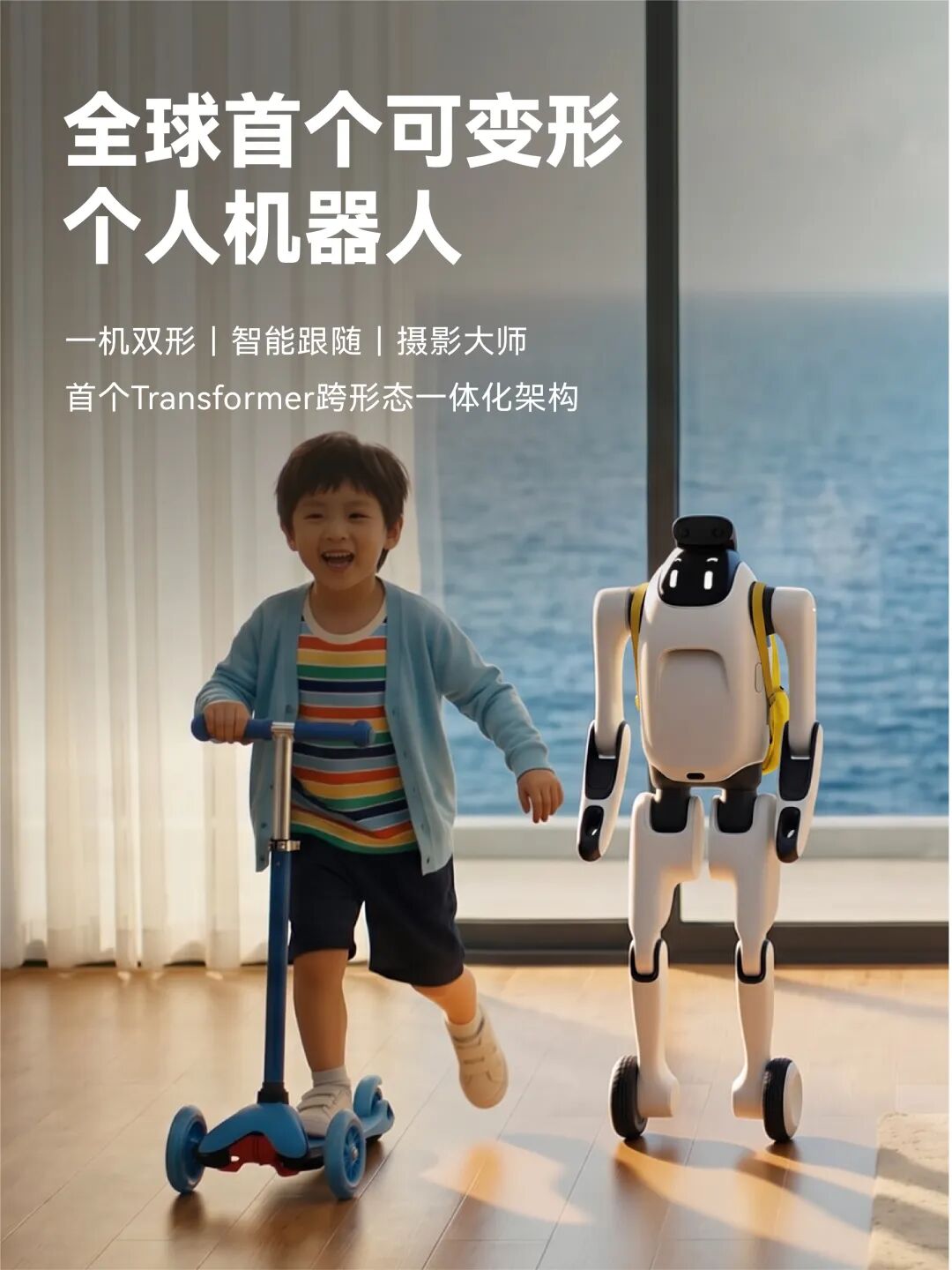
The small size and light weight are not technical compromises, but deliberate product decisions. One-eighth of the volume and weight means that users do not have to worry too much if the robot falls, it will not cause danger when bumping into people, and the trial and error cost is very low. A robot that can fit into a schoolbag and a full-size humanoid robot that requires dedicated space are two completely different types of products. The former can enter the living room, while the latter can only be placed in workshops and laboratories.
Common features of these scenarios including companionship, follow-up shooting, trendy toy experience, open customization and content creation are that they do not require the robot to complete a task that must be done perfectly. The robot does not have to perform flawlessly. Housework is a different case: if the robot messes up the housework, the user will directly suffer the consequences.
Policy guidelines are also guiding the development of robot consumer scenarios. On June 9, 2026, eight departments including the Ministry of Commerce issued the Implementation Opinions on Accelerating the Development of "AI + Consumption". Among the 17 measures, "accelerating the popularization of intelligent sweeping and mopping robots" and "supporting the R&D of humanoid robots with multi-modal perception and scenario adaptive problem-solving capabilities" are listed in separate entries. The verb for sweeping and mopping robots is "popularization", while the verb for humanoid robots is "R&D". For elderly care robots and companion robots targeted at the "elderly and children" groups, the verb is "application demonstration". The housework scenario is left by the policy to mature existing product categories.
There is another path in the industry to lower the user threshold. On December 22, 2025, Agibot's Qingtianzu platform was launched in Shanghai, where users can rent a robot for 200 yuan per day. Starting from January 1, 2026, 10 cities including Beijing, Shanghai, Guangzhou, Shenzhen, Hangzhou, Zhengzhou, Chengdu, Suzhou, Xiamen and Chongqing launched a 1-yuan flash rental service, with the main model being Lingxi X2, including 2 hours of basic experience and on-site installation and debugging. Three weeks after launch, the platform's registered users exceeded 200,000, with the average daily rental orders steadily staying above 200. Later, it completed a seed round of financing led by GL Ventures.
Rental solves the demand of wanting to try, while purchase solves the demand of wanting to own. The latter has a much higher threshold.
Consumer-grade does not mean mass popularization. Its real meaning is that for the first time, users pay for the robot with their own money, place it in their daily life, and define what functions it should have. The reason why open source shells and 3D printing customization are placed in such a prominent position is that manufacturers are fully aware that the usage scenarios of the first-generation products cannot be unilaterally stipulated by manufacturers.
Efforts are also made on the household side. During WAIC, Shangpin Home Furnishing signed a strategic cooperation agreement with Qiyuan Robotics to build the so-called "robot-friendly home", which pre-embeds requirements such as navigation, environment perception and autonomous energy replenishment into the design logic of whole-house customization, so that robots can move around smoothly inside the house. It is not enough for the robot to adapt to the household, the household also needs to adapt to the robot in reverse.
Dongwu Securities judges that consumer-grade embodied intelligence is accelerating from pure technical demonstration to the penetration stage of real demands such as game interaction, trendy toy socializing and companion services, and the product attribute is shifting from standardized hardware to customizable and expandable personal intelligent terminals.
After September
Pre-order is a show of