Whose turn is it for the most supply-constrained segment?
Since the development of large models began, AI data centers in North America have been experiencing a rare scramble for power resources. Whether large cloud vendors, NeoCloud, or model companies, all have to participate in power procurement directly.
Eaton disclosed at its performance meeting that the backlogged power demand of data centers in the United States has reached 307GW, which will take about 15 years to digest at the construction speed of 2025. Capital, land, and server racks are all in place at an accelerated pace, but the pace of power supply has not kept up.
The market's attention was once focused on power generation. Gas turbines, nuclear power, and solid oxide fuel cells were priced round after round.
Few people realize that the constraints that prevent GW-level projects from being delivered on time go far beyond the power generation side.
When power generation capacity is released intensively from 2028 onwards and its marginal scarcity declines accordingly, will the power distribution equipment in the later part of the industrial chain and the power supply at the server rack side become the next undervalued opportunity?
01
Power Shortage Spreads Downstream
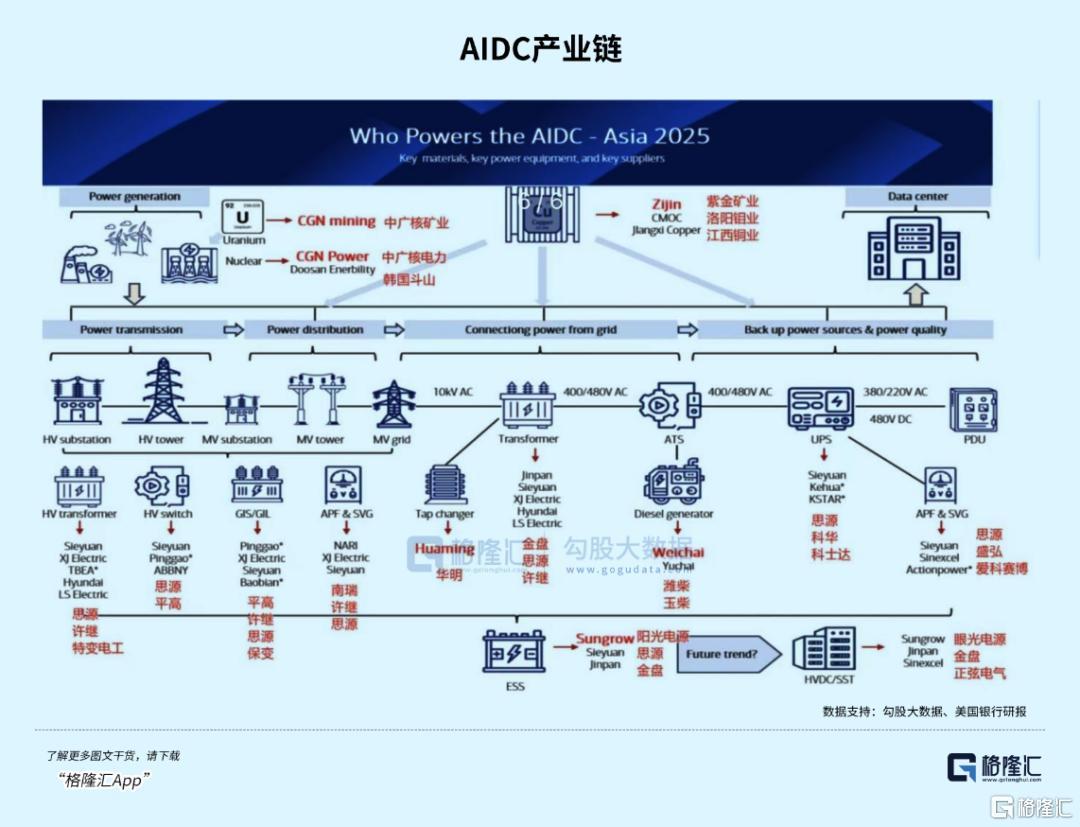
With the rapid construction and iterative upgrading of AIDC, the contradiction of the power shortage chain is not only concentrated on how to generate power, but all links that stably transmit power to the server racks will also be re-priced.
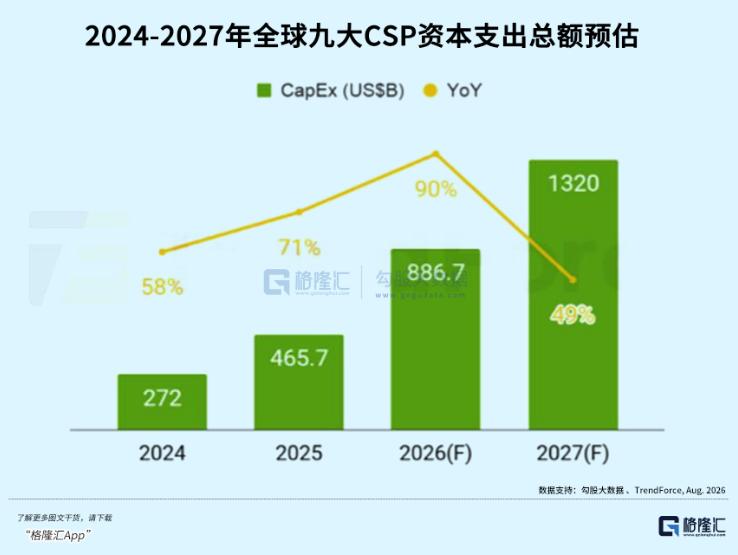
The demand for AI computing power is driving the accelerated expansion of data centers. The capital expenditure of the nine major cloud vendors in 2026 has increased by about 90% year-on-year, but the speed of power commissioning has almost become a constraint, and several figures can basically illustrate the problem.
The US disclosed data center pipeline tracked by WoodMackenzie reached 331GW in the first quarter of 2026. According to S&P Global's statistics, about 225GW of the signed grid-connected capacity will be put into operation from 2026 to 2028. CarbonDirect statistics show that the queuing capacity of the two markets PJM and ERCOT exceeds 300GW in total, corresponding to about 1,500 projects.
NVIDIA's CPO switches and Vera Rubin have started mass production and delivery this year. There is a gap measured in years between the expansion speed of computing power and the delivery speed of the power grid.
Under such circumstances, the industry can only turn to on-site power generation, building power plants next to the parks to bypass the grid queuing. For the same amount of power, the deployment of solid oxide fuel cells only takes 55 days. The orders of leading player Bloom Energy for gas turbines have been sold out until 2028, and Siemens Energy's orders are scheduled to 2029–2030.
Although there is a cost to bypass the queuing, the unit price of gas turbine equipment has risen from about $800 per kilowatt in 2021 to about $2800 for the batches to be delivered in 2028–2030.
This is the first half of the power shortage narrative.
But then, whether the generated power can be delivered to each server rack on time and stably depends on a complete set of power transmission and distribution equipment.
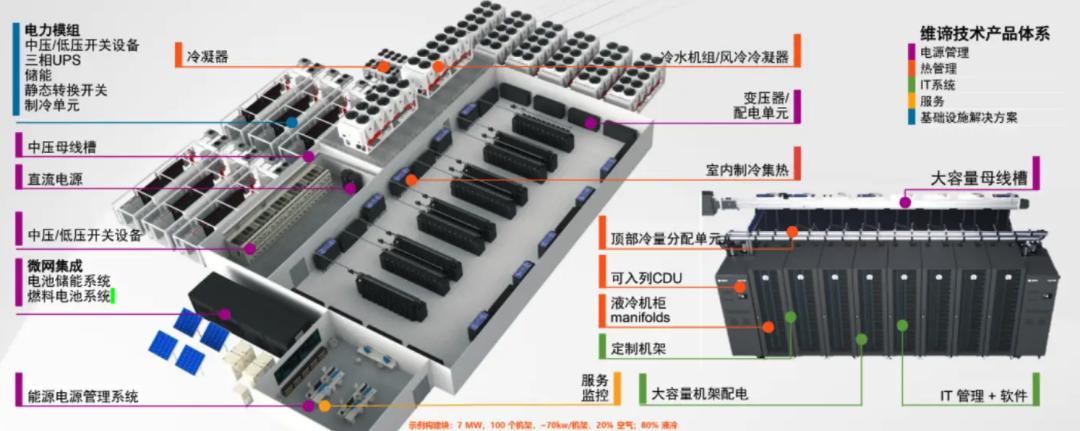
(Report on Full-chain Integrated Computing Infrastructure Empowering Digital Power Transformation)
According to Schneider Electric's 5MW model, the power distribution system accounts for about 36% of the infrastructure construction cost, making it the largest single component in infrastructure investment. According to Soochow Securities, electrical equipment accounts for about 35% of the computer room investment, which is almost consistent with the former figure.
In addition to the cost proportion, power distribution also has a capacity dimension. Multi-level conversion and redundancy make the total power supply and distribution capacity 3-5 times the power consumption of the chips. For each GW of computing power deployed, the power distribution capacity needs to be multiplied accordingly.
The more the power generation side is saturated, the more unavoidable the power distribution side becomes as the subsequent bottleneck. In the current situation, the second half of the power shortage narrative will most likely fall on the power distribution side.
In terms of delivery lead times, the lead time for medium-voltage switchgear has extended from 4-5 months to 44-80 weeks, 5/15kV units take about 52-72 weeks, 38kV units take about 78-104 weeks, some products are sold out until 2028, large power transformers need to wait for more than 128-160 weeks, and generator step-up units take about 144 weeks.
In terms of orders, Eaton's electrical business backlog increased by 43% year-on-year, with a total backlog of about $15.2 billion, and Schneider's Systems business achieved organic growth of 28%.
In terms of production capacity, according to The Wall Street Journal, the local self-sufficiency rate of large transformers in the United States is about 20%, and about 50% of distribution transformers rely on imports.
The contradiction between supply and demand on the power distribution side is even more acute than that on the power generation side, the root causes lie in:
The power generation side has alternative solutions to remedy the situation, such as self-built gas turbines, SOFCs, and internal combustion engines that can bypass grid queuing. However, there is no alternative path on the power distribution side. No matter the power comes from the grid or self-built power plants, equipment such as transformers, switchgears, and busbars are indispensable.
Secondly, power generation capacity will be released intensively from 2028 to 2030, while the delivery lead time of power distribution equipment is longer, raw material supply is more rigid, and capacity expansion lags behind. The global production capacity of oriented silicon steel has not seen substantial expansion since 2020, bushings and copper materials are also in short supply at the same time, there is a shortage of skilled technicians in panel factories, and newly built large transformer factories will not reach mass production until 2028.
For this gap in power distribution equipment, the ramp-up of local production capacity in North America lags behind, and Chinese manufacturers are expected to become the main undertakers of this round of penetration into the North American market. For A-share listed companies, this spillover trend corresponds to a 3-4 year penetration window, and the market share of non-local manufacturers is expected to rise from less than 10% to 30%-40%.
Many A-share companies have been labeled as concept stocks due to this expectation, but whether the fundamental logic can be successfully realized in the future depends on whether they have practical conditions, such as supply chain access for overseas customers or system integrators, park-level medium-voltage power distribution capabilities, UL certification and overseas channels.
02
New 800V Variable
In the past, the power consumption of data centers was only a procurement expenditure for purchasing power from the grid.
Now, leading manufacturers have started to build their own power generation facilities, covering the whole chain from power generation, power transmission, on-site power supply, power distribution, thermal management, to workload orchestration, extending all the way from the grid interface to GPUs.
The constraint of power shortage runs through the entire stack. Only looking at whether the power generation capacity is sufficient will miss most of the picture. In fact, the closer to the server rack, the more drastic the changes are.
NVIDIA's 800V HVDC roadmap has set the timetable for this change. Rubin will be mass-produced and delivered in the second half of 2026, after which the power of each generation of racks will increase step by step: Blackwell racks reach 145kW, Vera Rubin NVL72 reach 330kW, Rubin Ultra and Kyber reach 570kW, and the fourth-generation native 800V approaches 1MW.
Correspondingly, the first two generations mainly use 54V in-rack power supply, the third generation switches to liquid-cooled power racks and busbars, and the fourth generation adopts native 800V power distribution inside the rack. Every time the power rises to a new level, the power supply architecture also needs to be adjusted to adapt. For 1MW-level racks, 54V low-voltage power distribution will first hit its limit in terms of current and copper loss.
As a result, the rack-side power supply has changed from a static supporting facility to an incremental variable that continues to upgrade with the iteration of computing power.
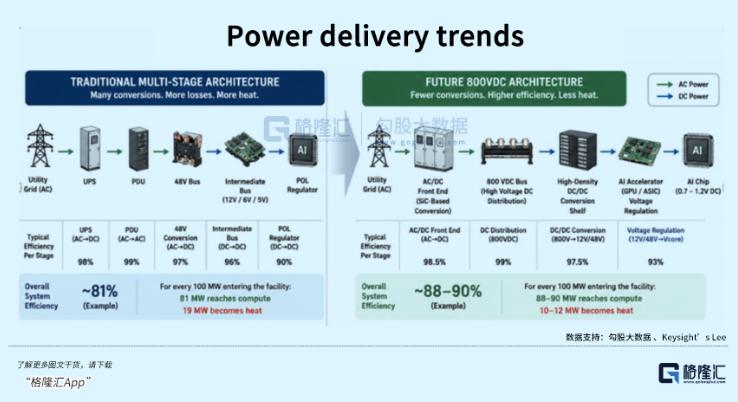
According to NVIDIA's "800V DC Architecture" white paper, the gradual increase of rack power, when mapped to the power supply architecture, is a three-step solution.
Option A is rack-level, which will be mass-produced in the third quarter of 2026. The 800V power rack can reach 660kW, and the power rack next to the server rack converts 415/480V AC to 800V DC without modifying the building's electrical system;
Option B is cluster-level, which will be deployed in the third quarter of 2027, with centralized rectification up to 2MW, and overhead or under-floor busbars distribute 800V DC, directly driving the demand for busbars, circuit breakers, and connectors;
Option C is computer room-level, the final form in 2029, where solid-state transformers step down medium-voltage AC to 800V DC in one go, eliminating step-down transformers, switchgears, and secondary power distribution. The transformation targets of the three steps are different, expanding from the rack to the cluster, and then to the entire computer room.
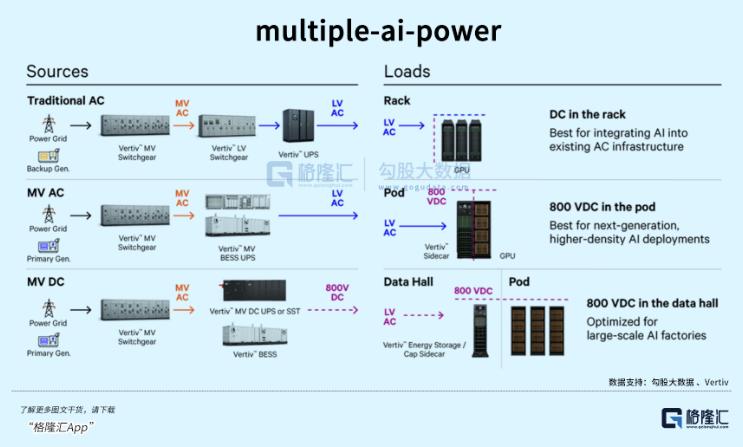
Although this solution will not be implemented all at once. During the transition period, about 60% of new AIDCs will preferentially adopt ±400V HVDC. Delta's ±400V products are planned to be shipped first in the second half of 2026, and NVIDIA plans to fully switch to 800V in 2027. But when these changes are superimposed, the value focus will shift accordingly.
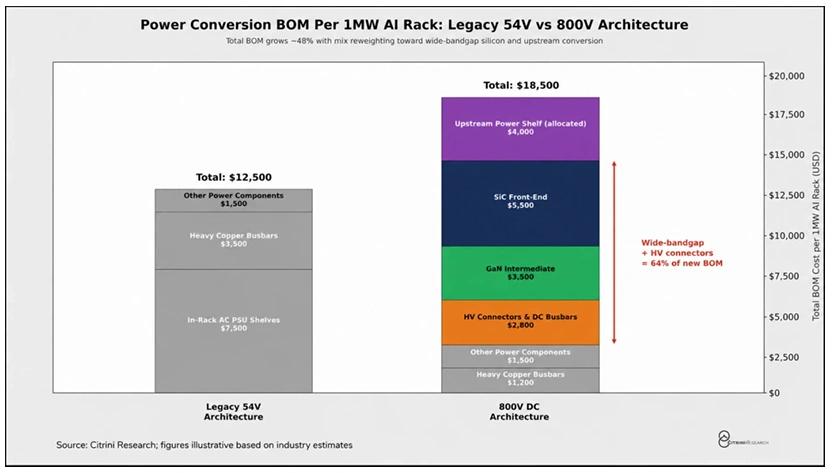
Under the 800V architecture, the current is reduced to about 1/16 of that under the 54V architecture, the cross-sectional area of copper materials and busbars is greatly reduced, and the value shifts from copper and iron cores to silicon carbide power semiconductors, high-frequency magnetic components and DC capacitors, a process the industry calls "silicon in, copper out".
Solid-state Transformer (SST) is a segment with great flexibility. It uses silicon carbide high-frequency power electronics to complete power conversion in one step, and also has the capabilities of bidirectional power regulation, active harmonic control and load fluctuation stabilization.
SST is still in the prototype and demonstration stage and has not yet achieved large-scale deployment. According to reports from Grand View Research, the global SST market size was about $169 million in 2024, and it is expected to reach $936 million in 2030, with a compound annual growth rate of up to 32% from 2025 to 2030.
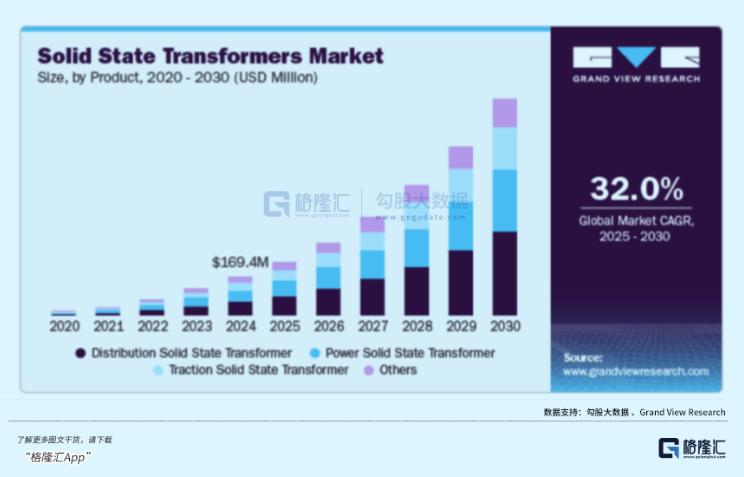
In terms of SST implementation progress, the Asia-Pacific region is about one year ahead of North America. Delta's SST has reached mass production capacity, Sungrow Power has established an AIDC business department and signed a 130MW-level SST project, planning large-scale deployment in 2028.
The 800V DC architecture has created a number of links that did not exist in the AC era, while bringing incremental market demand. To transmit 800V DC from the power rack to the server rack, DC bus ducts and high-voltage DC connectors are required. Every time the power rises to a new level, the demand for these products increases accordingly, and they are currently mainly supplied by overseas manufacturers.
DC does not have a natural zero-crossing point, so the arc is more difficult to extinguish than AC, and traditional mechanical circuit breakers cannot keep up with the breaking speed, so solid-state circuit breakers have become a new rigid demand. High-frequency power electronic conversion brings harmonics and voltage sags, which are handled by active power filters and static var generators.
When the power of a single rack exceeds the upper limit of air cooling, liquid cooling changes from an optional configuration to a mandatory requirement. Battery Backup Units and Power Conversion Systems for Energy Storage are separated from the server racks to form standardized site power racks to undertake the power backup function.
03
Epilogue
The power shortage narrative of AIDC is not complete without covering the crowding of power generation capacity, as well as power distribution equipment and rack-side power supplies.
In the past two years, the market has been focusing on the power generation side, and gas turbines, nuclear power, and fuel cells have been priced round after round.
Looking ahead, as a new batch of data center products are put into delivery from the second half of the year to next year, the investment priority may gradually shift from power generation equipment to downstream segments. The valuation has absorbed the expectations of the upstream, and the unpriced marginal changes may lie in the power distribution and rack-side segments.
The implementation of NVIDIA's 800V architecture is another driving force in this shift: Rubin will be mass-produced in the