Young people's online social interactions are quietly undergoing the "pigeonization" trend, where the behavior of standing others up on agreed plans without prior notice is becoming increasingly prevalent.
In the old days, time moved slowly, so did the carriages, horses and mails.
The short poem *Slow Carriages and Horses* by the writer Mu Xin is still the WeChat signature of many young people today. For the young generation who grew up with the mobile internet, the "slowness" of the pre-internet era is not an inconvenience, but a romantic nostalgia.
This is not their fault. On instant messaging tools like WeChat, messages are sent in real time, and you can even see the text "the other party is typing" on the screen — everything is moving too fast.
When this excessively fast internet speed starts to drain people's energy, resistance emerges.
Imagine this scenario:
You send a message. There is no "the other party is typing" on the screen. Instead, a pigeon is flying over the state of Ohio. The estimated time of arrival is 18 hours left, on the premise that it doesn't get lost and die halfway.
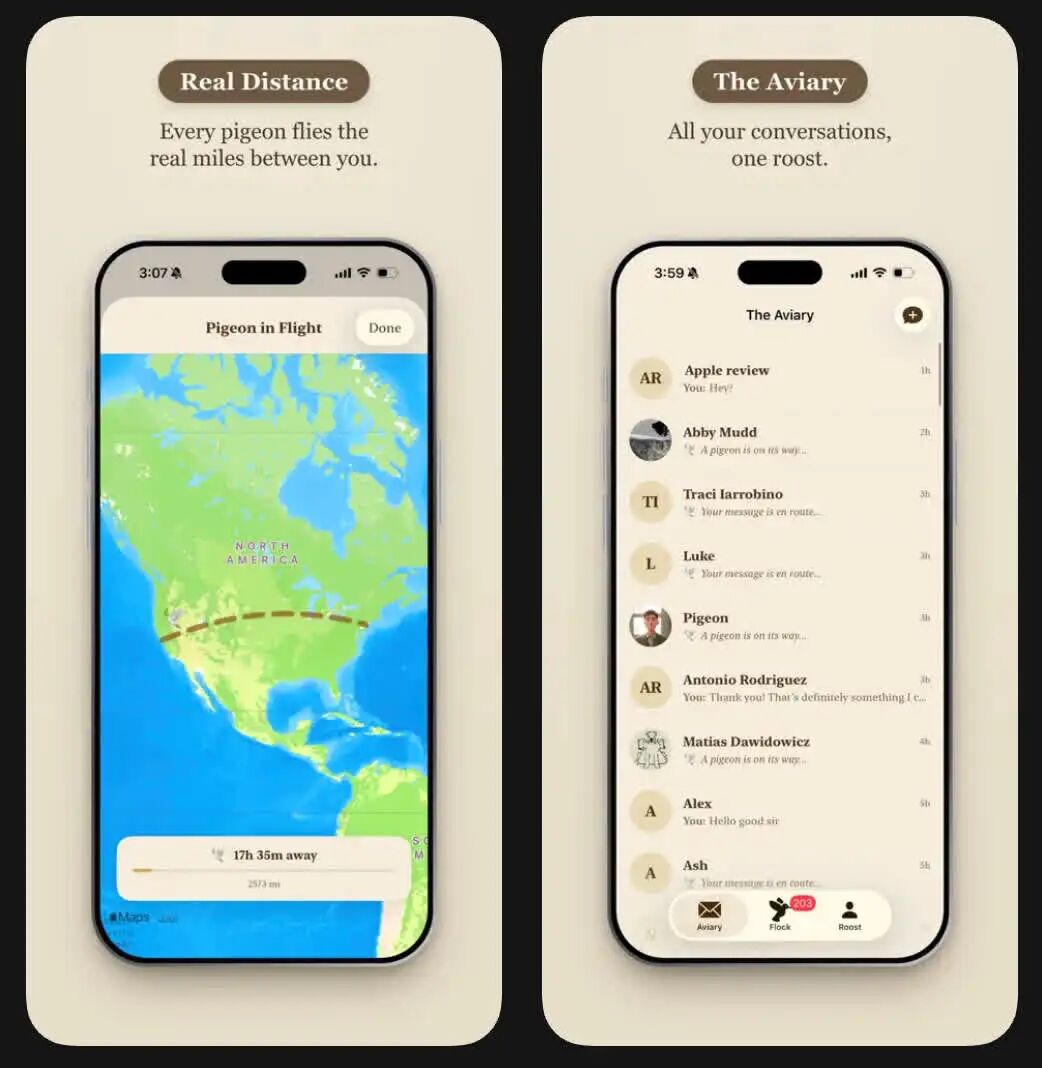
Page of the Carrier Pidge app | Image source: TechSpot
This is not performance art. This is what is actually happening on the social chart of US App Store in the summer of 2026.
Two messaging apps that "send messages with birds" exploded almost at the same time. One is called Carrier Pidge, the other is Roost. The total number of users exceeds 500,000, one has rushed to 24th on the social chart, and the other has seen its user base increase tenfold within three days. What they do is exactly the same:
Make your messages as slow as they were in the 19th century.
In China, it only takes a fraction of a second for a WeChat message to be sent from Beijing to Shenzhen. But in these two apps, the same distance will take a virtual pigeon nearly 7 hours to fly across.
Worse still, this pigeon has a 0.2% probability of dying halfway, and your message will disappear along with it.
It sounds absurd, but absurdity is precisely the point.
01
Messages Delivered by Homing Pigeons
Carrier Pidge is an iOS messaging app, which was developed by Noah Iarrobino in three weeks of vibe coding. He wrote a line in the product profile on the App Store that is probably the most honest line in the history of the app store:
This app is "genuinely of no practical use".
But for something that is "useless", its mechanism is designed with extraordinary care.
After you open Carrier Pidge and add friends, every message you send will be "tied" to the leg of a virtual homing pigeon. The app obtains the real-time locations of you and the recipient through GPS, calculates the actual distance between the two points, and then delivers the message according to the flying speed of the homing pigeon. The benchmark speed of the pigeon is 110 mph, which is about 177 kilometers per hour.
This means that local messages can be delivered in seconds to minutes, but it takes about 22 hours to send a message from Los Angeles to New York, and it may take two or three days to send a message from the US to the UK.
Being "slow" alone is not enough. Carrier Pidge adds a lot of "realistic disturbances" at the simulation level.
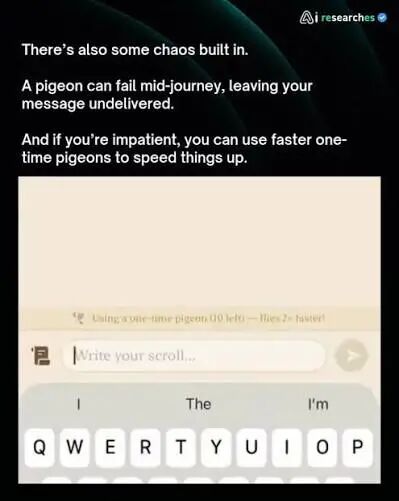
Carrier Pidge app prompts that the pigeon may get lost or die, and the message will not be delivered | Image source: Instagram
The flying speed of the pigeon has a random fluctuation of plus or minus 25% to simulate wind force and pigeon fatigue. Some pigeons will get "distracted" on the way, further slowing down the progress. More cruelly, each pigeon has a 0.2% probability of getting lost and dying during the flight. Once the pigeon dies, the message will disappear forever. No resend, no backup, no read receipt.
Every "bug" of this product is a deliberately designed "feature". Delay is not a defect, but an experience. Uncertainty is not a failure, but emotion.
The only thing you can do is open the app and watch your pigeon flying over which state and which sea on the map. There is a real-time countdown on the screen telling you when the pigeon is expected to arrive. The whole process has a wonderful sense of ritual, like tucking a note into a drift bottle and then standing on the shore watching it be pushed away by the waves.
The social system has also been "pigeonized". The friend list is called "flock", friend requests are presented in the form of "flying pigeons", and all chat records are stored in the "aviary". If your pigeon unfortunately dies and you want to get a new one, you have to pay for it.
Carrier Pidge is currently only available on iOS, and the developer says the Android version "will come eventually".
02
Bird-raising Social Universe
If Carrier Pidge is an exquisite minimalist experiment, then Roost is a complete "bird-raising social universe".
Roost was launched earlier than Carrier Pidge. It landed on the App Store in April 2026, supporting both iOS and Android. The full-time job of its developer Logan Mendelsohn is a product manager of Trust & Safety at Ticketmaster, and Roost was originally just an amateur project he made for fun for his friends. After his friends tried it, they felt "addicted" and urged him to launch it as soon as possible.
The biggest difference between Roost and Carrier Pidge is that it does not only have pigeons. Users have a "rookery", where they can collect all kinds of birds, from the common gray pigeons on the streets of New York, to cardinals, peregrine falcons, and even mythical creatures like phoenixes. The flying speed of each bird is based on real species data. The peregrine falcon delivers the fastest, the hummingbird flies slowly, and you can even choose a snail or a turtle to deliver your message.
What animal you choose to deliver the message is itself a kind of expression. When sending a message to your crush, will you choose a peregrine falcon or a snail? This choice is more thought-provoking than the content of the message itself.
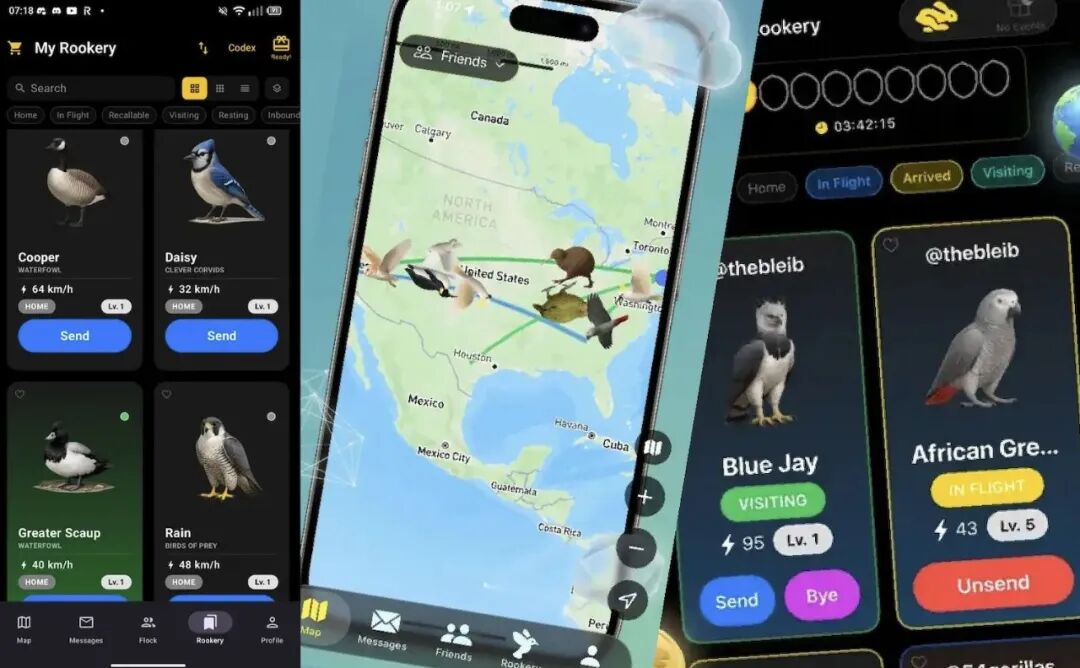
Users can choose to "raise birds" by themselves in the Roost app | Image source: Boing Boing
The nurturing system is another killer feature of Roost. Birds can be fed, upgraded, and trained for flying speed through mini-games, including a classic tribute "Flappy Pigeon" and a bullet shooter, as well as Tamagotchi-like pet care functions where you can bathe and groom your birds. The better you raise the bird, the faster it flies, and the earlier the message arrives.
Roost also has an anonymous pen pal feature called "Pen Pals". The system matches strangers by age group, and you can send a "bird message" to a stranger you have never met. In terms of privacy design, Roost only shows the city where the user is located to friends by default, without exposing the exact location; it does not even support sending pictures for now, and the reason is straightforward: the content moderation tool is not ready yet, so this feature will not be opened for the time being.
The real breakout point of Roost came from a Threads post.
An American mother posted a dynamic saying that her daughter and her friends wrote to each other in Elizabethan old English on an app that "sends messages with birds", which "made me laugh so hard". This single post pushed Roost from 10,000 users to 100,000 in three days. Five weeks later, the number of users was close to 300,000.
This detail is very important. Writing a message in Shakespeare's tone that takes 12 hours to deliver is not some "deep thinking of slow social", it is just a new way for young people to have fun.
Users on Roost are not pursuing the opposite of efficiency, they just think it's fun to do so.
The two apps were launched almost at the same time around April 2026. The developers do not know each other, and both claim to have conceived the concept independently. The fact that an idea appears in two unrelated people at the same time is not a random inspiration, but the emotion of the era.
03
The Evolution of "Slowness"
Products that use "slowness" to do communication content are actually not new, and there have been several waves of entrepreneurs trying similar projects before.
Slowly, this app has a group of loyal users in China, and there are many in-depth discussions on Zhihu.
The letter delivery time of Slowly is calculated according to the real geographical distance, which is logically closest to Carrier Pidge and Roost. It covers more than 180 countries around the world and has more than 9 million users. But Slowly is positioned as a "global pen pal platform", encouraging long letters and in-depth communication, with a stamp collection system, and its vibe is closer to a literary youth community. On Slowly, people write three paragraphs carefully to share their day, and wait two days to receive a reply that is equally carefully written.
Carrier Pidge and Roost represent a new stage. The fundamental difference between them and Slowly is that they do not pretend to be literary, and even deliberately "anti-literary". The developer of Carrier Pidge wrote in the product introduction "genuinely no practical use"; users of Roost send nonsense in Shakespeare's tone. They are not calling for "please slow down and think about life", but saying:
"Slowness" itself is great fun, no meaning is required.
The rising "SlowCial" movement in Europe and the United States | Image source: slowfoodhuronvalley.com
This also explains why "bird messaging" has exploded among Generation Z. Putting it into a larger cultural context, the resurgence of flip phones, the revival of iPods among young people, the long-term top ranking of the Forest screen-locking app, and BeReal's confrontation with polished photos, all these phenomena point to the same emotion.
Young people are not anti-technology, they are against the feeling of "being kidnapped by technology". They use the latest iPhone 16 to download an app that makes messages 22 hours slower, and watch a virtual pigeon fly slowly across the Pacific on the fastest 5G network. This contradiction itself is a declaration.
In an era when all apps are competing for who can push notifications faster, who can deliver messages more instantly, and who can tell you more accurately that "the other party is typing", Carrier Pidge and Roost have done a simple thing:
Turn "waiting" from anxiety into expectation.
The message is no longer "why didn't you reply after it arrived", but "the pigeon is still flying, and I don't know when it will arrive". This gives both the sender and the receiver a shared decent reason to say "no hurry".
04
The Business of "Slowness"
But how long can "fun" last? Can "slowness" become a real business model?
The current monetization method of Carrier Pidge is "replenishing pigeons": if your pigeon dies, you have to pay to buy a new one. Roost has launched paid subscriptions, and is doing retention through limited birds and weekly activities. From the perspective of product form, Roost's nurturing system and collection gameplay have a longer life cycle, while Carrier Pidge is more like an exquisite proof of concept.
However, both of them face the same problem. After the novelty of "delivering messages with birds" fades, how long can the daily active users last? When none of your friends are using this app anymore, your pigeon has nowhere to fly. The network effect of social products has become a double-edged sword here: growth comes fast through viral communication, but once it stagnates, it cools down just as quickly.
The deeper paradox is: When "slowness" is productized, monetized, and measured by KPIs, is it still the original "slowness"?
The nurturing system of Roost essentially creates another kind of efficiency anxiety. You train the bird to make it fly faster, you upgrade the rookery to unlock rarer species, and you log in every day to get weekly rewards. This logic is no different from all other apps that compete for your attention.
Just like meditation apps will eventually push notifications to urge you to meditate, once "anti-efficiency" becomes a business, it has already been swallowed up by the logic of efficiency.
This is probably the unavoidable fate of such products. Real "slowness" does not require an app, you just don't reply to the message. But people just need a virtual pigeon to do this for them.
Maybe what these young people really want to "pigeon" off is not the message itself, but the invisible social contract that "you must reply immediately".
A virtual pigeon that may die halfway gives everyone a decent excuse to say "no hurry".
It's just that this excuse itself may also have a 0.2% probability of disappearing while flying.
This article is from the WeChat public account "GeekPark" (ID: geekpark), written by Yuhangyuan, edited by Jingyu, and republished with authorization from 36Kr.