Refusing to be followers of Silicon Valley: Several young PhD candidates are betting on the integrated brain for bipedal humanoid robots
I was scrolling through social media platforms at home on the weekend when a video blew my mind.
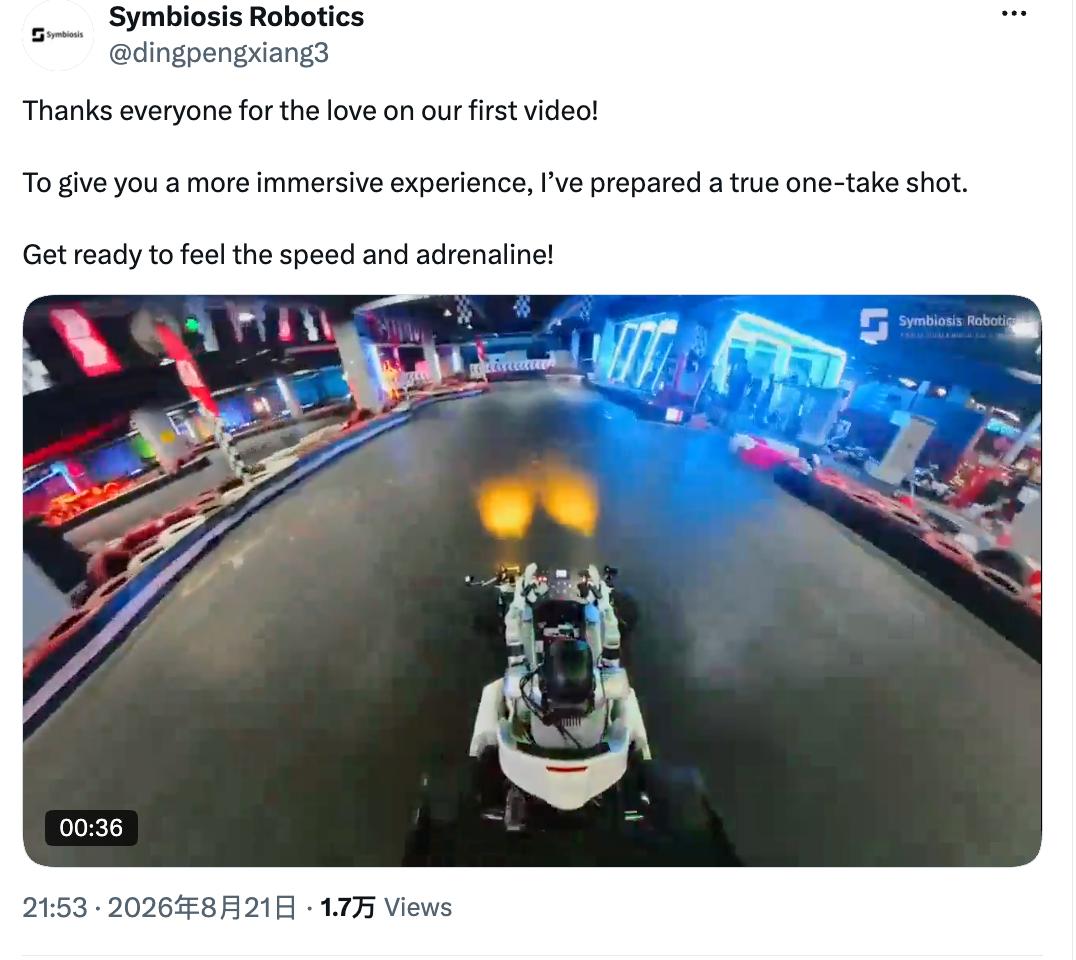
A robot driving a go-kart was speeding around the track, taking turns, accelerating, and steering in a single unbroken shot.
I never imagined our robots could now show off their skills on go-kart tracks!
Wait a minute?
This looks nothing like what I saw at WRC events!
Robots at exhibitions usually run around accompanied by sparks and flashes, I never expected that the robot in this video secretly signed up for a racing training course behind human backs!
It is a total seasoned pro, taking high-speed turns, nimbly avoiding obstacles, and finishing a full lap in one smooth go.
Compared to those past demos where robots slowly walk over and bend down to pick up objects, the robot in this video actually sits fully inside the vehicle, with synchronized coordination of hands, eyes and feet, completing multi-contact point balance and precise force control at full speed.
This kind of humanoid bipedal robot that can achieve full-body coordination of eyes, hands and feet, and complete detailed operations under high-speed movement and complex posture changes, has hardly ever appeared in previous humanoid robot demonstrations.
The team that released this video is a company called Symbiotic Robotics.
What Symbiotic Robotics develops is the end-to-end sensing and control integrated "brain" for bipedal humanoid robots, which is the foundation model.
Its founder Ding Pengxiang was born in 1996, all the other core team members are post-2000s generation, all of them are currently pursuing their doctoral degrees, and the company was just established two months ago.
Regarding this Demo that seems a bit "off the beaten track", Ding Pengxiang explained it this way:
I want robots to be more like humans, instead of only performing very mechanical service functions. Just as humans can drive go-karts, robots can do that too.
A question naturally arises: Why would a group of young people who haven't even got their graduation certificates dare to step into the most difficult and cutting-edge track in embodied intelligence?
Bet on the hardest path: Having researched hierarchical systems, they now challenge end-to-end architecture
How new is the track of "end-to-end" bipedal humanoid robot models?
It is so new that there are no existing qualified talents available on the market.
According to Ding Pengxiang, this direction only became popular in the past two years, people who understand the technology are still pursuing their PhDs, and they can hardly find people that meet their requirements from the talent pool.
Those who graduated many years ago can't keep up with the pace, and those who haven't completed their PhDs lack in-depth understanding of the underlying technologies. The most cutting-edge breakthroughs are in the hands of this group of top doctoral students.
The team of Symbiotic Robotics is exactly this group of young and cutting-edge practitioners.
They have won the most prestigious academic honor in China's embodied intelligence field — two Best Paper awards, with one more selected as a Best Paper Candidate; they have also built China's first embodied foundation model whose GitHub Stars have exceeded 2000.
More importantly, they are not followers after the trend came, but one of the earliest pioneers exploring embodied foundation models in China, and also the most steadfast long-term practitioners on this track. The team has published more than 40 papers in top academic conferences, with their technical coverage spanning the full stack of perception, decision-making, control, data and systems; a series of industry-first innovations ranging from dual systems, lightweight design to multi-configuration are all developed by this young team.
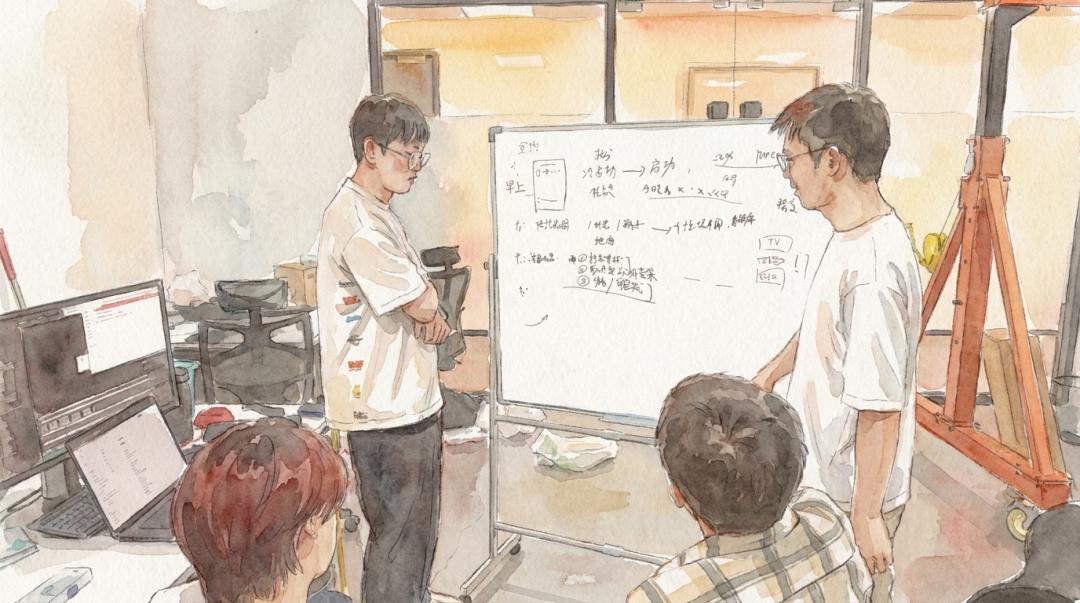
Their judgment is very clear: The form in which robots will eventually be most widely integrated into human life is bipedal.
Following the evolution path of autonomous driving and large models, end-to-end is the most efficient technical paradigm.
This judgment comes from their first-hand research experience.
As early as December 2023, Ding Pengxiang started to install "brains" for quadruped robots.
As the first author, he released QUAR-VLA, the first VLA task paradigm for quadruped robots, which allows the upper-layer model (brain) to take charge of understanding vision, language and task intentions, and then hand over the decision-making to the underlying motion system (cerebellum) for execution.
This hierarchical idea of "the brain managing decision-making and the cerebellum managing motion execution" is what the industry calls the hierarchical architecture, a solution that companies like Figure are still using today.
In the subsequent research, he gradually spotted the problems.
He described the hierarchical architecture as "a theoretically feasible but not very elegant solution":
The brain and the cerebellum operate independently. Every time a new task is received, the upstream output needs to be customized and fine-tuned to get the performance right.
More fundamentally, it has an inherent structural defect.
The brain and the cerebellum are trained separately and then combined during deployment. Even if every local part is optimized, it cannot guarantee the overall optimal performance.
Every translation between the two layers brings additional cascading errors and information loss.
Ding Pengxiang judged that "as long as the hierarchical architecture is adopted, there will be an information bottleneck in the middle, and this interface design determines that the hierarchical architecture cannot achieve true Scaling."
This judgment also comes from his long-term observation of the development of autonomous driving and large models.
Early autonomous driving relied on the collaboration of multiple modules including perception, prediction, planning and control, and later the industry began to explore letting models directly learn driving capabilities from data.
After Tesla FSD switched to end-to-end architecture, its performance improved significantly.
In Ding Pengxiang's view, robots may also experience similar changes, allowing models to learn the complete "perception-understanding-action" process from data.
His logic is that the hierarchical route has been fully tested repeatedly since 2023, and if it is judged that the future large-scale data will eventually push the system to the end-to-end direction, there is no need to take a detour again.
This transition is happening in 2026.
Google's Gemini Robotics 2 has used a single policy to unify full-body movements from feet to fingertips into one model;
However, the consensus of the top RSS 2026 conference states that the end-to-end single model cannot cover the complex dynamics of the whole body, and the hierarchical modularization is the optimal implementation scheme at the current stage.
The pure end-to-end architecture that Symbiotic Robotics bets on is a more radical, less traveled path.
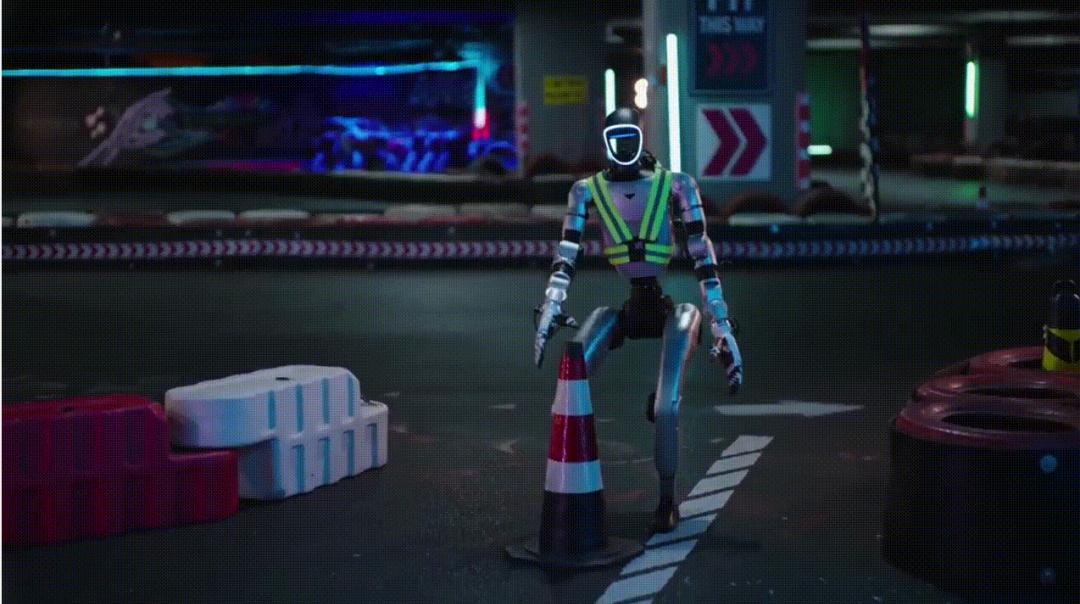
Why bipedal specifically? Ding Pengxiang's answer is first principles: The buildings, tools and environments in human society are all designed according to the body configuration of human beings.
Wheeled robots can only work in fixed production lines and shopping malls, while bipedal robots can go outdoors, climb stairs, drive vehicles, and complete different tasks across scenarios.
General versatility means diluted costs, and bipedal robots also have anthropomorphic friendliness.
Timing is also critical. Before April 2026, there was no general teleoperation model for bipedal humanoid robots, and no data source could be used to train the foundation model.
Until NVIDIA open-sourced Sonic, the industry had the cornerstone to generate data on a large scale.
This direction is no longer in the early stage of "no data available even if you want to train", and it is not yet mature enough for the technical routes to fully converge. Symbiotic Robotics is betting on this exact window of opportunity.
Technical watershed: While others are learning kinematics, they are delving into dynamics
First, clarify a key watershed: The vast majority of current robot foundation models actually learn kinematics.
Kinematics focuses on moving from point A to point B, where the hand moves to, and whether it grasps the target. This works fine for fixed-base robotic arms, because they cannot fall over.
When a bipedal robot reaches for an object, the center of gravity of its body changes at the same time.
When squatting down to pick up an object, the waist needs to lean forward, and the ankle and legs need to redistribute force to maintain balance.
When factors such as friction, collision, inertia and contact are added to the scenario, what the model faces is already a full-body dynamics system.
According to Ding Pengxiang, a g1 bipedal humanoid robot has 29 degrees of freedom, which is far more complex than the 7 degrees of freedom of a robotic arm.
In the past, robots learned "motion trajectories", while humanoid robots need to learn "how the body acts in the physical world".
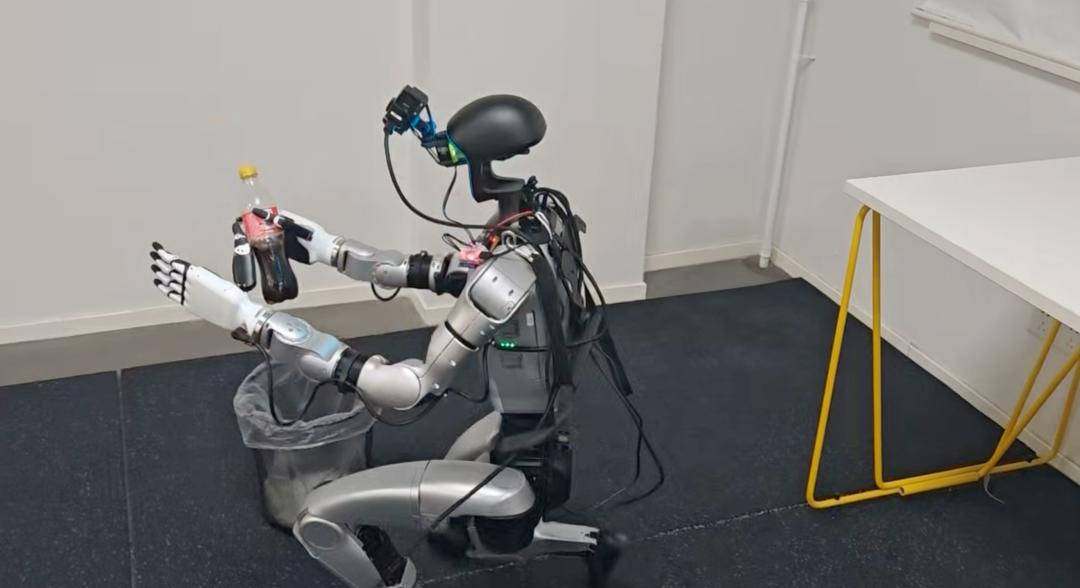
Shifting from kinematics to dynamics, from completing tasks to maintaining stability, this is the real technical watershed for bipedal robot models.
This explains why Symbiotic Robotics has developed its model all the way to Joint Target, which is the joint target layer.
In the hierarchical scheme, the brain first outputs kinematic targets, and the downstream cerebellum then solves them into joint movements.
Symbiotic Robotics removes this intermediate link, letting the model directly face the body states of dozens of joints.
The question naturally arises: Without the cerebellum, can the robot still stand stably?
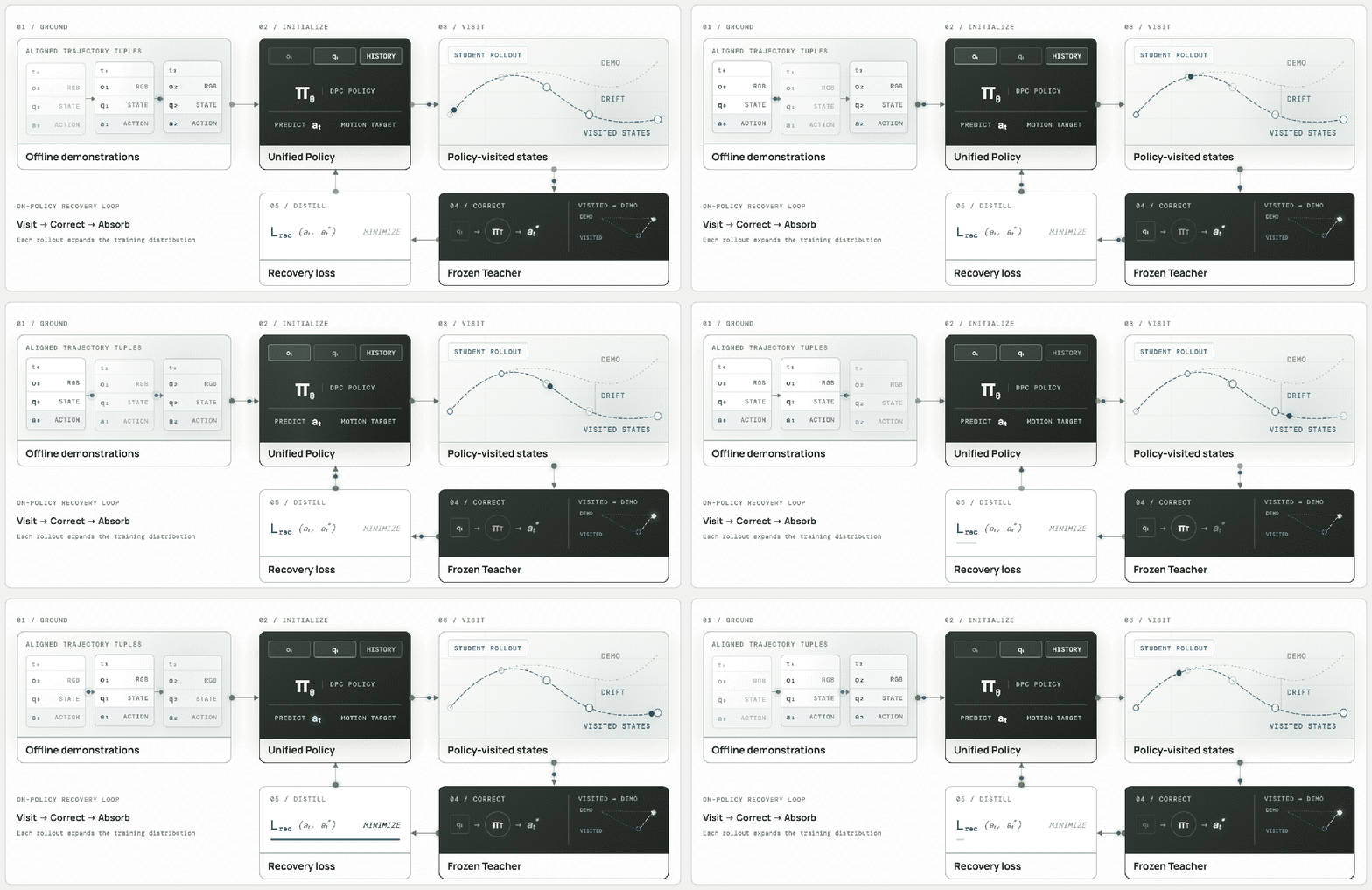
With imitation learning alone, the model only learns standard movements, and has never seen various staggering body states during execution, so it may fall directly when encountering unfamiliar states.
What it lacks is the ability to regain stability from failures.
The core technology of Symbiotic Robotics is a dual-domain collaborative optimization mechanism called "Task Behavior Modeling — Motion Prior Distillation".
One optimization path continues behavior cloning to ensure task accuracy and motion fitting ability; the other path uses DriftDistill to convert the stability, anti-disturbance and Failure Recovery capabilities accumulated by the underlying controller into the endogenous motion prior of the unified model.
It is not a simple superposition of two Loss functions, but integrates the two capabilities of "completing tasks accurately" and "controlling the body stably" into the same model, so that the large model obtains both task intelligence and physical body intelligence at the same time.
If DriftDistill can continue to expand with the model and the amount of data, it is trying to solve a larger problem:
Apart from cognitive Scaling, can robots also scale up their motion control capabilities at the same time.
Ding Pengxiang calls this motion capability aggregation module Motion Expert, which currently has a parameter scale close to 1B, and continuously absorbs the capabilities of different motion control models through distillation.
Going one step further, the end-to-end large model also needs to solve the problem of force output by the robot.
Most current robot systems mainly control position, but when robots truly enter the real world, correct position does not mean the task is completed.
The hand reaches the drawer handle, but the robot does not know how much force to apply, so the door still cannot be opened; when handing an object to a person, the position is correct, but excessive force is also unsafe.
The technical route of Symbiotic Robotics is to first take Force Expert as a safe contact expert, let it learn force application, compliance, impedance and contact feedback, and then gradually integrate it into Motion Expert and the final end-to-end model through policy distillation.
Position determines whether the robot can "get there", and force determines whether it can truly "get things done well".
This is also the meaning of Symbiotic Robotics' "full-body physical world model": Let the model understand how the body is stressed, loses balance and makes contact, and then turn these constraints directly into actions.
Data, emergence, and a realistic timeline
When the model is actually put into training, the first problem encountered is data shortage.
The total amount of compliant robot data worldwide was about 500,000 hours by the beginning of 2026, less than 1/20000 of the data volume of large language models.
The awkward fact is that a lot of collected data records stationary operation scenarios, where robots work in place in cubicles, which has very limited help for full-body mobile operations.
Symbiotic Robotics has released about more than 10,000 hours of data on its blog, with thousands of hours collected by themselves.
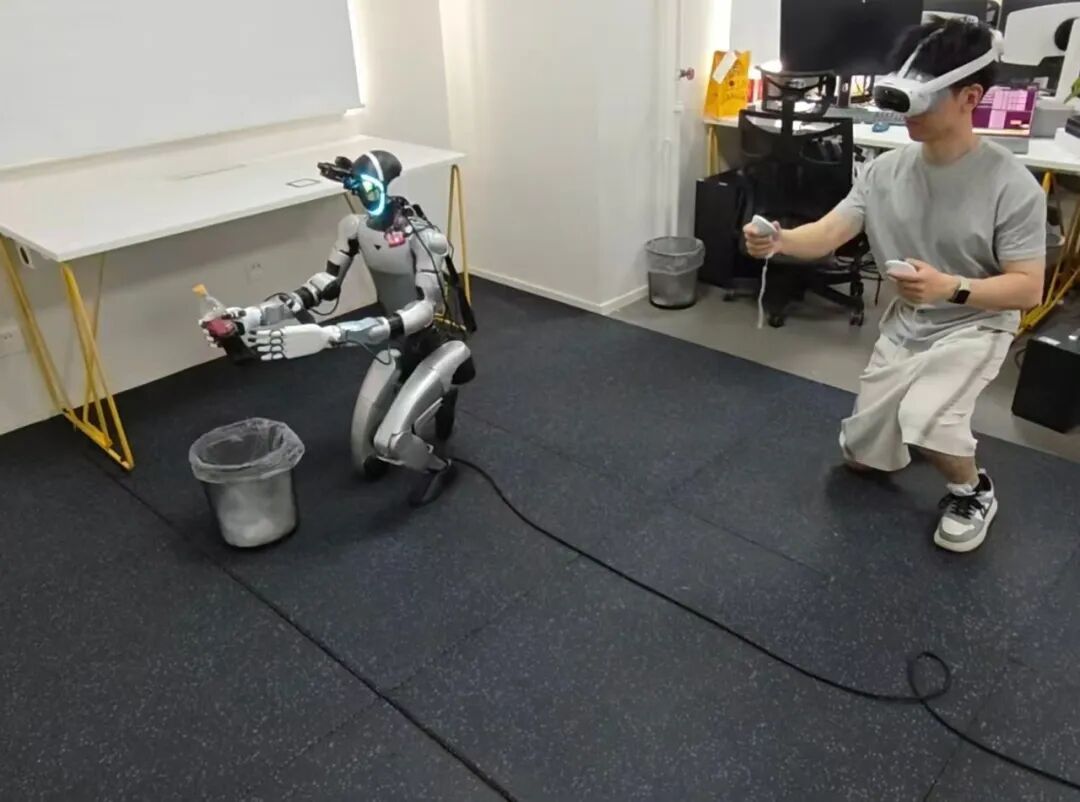
What is truly scarce for full-body coordination models is strongly coupled full-body mobile operation data in real life, such as riding a bicycle, driving a go-kart, pumping air into a basketball, and so on.
Their solution is TrajBooster: Extract the end-effector trajectory from a robotic arm or wheeled robot, let the humanoid robot track this trajectory and maintain balance in the simulation environment, unify actions from different sources into the same space, reuse the task diversity defined by the robotic arm, and provide pre-training data at low cost.
When talking about model capabilities, Ding Pengxiang hardly uses the word "generalization".
In his words, "this word is not very informative, as empty as describing a person as 'good'."
What he pursues is "emergence": At the joint angle level,