Your iPad can be instantly converted into a cellular-enabled version, and DJI's 4G module released five years ago has gone viral on Xiaohongshu, all thanks to AI?
Recently, Lei Tech (ID: leitech) has noticed that a new category of uniquely styled unboxing posts has emerged on Xiaohongshu. A small black box is connected to an iPad or MacBook via an adapter cable, usually with the caption "Your device can now make phone calls too".
What is even more unexpected is that this device that enables internet access for tablets and laptops is a 4G module from DJI. It was originally an accessory for drones, but users have found a completely new creative use for it.
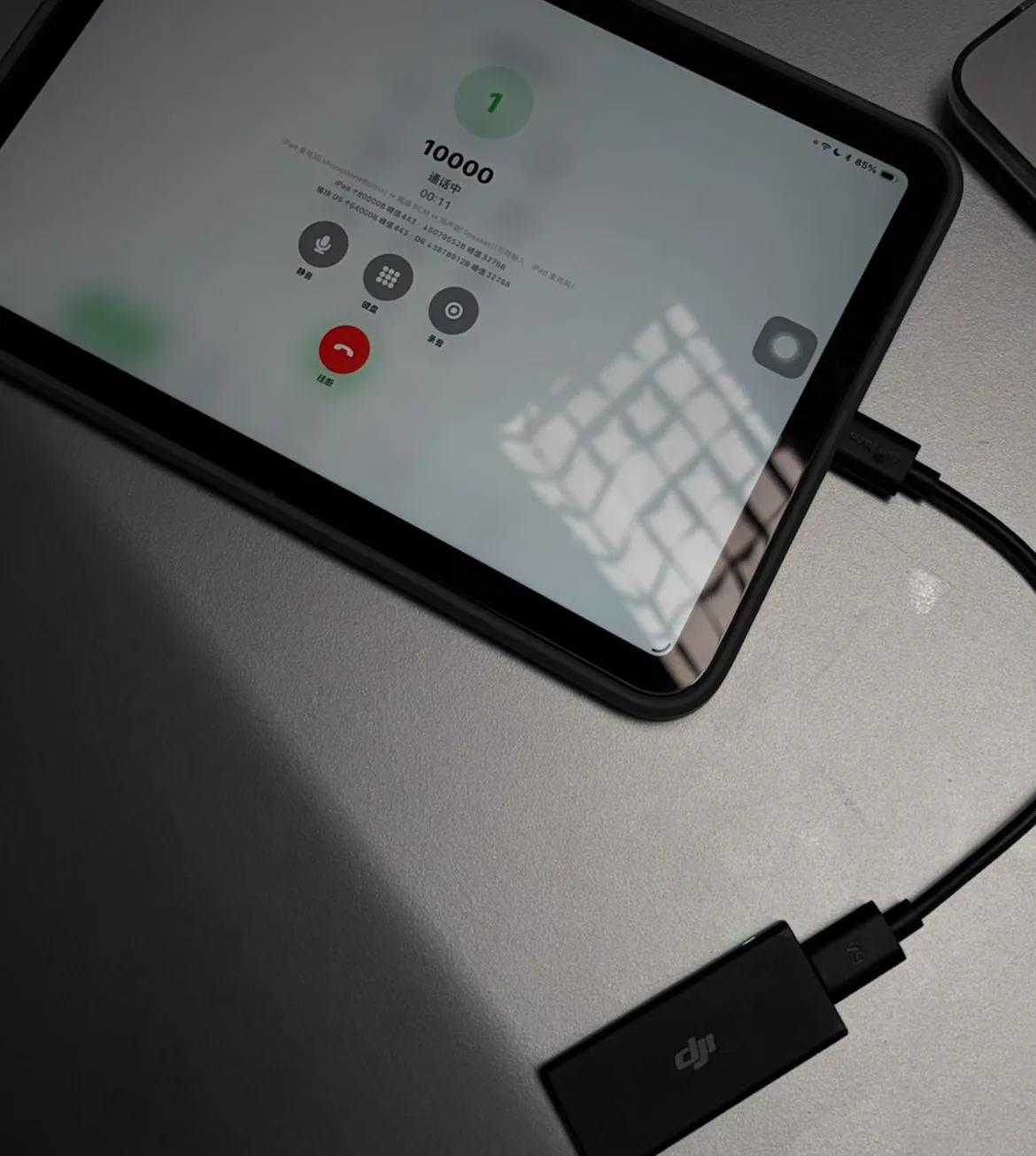
(Image source: Xiaohongshu)
Second-hand drone accessories suddenly go viral on Xiaohongshu
The DJI 4G module, originally a drone accessory embedded in aircraft like the Mavic 3, is responsible for transmitting footage and signals back to the ground via 4G network during beyond-visual-range flights. Now it has been developed for a new use case: acting as a mobile network terminal for iPads and MacBooks that do not have cellular network capabilities. It can access the internet once a SIM card is inserted, and with a data-channel-based calling method, the phone call function can also be realized. No one would have thought that a small accessory designed for drones could have such a usage.
Supporting tutorials have also been widely spread simultaneously. Complete tutorials covering everything from mode switching to driver installation can be found on platforms including Xiaohongshu, Douyin, Bilibili, and WeChat Official Accounts, with many users teaching others how to turn the 4G module into a USB network adapter. The comment sections under these posts have virtually become a small tech community, where some users share photos of their successful modifications, some ask for tutorials, and others inquire if the same trick can be applied to iPhones.
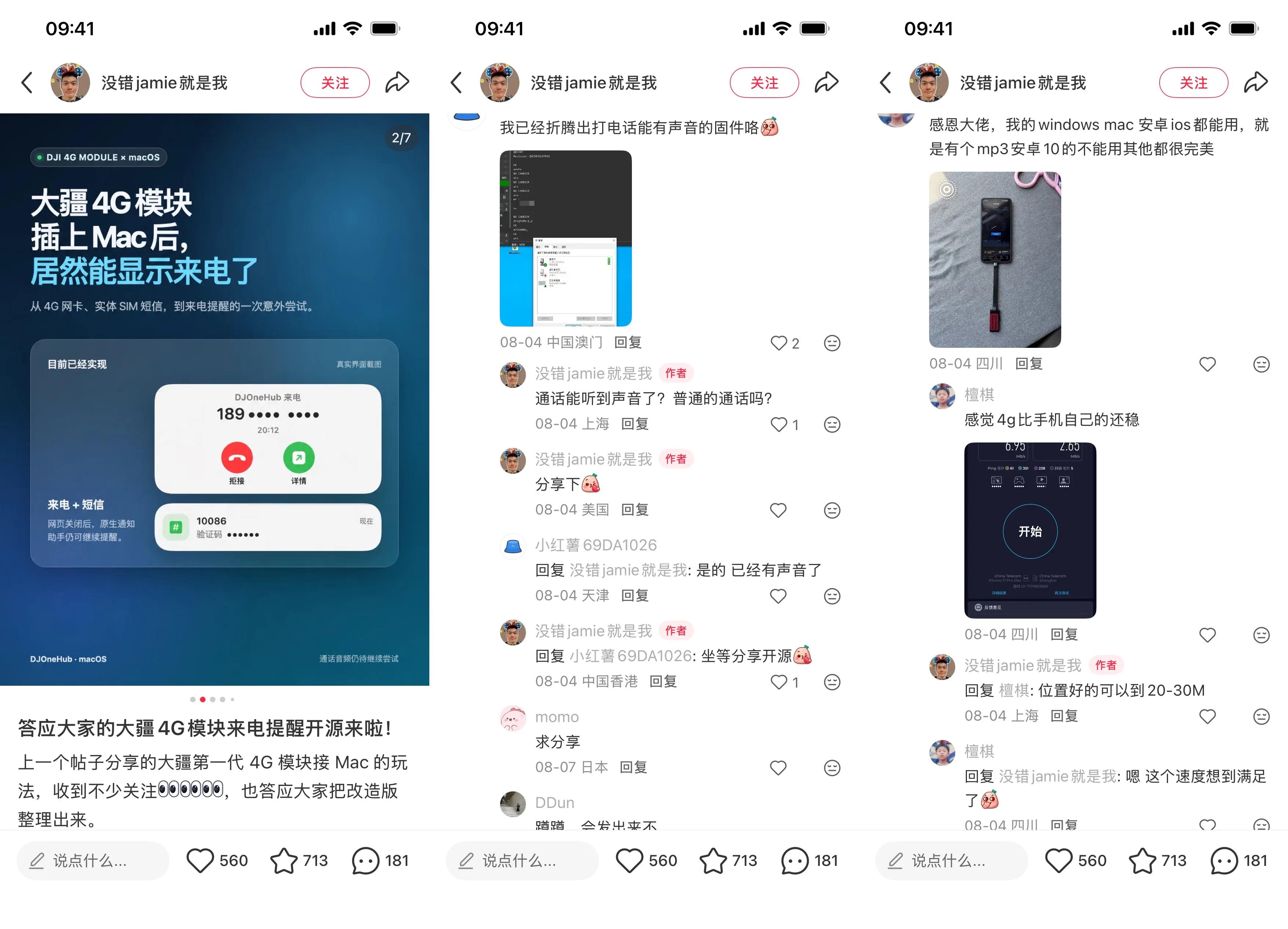
(Image source: Xiaohongshu)
As more people try this trick, the supply-demand relationship in the second-hand market has changed accordingly. Lei Tech (ID: leitech) noticed that this modification trend has made this previously overlooked second-hand product extremely popular. On e-commerce and second-hand platforms, the price of the first-generation DJI 4G transmission module has risen from 20-30 yuan to nearly 100 yuan, and units in good condition with short activation time can be sold for even higher prices.
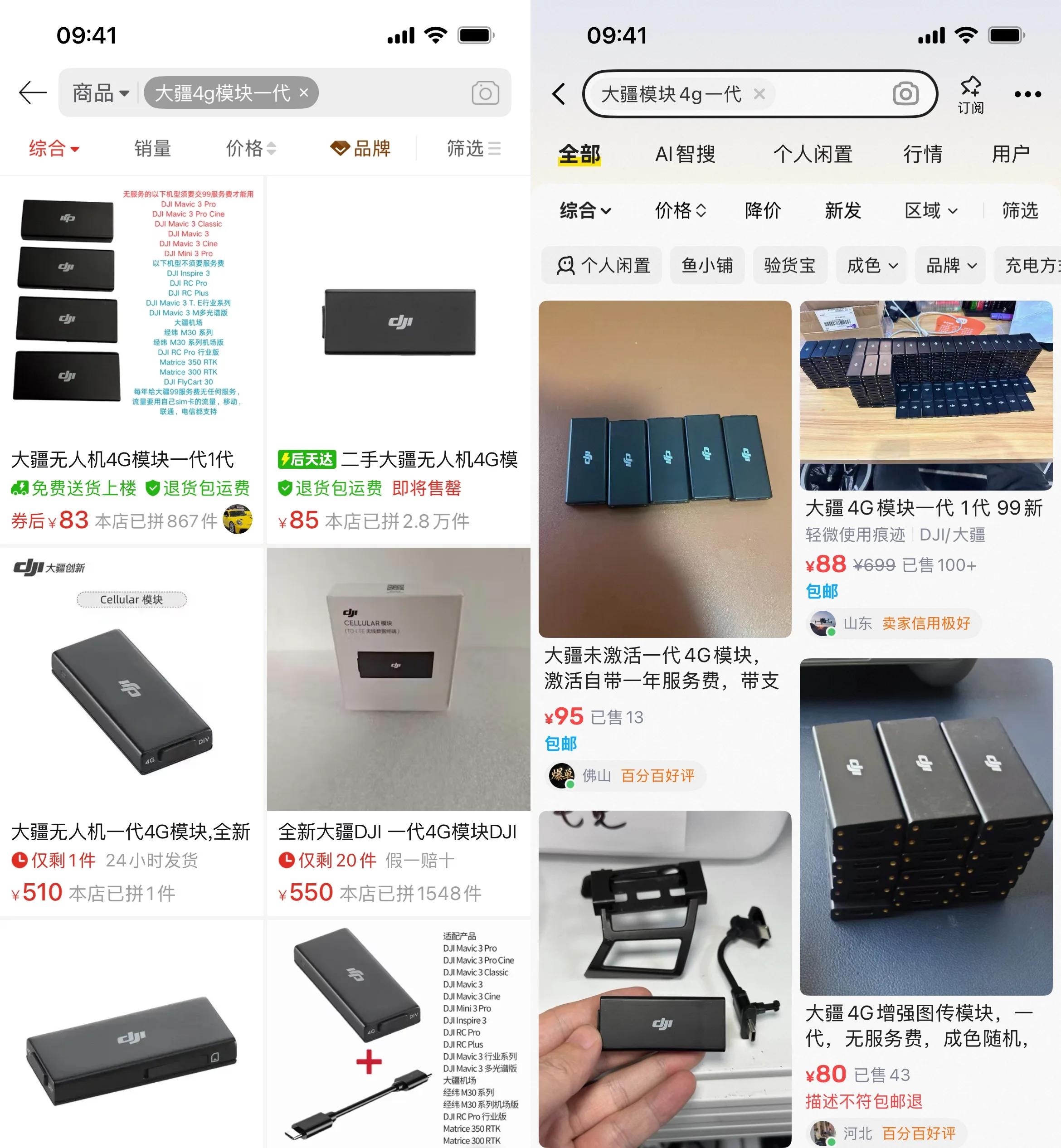
(Image source: e-commerce platform)
It is worth noting that this is not a new device. It is an accessory released alongside the Mavic 3 series in 2021, with an official price of 699 yuan. The Mavic 3 series sold in large volumes back then, and the supporting modules also had considerable shipments, but many drone players left them idle after using them only a few times. Before the modification trend became popular, it was a product that few people were willing to buy even for dozens of yuan on Xianyu. Now the price of the DJI 4G module has multiplied several times, individual sellers are getting fewer, and many professional sellers who hold stocks control the supply and pricing.
Why has this old accessory released nearly five years ago suddenly become popular again on Xiaohongshu? We will dive into the topic in the following content.
How did a drone accessory turn into an "Apple Peel"?
First, let's talk about the technical principle. This DJI 4G transmission module is officially named "DJI Cellular Module (TD-LTE Wireless Data Terminal)". The module contains a complete 4G communication solution: baseband, radio frequency, SIM card slot, and antenna, all fully equipped. Once a SIM card is inserted, it becomes a miniature internet terminal. To put it simply, it is essentially a standard 4G baseband plus radio frequency module, no different from the core components of an ordinary network adapter.
However, DJI has applied private encapsulation to it, restricting it to work only with its own drones and remote controllers. The SIM card and network configuration are all managed by DJI's system, and it is also bound to the enhanced transmission service. The official price of 699 yuan includes not only the hardware, but also this layer of ecological binding.
But for people who know the relevant expertise, this encapsulation is not difficult to crack. Some players have found that the module can be switched to the general modem mode with just one command. After switching, it is no longer an exclusive DJI accessory, but a standard USB 4G network adapter that can be recognized by any device that supports USB network cards.
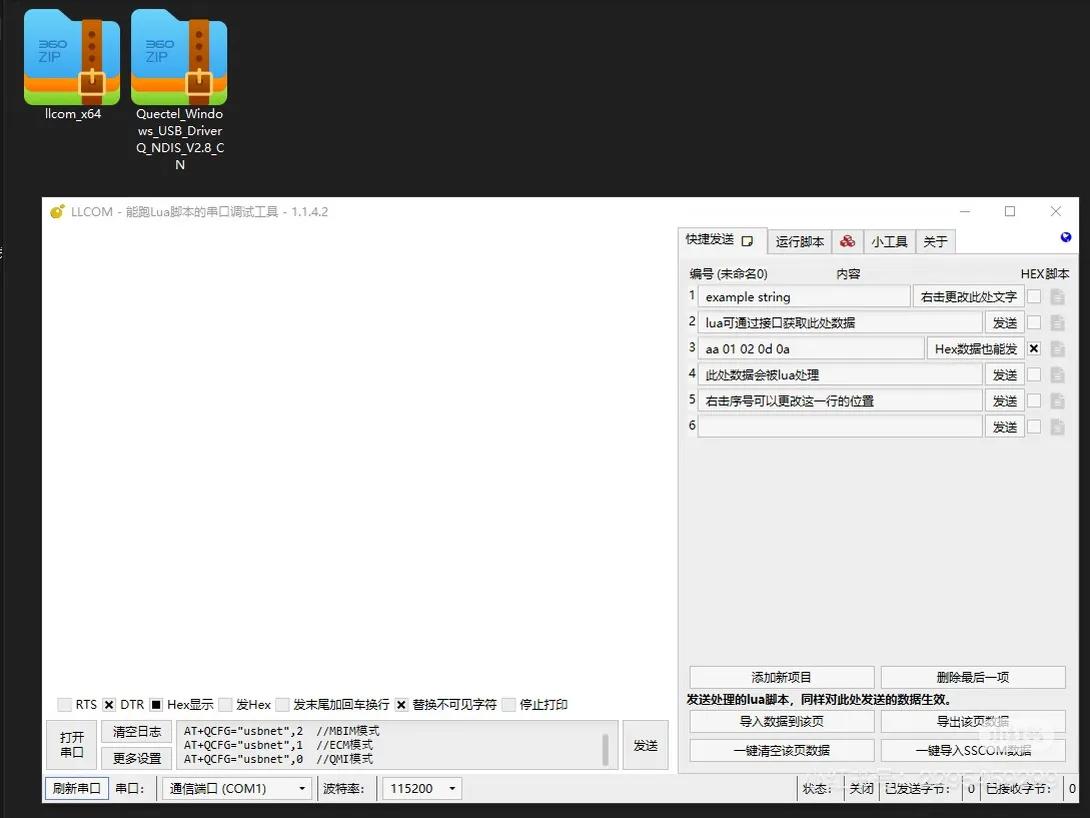
(Image source: Xiaohongshu)
The rest of the process follows naturally. After the iPad or MacBook is connected to the module via the USB port and the driver is installed, the system will recognize it as a network card, and you can dial up to access the internet once the SIM card is inserted. As for making phone calls, this 4G module does not have a voice function itself, but the hardware is not restricted, so the function can be realized with supporting software after cracking.
In fact, DJI has released several generations of 4G modules, but most users prefer to modify the first generation, simply because it was released earlier with an older firmware, and the community has fully researched it, with ready-made tutorials and tools available. The new generation modules are still bound to normally operating services, making them much harder to crack, so players have far less motivation to modify them.
It is worth mentioning that this 4G module can not only be used for tablets and computers, but also for iPhones. Of course, under normal circumstances, mobile phones come with built-in cellular network and voice functions, so plugging in a network adapter is unnecessary. However, some users have bought locked iPhones, many of which are locked iPhone Air models. Without a card slot installed with a sticker, the phone cannot use cellular networks. Now, by plugging in this 4G module, normal phone calls and internet access can be achieved.
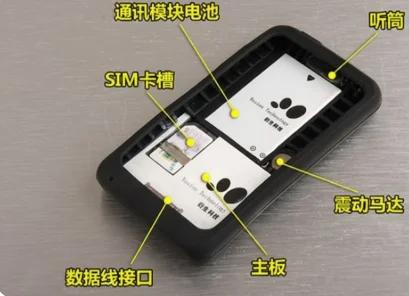
This usage reminds people of the "Apple Peel" peripheral from more than a decade ago. In 2011, a peripheral called Apple Peel became popular for a period. When you put it on an iPod touch and insert a SIM card, it enabled this "iPhone that cannot make calls" to realize call and SMS functions, though a dedicated supporting app had to be installed back then, which drove all the call and SMS features. At that time, an iPod touch 4 only cost more than 1000 yuan, plus an Apple Peel priced at around 500 yuan, the total cost was only about 2000 yuan.
The official price of the iPhone 4 at that time was 4999 yuan, but due to insufficient supply, the scalper price reached 7000 to 8000 yuan or even over 10000 yuan. However, the Apple Peel of that year had obvious shortcomings. It was implemented through cracking, only supported 2G network, and did not support the 3G network that was just starting to gain popularity at the time, leading to a much worse internet experience.
(Image source: e-commerce platform)
However, for ordinary people, there is actually no need to follow the trend and buy a 4G module for modification. First of all, it has a certain technical threshold. Although the tutorials seem to only require entering commands, every step including mode switching, driver installation and network configuration may run into problems. Secondly, there are many alternative solutions in real life. Mobile phone hotspots and portable WiFi can both solve the temporary internet access problem for iPads and MacBooks, and the total cost may not be higher than that of a second-hand module plus the monthly SIM card fee.
In addition, the price gap between Wi-Fi version and cellular version iPads is generally between 1000 and 2000 yuan. If you really need a cellular network, it is more worry-free to buy the cellular version directly at the beginning, so you do not need to carry an external module around, and do not have to worry about the overheating and high power consumption of the module after long hours of operation.
To put it bluntly, this usage is most suitable for hobbyists who love tinkering. Saving money is not the priority for them. The sense of achievement after overcoming all kinds of problems and completing the modification matters more, which is itself a kind of DIY fun. Nowadays, when mobile phone systems are locked and cannot be flashed, and the prices of PC DIY components are skyrocketing, this kind of happiness obtained with just dozens of yuan is very rare.
AI tools play a big role in old device modification
In the view of Lei Tech (ID: leitech), there are two reasons why the 4G module modification trend became popular: one is that the demand does exist, and the other is that AI tools have reduced the cost of modification.
Let's look at the demand first. This modification does hit the pain points of some users. Many iPad users bought the Wi-Fi version to save money at first, but after using it for a long time, they find it inconvenient to connect to hotspots when going out. For MacBook, the situation is even more straightforward, none of its product lines have a cellular version. A module costing dozens of yuan can give these devices independent internet access, without the need to carry an extra portable WiFi. The starting price of second-hand modules at just dozens of yuan also makes users willing to buy one for fun, without worrying too much about the loss if it does not work.
The popularization of AI tools has greatly lowered the threshold for ordinary users to DIY and modify devices. A few years ago, turning a drone module into a general 4G network adapter required knowledge of USB protocols, driver development skills, and the ability to adjust network interfaces, which was a task that only geek hobbyists could handle, and ordinary users did not even know where to start. In the past, the process of tinkering with such things was to visit forums, read technical documents, browse driver source code on GitHub, and you had to check every line of code yourself when compilation errors occurred. Even setting up the compilation environment could deter a large number of people.
Now all these steps can be handed over to AI. Many novice users on Xiaohongshu directly submit their demands to Agent tools like Codex, describe the needs in natural language, tell the tool the chip model and interface information of the module, and let it generate the driver and switching tool by itself. If an error occurs, users can directly copy and paste the error code and log, and the AI can find the problem and provide a solution on its own.
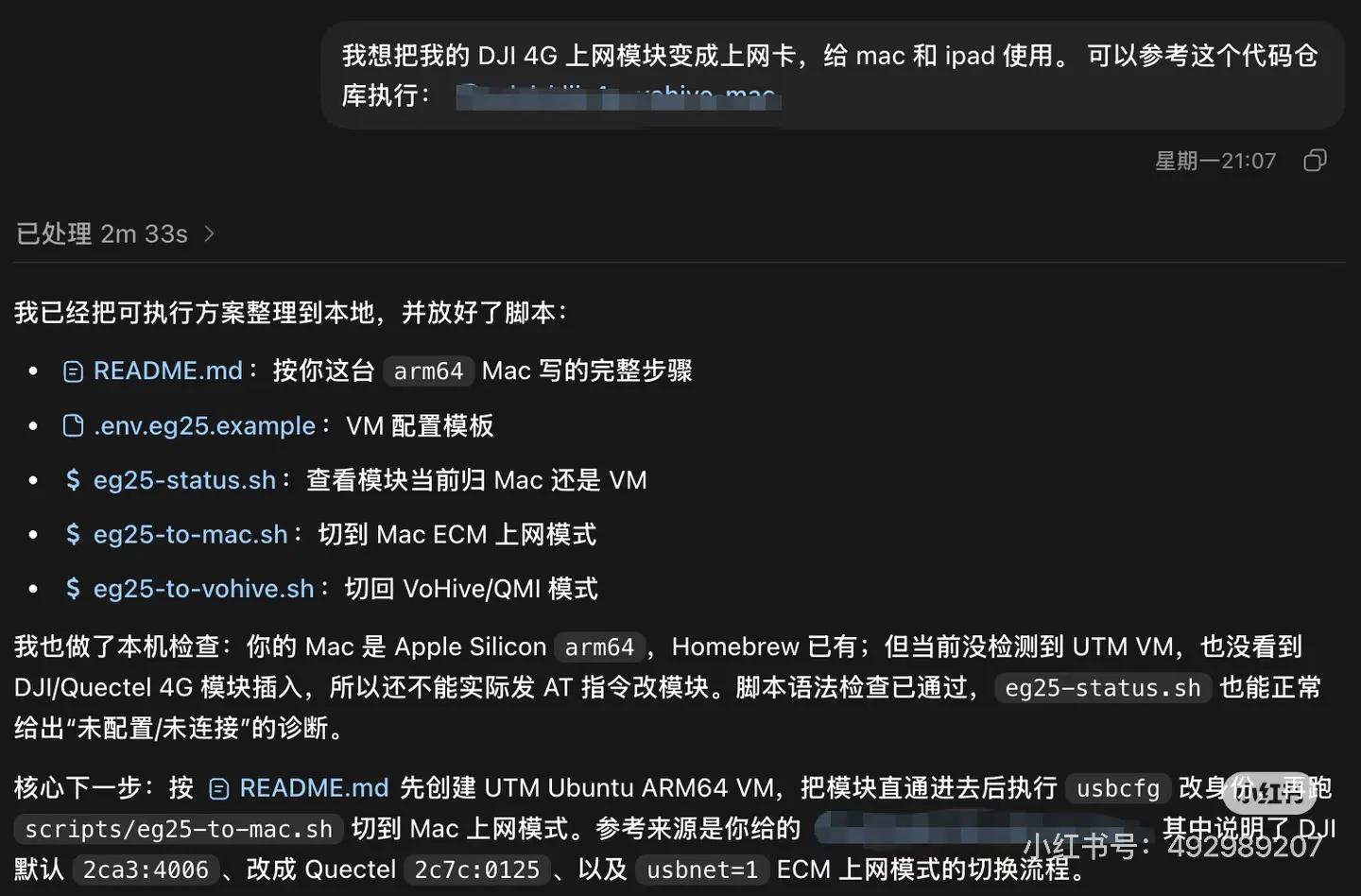
(Image source: Xiaohongshu)
In the past two years, AI tools themselves have also evolved. From helping users write a few lines of code in the early days, to tools like Codex that can now read error reports, modify and retry automatically. When you assign a task to it, the Agent can complete the entire process on its own. Writing drivers is exactly the type of task it is good at.
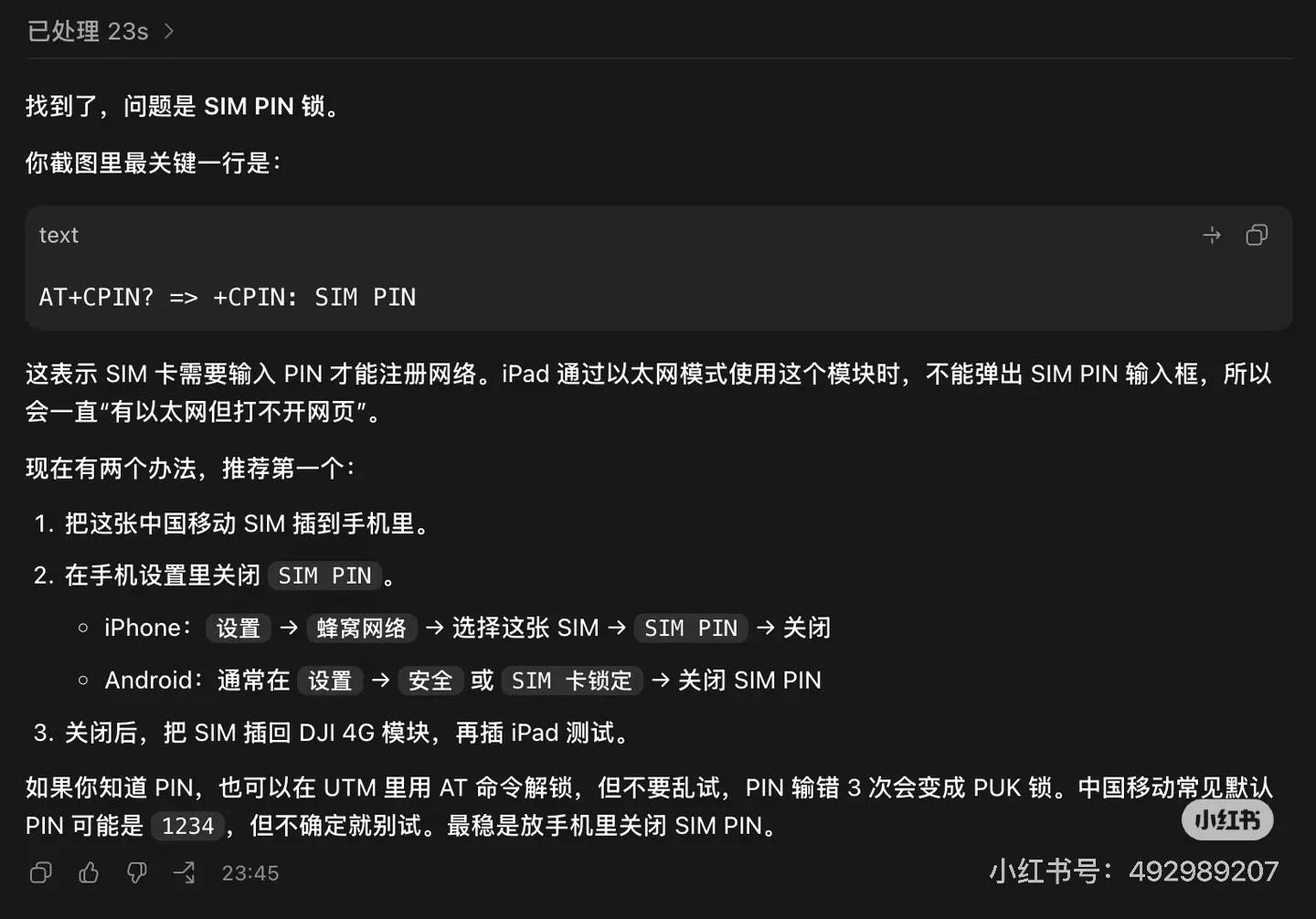
(Image source: Xiaohongshu)
In the past few years, we have seen many cases where AI lowers the threshold of content creation and software development, and now this trend is also happening in the hardware tinkering field, which used to have a high entry barrier.
When an ordinary person can turn a drone accessory into a network device for a tablet with the help of AI, the fun of low-cost DIY is no longer the privilege of a small number of technical players. Apart from this 4G module modification, we have also seen people use AI tools to flash firmware for routers. Users can complete the task by themselves, but AI can replace humans to finish many tedious steps.
Another feature of this wave of posts is that what users share is not that they bought a new product, but more about "I made this happen with my own hands". The sense of achievement after successful modification, plus the natural sharing and communication attributes of platforms like Xiaohongshu, itself makes the 4G module modification a highly trending topic.
Of course, despite all the excitement, for the vast majority of people, this module costing dozens of yuan is just something to tinker with for two days after purchase, and it will most likely be left unused when the interest fades. The second-hand price rising from 20-30 yuan to nearly 100 yuan is definitely driven by the herd mentality. But from another perspective, the fact that AI makes more people willing to try tinkering with hardware is already quite remarkable.
This article is from "Lei Tech", published with authorization from 36Kr.