Post-2000s Tsinghua doctoral student launches a "neural interface" startup: turning human muscle reactions into tokens
A new path has emerged for embodied AI data collection.
Before the formal introduction, let's do a quick interaction: put aside AI, do not check any references, how many existing embodied data collection methods can you name within 5 seconds?
Real robot teleoperation collection, ontology-free portable collection (UMI/Ego), simulated synthetic data, and internet video distillation are the four most mainstream approaches.
(The order does not represent priority, this is a casual list I made)
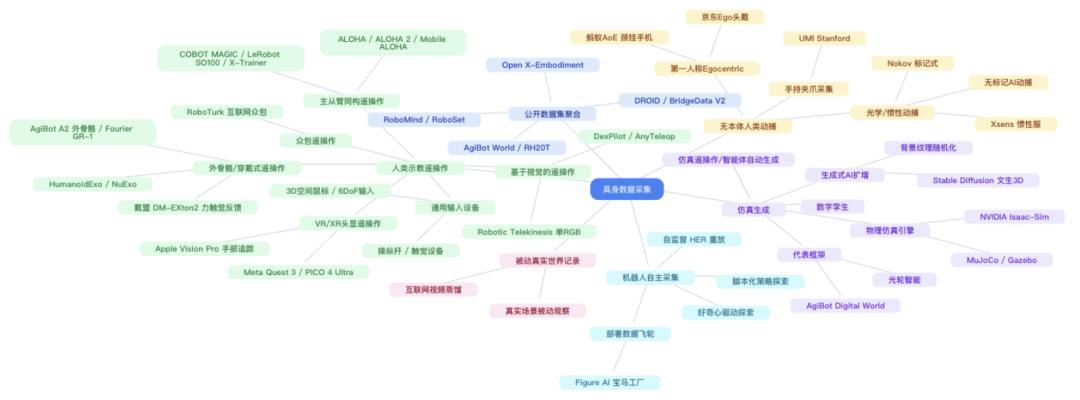
If you want to classify them in more detail, you can list a long checklist.
At least that's the answer AI gave me, you can take a look —
Recently, a new route has emerged and gradually gained popularity. This approach shifts the focus of data collection from external motions further to the human body's motion output side.
This is the highly concerned surface electromyography (sEMG) solution.
OriginFlow is the hottest and most sought-after startup in this track.
Qin Shentao, Founder and CEO, was born in 2001, and is currently a PhD candidate at the School of Vehicle and Mobility, Tsinghua University.
In August last year, he founded OriginFlow in Beijing; as of May this year, the company has publicly disclosed that it has successively completed angel round, strategic round and Pre-A1 round financing, with a total amount of more than 500 million RMB, and investors include BlueRun Ventures, Oasis, Monolith, etc.
Qin Shentao told us:
There is a missing layer of capability between real industrial scenarios and models that can abstract unstructured, high-precision, physically complex interaction information into trainable representations.
Therefore, he started his own business to build Physical AGI infrastructure, aiming to take sEMG as one of the entry points for embodied data collection.
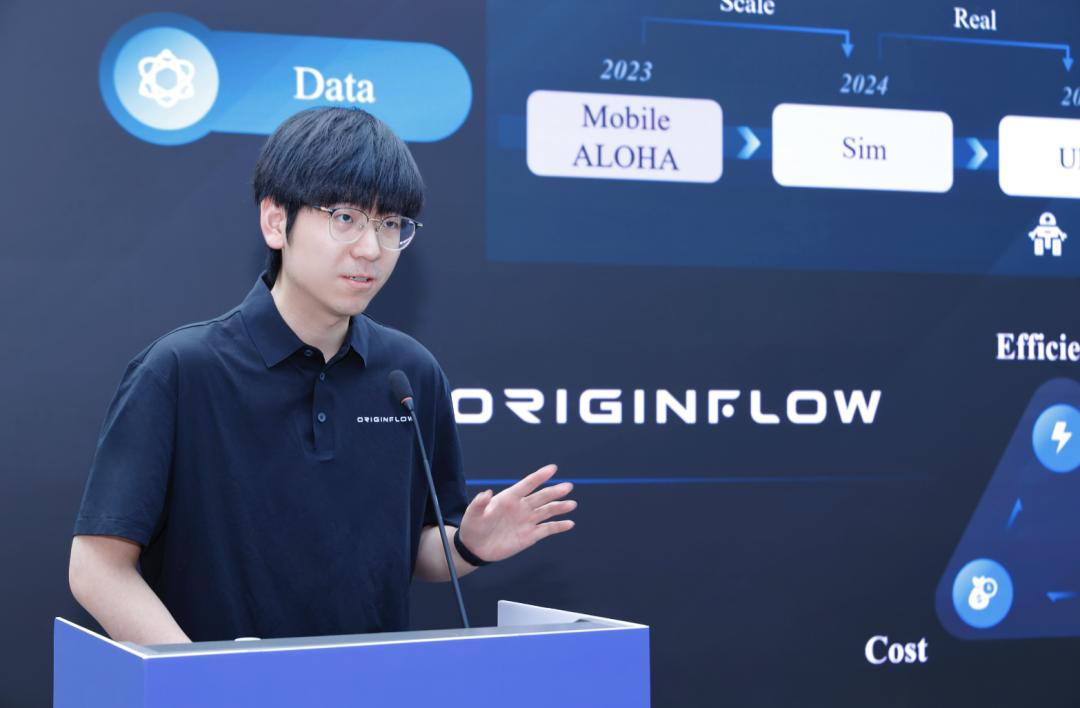
Qin Shentao said that in the short term, for UMI solutions and Ego first-person vision solutions, NeuroScale is more of an incremental supplement; but non-intrusive data collection is definitely an important trend in the future.
When new changes arise, the more appropriate strategy is to evolve synergistically with existing technologies.
Collect embodied data through "neural interfaces"
First, let's get a close sense of what OriginFlow is doing at this stage.
When a person tightens a screw, steadily holds a bowl of soup, or grips a soft object, the body constantly gives tiny feedback according to the actual situation.
When do the fingers start to squeeze? How does the force increase or decrease? ... In fact, people do not think carefully about these issues one by one. In a very short time, the body can complete and execute a series of judgments about contact, friction, weight and stability.
OriginFlow hopes to record the reactions involved in this process as part of the embodied AI data.

The reason for betting on this direction dates back to Qin Shentao's undergraduate years.
During his undergraduate studies, Qin Shentao led his team to win almost all the robotics competition championships available; it was also during his undergraduate period that he came up with further thinking:
Keyboard, mouse and voice are not the most direct way for humans to communicate with machines. Human hands are the most flexible tools. If machines can understand the real intentions behind hand movements, human-computer interaction will reach a whole new level.
As a result, neural interfaces came into the view of Qin Shentao, who has a strong obsession with human-machine integration.
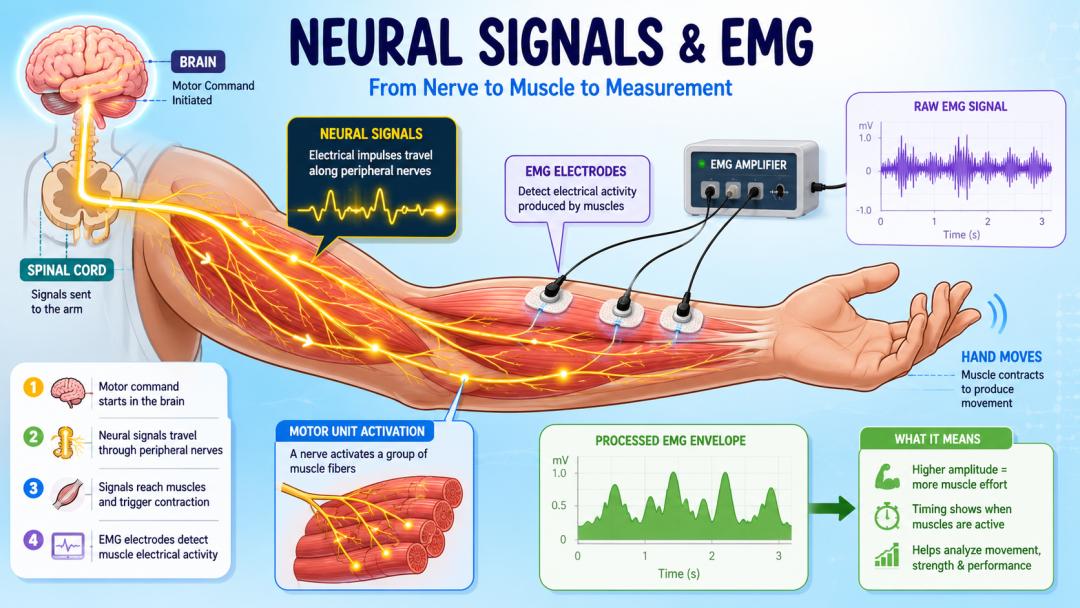
Neural interfaces collect surface electrical signals related to peripheral motor nerves (that is, sEMG signals), avoiding the problems of high invasiveness, high channel count and brain region mapping in brain-computer interfaces.
Since the official birth of sEMG, it has long been limited to university laboratories.
Later, with the iteration of wireless sensing, dry electrodes and AI algorithms, sEMG began to be used as an entry point for human motion intention perception, and was widely applied in biofeedback training for rehabilitation medicine, motion competition action analysis, occupational work fatigue assessment, and discrete motion control of myoelectric prostheses.
△
Take a typical example ~
In 2019, Meta's core R&D department Reality Labs acquired CTR-Labs, a non-invasive neural interface company.
Before the acquisition, CTR-Labs had released a developer kit, including a main device the size of a watch and a tethered component containing electrodes.
It uses 16-channel EMG sensors to monitor the myoelectric signals transmitted from motor neurons to fingers at the wrist, and uses AI algorithms to decode these signals into digital commands (such as clicks, swipes, gestures, etc.).
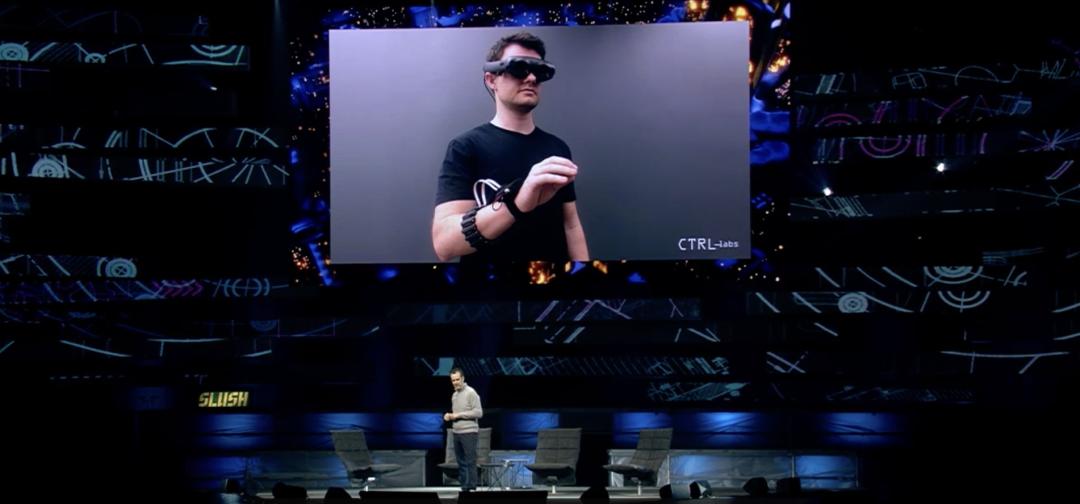
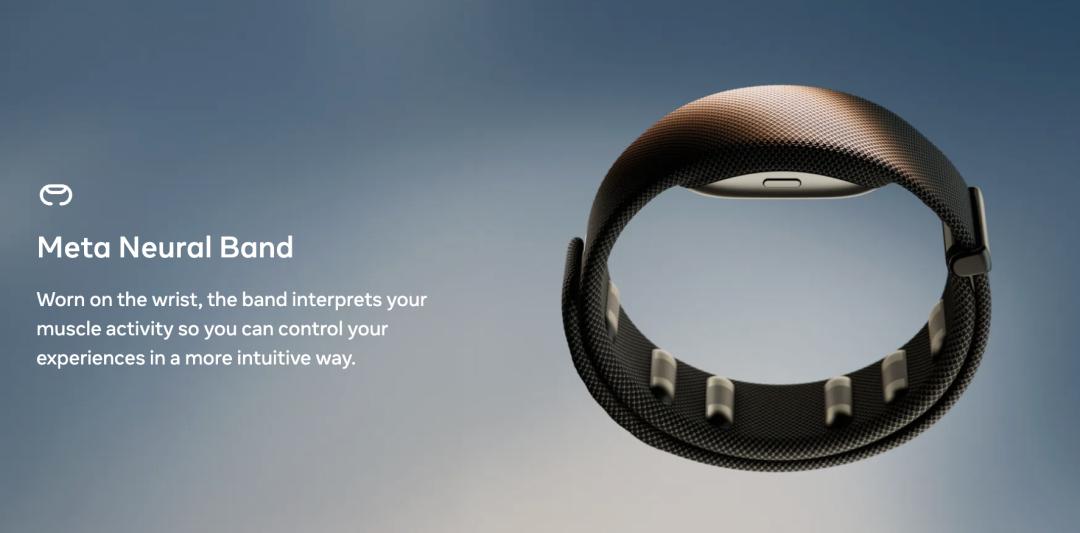
Two years later, Meta publicly demonstrated for the first time the neural interface wristband prototype Meta Neural Band based on CTR-Labs technology, showing its potential to control AR interfaces by capturing tiny neural signals, such as typing in the air and selecting menus.
Mark Zuckerberg said at the time that because it can accurately perceive the user's movement intentions even before the action is made, this interaction method is "almost infinitely controllable".
Last year, Meta's third-generation smart glasses introduced a neural input wristband, allowing users to directly control the interface on the glasses through hand movements (imagining swiping and clicking).
(An off-topic note: The "pinch" gesture on Apple Watch to confirm and close windows is mainly based on optical sensors)
Different from Meta's focus on making it more convenient for people to click, swipe or input text, Qin Shentao's thinking focuses on the missing conditions for Physical AGI.
In his view, first of all, the current extreme lack of high-quality physical interaction data has become the key constraint for the advancement of embodied intelligent robots.
Current embodied data collection methods all have their own drawbacks. Can we take sEMG as an entry point to make further supplements?
Moreover, choosing sEMG collection may bypass the differences in materials and sensors of specific contact surfaces, starting from the respective driving sides of humans and machines, to find a shared motion representation that can connect muscle activation, tendon force and joint motion.
Data collection starts with a wristband
In 2025, Qin Shentao, a PhD candidate, officially started his business and registered OriginFlow, with the vision of building a "motion foundation" beyond text and video for Physical AGI.
Soon, the team proposed the NeuroScale technology system.
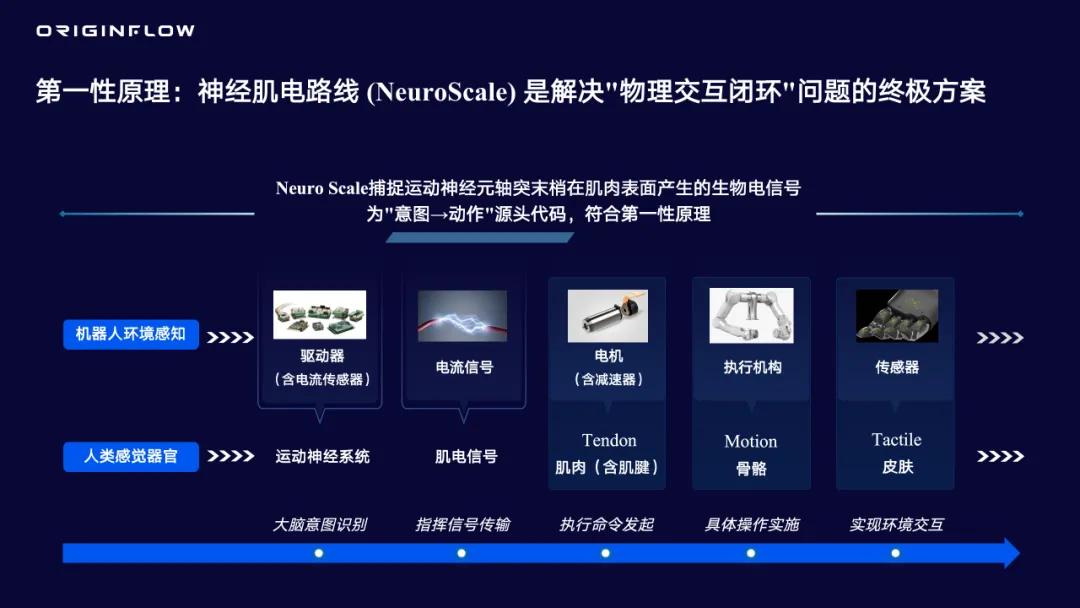
NeuroScale is not simply adding a myoelectric wristband to existing embodied data collection devices.
It is a complete data and model system covering signal collection, physical quantity reconstruction, motion representation and cross-embodiment transfer.
This system takes the non-invasive neuromotor interface as the signal entry point, integrates multi-modal information such as sEMG, first-person vision and IMU, reconstructs the posture, contact force and driving force in human operation through the PULSE foundational model, and organizes a real operation into machine-learnable Human Tokens.
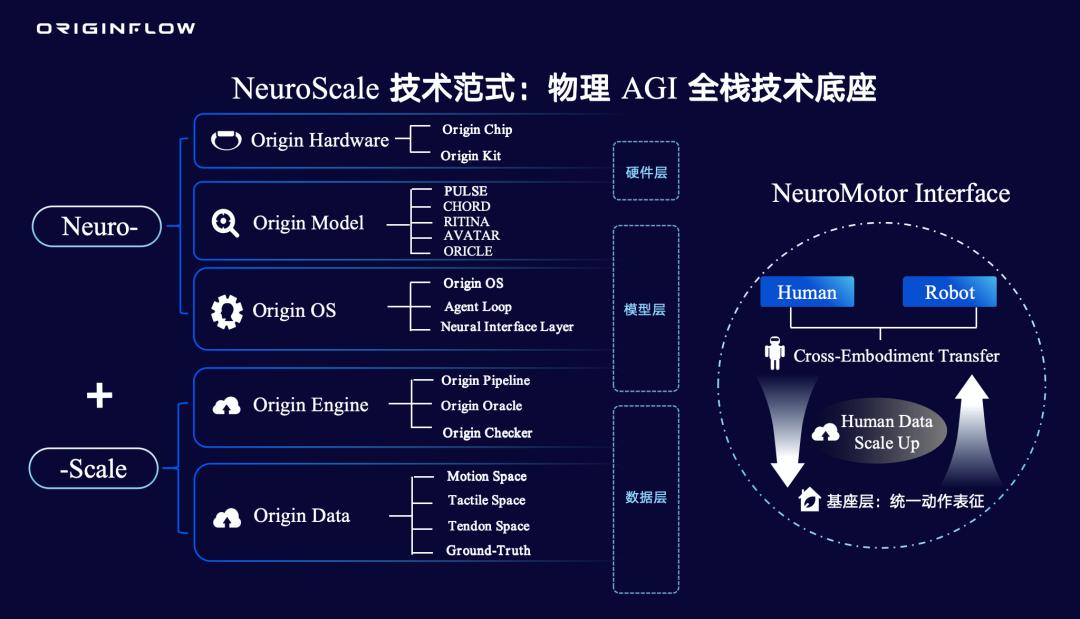
NeuroScale focuses on two core issues in the long run.
First, how to realize Human Data Scale Up?
That is, on the premise of not disturbing people's natural perception and motion as much as possible, continuously record real operations to produce more high-quality physical interaction data.
Second, how to realize Cross-Embodiment Transfer between Human and Robot, so that human motion experience can be adapted after representation and applied to robots of different structures.
Under these two issues, there is a more fundamental technical problem: in what form should human motions be input into the foundational model?
Text has formed a relatively mature Token representation, and vision has gradually converged to Patch or Latent representation, but the motion modality still lacks a universally recognized standard representation.
OriginFlow disassembles a physical operation into three interrelated spaces:
MotionSpace, which describes hand posture and motion trajectory
TactileSpace, which describes normal force, tangential force and contact feedback
TendonSpace, which describes muscle, tendon driving force and joint torque
Driving force generates motion, motion brings contact, and contact finally forms acting force. The three together form a physical causal chain.
The Human Tokens defined by OriginFlow are exactly the motion representation built on these three types of physical quantities.
"Formally, a human can be regarded as a special case in the embodiment configuration space. Therefore, the transfer from 'human to robot' is essentially a sub-problem of 'cross-embodiment transfer'." Qin Shentao said.
Specifically, large-scale Human Data is responsible for covering as wide a distribution of human motions and skills as possible; Cross-Embodiment Data with a relatively small scale but sufficiently diverse robot configurations provides alignment anchors between humans and different robot embodiments.
After the two types of data are combined, the model has the opportunity to learn a set of shared motion representations that are decoupled from specific embodiments, and then redirect the same segment of human motion and force information to robot embodiments with different degrees of freedom and different driving methods.
Therefore, OriginFlow does not want to directly copy human operation data to robots, but first finds the shared motion, driving force and contact relationships between different embodiments, and then completes adaptation and mapping.
In the real world, NeuroScale starts with a wristband.
The wristband is named OriginKitGen 1.0. It is designed to be slightly wider than the Apple Watch strap, but the overall volume is smaller and the weight is lighter.
The wristband is responsible for collecting the microvolt-level sEMG signals emitted by the wearer. Its system adopts 16-channel acquisition with an information bit rate of about 96KB per second, and continuously models hand motions.
However, the implementation of NeuroScale does not only rely on the wristband.
Relying only on the wristband, the system can only know the changes of forearm muscle activity, but it is difficult to judge what exactly the fingers are doing.
The signals collected by OriginKitGen 1.0 will enter the NeuroScale data link together with first-person vision, IMU and other information.
After the original waveforms are aligned, calibrated and processed, the team's self-developed foundational model PULSE extracts the clues related to hand posture, motion trajectory, contact force and tendon force — corresponding to the three core physical quantities of Motion Space, Tactile Space and Tendon Space respectively — the hardware end performs filtering, differentiation and motion artifact suppression, and the model end performs neural signal coding and strong supervision learning — to gradually organize them into machine-learnable motion representations.
This is what the team calls Human Tokens.
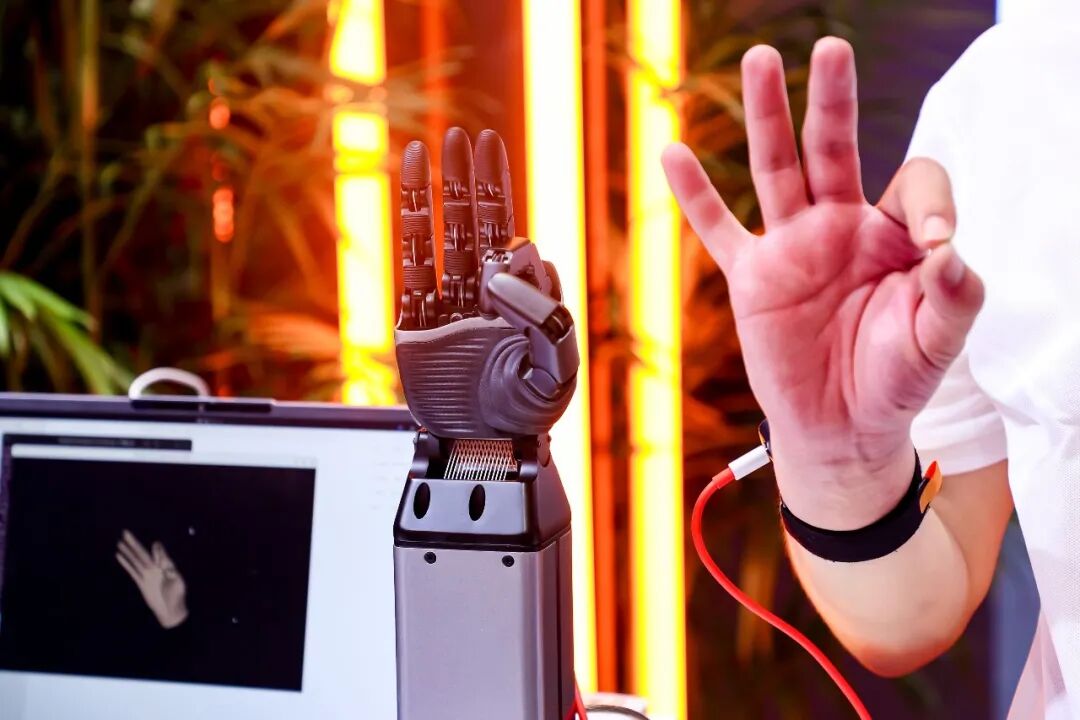
During WAIC, Qin Shentao and his team demonstrated the current results, the demo of PULSE version 0.2:
The wristband is responsible for collecting 16-channel sEMG signals. Taking these signals as input, PULSE continuously models hand motions and observes the force changes in the finger-to-finger movement.
Different from discrete gesture recognition, PULSE focuses on continuous hand tracking and fingertip force representation.
When the user performs a finger-to-finger movement, the system can observe the force change in real time.
However, reconstructing motion from a segment of neural signal does not mean that you have obtained data that can be directly used for robot training.
The original data still needs to go through multi-device clock alignment, individual calibration, motion artifact processing, task segmentation, motion and force annotation, quality screening and cross-embodiment mapping.
To this end, OriginFlow has also built a set of Data Infra covering data production, processing, evaluation and training.
Among them, ORACLE uses a multi-modal model to complete automatic annotation of motion, force, semantics and task segments; the full-modal unified foundational model CHORD is responsible for the timing and representation alignment between sEMG, vision, IMU, language and robot states.
The data will go through quality checks of physical validity, task validity, annotation validity, model value and real machine evaluation in sequence