Why didn't the more powerful GLM-5.3 dominate social media feeds?
On August 14, Zhipu AI released its new flagship model GLM-5.3. On August 19, the official API was opened for calls, with pricing aligned with that of GLM-5.2.
GLM-5.3 inherits the base model of GLM-5.2, and mainly enhances its capabilities in Coding, long-range Agent, and cybersecurity by scaling up post-training. At present, the model has been made available to all users of the GLM Coding Plan, and integrated into mainstream programming tools including ZCode, Claude Code, and OpenCode. The model weights will be open-sourced next Friday.
According to test results, GLM-5.3 has achieved remarkable progress. In the latest comprehensive intelligence index released by Artificial Analysis, GLM-5.3 scored 60 points, entering the global cutting-edge model tier, which is at the same level as closed-source flagships such as Claude Fable 5 and GPT-5.6 Sol, and ties for first place among open-source models with Kimi K3. In addition, according to the single-task cost statistics from Artificial Analysis, GLM-5.3 is a low-cost performer among models in the same tier.
However, the improvement of model capabilities has not brought the same level of market popularity as its previous generations. When GLM-5.1 was released in April, Zhipu AI's closing share price rose by 11.5%; after the launch of GLM-5.2 in June, its share price increased by another 32.8%. But on the day GLM-5.3 was released, Zhipu AI's share price dropped by 3.6%. The industry discussion volume after the model's release is also far lower than that of previous flagship launches. The model is clearly more powerful, so why has it not become the market focus again?
This contrast does not mean that GLM-5.3 has not become stronger. Instead, it indicates that against the backdrop of intensive iteration of domestic models and rapidly narrowing capability gaps, leading model benchmark scores can hardly excite the market anymore. For Zhipu AI, the more critical question is how much differentiated advantage can a more powerful model still bring? And can this advantage continue to be translated into products and revenue?
01. How much progress has GLM-5.3 made?
The most notable change of GLM-5.3 is the relatively obvious performance improvement achieved by scaling up post-training. In simple terms, Zhipu AI did not retrain a larger base model from scratch, but let the existing model train repeatedly in a more complex environment that is closer to real work scenarios to further "deepen" its existing capabilities.
Zeng Xiaojian, a large model researcher, told AIX Finance that pre-training is more about increasing the "content the model has read", while post-training is about increasing the "tasks the model has completed". The model not only continues to learn knowledge, but also enters real environments to perform tasks, obtains feedback, and then adjusts its practices based on the results.
Supporting this round of post-training is a set of training methods developed earlier. IndexShare mainly reduces the computational cost of long contexts; SAO allows a task to enter the training process immediately after completion, without waiting for all tasks in the batch to finish; the slime framework separates the two processes of model task execution and model update based on results, reducing idle computing power caused by the difference in time consumption of different tasks.
Zeng Xiaojian gave an example: assuming that among 100 Agent tasks, 80 can be completed in ten minutes, 15 take half an hour, and the last 5 take two hours to run. Traditional training methods require all tasks in this batch to be completed before proceeding to the next step, and the tasks that finish earlier can only wait for the 5 slowest ones, resulting in idle expensive GPUs. The new framework no longer waits for all tasks to "hand in papers" at the same time, which can reduce waiting time and improve computing power utilization.
After the training efficiency is improved, there must be enough "exercises" for the model to practice. GLM-5.3 has built a process that automatically generates training environments. The Research Agent is responsible for finding tasks from real work scenarios, and then the Judge Agent runs the tasks personally to confirm that the tasks can indeed be completed; the system will also check whether the model uses scoring loopholes to take shortcuts. It can be understood that AI generates, tests, and verifies the questions by itself, and then sends the qualified questions to the training process.
With this general premise clarified, let's take a closer look at the areas where GLM-5.3 has made progress.
The effect of this set of methods is first reflected in programming capabilities. Judging from the benchmark test results, the items where GLM-5.3 has achieved significant improvements are mostly related to long-range software engineering, terminal operation, and automated tasks. For example, in DeepSWE v1.1, which focuses on long-range software engineering, its score increased from 46.2 points of the previous generation to 66.9 points. This shows that GLM-5.3 is better able to complete a complex task from start to finish. It can understand an unfamiliar project, locate problems by itself, call tools, modify code, and continue to make corrections based on test results.
Zhipu AI's own Code Bench also emphasizes this point. This set of tests directly places the model in a local development environment, with tasks of different difficulty levels. At the highest difficulty level, GLM-5.3 achieved a score of 34.5% with an average output of about 75,000 tokens, while GLM-5.2 required about 96,000 tokens and only scored 23.4%.
Zeng Xiaojian believes that the improvement of completion rate accompanied by a drop in token consumption is more noteworthy than a simple rise in benchmark scores, which indicates that the model has learned to explore more efficiently, rather than exchanging scores for longer thinking time.
The experience of independent developer Li Ran also confirms this change. He believes that GLM-5.3 has made obvious progress compared with GLM-5.2, and the Goal Mode of ZCode is the function that impresses him the most. Given a target, the model will continue to advance, check and verify until the task is completed, and the reliability of long tasks is higher than that of the previous generation.
Another more prominent improvement lies in cybersecurity. In ExploitBench, which tests the reasoning of vulnerability exploitation, the score of GLM-5.3 increased from 24.4% of the previous generation to 54.4%, more than doubling. Security tasks require the model not only to understand the code, but also to judge where the vulnerability is hidden and how to trigger it, which puts higher requirements on code understanding, tool calling, and long-range planning.
This capability has also been applied to real projects. Zhipu AI officially mentioned that since GLM-5.2, Zhipu AI has cooperated with many domestic security institutions to continuously use the model to find vulnerabilities in real projects. By the time GLM-5.3 was released, after expert review, screening, and deduplication, a total of 2436 vulnerabilities had been found covering 269 projects, of which 1097 were medium and high-risk issues, and some vulnerabilities had existed for decades.
Overall, the changes of GLM-5.3 compared to its previous generation are: its programming capabilities are closer to full engineering tasks, the stability of long tasks has been improved, and the progress in cybersecurity capabilities is particularly significant.
However, to judge whether a model has competitive advantages, it needs to be compared with its peers in the same period. We selected the latest flagship models from Alibaba, Moonshot AI, and DeepSeek as references, on the one hand, because these models have all been updated recently, and on the other hand, Coding, Agent, and long-range tasks are also the key directions they are all investing in.
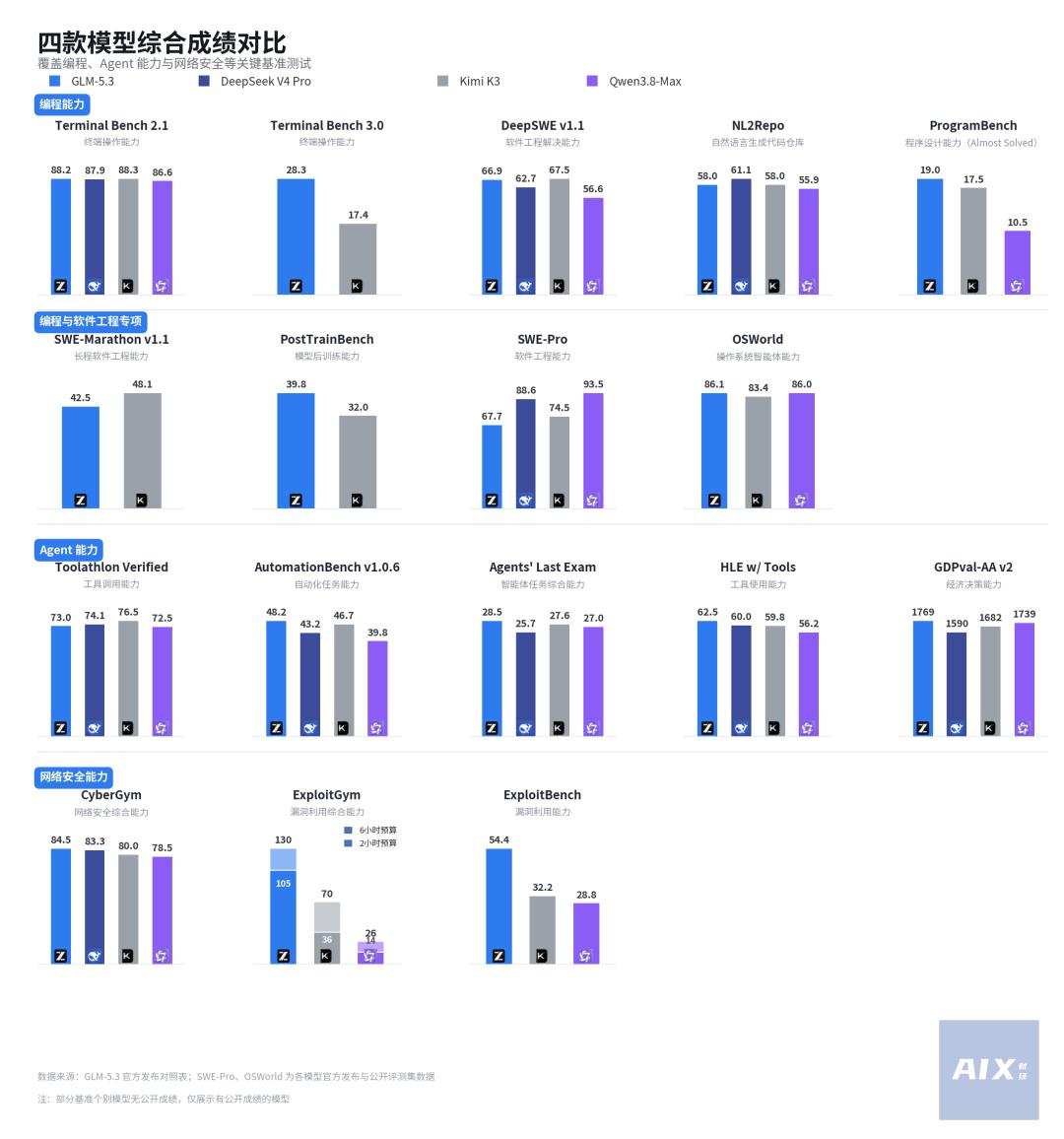
Judging only from the scores, GLM-5.3 does have many first places, among which the advantage in cybersecurity is the most obvious; Coding and long-range Agent have also entered the first tier, but there is no obvious gap compared with Kimi K3 and DeepSeek V4 Pro.
Then look at the advantages of each player. DeepSeek V4 Pro still has advantages in comprehensive capabilities and pricing; Kimi K3 competes almost head-to-head with GLM-5.3 in long-range software engineering, and has native multimodal capabilities with more complete capability coverage; although Qwen3.8-Max does not have advantages in some benchmark scores, it is backed by the Alibaba ecosystem, which gives it a better foundation in enterprise workflows and application implementation.
Therefore, GLM-53 is indeed more powerful, but it has not formed an advantage that other domestic flagship models in the same period cannot catch up with in the short term.
02. It is increasingly difficult for large model releases to create a "hit product"
So why has the improvement of GLM-5.3's capabilities not brought the same level of dissemination?
One direct reason is that the upgrade direction it chose is relatively "professional". The two main directions of this round of update are programming capabilities, which mainly serve developers; and cybersecurity capabilities, whose audience is mainly security researchers and enterprise customers. The capabilities are very practical, but the audience is relatively concentrated.
This is misaligned with user expectations before the release of GLM-5.3. Earlier, Tang Jie, founder of Zhipu AI, solicited user expectations for the new model on X, and visual and multimodal capabilities were the most popular directions. The reason is not difficult to understand: more and more Agent tasks now are not just processing text. To make a web page, you need to view screenshots; to modify the UI, you need to understand the design draft; analysis reports may contain charts and PDFs, and even when writing code, you often need to make adjustments according to the page effect.
Li Ran mentioned that many development tasks are actually difficult to describe completely in words, especially page design and creative coding. With visual capabilities, the model can directly "see the result" without repeatedly translating requirements into text. In his actual use, GLM-5.3 performs well in conventional code tasks, with a level higher than Kimi K3 and slightly lower than GPT-5.6 Sol, but in scenarios that rely on visual feedback such as game generation and creative coding, the experience is relatively average, and there have even been cases where the generated page buttons are all skewed.
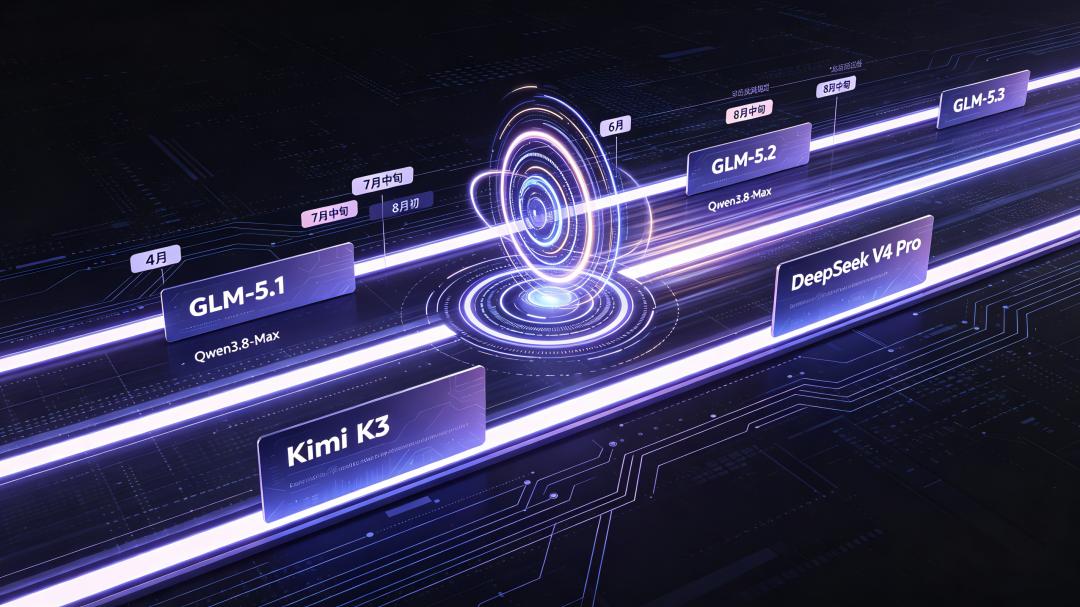
A greater change is that the novelty of new models is being rapidly consumed by the intensive release rhythm. Zhipu AI alone released GLM-5.1 in April, updated GLM-5.2 in June, and launched GLM-5.3 on August 14, basically maintaining a flagship iteration every two months or so. Its peers are certainly not idle. Kimi K3 was launched in mid-July, Qwen3.8-Max followed in early August, and the official version of DeepSeek V4 Pro was released in mid-August.
Source / AI Generated
In less than a month, four domestic flagship models were released in succession. A model that just took the lead with benchmark scores will be overtaken by a new version in just a few weeks.
As the release frequency increases, the gold content of the "first place" is no longer as high as before. Two years ago, when a company suddenly caught up with or even surpassed overseas flagship models in a certain core capability, it would easily become a hot industry event. Now, leading domestic models have basically reached a similar capability range. Zhipu AI has pushed Coding forward this time, the next generation of Kimi may also continue to strengthen long-range software engineering, and DeepSeek can also quickly catch up with Agent tasks after completing post-training. The leading window period has begun to be calculated in weeks.
Behind the convergence of capabilities, all players are solving the same problem. Coding requires better training environments and high-quality code data, Agent requires longer task trajectories and tool calling training, and multimodal requires supplementary understanding of information such as images and videos. After one company verifies an effective path, peers will soon invest computing power, data, and engineering resources. The result is that everyone is focusing on improving Coding, emphasizing Agent, lengthening contexts, and supplementing multimodal capabilities. The direction in which GLM-5.3 has been improved happens to be the most crowded competitive track.
The threshold for a "hit product" has therefore become higher. Relying only on capability improvement is no longer enough, and there must be a topic point that "others do not have". Taking the official version of DeepSeek V4 Pro, which was released almost at the same time as GLM-5.3, as an example, DeepSeek also open-sourced its first Harness product at the same time, focusing on "everything is a plug-in", creating a new topic for conventional upgrades through the gameplay that models, tools, and Agent running components can all be recombined.
In this light, it is almost inevitable that GLM-5.3 did not achieve the same level of dissemination popularity as before. Its capability improvement did not exceed expectations, it avoided the multimodal capability that users most want, and its release node coincided with the launch of DeepSeek's new product.
03. Beyond GLM, what else does Zhipu AI need?
Back to the company level, what really affects long-term value is whether the growth driven by programming advantages in the past can continue.
In September 2025, Zhipu AI launched the GLM Coding Plan. After entering the GLM-5 series, it continued to strengthen its programming and long-range task capabilities, and further launched the programming tool ZCode. Developers are willing to pay for efficiency, and programming has become the fastest-growing scenario for Zhipu AI's API, which has initially verified the connection between model capabilities, user calls, and commercial revenue.
However, the first-mover advantage that Zhipu AI gained in the early stage is weakening. Other domestic manufacturers have taken programming as the upgrade direction for their flagship models, and developers have more and more models to choose from. In addition, Zhipu AI is also bidding farewell to the strategy of acquiring customers at low prices. When GLM Coding Plan was first launched, the entry price was only 20 yuan per month. After full opening for purchase at the end of July, the price of the Lite version has risen to 118 yuan per month. At the same time, it has adopted a point system, with upper limits set for every 5 hours and per week.
The price increase has realistic reasons. Coding Agent consumes more tokens than ordinary chat, and a long task may run continuously for several hours, consuming tens of thousands or even hundreds of thousands of tokens. Demand is rising, but Zhipu AI's reasoning computing power supply is limited, so low prices are difficult to maintain for a long time.
But for developers, when the price difference is large enough, low cost will become a reason to switch models. Besides, the switching cost of models is not high, and developers can use multiple models at the same time.

Source / AI Generated
Therefore, the programming scenario has proved that Zhipu AI can translate model capabilities into revenue, but the next test is whether it can retain this group of users attracted by model advantages.
Zhipu AI's solution is to focus on productization. If it only sells APIs, developers can switch models at any time; but after entering the Agent field, project contexts, tool configurations, and workflows will gradually precipitate, and the migration cost will naturally become higher. The role of ZCode and AutoClaw is to allow Zhipu AI to further move from a model supplier to real workflows, and build longer-term user relationships beyond model capabilities.
At the product layer, Zhipu AI faces two groups of competitors. On the one hand, there are large manufacturers such as Alibaba and ByteDance, who have users, accounts, data, and business ecosystems, and can directly integrate AI into office, cloud service, and consumer scenarios; on the other hand, there are model companies such as Moonshot AI and