In the era of AI computing power shortage, college students can no longer afford to buy computers.
The new cohort of soon-to-be college students are about to enter campus, and the annual back-to-school electronics purchasing season has arrived as scheduled. In previous years, the 5,000-yuan price bracket was the sweet spot for soon-to-be college students to buy laptops, with a rich selection of lightweight laptops and entry-level gaming laptops, allowing parents and students to compare numerous models at their leisure.
However, the 2026 summer market presents a completely different picture. Apple's MacBook Air has seen a price hike starting from 1,500 yuan per unit, Lenovo's Legion R7000P has risen by over 1,000 yuan in just one month, and the NVIDIA RTX 5090 graphics card has soared from around 20,000 yuan to 35,000 yuan...
No matter if you walk into an offline digital store or open an e-commerce product selection page, the once thriving 5,000-yuan mainstream price range is shrinking rapidly. Laptops with the same configuration have generally increased by 800 to 1,500 yuan compared to last year. To get the mainstream configuration of 16GB RAM + 1TB SSD, the threshold for new machines has risen to more than 6,000 yuan.
Many consumers are caught in a dilemma: either compromise on configuration, accept reduced performance, and barely make the device work for two or three years, or break the original budget and pay an extra thousand or even two thousand yuan to buy a machine that meets their needs.
On the other hand, leading companies in the industry have also sent out more stern signals. Industry leaders including senior executives from Apple have publicly stated that the hardware price hike is not a short-term market speculation, but will become the "new normal" of the industry.
As the era of low-cost PCs fades away, what brand-new development stage will the computer market step into?
The "Butterfly Effect" Spreading from Memory Sticks to the Entire Industrial Chain
If one word is used to describe the memory chip market in 2026, many industry insiders will probably mention "famine year". It is not that there is no rice, but that all the rice has been wrapped up by large manufacturers.
From Microsoft, Google, Amazon to domestic companies including ByteDance, Tencent and Alibaba, everyone is scrambling to build AI training clusters, and these "super brains" have an insatiable appetite for memory that far exceeds everyone's estimates. A top-tier AI server often requires several terabytes of memory, and its memory consumption is 8 to 10 times that of an ordinary cloud server.
At the end of last year, Samsung, SK Hynix and Micron successively disclosed that their 2026 production capacity for next-generation high-bandwidth memory HBM has been almost fully booked, and the wafer input volume for consumer-grade computer memory has been suppressed to almost the lowest level in history.
As a result, a ridiculous wave of memory price hikes hit the market. The spot price of DDR4 16GB memory sticks skyrocketed by 340% within a year, surging from less than 200 yuan in August 2025 to nearly 900 yuan in July 2026; the 32GB DDR5 kit jumped from 900 yuan to nearly 4,000 yuan, with an increase of more than 300%.
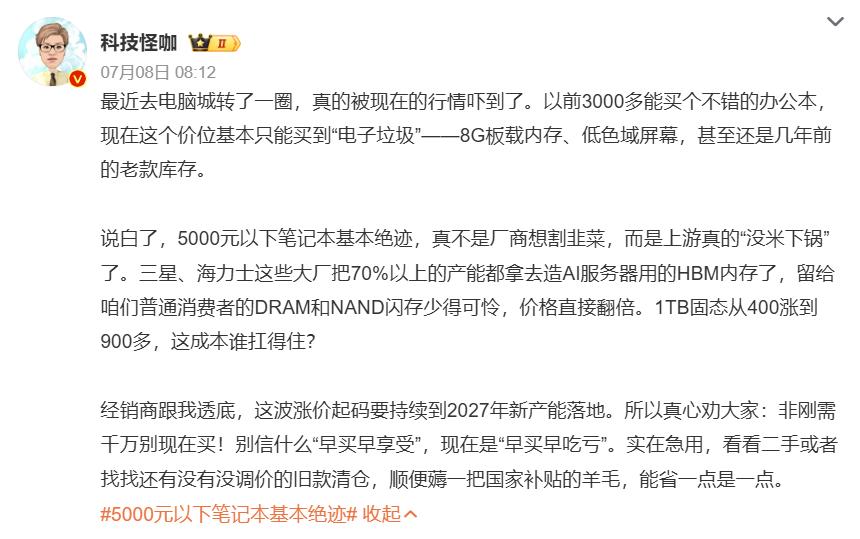
Top tech influencers discuss the computer price hike wave
Lao Zhou, who has been in the memory wholesale business in Huaqiangbei, Shenzhen for 12 years, smiles bitterly at the price tags covering the wall: "I have been in this industry for so long, and I have never seen such a weird market. Previously, prices would rise at the end of the year and fall back after the new year, but now prices change every day. I sell at whatever price the upstream offers, and I don't dare to stock up at all." He points to the few scattered memory sticks on the counter and says: "These few sticks were snatched from channels in Hong Kong through my connections. At this time last year, I had at least hundreds of sticks in my warehouse."
The turbulence reflected in the consumer market is even more obvious.
In early August, Zhang Chi took his son who had just been admitted to university, with a budget strictly set by his wife as "never exceeding 10,000 yuan", shopped from Dell to HP, then to Lenovo. Every time he entered a store, his son looked at the high-spec models with sparkling eyes, while Zhang Chi felt a little troubled.
Finally in a Lenovo store, his son took a fancy to the 13,999-yuan Legion Y7000P. Zhang Chi originally wanted to persuade his son to buy a laptop of 8,000 to 9,000 yuan first, and then replace it with a better one after being admitted to postgraduate school. But after several requests from his son, he gritted his teeth and bought the computer, then sent a WeChat message to his wife saying "It's 4,000 yuan over budget, I will cover the extra cost with my bonus next month".
Zhao Mengke, who was admitted to the civil engineering program of a second-tier undergraduate college this year, has a different idea. After learning that the gaming laptop of his favorite brand Mechanical Revolution is nearly 2,000 yuan more expensive than last year, he changed his mind directly. That night he bought a second-hand ThinkPad T14, and purchased an extra 16GB memory stick.
"It should be barely enough for writing papers, drawing CAD, playing games and so on. I will consider replacing it with a higher-spec model after the computer price drops. Now is really not a good time to buy a new one." Considering the limitation of his family's financial condition, Zhao Mengke thinks there is no need to force himself to buy a high-spec computer.
The choices of people like Zhao Mengke are converging into an undercurrent.
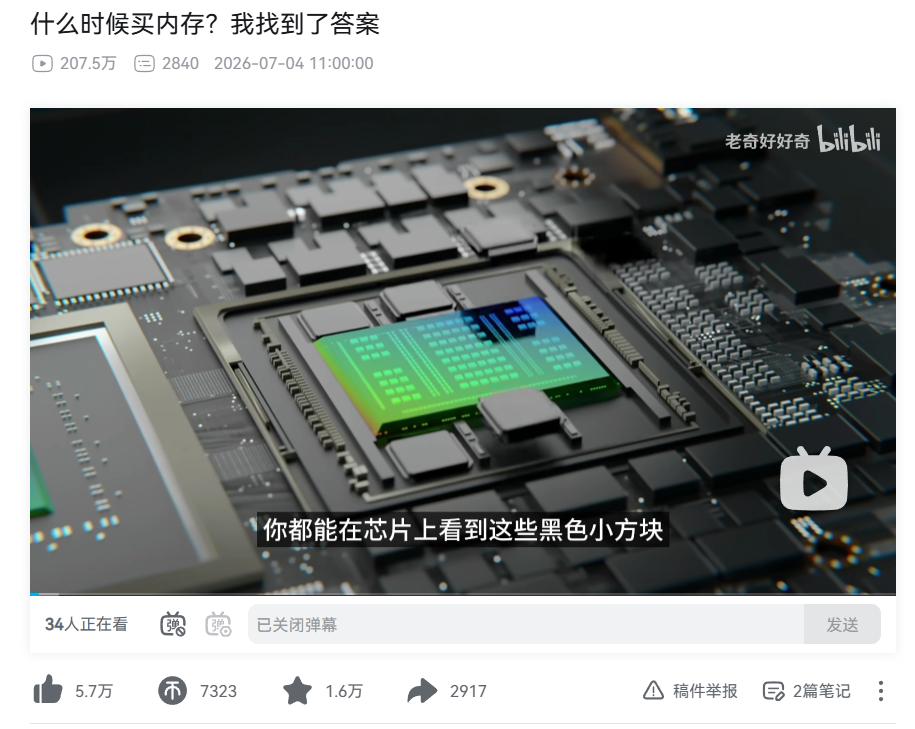
Many digital influencers suggest "don't buy for the time being"
Data shows that in the first two months of this year, the domestic online retail sales of laptops were 947,000 units, a sharp year-on-year decline of 40.5%. The sales volume was 5.99 billion yuan, also down 40.5%, hitting a rare opening drop in recent years.
Meanwhile, since late April 2026, a large number of Dell laptops equipped with 12th Gen Intel Core processors have appeared on mainstream second-hand trading platforms such as Xianyu and Zhuanzhuan. Typical models like Latitude 7430 are generally priced in the range of 1,600 to 2,000 yuan, and some devices are still under warranty. This phenomenon covers multiple product lines including commercial laptops, consumer lightweight laptops and gaming laptops, forming a sharp contrast with the current skyrocketing prices of memory and storage chips, which has aroused market attention.
What's more interesting is that many high-end models of previous years that were originally regarded as "old antiques" have become the most cost-effective "hot favorites" precisely because their memory and hard drives can be upgraded freely. Some netizens joked: "Previously I thought buying second-hand was embarrassing, but now I think buying new machines is just paying the 'anxiety tax'."
The Temporarily Irreversible Price Hike Requires a New Balance Point
In the face of the collective computer price hike, a strange scene has emerged in the market: the 5,000-yuan price range that was once a must-win battlefield for all brands now only has "shell machines" that are shrunk to the extreme: 8GB RAM, 256GB low-speed hard drive, low-gamut TN screen, which can barely even run Windows 11 smoothly. The starting price of computers that can run games, compile codes and edit videos smoothly has quietly climbed to the 7,500-yuan level.
According to previous market fluctuations, memory price hikes usually fall back after 3 to 6 months. But this time, institutions and analysts almost unanimously believe that the situation is different.
The research report of CITIC Securities states that in the Agent AI era centered on storage capacity, the storage industry is embracing a long-cycle paradigm shift. In terms of supply and demand, AI reasoning drives a sharp increase in Token consumption, and KV Cache surges linearly accordingly. The mismatch between explosive demand and original factory capacity expansion makes shortage a normal state. It is expected that the supply shortage will last until 2027, and the price hike will run through the whole year of 2026.
This means that the old experience of "waiting for Double 11 price cuts" or "waiting for back-to-school season promotions" is no longer valid. It is not that manufacturers do not want to offer discounts, but that they have no profit space to cut prices.
Some consumers have found after visiting several digital stores that the free gifts offered in back-to-school season activities are nothing more than computer bags, mice and other accessories, and high discounts or high-value gifts no longer conform to the current market situation.
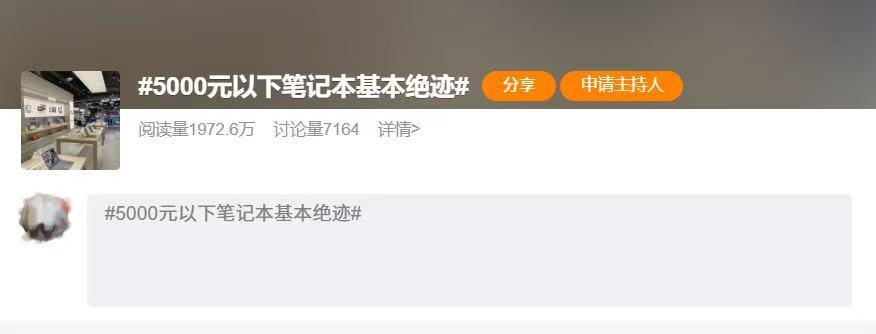
In the face of the temporarily irreversible price hike, consumers are not helpless.
"If you are majoring in humanities, social sciences, economics and management, and only need the Office suite and browser for daily use, you don't need to pursue a high-performance discrete graphics card at all. You can upgrade it by yourself later when the memory price eases or you have saved enough pocket money." Xu Pengfei, who is engaged in second-hand laptop sales, told Zinc Scale, "At this stage, if your child still has a laptop that is three or four years old, don't rush to replace it. Spend a small amount of money to upgrade the memory to 16GB, replace the mechanical hard drive with a solid-state drive, and add an external monitor. It is completely sufficient for most learning scenarios. A computer is a tool, not a status symbol."
Meanwhile, there is a view in the market that as long as major storage manufacturers continue to expand production, prices will fall soon. But the construction of HBM production lines and production line transformation require a long cycle. Even if new production capacity is launched, the orders of AI servers have been locked in advance, and the new production capacity will give priority to meeting the computing power demand. The supply gap of consumer-grade hardware will be repaired at the back of the priority list.
Of course, this does not mean that the PC industry will completely abandon the mass market. Manufacturers such as Gigabyte, ASUS, Lenovo and Dell still need to maintain the huge base of consumer users. Subsequently, the industry may see more compromise solutions, for example, the proportion of models with upgradable memory and hard drives will increase, allowing users to buy a basic version in the early stage and expand the capacity by themselves after prices fall.
As for the current boom in the second-hand computer market, we also need to view it objectively. The second-hand market is not a long-term low-price zone, and it will also be affected by the new machine price hike. The price hike of new machines drives up the valuation of second-hand devices, and the second-hand transaction price of popular models in previous years has risen by 500 to 1000 yuan synchronously, and there is no bargain everywhere. At the same time, the second-hand market is mixed with good and bad products, with endless hidden troubles such as refurbished devices, aging batteries and undiscovered faults, which ordinary consumers lack the ability to identify.
The 2026 PC price hike indirectly caused by the AI computing power wave is driven by the computing power hunger brought by artificial intelligence, transmitted by the capacity redistribution of storage chips, and finally falls on the wallets of every ordinary family. The big era of computing power is moving forward rapidly, and the digital life of ordinary consumers is also finding its own new balance point in this wave.
This article is from WeChat official account "Zinc Scale" (ID: znkedu), Author: Li Jinyi, Editor: Chen Denao, Published with authorization from 36Kr.